

Military Load Bearing Belt Platform Supplier Guide
Choosing a military load bearing belt platform supplier is a systems decision, not a catalog decision. Government buyers need evidence that the supplier can control materials, integrate modular components, validate the finished platform, document the configuration, and support repeatable production under the terms of the solicitation.
Request a capability statement or government pricing from Fusion Tactical USA.
What should a government buyer evaluate first?
Start with the complete platform requirement, then evaluate the supplier's evidence against it. The review should connect mission use, belt architecture, attachment interfaces, rated components, applicable sourcing rules, inspection records, and production capacity. A supplier that can only provide a product photo or a generic material claim has not yet demonstrated contract readiness.
Before requesting proposals, convert the requirement into a short evaluation matrix. Define the intended users, carried equipment, attachment method, adjustment range, environmental exposure, expected service life, packaging, marking, and delivery quantity. Include any government clauses that affect country of origin, domestic content, testing, quality records, or configuration control.
The goal is not to select the belt with the most features. It is to select a supplier that can show how each feature supports the mission and how the delivered configuration will remain consistent from the first article through later production lots.
Does the supplier control materials and traceability?
A qualified supplier should be able to connect the delivered platform to its material sources, production records, component specifications, and lot or batch identifiers. Traceability lets a buyer verify what was ordered, what was built, and what evidence supports that configuration. It also gives the agency a defensible path for investigating a nonconformance without treating every fielded unit as an unknown.
Review the webbing and textile specification
Ask the supplier to identify the webbing construction, width, tensile rating, coating or finish, and approved source. Fusion Tactical's technical context identifies MIL-SPEC Type 13 webbing for load-bearing systems with a 5,000 lb rating, along with 600D and 1000D ballistic nylon, Cordura, and other technical fabrics. These details should be matched to the exact platform configuration, not copied from a different product family.
Material traceability should cover more than a label. A useful record can include the supplier or mill, material description, lot number, receiving inspection, and the relationship between the material lot and the finished production batch. When a requirement calls for domestic materials, the record should also support the origin claim for the specified configuration.
Check hardware and attachment interfaces
Hardware needs its own evidence trail. Buckles, D-rings, adjusters, and other connectors can have different ratings, alloys, finishes, and approved uses. Fusion Tactical's documented belt capabilities include aluminum hardware and Raptor buckles in the 2,000 to 4,000 lb range, plus steel D-rings rated to 5,000 lb in applicable products. A buyer should request the rating and intended use for each component in the proposed bill of materials.
Do not treat a component rating as the rating of the entire platform. The webbing, stitching, hardware, attachment pattern, and load direction work together. The supplier should identify which values are component ratings, which are assembly test results, and which are working-load or maximum-breaking-strength values. That distinction prevents a high component number from being used as an unsupported system claim.
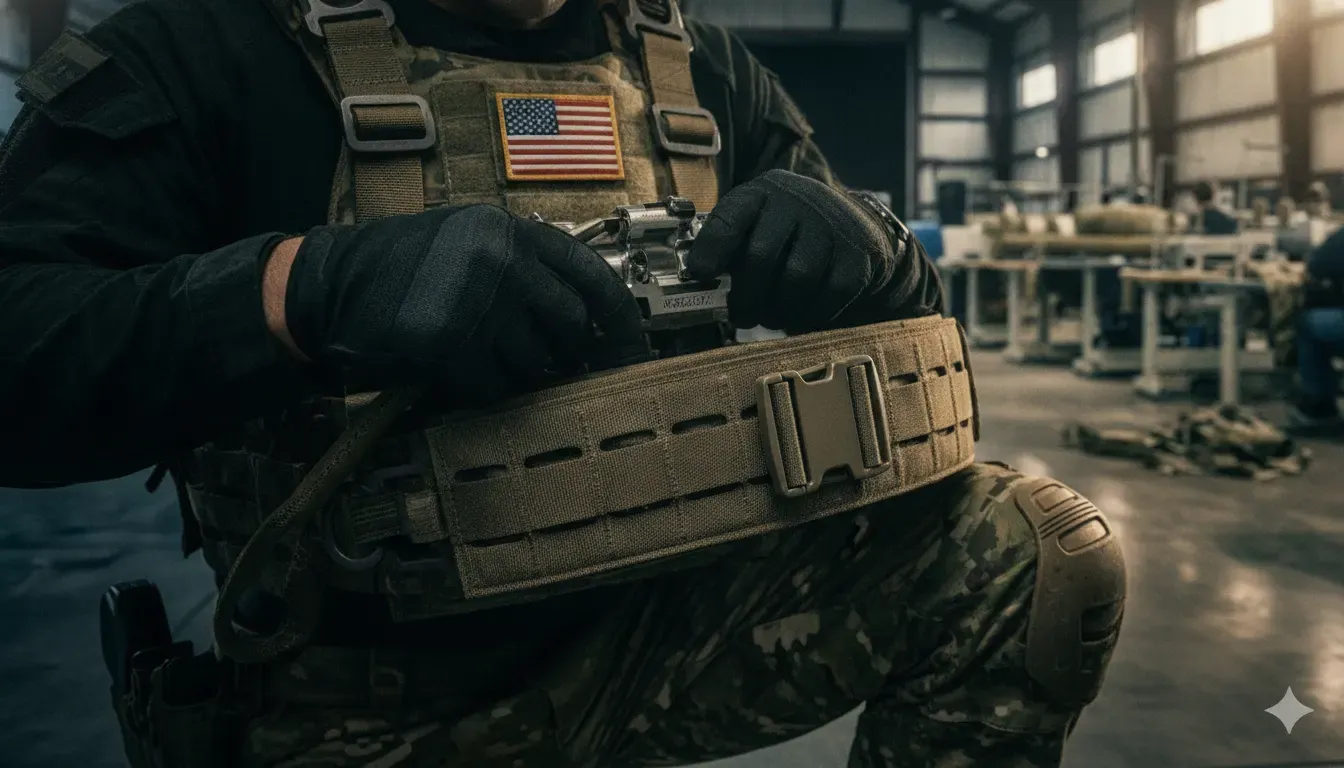
How does the belt platform integrate with mission equipment?
Platform integration should be evaluated as an interface-control problem. A military belt platform must maintain a stable fit while carrying the specified pouches, holsters, tools, medical equipment, or other mission components. The supplier should explain how the belt, liner, suspenders, MOLLE or PALS fields, buckles, and accessory interfaces work together under the actual load plan.
Evaluate the architecture, not only the attachment field
Ask for a configuration drawing or controlled product specification that identifies the belt width, layers, reinforcement zones, stitch patterns, hardware positions, adjustment method, and available attachment areas. A modular platform is useful only when the attachment system is compatible with the equipment the agency already owns or plans to issue.
Review practical interface questions:
- Does the platform accept the specified pouches and holsters without blocking adjustment or release hardware?
- Does the inner belt or liner maintain position during movement and repeated donning?
- Can the load be balanced around the operator rather than concentrated at one attachment zone?
- Are accessory locations repeatable across sizes and production lots?
- Can the supplier document any compatibility limits for suspenders, body armor, rescue hardware, or vehicle seating?
These questions separate a platform from a simple strap with accessories. Fusion Tactical's modular battle belt collection includes inner and outer configurations, MOLLE attachment fields, and MIL-SPEC webbing options. Its tactical belt collection provides additional belt configurations for review. The relevant procurement question is which specific configuration satisfies the agency's load plan and how that configuration will be controlled after award.
Test the platform with the intended load plan
Fit and integration should be confirmed with representative equipment before final production. A prototype review can reveal interference between pouches, release hardware, armor, seat belts, packs, or other issued equipment. It can also expose size and adjustment problems that are difficult to detect from a flat specification sheet.
For a government program, record the approved configuration. Identify the prototype revision, attachment layout, colors, materials, hardware, size range, and any approved substitutions. A supplier should not make a seemingly minor substitution without a controlled review when that substitution could change fit, weight distribution, strength, country of origin, or test evidence.
What load testing should the supplier document?
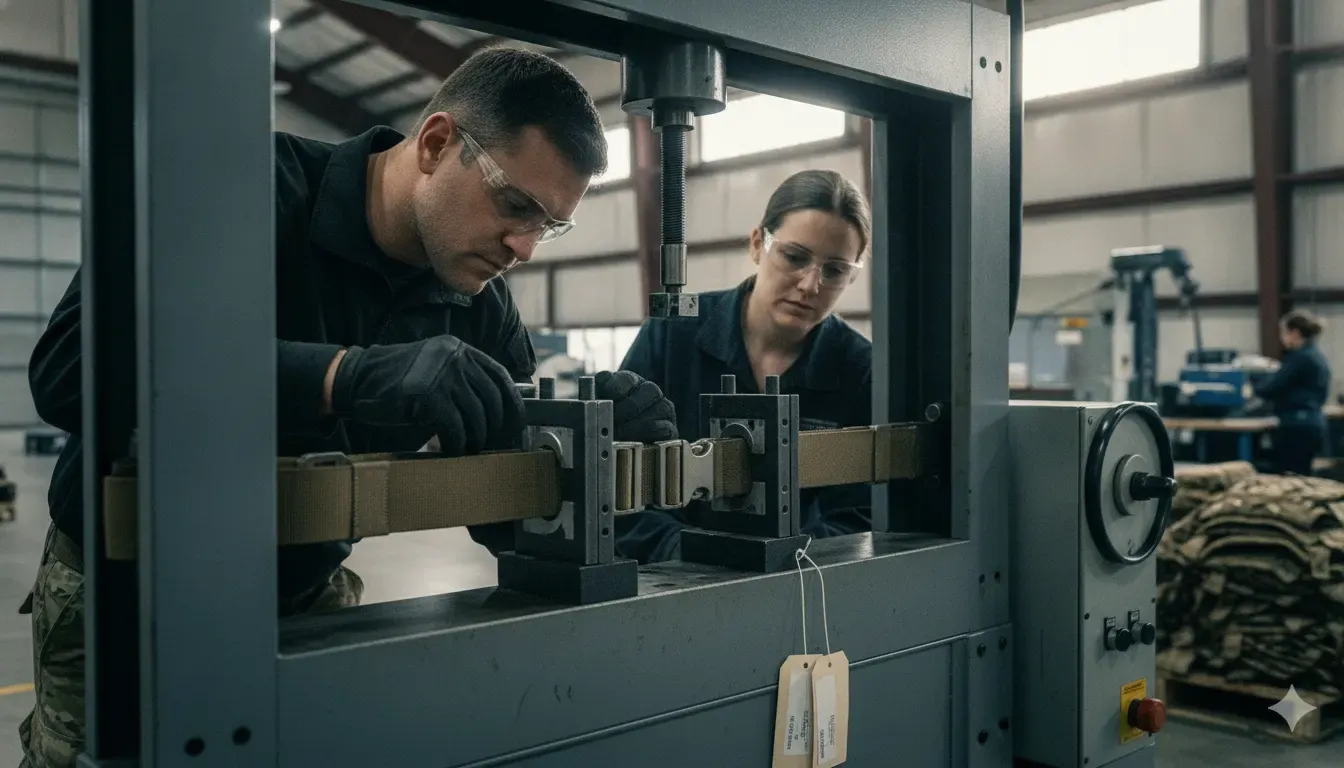
Request test evidence that matches the way the platform will be loaded, handled, and used. A tensile test on a strip of webbing does not prove the performance of a complete belt platform. Buyers should look for component evidence, assembly-level testing, test method, specimen or configuration identity, load direction, conditioning, result, and acceptance criteria.
Separate material, component, and assembly evidence
A disciplined supplier can show three related but different layers of proof:
- Material evidence: webbing, fabric, thread, and hardware meet the specified material or component requirements.
- Component evidence: buckles, D-rings, adjusters, and other parts are rated for the intended direction and application.
- Assembly evidence: the finished platform, including stitching and attachment zones, performs as specified in the approved configuration.
Ask whether the test specimen represents production construction. Stitch count, thread, bartack length, seam allowance, reinforcement layers, buckle installation, and edge finishing can affect performance. If the test article was a one-off prototype, the supplier should explain how production units will preserve the tested construction.
Ask what the test report actually proves
A useful report identifies the laboratory or internal test method, date, equipment, specimen, conditioning, applied load, failure mode, and result. Fusion Tactical's documented quality capabilities include tensile strength, breaking-point, load-limit, abrasion, UV, chemical, temperature, moisture, salt-spray, and batch testing, with third-party validation available for applicable work.
Those capabilities should be matched to the contract requirement. A buyer should not assume that every platform receives every test. Instead, ask the supplier to build a verification plan for the proposed configuration. The plan should state which tests are required, which are qualification tests, which are production checks, how samples are selected, and what happens when a result falls outside the acceptance criteria.
Also clarify whether a belt platform is being used for load carriage only or as part of a life-safety or fall-protection system. ANSI Z359 and OSHA requirements may apply to specific harnesses, connectors, or fall-protection applications, but they should not be used as a blanket claim for a tactical belt platform unless the exact product and use case are covered. The supplier should identify the applicable standard for each safety-critical interface.
How should Berry Amendment and TAA claims be verified?
Berry Amendment and TAA are sourcing questions that must be evaluated against the solicitation and the exact delivered configuration. They are not interchangeable labels, and a supplier's general U.S. manufacturing statement does not by itself prove that every material or component in every standard product satisfies a particular clause.
Berry Amendment review
The Berry Amendment restrictions are implemented through federal acquisition rules for covered items and circumstances. The Defense Federal Acquisition Regulation Supplement provisions should be reviewed with the solicitation, contracting office, and agency counsel or compliance team.
For a belt platform, ask the supplier to identify the country of origin for the webbing, textile layers, thread, hardware, packaging, and any other covered input. Require the supplier to state whether the quote is for a standard product or a custom Berry-compliant configuration. Fusion Tactical's Berry-compliant manufacturing information documents that 100% U.S.-sourced materials and domestic manufacturing are available for custom orders, with traceability documentation. Its context also states that standard products may include non-U.S. components. That distinction belongs in the procurement file.
TAA review
The Federal Acquisition Regulation Trade Agreements clause defines terms and requirements that can affect designated-country end products and services. TAA analysis is not the same as a simple statement that a product was assembled in the United States. Request the supplier's country-of-origin determination and supporting documentation for the exact configuration, especially when the purchase uses a federal contract vehicle or incorporates sourced components.
Fusion Tactical's government contracting profile identifies TAA-compliant capability and documentation available upon request. Treat that as a starting point for due diligence. The final purchase file should record the applicable clause, the supplier's representation, the reviewed configuration, and any certificates or chain-of-custody records supporting the determination.
Use a compliance decision record
For every proposal, create a simple record with four fields: requirement, supplier representation, evidence reviewed, and final contracting determination. This prevents a broad capability statement from being separated from the product configuration it was intended to describe. It also gives the buyer a repeatable way to review a later engineering change or approved substitution.
Can the supplier scale from prototype to contract quantities?
Scalability means preserving the approved design, evidence, and quality controls while production volume increases. Ask the supplier to explain the path from requirements analysis to CAD or pattern development, prototype, testing, first article, production release, lot inspection, packaging, and delivery. A supplier that can make one sample but cannot control the transition creates avoidable schedule and configuration risk.
Review the development path
For custom work, Fusion Tactical documents a process that includes requirements analysis, design and 3D modeling, prototype development, testing, production scaling, and quality assurance. This is the right sequence to examine, but the buyer should request deliverables for each gate.
- Requirements review: mission use, load plan, fit range, environment, compliance clauses, and acceptance criteria.
- Design review: controlled drawings, patterns, bill of materials, interface dimensions, and approved materials.
- Prototype review: representative samples, user feedback, fit checks, and documented revisions.
- Verification review: test plan, reports, nonconformance handling, and approval of the production configuration.
- Production release: work instructions, inspection points, lot records, packaging, marking, and change-control rules.
Test capacity with a written production scenario
Do not ask only whether the supplier can support a large order. Give the supplier a scenario that includes the number of sizes, colors, configurations, delivery windows, inspection requirements, packaging, and replacement units. Ask how capacity will be scheduled and how the supplier will preserve consistency across lots.
Fusion Tactical's manufacturing context describes an integrated Chino, California design, manufacturing, and distribution facility, in-house cut-and-sew production, hardware assembly, made-to-order manufacturing, single-unit prototypes, small-batch production, and larger government contract quantities. It also identifies laser cutting, multi-row stitching, heat sealing, welding, CAD and 3D modeling, in-process inspection, final inspection, and random batch testing. Buyers should verify which of these capabilities apply to the proposed belt platform and contract quantity rather than assuming that every capability is included automatically.
Production scalability also includes sustainment. Ask how the supplier will handle replacement belts, repair decisions, material obsolescence, approved substitutions, technical questions, and future configuration changes. A platform that cannot be replenished consistently can create more operational burden than a product with fewer features but stronger lifecycle control.
What should the procurement file contain?
A defensible procurement file should let a reviewer reconstruct why the supplier and configuration were selected. Include the requirement, evaluation matrix, supplier responses, technical data, compliance representations, test evidence, approved prototype revision, configuration record, quality plan, production schedule, and acceptance criteria.
Use the following supplier-evaluation scorecard:
| Evaluation area | Evidence to request | Decision question |
|---|---|---|
| Mission fit | Load plan, use environment, fit range, interface map | Does the platform support the actual operational requirement? |
| Materials | Webbing, fabric, thread, hardware specifications and sources | Are inputs suitable, controlled, and traceable? |
| Integration | Drawings, pattern, bill of materials, prototype revision | Can the configuration be repeated across sizes and lots? |
| Testing | Test plan, method, report, acceptance criteria, batch checks | Does the evidence cover the complete platform? |
| Compliance | Origin statement, Berry or TAA records, applicable certificates | Does the exact configuration meet the solicitation? |
| Production | Capacity scenario, quality plan, lead-time assumptions, change control | Can the supplier deliver and sustain the contract? |
Review the scorecard with technical, contracting, safety, and end-user stakeholders. A contract-ready supplier should be able to answer questions consistently across those groups. If the answer depends on an undocumented assumption, convert it into a written requirement or evidence request before award.
Contact Fusion Tactical USA to review a mission-specific belt platform requirement.
Frequently Asked Questions
What is a military load bearing belt platform supplier?
A military load bearing belt platform supplier provides a belt system and the engineering, manufacturing, testing, and documentation needed to support a defense or government requirement. The supplier may provide standard configurations, custom platform development, or both. Buyers should evaluate the complete system and evidence, not just the belt's appearance.
What should a government buyer ask a belt platform supplier?
Ask for material specifications, origin and traceability records, component ratings, assembly-level test evidence, configuration drawings, compatibility information, applicable compliance documentation, production capacity, quality controls, and change-management procedures. The questions should match the solicitation and the actual operating environment.
Does U.S. manufacturing automatically make a belt Berry Amendment compliant?
No. U.S. assembly alone does not automatically establish compliance for every covered item or configuration. The buyer must review the applicable clause and country of origin for the required materials and components. A supplier should identify whether the quote covers a standard product or a custom configuration with the required domestic sourcing.
Is TAA compliance the same as Berry Amendment compliance?
No. TAA and Berry Amendment requirements address different sourcing frameworks and may apply under different clauses and circumstances. A procurement team should request the supplier's determination and supporting records for the exact configuration, then confirm the result against the solicitation and contracting requirements.
What is the difference between a belt component rating and a platform rating?
A component rating describes one buckle, ring, webbing section, or connector under a defined test condition. A platform rating must address the complete assembly, including seams, stitching, attachment zones, hardware, load direction, and configuration. Buyers should never treat the highest component number as proof of complete system performance.
Why is configuration control important for a modular belt platform?
Configuration control ensures that the tested and approved materials, dimensions, attachment layout, hardware, stitching, and substitutions remain identified over time. It helps the buyer compare later production lots with the approved first article and makes changes reviewable before they affect fielded equipment.
Can Fusion Tactical support custom military belt platform requirements?
Fusion Tactical's documented capabilities include U.S.-based design and manufacturing, custom dimensions and hardware configurations, modular system integration, prototype development, load testing, and production scaling. Government buyers can contact Fusion Tactical USA to discuss the mission, required configuration, compliance documentation, and contract quantity.
Request a government supplier review with Fusion Tactical USA.


