

Mission Safety Hardware Production Capability Guide
In a high-consequence program, a connector or buckle is not evaluated in isolation. Buyers need to understand how materials, rated components, attachment methods, testing, documentation, and production controls work together across the finished assembly. A supplier that can produce a part is not necessarily equipped to control an integrated safety system through design release, qualification, and repeat production.
Mission safety hardware production capability means more than access to carabiners, D-rings, buckles, or connectors. It includes requirements analysis, configuration-controlled design, traceable materials, stated ratings for the exact product, documented testing, quality inspection, and a production process that can scale without losing consistency.
For aerospace, defense, rescue, and industrial applications, the review should begin with the supplier's engineering input and continue through integration, verification, compliance, and delivery. That framework helps distinguish a catalog component from a manufacturing partner prepared to support the requirements of the complete safety assembly.
Request a quote or engineering consultation for your safety hardware program.
What Should Mission Safety Hardware Production Capability Include?
Mission safety hardware production capability should connect requirements analysis, controlled design, documented ratings, configuration-specific testing, and repeatable manufacturing. Buyers should be able to trace how a stated requirement becomes a qualified component or integrated assembly, then verify that the delivered configuration matches the evidence.
A practical review should cover four linked areas: engineering input, production controls, verification, and delivery readiness. A supplier that can discuss only individual components or shop processes has not necessarily demonstrated the capability to produce a complete mission-ready system.
Start with requirements and controlled design
The process should begin with the operating environment, attachment points, user interface, expected loads, materials, dimensions, inspection requirements, and applicable program standards. Fusion Tactical reports engineering services that include requirements analysis, 3D modeling and CAD, rapid prototyping, technical specification development, prototype testing, production scaling, and optimization. This sequence gives procurement and engineering teams a defined path from an initial concept to a repeatable configuration. More detail is available in Fusion Tactical's in-house production capabilities.
Ask whether design records identify the exact hardware, webbing, stitching, welds, fasteners, and interfaces used in the proposed assembly. Configuration control matters because a change in connector, mounting method, material, or geometry can alter performance and invalidate earlier test evidence.
Review integration and production controls
Capability should include the processes needed to build the complete assembly, not just source a rated buckle, D-ring, carabiner, or connector. Relevant controls may include precision mounting, modular integration, stage-by-stage quality checks, and documented workmanship criteria. Fusion Tactical lists in-house processes such as hardware mounting, welding, cut-and-sew production, laser cutting, stitching and bartacks, heat sealing, and custom configuration. The right mix depends on the product and its requirements.
Require evidence for the finished configuration
Verify ratings and standards for the exact product and configuration. A component rating is not automatically the rating of a finished integrated system. So request configuration-specific documentation and test evidence before treating a published value as an assembly qualification. This distinction is especially important when hardware is combined with webbing, sewn interfaces, welded elements, or custom mounting geometry.
Finally, evaluate whether the production plan can preserve the approved configuration across prototypes, repeat orders, and program quantities. The strongest capability review connects the drawing and specification to inspection records, test results, material traceability, and a defined method for handling approved changes.
How Should Buyers Evaluate Materials, Ratings, and Hardware Integration?
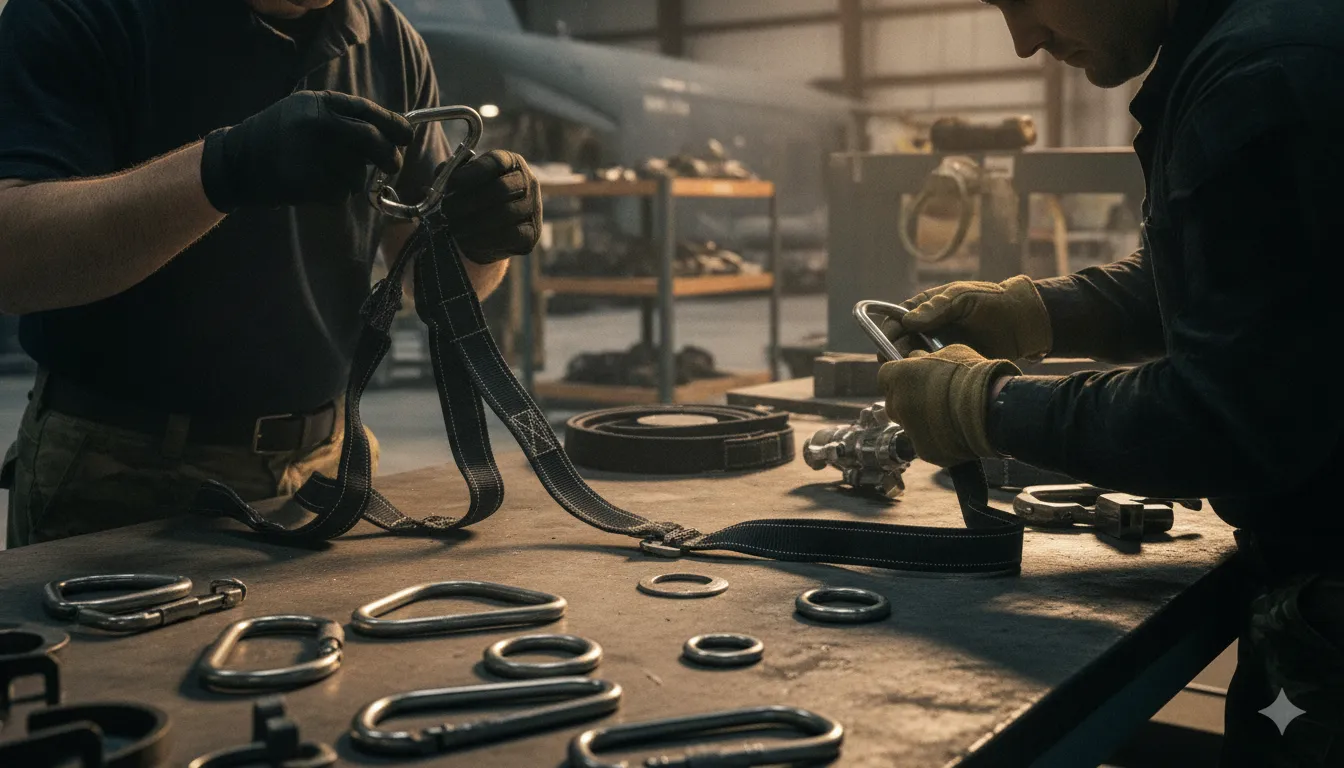
Direct answer: Buyers should evaluate the material, stated rating, connection method, and completed assembly as one controlled configuration. A webbing or hardware rating is useful, but it does not by itself establish the performance of the finished system. Request evidence that identifies the exact materials, hardware, attachment method, test basis, and configuration being supplied.
| Review area | Questions to ask | Evidence to request |
|---|---|---|
| Materials | Which materials and lots are specified? | Material specifications and traceability records |
| Hardware | Which connector, buckle, carabiner, or D-ring is used? | Part identification, rating, and configuration details |
| Integration | How is the hardware attached to the assembly? | Drawings, workmanship criteria, and interface inspection records |
| Verification | What proves the complete assembly meets requirements? | Configuration-specific test reports and acceptance records |
Start with the intended load path. Fusion Tactical reports MIL-SPEC Type 13 webbing with a 5,000 lb rating, along with military-grade aluminum and steel components. Aluminum buckles and hardware are listed at 2,000 to 4,000 lb, while steel D-rings and connectors are listed at 5,000 lb. These figures should be treated as product and configuration information, not as a universal rating for every assembly or use case.
Material selection should reflect the environment as well as the nominal load. Ask whether the design must address abrasion, ultraviolet exposure, chemicals, temperature, repeated handling, or contact with adjacent equipment. Then confirm how the selected webbing, sewn interfaces, metal components, and protective materials work together. The relevant question is not simply whether a component is strong. It is whether the complete load path remains controlled under the conditions defined in the requirement.
Hardware integration is another procurement checkpoint. In-house processes reported by Fusion Tactical include cut-and-sew production, laser cutting, multi-row stitching, bartacks, heat sealing, welding, hardware mounting, and custom configuration. Precision mounting, modular integration, load testing, and stage-by-stage quality control are also identified as part of its production approach. Buyers should ask which processes apply to the requested configuration and how each critical interface is inspected.
Terminology and standards matter during review. OSHA defines a connector as a device used to couple parts of a fall-protection system, while a D-ring can serve as an integral attachment element in a harness. ANSI Z359.12 addresses connector performance, design, marking, qualification, test methods, and removal from service, including connecting components such as carabiners, snap hooks, and D-rings. Buyers can use this framework alongside their program requirements and review kN ratings for life-safety hardware without assuming that a standard reference replaces configuration-specific qualification.
The central caveat is simple: a component rating is not automatically the rating of a finished integrated system. Confirm the exact product, materials, hardware, stitching or welding details, and intended configuration. Ask for configuration-specific documentation and test evidence before treating a listed rating as applicable to the delivered assembly.
What Testing and Quality Records Should a Supplier Provide?

Direct answer: A qualified supplier should provide configuration-specific test evidence, inspection and quality records, applicable standard references, and traceability for the materials, connectors, and assembly processes used. The record package should show what was tested, against which requirements, using which configuration, and how nonconforming product is controlled. A component rating alone is not evidence of the finished assembly's performance.
Start with the applicable definitions and requirements. OSHA defines a connector as a device used to couple parts of a fall-protection system. It defines a carabiner as a connector with a gate that automatically closes to retain an object. OSHA also defines a D-ring as a connector used as an integral attachment element or fall-arrest attachment in a harness. These definitions help buyers describe the intended function. They do not replace product- or configuration-specific qualification evidence. Review the applicable OSHA requirements at OSHA 29 CFR 1910.140.
For connectors, request records that address design, marking, qualification, test methods, performance, and removal-from-service criteria. ANSI/ASSE Z359.12-2019 covers connecting components such as carabiners, snap hooks, and D-rings. The CDC's standards reference identifies the standard's scope and should be used alongside the requirements that govern the specific application: CDC ANSI Z359.12 reference. The supplier should identify which clauses or test methods apply, rather than presenting a standard name as a blanket certification claim.
What should the test report identify?
At minimum, ask for the tested part number or drawing revision, material and hardware configuration. Sample identification, test method, applied load or environmental condition, results, acceptance criteria, date, and laboratory or technician responsible. For integrated assemblies, the report should identify attachment geometry, stitching or bartack details where relevant, hardware orientation, and any interfaces that could affect load transfer. This is the evidence needed to determine whether the test represents the delivered configuration.
A useful program may combine in-house and independent verification. Fusion Tactical reports in-house tensile, breaking-point, load-limit, abrasion, UV, and chemical-resistance testing, as well as independent verification through John Batchelor Testing, Midwest Testing, and Exvo OCM Test Laboratories. Quality records should also show inspection points and disposition of nonconforming work. Fusion describes precision mounting, modular integration, load testing, and stage-by-stage quality control as part of hardware integration.
Buyers evaluating mission safety hardware production capability should request the supplier's engineering, testing, and rapid prototyping documentation before award. Finally, confirm that every rating and standard applies to the exact product and configuration. If the supplier cannot connect a claim to a drawing, test record, inspection record, or controlled specification. Treat the claim as unverified rather than assuming the finished system inherits a component's rating.
How Do Compliance and Traceability Affect Government Programs?
Direct answer: Compliance and traceability give government buyers a way to verify that a safety assembly matches the contract requirement. Can be supported by records, and was produced under a controlled sourcing and quality process. They do not replace configuration-specific engineering evidence. A supplier should identify the applicable framework, document material and component origin, and show how the delivered configuration was reviewed and tested.
For aerospace, defense, rescue, and industrial programs, the relevant framework may include ISO 9001:2015, AS 9100 aerospace quality principles, MIL-STD specifications, OSHA guidance, EN 362, or EN 12275. These references are not interchangeable, and listing a standard does not establish that every product or configuration meets it. Procurement teams should ask the supplier to state which requirements apply to the exact assembly, what evidence supports that determination, and which records will accompany delivery. Fusion Tactical lists these frameworks among its applicable quality and compliance references, with scope subject to the product and program requirements. Review the engineering and testing approach before treating any framework as a purchasing conclusion.
Traceability is the practical link between a requirement and the delivered hardware. It can include material-source records, component identification, configuration details, inspection results, and test documentation. That chain matters when a program requires domestic sourcing, controlled substitutions, or repeatable production across multiple lots. It also helps buyers distinguish a component claim from a finished-system claim. A rated carabiner, D-ring, buckle, or webbing component does not automatically establish the rating of the integrated assembly. The evidence must match the complete configuration, including how hardware is mounted and how loads transfer through the system.
For custom production, Fusion Tactical reports Berry capability with traceability and 100% U.S.-sourced materials. This is a custom-production capability, not an automatic designation for every standard product. Buyers should identify the applicable Berry requirement in the solicitation, confirm that the proposed bill of materials and production scope satisfy it, and request the supporting documentation. The company also reports TAA compliance for federal procurement. That claim should likewise be evaluated against the contract, product, sourcing route, and required representations. See the Berry Amendment requirements discussion and review the TAA compliance overview as starting points for procurement questions.
Supplier identifiers can support administrative review, but they are not substitutes for technical evidence. Fusion Tactical reports CAGE Code 0KQN1, active SAM.gov registration, UEI JSR6VV16YGH5, and Small Business Certification #2011930. A responsible review connects those procurement records to the exact statement of work, configuration-controlled drawings or specifications, sourcing requirements, inspection plan, and delivery records. That combination makes compliance review auditable rather than dependent on a broad capability statement.
Can a Manufacturer Scale From Prototype to Production?
Yes, when the supplier carries the same controlled requirements from the first sample through repeat production. A credible scale-up path connects prototype development, configuration control, validation, manufacturing capacity, and delivery planning. It should show how a buyer can move from a single assembly to defined batch sizes without losing visibility into materials. Workmanship, testing, or the requirements that established the design.
Fusion Tactical reports a made-to-order production model that supports single-unit prototypes, batches of 10 to 100 units, production of more than 1,000 units, and government contract quantities. These stated ranges describe available production pathways, not an unconditional output or lead-time guarantee. Actual capacity depends on the assembly, materials, testing, documentation, purchase requirements, and schedule agreed for the program.
What changes between a prototype and a production run?
Early work should resolve the technical definition before volume increases. Fusion Tactical lists requirements analysis, 3D CAD modeling, rapid prototyping, technical specification development, prototype testing, production scaling, and optimization among its engineering services. That sequence gives procurement and engineering teams a basis for reviewing the design before committing to a larger order. It also helps identify whether a requested change affects hardware, webbing, stitching, welding, mounting, or the performance evidence required for the finished assembly.
Production control matters because a rated component does not automatically establish the rating of the integrated system. Buyers should request documentation and test evidence for the exact product and configuration, including any changes made between the prototype and production version. Fusion Tactical describes precision mounting, modular integration, load testing, and stage-by-stage quality control as part of its hardware integration process. Review the custom safety assemblies and configurations available for the program, then confirm which controls and records apply to the proposed build.
How should buyers interpret sample and delivery timing?
Fusion Tactical documents initial samples in approximately three to five days, followed by two to three days for testing and validation. It also lists standard soft-goods lead time at one to two weeks, subject to requirements. These figures should be treated as documented planning references rather than promises. A responsible schedule should identify the approval point, test scope, material availability, configuration changes, inspection requirements, and quantity before a delivery date is accepted.
The Chino, California facility combines design, manufacturing, and distribution, and Fusion Tactical reports more than 26 years of continuous manufacturing operations. For a procurement review, the practical question is not simply whether a supplier claims scale. Ask how the supplier will preserve the approved configuration, communicate changes, document testing, and coordinate production as the order moves from prototype to the required quantity.
What Should a Procurement Review Request Before Award?
Before award, procurement should request a configuration-specific evidence package, not a general capability statement. The review should connect the program requirements to materials, ratings, testing, traceability, compliance, production scale, and delivery commitments.
Use the following checklist to determine whether the proposed supplier can support the actual mission safety hardware production capability required by the program.
- Requirements and configuration: Provide the approved requirements, drawings, specifications, interfaces, intended use, environmental conditions, and acceptance criteria. Confirm that the supplier understands whether the deliverable is a component, a finished assembly, or an integrated system. Requirements analysis, CAD, prototyping, and technical specification development should be documented before production begins. Review the supplier's government and defense contracting capabilities when the program includes federal or defense procurement requirements.
- Materials and component records: Request the material types, part numbers, applicable specifications, supplier records, and lot or batch traceability for webbing, metal hardware, buckles, connectors, stitching materials, coatings, and other load-bearing elements. The package should identify the exact configuration under review rather than relying on a generic catalog description.
- Ratings and integration evidence: Ask for stated load ratings, minimum breaking strength information where applicable, and the test basis for each component. Confirm how hardware is mounted, stitched, welded, or otherwise integrated. A component rating does not automatically establish the rating of the finished system, so request configuration-specific drawings, calculations, and test evidence before accepting an assembly. Fusion Tactical specifically advises buyers to verify ratings and standards by product and configuration.
- Testing and quality records: Request test plans, methods, results, inspection points, nonconformance handling, and final acceptance records. Depending on the use case, the review may include tensile, breaking-point, load-limit, abrasion, ultraviolet, or chemical-resistance testing. If independent verification is required, identify the laboratory, test article, configuration, and report date.
- Compliance and traceability: Match each required framework to the exact product and contract requirement. Request applicable standards, domestic-sourcing or Berry documentation for custom production, TAA documentation where required, government identifiers, and quality-system records. Do not treat a listed framework as proof of compliance without reviewing its scope and supporting records.
- Scale and delivery: Confirm prototype, pilot, production, surge, packaging, inspection, and delivery capacity against the program schedule. Request a realistic manufacturing plan, lead-time assumptions, change-control process, and communication points. A supplier should explain how it will preserve configuration control and quality as quantities increase.
Discuss your requirements with Fusion Tactical before award.
Frequently Asked Questions
What evidence should a supplier provide for a rated connector or buckle?
Request the exact product or configuration, stated load rating, material information, applicable standards, test methods, and inspection records. The rating should be tied to the part and configuration under review, not presented as a generic capability. See the engineering, testing, and rapid prototyping details for the types of documentation buyers should evaluate.
Does a component rating apply automatically to a completed safety assembly?
No. A component rating is not automatically the rating of the finished integrated system. Ask for configuration-specific evidence that addresses the hardware, attachment method, stitching or welding, interfaces, and intended use. This distinction is especially important when a connector, D-ring, or buckle is integrated into a larger assembly. Source: Fusion Tactical custom solutions guidance.
Which tests are relevant when evaluating production capability?
The appropriate test plan depends on the requirement, environment, and configuration. Common evaluation areas include tensile, breaking-point, load-limit, abrasion, UV, and chemical-resistance testing. ANSI Z359.12 covers connector performance, design, marking, qualification, test methods, and removal from service, including connecting components such as carabiners and D-rings. Source: ANSI Z359.12 information.
How can a buyer assess whether a manufacturer can scale?
Ask how the supplier moves from requirements analysis and prototypes to repeatable production, quality control, traceability, and delivery. Fusion Tactical reports support for single-unit prototypes, batches of 10 to 100 units, production of more than 1,000 units, and government quantities, subject to the program requirements. Source: professional manufacturing capabilities.
What should government buyers verify before award?
Verify the required sourcing rules, traceability, registrations, quality framework, test evidence, and documentation for the exact deliverable. Berry requirements and TAA compliance are not interchangeable, and applicability should be confirmed for the specific contract and configuration rather than assumed from a product label.
Ready to Review Your Safety Hardware Program?
A focused engineering and procurement discussion can help align rated connectors, buckles, carabiners, D-rings, and integrated assemblies with your application requirements and documentation needs. To request a quote or discuss a production approach, contact Fusion Tactical. You can also call (909) 393-9450 to speak with the team about your hardware or assembly requirements.


