

Confined Space Rescue Plan: Readiness Guide
A confined space emergency is rarely solved by equipment alone. Industrial, government, and tactical rescue teams need a documented operating plan that connects hazard controls. Trained roles, retrieval decisions, communications, medical support, and evidence of readiness before anyone enters.
A confined space rescue plan should define the space and its hazards, acceptable entry conditions, emergency triggers, rescue method, command authority, equipment interfaces, medical handoff, training requirements, and records. OSHA identifies confined-space hazards and monitoring-equipment failures as potential emergency conditions, but the applicable requirements depend on the work sector, site, and jurisdiction.
The strongest plans begin with a site-specific assessment rather than a generic equipment list. That means confirming how entrants can be protected, how unauthorized access is controlled, and what changes would stop the operation. The pre-entry review establishes the decisions, responsibilities, and documentation the team must have in place before rescue capability is tested in the field.
What Should a Confined Space Rescue Plan Include Before Entry?
A confined space rescue plan should define the space, identify credible hazards, establish acceptable entry conditions, and specify exactly when and how the operation will stop. It should also show who controls access, who monitors conditions, how help is summoned, and what records prove the plan was prepared and verified. The plan boundary is broader than selecting a harness or retrieval device. It is a site-specific control document that connects the entry team, rescue capability, equipment, communications, and emergency response.
Start with a space profile and hazard assessment
Record the space location, configuration, access and exit points, work task, occupancy limits, and conditions that could change during the entry. Under OSHA's general-industry definition, a confined space is large enough for an employee to bodily enter and perform assigned work. Has limited or restricted entry or exit, and is not designed for continuous occupancy. The applicable work sector and jurisdiction determine which requirements govern the operation, so the plan should identify that basis rather than treating one rule as universal.
Before entry, evaluate atmospheric, electrical, engulfment, flooding, fall, chemical, pressure, and other physical hazards relevant to the site. OSHA construction requirements call for identifying and evaluating permit-space hazards before entry. The assessment should also address isolation of the space and its physical hazards, including any condition that could make removing an entrance cover unsafe, such as high pressure. Where atmospheric hazards are possible, document the testing, monitoring, purging, flushing, or ventilation measures required for the specific space.
Define entry conditions and stop triggers
Write measurable, observable conditions for authorization. The plan should identify what must be controlled before entry, how monitoring will be performed, and how the team will detect a worsening atmosphere if ventilation fails. Conditions must remain acceptable throughout the authorized entry, not only at the initial check. An emergency trigger should include any event or failure of hazard-control or monitoring equipment that could endanger entrants. State who has authority to stop work, order evacuation, summon rescue, and confirm that re-entry is prohibited until conditions are reassessed.
Control access and preserve the record
Use barriers, signs, attendants, or other controls to prevent unauthorized entry and protect entrants from pedestrian, vehicle, and nearby operational hazards. Keep the current permit or equivalent authorization, hazard assessment, monitoring results, isolation verification, communications method, rescue contact details, equipment inspection status, and changes to site conditions together. The rescue service should receive the information needed to understand the space and its hazards. For additional context on government harness compliance requirements, review the related procurement guide, while keeping equipment selection subordinate to the completed site assessment and rescue plan.
How Are Rescue Roles and Command Interfaces Assigned?
A confined space rescue plan works only when responsibility is explicit before entry begins. The plan should identify who controls the entry, who remains outside, who enters, who leads the rescue, who interprets atmospheric data, and who coordinates medical care. These are operating interfaces, not titles assigned for paperwork. Each person needs a defined authority, communication method, and handoff point.
Define entry control and the attendant's authority
The entry supervisor owns the entry decision and confirms that the space profile, hazards, acceptable conditions, isolation measures, communications, and rescue arrangements are ready. The supervisor also confirms that the designated rescue service can respond within a timeframe appropriate to the identified hazards. OSHA states that response timeliness varies with the specific hazards. And that rescue services should be proficient with the tasks and equipment required for the particular space or space types involved. See the requirements in OSHA 1926.1211.
The attendant remains outside the space and maintains an active link with the entrant. This role tracks who is inside, watches for changing conditions, communicates status, summons assistance, and initiates evacuation or escalation when the plan's triggers occur. The attendant should not be assigned unrelated duties that compete with continuous monitoring. Stop-work authority should be stated plainly: an attendant, entrant, atmosphere monitor. Or rescue lead must be able to halt entry when conditions become uncertain or unsafe, then notify the entry supervisor.
Separate technical rescue from atmospheric and medical interfaces
The entrant performs only the authorized work and reports changes in conditions, symptoms, or communications. The atmosphere monitor verifies that the specified testing and monitoring process is operating. Understands alarm thresholds defined by the responsible program, and communicates trends rather than treating a single reading as the entire decision. If monitoring or hazard-control equipment fails, the plan should treat that failure as an emergency trigger because it can endanger entrants.
The rescue lead directs the rescue sequence and prevents uncoordinated entry by well-intentioned personnel. Communications should identify the caller, space, entrant status, hazard condition, access point, and assistance required. The medical handoff begins before extraction: designate who meets emergency medical services, who provides the incident briefing, and who transfers relevant observations without delaying lifesaving care. Construction rescue provisions also address assigned-duty training, first aid and CPR capability, and practice before an actual rescue. Verify the applicable rule and site requirements with qualified safety personnel.
Document these interfaces in a role matrix, briefing record, and call tree. For broader planning context, review this guide to public safety rescue equipment selection, then validate every assignment against the space, hazards, staffing, and rescue service actually available.
Which Rescue Method Fits the Space and Hazard?
The rescue method should be selected from the space profile and credible failure modes, not from the equipment already on hand. Start by asking whether an incapacitated entrant can be reached and removed without sending another person into the hazard. Then test that option against the opening, internal obstructions, travel path, atmosphere, isolation controls, communications, staffing, and medical interface. Non-entry retrieval is not always feasible. A narrow route, entanglement risk, victim position, or requirement for hands-on disentanglement may make entry rescue necessary. While some sites may need a designated outside rescue service rather than an on-site team.
The plan should also define what changes the method. A failed monitor, ventilation problem, loss of isolation, flooding, engulfment potential, or other changed condition can make the original approach unsafe. OSHA identifies failures of hazard-control or monitoring equipment as potential emergencies, so the team should establish stop-work and escalation criteria before entry, not improvise them during an incident.
| Method | When it may fit | Controls and staffing to validate |
|---|---|---|
| Non-entry retrieval | The entrant can be connected to a compatible retrieval system. The available opening allows removal without creating additional hazards. | Confirm a clear path and compatible system. Verify that the attendant can activate the response. Practice the sequence. A retrieval line does not solve every obstruction, entanglement, or access problem. |
| Entry rescue | Recovery requires a rescuer to enter because the entrant cannot be reached, connected, or removed from outside. | Validate hazard isolation, atmospheric controls, communications, trained personnel, PPE, and backup support. Include respiratory protection where required. The rescuer must not become a second casualty. |
| External emergency response | A designated rescue service has the capability, availability, site access, and space-specific proficiency needed for the identified hazards. | Confirm the service knows the site, space types, hazards, access route, activation process, and equipment needs. OSHA cautions that not all emergency responders are trained and equipped for confined-space rescue, so a generic emergency number is not a complete plan. |
Validation must be practical. Give the rescue team access to the actual space or a representative configuration, review the hazards it may encounter, and rehearse the communications and handoff to medical support. For the narrower equipment-configuration question, see the confined space tripod setup guide; this article's concern is how that configuration fits into the broader plan, roles, and decision process.
For designated rescue services, evaluate proficiency with the tasks and equipment required by the particular space types. And confirm that the service can reach a victim within a timeframe appropriate to the hazards. The plan should record the evidence used for that decision, including drills, access checks. Equipment inspections, and any limits that require the entry to stop or the method to change.
How Should Equipment, Communications, and Medical Support Be Staged?
Stage the rescue system around the specific space, hazards, access route, and assigned method, not around a generic equipment list. Every component should have a defined role, a known location, and a clear interface with the other components. That includes retrieval equipment, atmospheric monitors, ventilation, personal protective equipment, communications, first-aid resources, and the route used to move an injured entrant to medical care.
Confirm compatibility before the entry begins
Check that connection points, lines, harnesses, retrieval devices, anchors, and edge protection are intended to work together. Confirm the applicable manufacturer instructions, inspection status, and any required training for the exact configuration. A rated interface is not automatically suitable simply because both items are individually rated. The team should know which attachment points are intended for the planned task, what limitations apply, and how the system will be recovered if conditions change. For broader context on selecting equipment for rescue work, review rescue harness standards and compliance.
Before staging, document the condition of each critical item. Remove equipment from service when inspection findings, damage, contamination, expired service information, or uncertain history make its status unclear. PPE must match the identified hazards and be available to the rescuers who may need it, rather than stored somewhere inaccessible during an emergency. OSHA identifies atmospheric monitors, fall protection, extraction equipment, and respiratory equipment as examples of rescue resources to evaluate for particular permit-required spaces, not as a universal checklist. See OSHA's confined-space rescue guidance.
Build redundancy into monitoring and communications
Atmospheric monitoring should be positioned and operated according to the hazards identified in the space. The procedure should address pre-entry testing, ongoing verification, alarm response, and what happens if ventilation stops or the monitor fails. OSHA's construction requirements call for monitoring procedures that can detect increasing atmospheric hazards in enough time for entrants to exit safely when ventilation fails. Ventilation, isolation, barriers, and retrieval must therefore be treated as connected controls, not separate accessories.
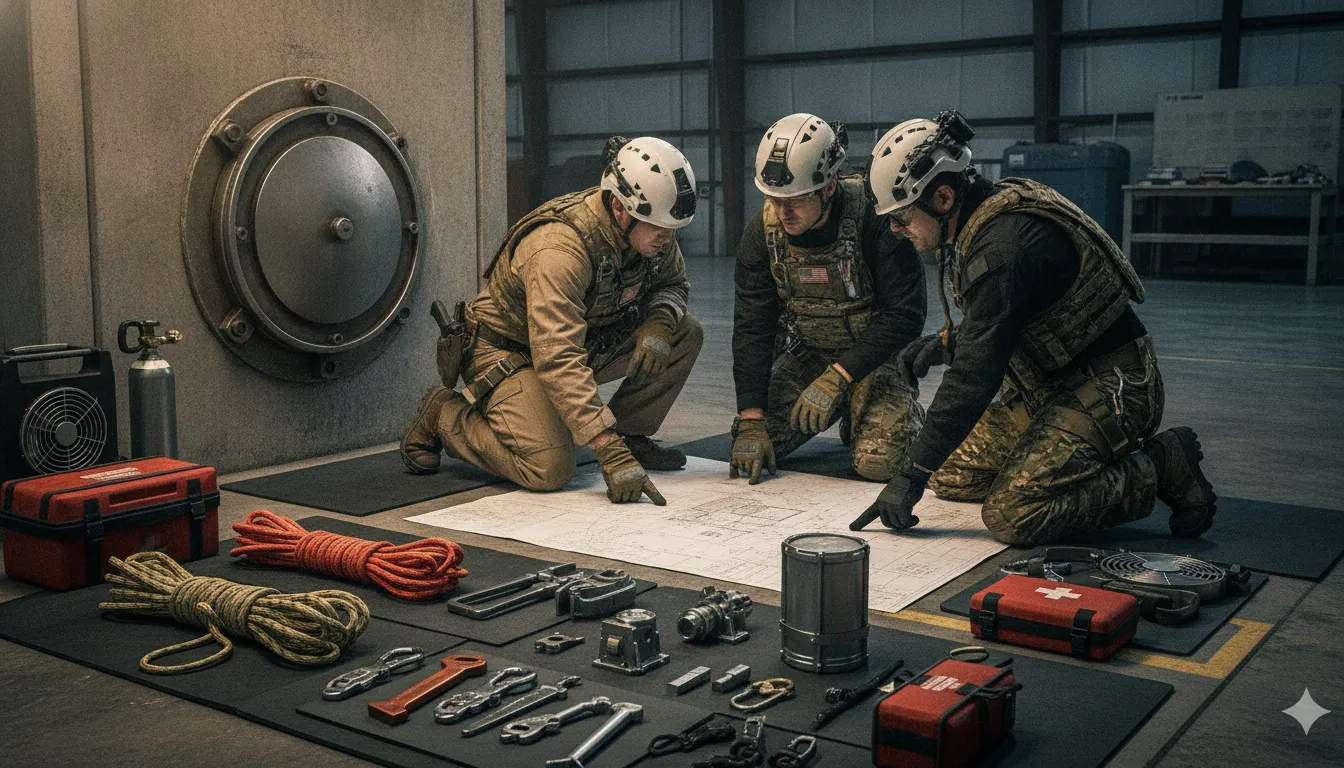
Use a primary communication method that works from the entry point, inside the space, and at the command position. Establish a backup method before entry, along with plain-language emergency signals and a person responsible for confirming messages. Provide the rescue service with the exact location, space characteristics, hazards, access route, and equipment requirements. Keep access lanes, staging areas, and any emergency vehicle approach clear. The plan should also identify the first-aid resources available on site, who is trained and assigned to provide initial care. How EMS will be summoned, and where the medical handoff will occur. Do not assume that a general emergency response unit is equipped or trained for confined-space rescue. Capability, availability, and site access should be confirmed in advance.
How Do Drills and Records Prove Rescue Readiness?
A confined space rescue plan becomes credible when the team can demonstrate that its decisions, equipment, communications, and handoffs work under realistic conditions. A written plan alone cannot show whether rescuers can reach the space, recognize changing hazards, or transfer a patient safely. Use a repeatable readiness cycle, then retain enough evidence for supervisors, auditors, and rescue leaders to identify gaps.
- Design a site-specific scenario. Base the exercise on the actual space, access route, entry conditions, foreseeable hazards, and selected rescue method. Include a credible trigger, such as a communications failure or a change in atmospheric conditions. OSHA identifies failure of hazard-control or monitoring equipment as an emergency when it could endanger entrants, so the scenario should test more than a simple equipment retrieval. Avoid assuming that one exercise applies to every space or hazard.
- Rehearse roles and authority. Assign the entry supervisor, attendant, entrant, rescue lead, monitor, communications contact, and medical liaison before the exercise begins. Confirm who can stop the operation, summon outside assistance, and change the plan when conditions no longer match the entry assumptions. Rescue personnel should practice assigned duties and work with the space types they may actually encounter. OSHA also emphasizes evaluating rescue-service proficiency and the ability to reach victims within a hazard-appropriate timeframe: https://www.osha.gov/laws-regs/regulations/standardnumber/1926/1926.1211.
- Check equipment and interfaces. Verify inspection status, compatibility, access, retrieval paths, atmospheric monitoring, protective equipment, and any rated connection points required by the method. The check should confirm that the team can use the equipment in the actual configuration, not merely locate it in storage. Fusion Tactical's engineering and testing capabilities can support a technical review of equipment requirements, but product selection does not replace site-specific assessment, training, or applicable rules.
- Test communications and medical handoff. Send the emergency message through the primary channel, then test the backup method. Confirm that the receiving contact knows the exact site location, access route, space type, hazards, and equipment likely to be needed. Practice the handoff from the rescue team to the designated medical response, including who communicates the patient's status and who controls access for incoming responders. OSHA recommends pre-planning with emergency services and ensuring an efficient way to contact them: https://www.osha.gov/sites/default/files/publications/OSHA3849.pdf.
- Debrief, correct, and control the record. Record observed actions, response times where relevant to the exercise, communication failures, equipment issues, role confusion, and conditions that differed from the plan. Assign each corrective action an owner and due date, then verify closure before treating the issue as resolved. Keep the scenario, attendance, training or proficiency evidence, equipment inspection status, debrief, revisions, and approval history together under controlled records. Do not claim a universal drill interval; applicable requirements vary by work sector, jurisdiction, hazards, and the responsible organization's program. The durable proof is a traceable cycle showing that the team practiced, learned, corrected, and revalidated its confined space rescue plan.
What Are the OSHA Requirements for a Confined Space Rescue Plan?
OSHA requirements for a confined space rescue plan depend on the work sector, the type of space, the hazards present, and the jurisdiction governing the work. This section provides general planning context, not legal advice. The responsible employer should confirm the current requirements with a qualified safety professional and identify whether the general-industry rule in 29 CFR 1910.146, the construction requirements in 29 CFR 1926.1204, or another rule applies.
For general industry, OSHA defines a confined space by three characteristics: it is large enough for an employee to enter and perform assigned work. Has limited or restricted entry or exit, and is not designed for continuous occupancy. The permit-required space program addresses practices and procedures for protecting employees from entry hazards. A plan should therefore begin with a documented space profile and hazard assessment, rather than with equipment selection alone. See OSHA's permit-required confined-space standard for the applicable definitions and program requirements.
For construction work, OSHA identifies several planning elements that may affect rescue readiness. These include identifying and evaluating hazards before entry, preventing unauthorized entry, specifying acceptable entry conditions, isolating physical hazards. Controlling atmospheric hazards through measures such as ventilation when necessary, and verifying that conditions remain acceptable throughout the authorized entry. The plan should also account for external hazards, such as vehicle or pedestrian traffic, and define what happens when monitoring or hazard-control equipment fails. See 29 CFR 1926.1204.
Rescue-service selection must be specific to the space and its hazards. Under 29 CFR 1926.1211, construction employers evaluating a designated rescue service should consider whether it can respond in a timeframe appropriate to the identified hazards. Reach victims, and perform the required tasks with suitable equipment and proficiency. The regulation also addresses informing rescuers about site hazards and providing access to permit spaces so the service can develop plans and practice operations. OSHA cautions that not every emergency responder is trained or equipped for confined-space rescue, so availability should not be assumed.
A defensible plan should connect the applicable rule to the actual site: entry procedures. Atmospheric monitoring, isolation, communications, retrieval or entry-rescue methods, medical coordination, rescue-team qualifications, drills, and record control. Have the completed plan reviewed by the responsible safety authority and qualified rescue personnel before entry.
Frequently Asked Questions
What are the OSHA requirements for a confined space rescue plan?
Requirements depend on the work sector and space classification. A plan should identify hazards, define acceptable entry conditions, establish monitoring and isolation controls, and specify how rescue will be summoned. For general industry, review OSHA 1910.146. Construction planning requirements, including hazard evaluation and rescue procedures, appear in OSHA 1926.1204 and 1926.1211.
What is the best rescue option for a confined space?
The best option is the method that can reach an entrant within a hazard-appropriate timeframe while protecting rescuers. Evaluate non-entry retrieval, entry rescue, and an external rescue service against the space configuration, atmospheric and physical hazards, access, communications, staffing, and equipment. OSHA notes that emergency responders may be suitable when capability, availability, and preparedness are established in advance.
What are the three types of confined space rescue?
The three commonly evaluated approaches are non-entry rescue, entry rescue, and rescue by an external emergency service. Non-entry retrieval avoids sending a rescuer into the space when the layout and victim condition permit it. Entry rescue requires a trained, equipped team. External response depends on verified access, communications, response time, and space-specific capability.
What is the first thing that should be done when a confined space rescue is needed?
Activate the defined emergency communication process, stop entry operations, and control the scene so untrained personnel do not enter impulsively. The attendant or designated coordinator should summon the planned rescue service, report the space and hazards, and maintain communication when possible. OSHA defines equipment or monitoring failure that could endanger entrants as an emergency.
How do you know a confined space rescue plan is ready for use?
Readiness requires more than having equipment staged. Confirm that assigned personnel understand their roles, the rescue service can reach the space in a hazard-appropriate timeframe. Communications work, and the team is proficient with the relevant tasks and equipment. Provide access for planning and practice, then document corrective actions from realistic drills before entry work begins.
How often should a confined space rescue plan be practiced?
Practice before attempting an actual rescue and whenever the space, hazards, team, or method changes materially. For construction rescue services, OSHA requires simulated permit-space rescue practice at least once every 12 months. Exercises should test access, communications, retrieval or entry methods, handoff, and responder coordination, with records showing deficiencies, owners, and corrective actions.
Ready to Strengthen Your Confined Space Rescue Plan?
A site-specific readiness discussion can help your team connect hazard assessment, rescue roles, equipment staging, retrieval interfaces, drills, and documentation into a practical operating plan. For guidance aligned with your environment, team responsibilities, and procurement needs, contact us to request a confined-space rescue equipment and readiness discussion. Share the spaces, hazards, and operational interfaces your team needs to evaluate so the conversation can stay focused on useful next steps.


