

Public Safety Rescue Equipment Manufacturer Guide
Choosing a public safety rescue equipment manufacturer is a readiness decision, not a catalog exercise. Fire-rescue teams, emergency-response units, law-enforcement agencies, and government procurement offices need equipment that fits the mission, carries defensible ratings, arrives with usable documentation, and can be supported after award. This guide provides a practical framework for qualifying the manufacturer before a purchase order or contract option is released.
What should a public safety rescue equipment manufacturer prove?
A qualified public safety rescue equipment manufacturer should connect the equipment to a defined operational use, identify the materials and hardware used, and show how performance is verified. The strongest supplier can explain design controls, inspection points, configuration management, documentation, and support without relying on broad claims such as "built for any mission."
Start with a written qualification request that asks for evidence, not only a product list. A serious response should make it possible for a technical evaluator and a contracting officer to compare suppliers on the same criteria.
- Application fit: Identify whether the system is intended for high-angle rescue, confined-space response, vehicle extrication support, aircraft operations, tactical recovery, or another defined use.
- Rated configuration: Confirm which assembled configuration was tested, including webbing, stitching, connectors, attachment points, hardware, and any limits on use.
- Quality controls: Ask how incoming materials, work-in-process assemblies, and finished equipment are inspected and released.
- Evidence package: Request drawings or configuration references, inspection records, test summaries, care instructions, and lot or serial traceability where applicable.
- Program support: Establish who handles technical questions, replacement components, modifications, training coordination, and follow-on production.
The Department of Homeland Security SAVER guidance on using standards when selecting and purchasing responder equipment recommends treating standards as objective procurement criteria tied to the equipment and mission. That approach is more useful than asking whether a manufacturer is generally "compliant."
How should buyers evaluate materials, hardware, and load ratings?
Materials and hardware should be evaluated as a connected load path, not as isolated features. A webbing tensile value, connector rating, or stitch pattern has limited meaning unless the manufacturer explains the complete assembly, intended loading, direction of force, environmental conditions, and inspection limits.
For each candidate system, request a configuration-specific review of the following:
| Evaluation area | Questions for the manufacturer | Procurement evidence |
|---|---|---|
| Webbing and sewn assemblies | What material specification, width, tensile rating, edge treatment, and stitch pattern apply to the delivered configuration? | Material identification, approved drawing, inspection criteria, and test summary |
| Metal hardware | What are the material, finish, gate or locking mechanism, working limits, and minimum breaking strength where applicable? | Hardware specification, supplier traceability, and configuration record |
| Attachment points | How are loads transferred through loops, plates, rings, connectors, or rescue interfaces? | Assembly drawing, orientation limits, and qualification evidence |
| System limits | What loads, users, environments, and procedures are outside the approved use? | Instructions, warnings, inspection intervals, and replacement criteria |
Do not compare a static rescue or extraction component directly with an energy-absorbing fall-arrest assembly unless the intended use and test basis are the same. A manufacturer should explain those distinctions in plain technical language and identify the correct standard or specification for the equipment under consideration. Fusion Tactical USA's technical rescue equipment and harness collection gives buyers a starting point for matching rescue categories to a defined application.
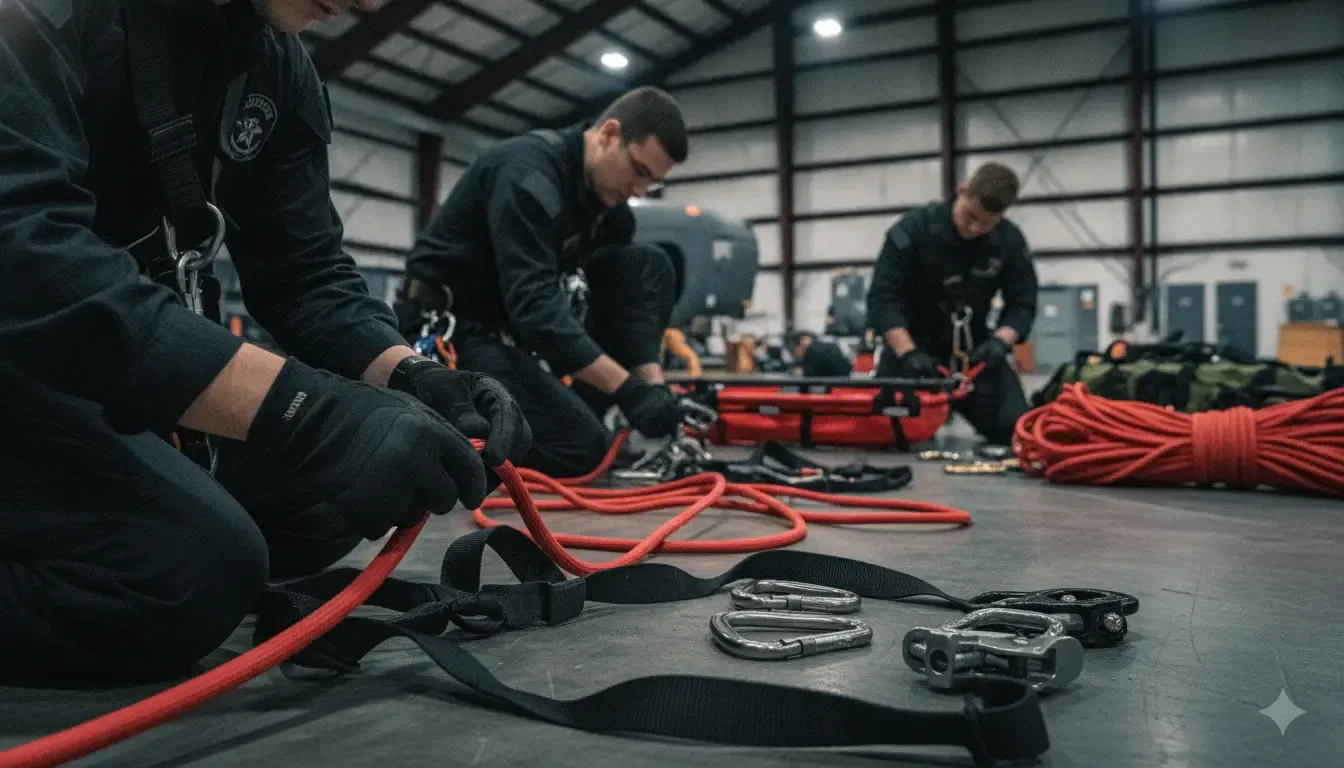
What testing and inspection evidence should a manufacturer provide?
Testing evidence should answer three questions: what was tested, how it was tested, and whether the delivered configuration matches the tested configuration. Inspection evidence should then show how the manufacturer controls production so that an approved design does not drift across lots, revisions, or custom orders.
For a public-safety rescue equipment purchase, ask for a controlled evidence package that can include:
- A product or assembly identification that matches the quotation and purchase order.
- Applicable material certificates or supplier records for load-bearing components.
- Test method, sample configuration, conditioning, load direction, and result summary.
- Inspection points for webbing, stitching, connectors, protective finishes, and labels.
- Release criteria and nonconformance controls for equipment that does not meet requirements.
- Care, storage, inspection, retirement, and replacement guidance that the end user can apply.
Standards are not interchangeable. For example, the U.S. Fire Administration's guidance on selecting and purchasing responder equipment explains why buyers should connect standards to the equipment and mission, while a product standard or test method addresses a particular class of equipment. A manufacturer should help the buyer identify which requirements apply instead of placing a familiar standard on every product description.
Also ask how inspection findings are handled in the field. A supplier that can provide replacement components, revision-controlled instructions, and a clear technical contact reduces the risk that equipment will remain in service after damage, contamination, unauthorized modification, or an expired inspection interval.
How do domestic sourcing and compliance affect public safety procurement?
Domestic sourcing and trade compliance can affect eligibility, documentation, lead-time planning, and contract administration. Buyers should specify the requirement at the solicitation or statement-of-work level, then verify that the exact materials and manufacturing path for the proposed configuration satisfy the contract rather than accepting a generic company-level statement.
Use a supplier questionnaire that asks:
- Where are the relevant materials sourced and where is final manufacturing performed?
- Which Berry Amendment or Trade Agreements Act requirements apply to the contract?
- Can the supplier provide a country-of-origin statement or supporting sourcing documentation?
- How are substitutions, alternate components, and engineering changes approved?
- Can the manufacturer support agency-specific documentation, packaging, labeling, and delivery requirements?
For federal, state, local, or cooperative purchasing, the buyer should also confirm the appropriate acquisition route, contract vehicle, clauses, and agency requirements with its contracting authority. Compliance is a requirement to verify for the transaction and configuration, not a marketing adjective that replaces contract review.
Fusion Tactical USA positions its U.S.-based manufacturing and Berry and TAA compliant capabilities for defense, aerospace, law-enforcement, government, and industrial buyers. Its rescue system collection can help procurement teams organize an initial category review, but the final quotation should identify the exact product, configuration, documentation, and sourcing requirements.
Can a manufacturer support customization and production readiness?
Customization is valuable when it solves a documented operational or integration need. It becomes a procurement risk when a supplier changes dimensions, materials, hardware, or attachment geometry without controlling the revision and re-establishing the evidence required for the new configuration.
Before approving a custom rescue system, define the following:
- Operational requirement: What task, platform, user group, or environment requires the change?
- Interface: What existing harness, anchor, vehicle, aircraft, litter, rope system, or storage method must it connect to?
- Acceptance criteria: Which dimensions, loads, cycles, environmental conditions, and inspection points must be met?
- Configuration control: How will drawings, bill of materials, revisions, samples, and approvals be recorded?
- Production plan: What are the prototype, pilot, first article, and recurring production checkpoints?
- Support plan: How will the agency order replacements, report defects, and request future modifications?
A capable manufacturing partner should be able to move from requirement capture to prototype review, testing, and repeatable production without losing the evidence trail. Ask for a realistic path from engineering consultation to delivery, and make sure the quote states what is included in each phase.
How should teams compare manufacturer support before award?
The final comparison should score evidence and operational support alongside product features. A lower-friction supplier is often the one that answers technical questions precisely, identifies limits without prompting, and provides records that a safety manager, contracting officer, and field supervisor can use.
| Decision factor | Strong response | Warning sign |
|---|---|---|
| Mission fit | Maps the configuration to the stated rescue application and user procedure | Uses one generic description for unrelated operations |
| Ratings and tests | Connects ratings to a defined assembly and test basis | Lists numbers without configuration or limitations |
| Quality records | Explains inspection, release, traceability, and change control | Cannot identify how production variation is controlled |
| Compliance | Separates company capability from configuration and contract verification | Promises blanket compliance without sourcing evidence |
| Readiness support | Provides care guidance, technical support, replacement path, and production planning | Ends support at shipment or treats documentation as optional |
Use the completed scorecard to document why a manufacturer meets the operational requirement, not merely why a product appears attractive. This creates a defensible record for internal review and gives the selected supplier a clearer basis for quotation, configuration, and delivery.
For a related framework on supplier due diligence, review Fusion Tactical USA's mission-critical safety equipment manufacturer vetting guide. Use that broader framework as a companion, while keeping this article focused on public-safety rescue readiness and cross-category procurement.
Public safety rescue equipment manufacturer FAQs
What does a public safety rescue equipment manufacturer make?
A public safety rescue equipment manufacturer may design and produce equipment for fire-rescue, emergency response, law enforcement, search and rescue, tactical recovery, confined-space response, or related operations. The product range can include harnesses, webbing assemblies, connectors, rigging components, rescue systems, and custom integrated equipment. The applicable requirements depend on the use case and configuration.
What should a buyer ask before selecting a rescue equipment manufacturer?
Ask about application fit, materials, hardware, load ratings, test methods, inspection controls, traceability, standards, sourcing, configuration changes, documentation, lead-time planning, customization, and post-delivery support. Require the answers to identify the exact configuration being quoted.
Does every rescue product need the same safety standard?
No. Standards and test requirements depend on the equipment class, intended use, loading, environment, and contract. A qualified manufacturer should identify which requirements apply and avoid presenting a single standard as proof that every product or use case is covered.
Why are load ratings not enough when comparing suppliers?
A load rating is meaningful only when the buyer knows the tested assembly, load direction, hardware, materials, limitations, and test basis. Comparing isolated numbers can hide differences in configuration and intended use. Request the supporting evidence and instructions that make the rating usable in the field.
How can government buyers verify domestic sourcing?
Government buyers should state the applicable sourcing requirement in the solicitation, then request configuration-specific country-of-origin and manufacturing information. They should also verify substitutions, material changes, and contract clauses with the contracting authority. A company-level statement does not replace transaction-level compliance review.
When is custom rescue equipment appropriate?
Custom equipment is appropriate when an agency has a documented interface, mission, user, or environment that standard equipment cannot address. The manufacturer should control the design revision, acceptance criteria, testing, approval, and production transition. A custom request without configuration control can create avoidable readiness and support risk.


