

Reinforced Nylon Duty Belt Load Bearing Guide
Duty belts carry radios, medical kits, restraints, tools, and other mission equipment through repeated movement, vehicle transfers, and long operating periods. Their performance depends on more than a thick strap. Material selection, belt width, reinforcement, stitching, hardware interfaces, and how the load path reaches the wearer all influence stability and service life.
Reinforced nylon duty belt load bearing comes from a coordinated construction system: durable ballistic nylon, appropriately specified webbing. Reinforced stitch lines, secure buckles, and a structure that distributes equipment weight without excessive sag or shifting. A component rating must not be treated as the rating of the fully assembled belt, and a duty belt is not fall-arrest equipment.
For procurement teams, the key question is how each construction decision supports the intended equipment load and operating environment. The analysis starts with the belt materials and structural geometry that create a stable foundation for the rest of the system.
Request a quote or schedule an engineering consultation
What Makes Reinforced Nylon Duty Belt Load Bearing?
A reinforced nylon duty belt is load bearing when its material, width, structure. Attachment interfaces, and hardware work together to support carried equipment without excessive sagging, shifting, or twisting. The fabric grade matters, but a denier specification alone does not establish the performance of a complete belt assembly.
For procurement teams, the key distinction is between a belt designed to organize and carry operational equipment and a separately engineered life-safety system. A duty belt should not be represented as fall-arrest equipment or evaluated as an equivalent substitute.
Fabric construction: 600D and 1000D ballistic nylon
Denier describes the linear density of the yarn used in a textile. In practical terms, 600D and 1000D ballistic nylon provide different construction options for balancing abrasion resistance, thickness, flexibility, and weight. Fusion Tactical lists both 600D and 1000D ballistic nylon among the technical fabrics it processes. The correct selection depends on the belt architecture, intended equipment load, attachment method, and expected operating environment, not on the denier number in isolation.
Ballistic nylon becomes part of a load-bearing design through its full assembly. The outer material may be layered with webbing, reinforcement, a stiffening element, or an inner belt. Stitching and hardware then transfer forces between the belt and attached pouches, holsters, or other equipment. Weakness at any interface can limit practical performance even when the textile itself has strong laboratory characteristics.
Width and rigidity distribute equipment loads
Duty belts are generally wider and more substantial than everyday belts because width creates a broader platform for carried equipment. Common duty-belt dimensions are selected partly to align with standard pouch and holster interfaces. A wider, more rigid structure can spread pressure over more of the wearer interface and help control bending, sagging, and movement as equipment is added. It also gives designers more material area for reinforced attachment points and load paths.
That does not mean maximum stiffness is always the right specification. A belt that is too rigid, poorly fitted, or incompatible with the intended equipment can reduce mobility and create uneven loading. Buyers should evaluate the complete configuration, including belt width, fit adjustment, inner-belt interface, equipment placement, and the way each attachment transfers load into the belt.
What MIL-W-17337D context tells a buyer
NIST identifies MIL-W-17337D as a U.S. Department of Defense standard associated with woven nylon webbing. That reference can help a buyer frame material and sourcing requirements, but it should not be treated as a blanket rating for every finished duty belt. The specification, revision, webbing type, test method, and finished assembly must be identified in the procurement record.
For a purpose-built platform, review the supplier's material documentation and ask how the webbing, reinforcement, stitching, hardware, and attachment points were evaluated together. Fusion's 2-inch MIL-SPEC nylon patrol belt is one example of a product configuration that can be reviewed against a specific operational requirement.
Finally, never convert a component value into a system conclusion. Webbing tensile data, a buckle rating, or a fabric description is only one part of the evidence. Complete belt performance depends on construction details, load path, fit, interfaces, test conditions, and the intended equipment application.
How Do Webbing and Reinforcement Affect Belt Performance?
Webbing and reinforcement determine how a duty belt carries equipment, manages tension, and maintains its shape during repeated use. A specification such as MIL-SPEC Type 13 webbing rated at 5,000 lb describes a material or component capability, not the capacity of a complete assembled belt. Procurement teams should therefore evaluate the webbing, seams, interfaces, hardware, test method, and intended load path together.
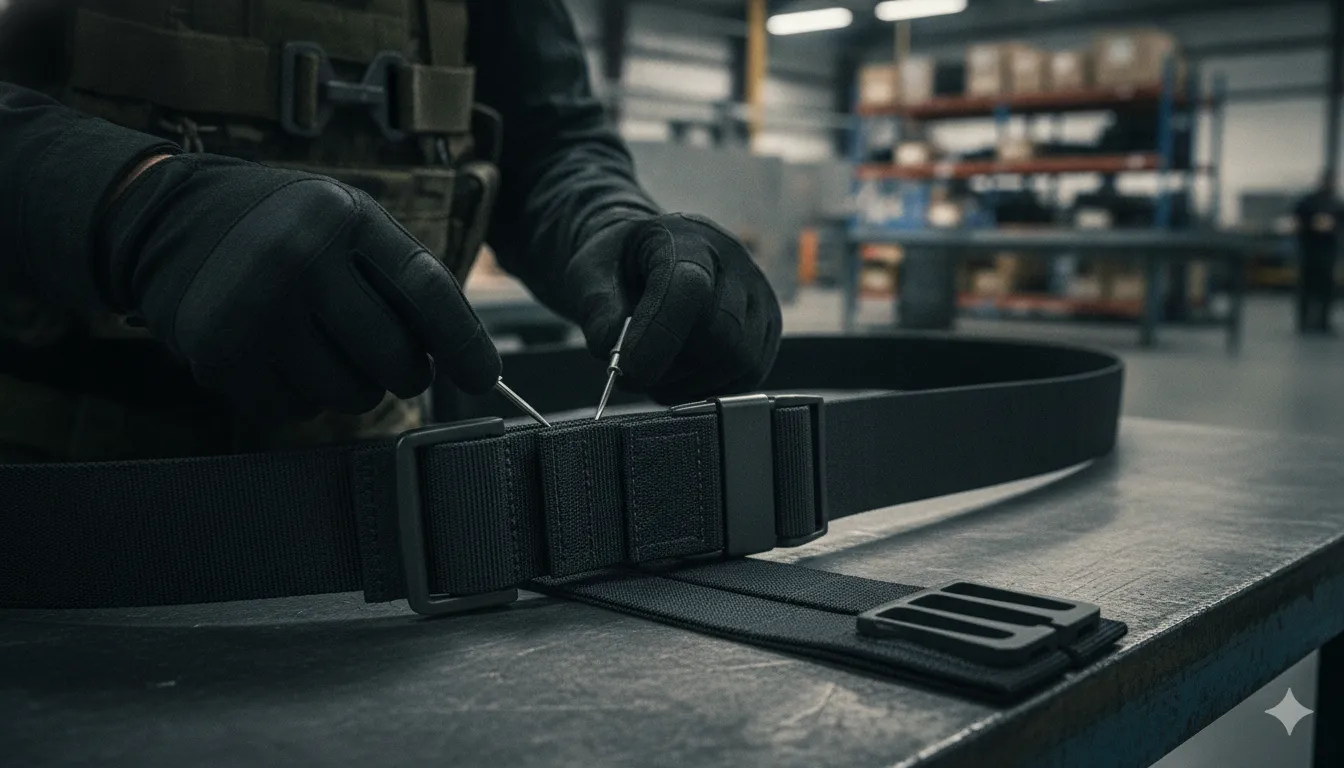
For a reinforced nylon duty belt load bearing system, webbing is the primary tension-carrying structure. Fusion Tactical lists MIL-SPEC Type 13 webbing with a 5,000 lb rating in its load-bearing systems. That figure is useful when comparing specified materials, but it should never be read as a complete system rating. A belt assembly also depends on how webbing is folded, joined, stitched, terminated, and connected to the buckle or attachment points. The weakest interface can govern real-world performance even when the base webbing has a higher published rating.
Type 13 terminology also gives a buyer a more precise starting point than a general description such as "heavy-duty nylon." The applicable NIST standards record identifies MIL-W-17337D as a U.S. Department of Defense standard associated with nylon webbing. Buyers should request the exact webbing designation, width, construction, finish, and applicable test documentation rather than accepting an unqualified material label. NIST's standards record for woven nylon webbing provides a useful reference point for this documentation review.
Why static and dynamic strength are different
Static tensile testing applies force in a controlled manner. Dynamic loading introduces force more rapidly, which can change stretch, energy absorption, and the point at which webbing fails. NIST research investigated load-stretch relationships and other mechanical properties under dynamic tensile loading, and obtained both dynamic and static breaking strengths. It reported reduced strength, stretch, and energy-absorption capacity under dynamic loading compared with static loading for the tested nylon specimens. The study used a falling mass to apply tensile force, illustrating why a static pull test alone may not represent every operational event.
These results do not automatically establish how a specific duty belt will perform in service. They show why test conditions matter. When reviewing supplier data, ask whether the value is tensile strength, breaking strength, working load limit, or another defined metric. Ask whether testing was static or dynamic. Ask how specimens were prepared and whether the result applies to webbing or the finished assembly. Also request the safety factor and acceptance criteria. The NIST dynamic and static webbing study helps distinguish these conditions.
For a product-level comparison, review the 2-inch MIL-SPEC nylon patrol belt alongside its stated construction and testing information. A sound procurement decision connects material rating to assembled design, equipment configuration, inspection requirements, and mission environment. Most importantly, equipment load support is not the same as fall-arrest or life-safety retention. Those applications require separately specified, tested, and approved systems.
Which Stitch Patterns and Interfaces Matter Most?
The most important construction details are the ones that keep forces moving through the belt instead of concentrating at a seam, edge, or attachment point. Multi-row stitching, five-row bartacks, accurately positioned MOLLE interfaces, and controlled cut-and-sew assembly all contribute to repeatable construction, but no individual stitch pattern guarantees a complete system rating.
For procurement teams, the practical question is whether the manufacturer can connect those details to documented inspection and testing. Fusion Tactical lists multi-row stitching and five-row bartack construction among its production techniques. Alongside in-house cut-and-sew production, hardware assembly, precision mounting, load testing, and quality control at each stage. Review the manufacturing capabilities to understand how these operations fit together.
Multi-row stitching and bartacks
Multi-row stitching spreads a seam's holding function across more than one line of thread. That matters where layers overlap or where an interface transfers repeated equipment loads into the belt body. The stitch layout should match the belt's material stack, seam allowance, thread, and intended load path. Simply counting rows is not enough. A poorly aligned stitch line, inadequate edge distance, or inconsistent tension can undermine an otherwise substantial-looking seam.
Five-row bartacks provide concentrated reinforcement at selected termination points and attachment interfaces. They are useful where webbing ends, mounting sections, or other components need additional resistance to pullout and peel forces. Their value depends on placement and integration with the surrounding layers. A bartack is not a substitute for evaluating the webbing, substrate, hardware, and complete assembled belt together.
Attachment points and MOLLE precision
Attachment points deserve particular scrutiny because they are where carried equipment introduces localized force. Reinforcement should extend beyond the immediate point of contact so the load can enter the belt structure without creating an abrupt stress concentration. Buyers should ask how reinforcement is layered, how stitch paths are specified, and how attachment locations are checked during production.
Laser cutting can support precise MOLLE pattern placement, helping maintain consistent spacing and alignment across production runs. Precision is operationally relevant because pouch interfaces must remain usable and repeatable when equipment is repositioned or replaced. It does not, by itself, establish the strength of the finished belt. Interface geometry, webbing selection, seam construction, backing layers, and hardware still require evaluation.
Cut-and-sew control and quality assurance
Cut-and-sew assembly is the point where material specifications become a physical belt. Controlled cutting, accurate layer registration, consistent stitch tension, and properly mounted hardware reduce variation between units. Quality control should examine seam appearance, bartack placement, edge treatment, hardware alignment, and any visible damage before the product moves to functional testing.
A credible qualification package should connect those inspections to relevant test methods and acceptance criteria. Fusion reports testing that covers tensile strength, breaking points, load limits, abrasion, UV degradation, and chemical resistance. Those results should be interpreted for the intended equipment-support application, not treated as proof that a particular pattern alone defines the performance of every assembled system.
How Should Procurement Teams Evaluate Buckles and Hardware?
Procurement teams should evaluate buckles and hardware as part of a complete load-bearing assembly, not as isolated components. The review should confirm retention, release control, interface compatibility, material durability, rating basis, test method, inspection requirements, and traceability before approval. A component capability does not establish the performance of a complete reinforced nylon duty belt load bearing system.
Start by defining the operational requirement. A quick-release buckle may reduce donning and doffing time, but it must remain secure during normal movement, equipment handling, and the forces expected in the intended application. Ask whether the release can be operated deliberately while gloved, whether accidental release is controlled. And whether the buckle is compatible with the belt width, webbing thickness, keepers, and attached pouches. The answer should come from documented design requirements and testing, not from appearance alone.
| Hardware/interface | What to verify | Procurement implication |
|---|---|---|
| Quick-release buckle | Retention under expected use, release control, operating method, belt-width fit, and inspection guidance | Specify rapid donning and doffing without accepting uncontrolled release or interface mismatch |
| Aluminum hardware | Material, stated rating basis, test method, corrosion considerations, and connection geometry | Fusion lists aluminum hardware capabilities in the 2,000 to 4,000 lb range. This is hardware data, not a complete belt rating. |
| Steel D-rings and connectors | Steel specification, rated direction of loading, finish, test report, and inspection interval | Fusion lists steel D-rings and connectors at 5,000 lb. Confirm how it applies to the selected configuration. |
| Webbing-to-hardware interface | Stitching, bartacks, edge protection, load path, abrasion exposure, and assembly quality controls | Approve the interface as an engineered assembly, rather than selecting a buckle solely by its catalog rating |
Rating language requires particular discipline. Fusion lists aluminum hardware at 2,000 to 4,000 lb and steel D-rings and connectors at 5,000 lb on its professional manufacturing information. These figures describe listed hardware capabilities under their stated conditions. They do not automatically describe the belt, stitching, webbing, attachment points, or any assembled system. Require the supplier to identify whether a value is a breaking strength, working load limit, or another test result, and request the governing test method and report.
Corrosion review should match the environment and sustainment plan. Consider salt exposure, moisture, chemicals, abrasion, temperature cycling, and storage conditions. The buyer should ask what finish or material protection is used, which damage indicators require removal from service. And how field personnel should inspect the buckle, connector, webbing, and stitch interface. A durable finish is useful only when paired with a practical inspection standard.
Traceability closes the procurement loop. Request the applicable material specifications, lot or batch identification, production records, quality-control checkpoints, test results, and inspection guidance. Fusion identifies in-house hardware assembly, load testing, and quality control as part of its manufacturing process. For a government or enterprise purchase, retain those records with the approved configuration so replacement hardware and future production can be evaluated against the same requirements.
Finally, define acceptance at the system level. Confirm the selected buckle and connector work with the actual belt construction, attachment layout, fit range, and mission load. A technically strong component can still create a weak or unusable interface when paired incorrectly. The procurement package should therefore state the complete configuration, intended use, verification method, and limitations alongside each hardware requirement.
How Does Load Distribution Change Real-World Duty-Belt Performance?
Load distribution determines whether a duty belt stays stable as equipment is carried, accessed, and repositioned throughout a shift. Width, fit, pouch placement, belt stiffness, and the connection between inner and outer layers all affect how force travels around the waist. A reinforced nylon duty belt load bearing design should therefore be evaluated as an integrated equipment platform, not as webbing in isolation.
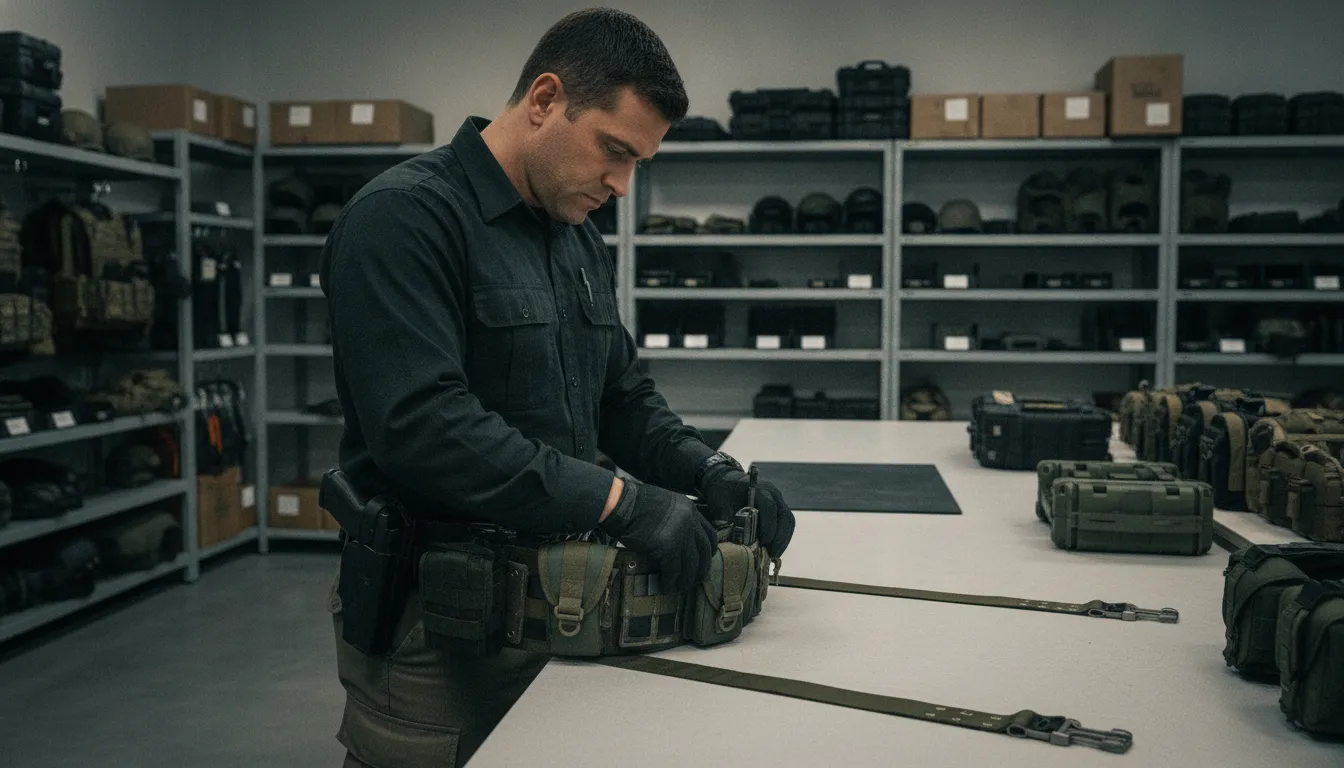
A wider belt spreads contact over more of the body and provides a stable foundation for holsters, pouches, radios, and other equipment. Width alone does not solve poor loading. If heavy items cluster on one side, the belt can rotate toward that load. A rigid structure helps resist bending and sagging, but the equipment manager must still balance the configuration.
Load path is the practical connection between an attached item and the wearer. Each pouch transfers force through its attachment points, the belt webbing, the belt interface, and the inner layer or clothing beneath it. Placement should account for access as well as balance. Frequently accessed items belong where they can be reached without forcing the belt to twist. Larger or heavier items should be distributed instead of stacked in one area, particularly near the front or behind a single hip.
Fit controls whether that load path remains effective. An outer belt that is too loose can sag when pouches are filled, while one that is too tight can create pressure points and restrict movement. The inner belt should hold the outer belt in a consistent position without relying on friction alone. A dual-belt setup can add stability and increase overall rigidity. Helping the outer belt stay aligned as the wearer walks, enters a vehicle, or works from a kneeling position. Inspect the hook-and-loop or other interface for full engagement across the intended contact area.
MOLLE and PALS integration makes configuration easier, but modular attachment is only useful when the underlying structure supports it. Consistent rows and secure stitching help keep pouches from migrating. The dual-layer MOLLE duty belt is an example of a layered platform intended to combine attachment flexibility with structural stability. For teams that need a more integrated layered configuration, review the three-layer MIL-SPEC battle belt as a separate equipment architecture.
During evaluation, load the belt with the actual pouch arrangement and observe it in motion. Check for sagging, hip twisting, pouch tilt, buckle migration, and loss of inner-to-outer belt engagement. These observations add context beyond an isolated material specification. Complete performance depends on placement, fit, reinforcement, stitching, and hardware working together. Fusion Tactical's engineering and testing capabilities can help teams define requirements for a specific configuration.
Is a Duty Belt the Same as Fall-Arrest Equipment?
No. A duty belt is designed to position and carry operational equipment around the waist, while fall-arrest. Hoist, extraction, and operator-retention systems are engineered for a different hazard and a different load path. A product should never be treated as fall-arrest or retention equipment unless the manufacturer expressly documents that intended use, the applicable test protocol, and the complete system limitations.
This distinction matters even when both products use strong nylon webbing, reinforced stitching, metal hardware, or similar attachment features. A reinforced nylon duty belt load bearing design may distribute the weight of pouches, communications equipment, tools, or other carried items. Its construction can reduce shifting and maintain equipment access during routine movement. Those benefits describe equipment support, not protection against a fall or suspension event.
Fall-arrest and operator-retention applications introduce forces and failure modes that ordinary equipment carriage does not address. The load may be transferred through a dedicated harness, rated connector, anchor, lanyard, or retention point. The direction, duration, and rate of loading can also change the result. NIST testing demonstrates why the test condition matters: nylon specimens showed different strength, stretch, and energy-absorption behavior under dynamic loading than under static loading. The study also measured both dynamic and static breaking strengths, rather than treating one value as universal. Review the NIST webbing research for the distinction between loading conditions.
Procurement teams should therefore evaluate four questions before approving a belt for a mission:
- What hazard is being controlled? Carrying equipment, preventing operator egress, supporting a hoist, and arresting a fall are separate requirements.
- Where does the load travel? Trace the path through the webbing, seams, bartacks, buckle, connector, attachment point, and the user interface.
- What test protocol applies? Request the documented method, loading condition, specimen or assembly tested, and acceptance criteria. Do not transfer a webbing or hardware value to a finished system without supporting evidence.
- What does the manufacturer authorize? Confirm intended use, limitations, inspection guidance, and whether the documentation covers the complete assembled product.
Fusion Tactical's engineering and testing information describes tensile, breaking-point, and load-limit testing, but a listed component capability is not a blanket authorization for another application. Select a duty belt for equipment carriage, and specify a dedicated fall-arrest, hoist, extraction, or operator-retention system when the mission requires life-safety performance.
What Should a Government Buyer Request Before Approving a Belt?
Before approving a reinforced nylon duty belt load bearing system, a government buyer should request controlled specifications. Material and hardware details, test methods, quality records, compliance documentation, and a sustainment plan. The review should evaluate the complete belt assembly and its intended equipment load, not treat one webbing or hardware rating as the performance rating of the finished system.
A practical request-for-information or source-selection checklist should make each requirement traceable to evidence. Ask the supplier to provide the following:
- Controlled product specification. Request the current drawing, revision level, dimensions, tolerance requirements, belt width, attachment layout, adjustment range, color requirements, and intended equipment configuration. The specification should identify whether the belt supports carried equipment only and should state any applications that are out of scope. This prevents a component intended for load-bearing equipment from being misinterpreted as fall-arrest or life-safety equipment.
- Material identification. Require the fiber, webbing construction, fabric type, coating or finish, and applicable material specification. Fusion Tactical lists 600D and 1000D ballistic nylon among its processed technical fabrics. Nylon webbing is also covered by the U.S. Department of Defense standard identified as MIL-W-17337D in the NIST standards record. Ask for lot or batch identification and certificates that connect the supplied material to the approved specification.
- Hardware and interface data. Request the buckle, adjuster, D-ring, connector, hook-and-loop, and attachment-component materials, dimensions, ratings, corrosion considerations, and retention requirements. Fusion Tactical lists aluminum hardware rated from 2,000 to 4,000 pounds and steel D-rings and connectors rated at 5,000 pounds. But those figures must be understood as listed component data. The buyer should require evidence for the specific hardware, interface, and assembled configuration being offered.
- Test methods and complete results. Do not accept a rating without the method, specimen or assembly tested, loading direction, conditioning, pass criteria, and report date. Request tensile-strength, breaking-point, and load-limit results, along with abrasion, UV-degradation, and chemical-resistance testing where the operating environment requires them. Static and dynamic loading can produce different webbing behavior, so the test record should explain which condition was evaluated. Fusion Tactical describes these categories through its engineering and testing capabilities.
- Quality control and traceability. Ask how incoming materials, cutting, stitching, bartacks, hardware installation, final inspection, and nonconforming product are controlled. Records should connect the finished belt to material lots, production dates, inspection results, and approved revisions. In-house cut-and-sew, hardware assembly, precision mounting, load testing, and stage-by-stage quality control can simplify that chain when the supplier can provide corresponding records.
- Domestic-content and trade documentation. For covered procurements, request the supplier's Berry Amendment and TAA documentation, country-of-origin information, and any applicable representations or certifications. Fusion Tactical identifies Berry Amendment and TAA compliant load-bearing systems for defense, aerospace, law enforcement, and industrial markets. Review the exact contract requirement and preserve the supporting documentation in the procurement file. The supplier's Berry Amendment compliant manufacturing information provides a starting point, not a substitute for contract-specific verification.
- Fit, fielding, and sustainment plan. Confirm sizing, adjustment, compatibility with issued pouches and holsters, user fitting instructions, cleaning limits, inspection intervals, replacement components, repair options, and configuration-control procedures. Ask how changes in pouch placement or equipment mass affect the intended load path. A belt that meets a laboratory requirement but cannot be fitted consistently or maintained across the program will create avoidable field risk and replacement cost.
The approval record should retain the submitted specification, test reports, compliance evidence, sample evaluation, and acceptance criteria. This gives contracting teams a defensible comparison record while preserving the distinction between equipment support and separately qualified fall-arrest equipment.
Request a quote or schedule an engineering consultation
Frequently Asked Questions
What makes a nylon duty belt suitable for a full equipment load?
A suitable belt combines adequate width, a stable structure, reinforced webbing, secure stitching, compatible hardware, and a fit that keeps equipment positioned. The belt should be evaluated as an assembled load-bearing platform, not by fabric weight or a single component specification.
Is 600D or 1000D ballistic nylon better for a duty belt?
Neither designation alone determines the correct choice. Both are technical fabrics used in duty-belt construction, while the application also depends on webbing, reinforcement, seam design, hardware, abrasion exposure, and required flexibility. Fusion Tactical lists both 600D and 1000D ballistic nylon among its processed materials: professional manufacturing capabilities.
What should a procurement team verify about webbing strength?
Request the material specification, rating basis, test method, and documentation for the complete belt assembly. Fusion Tactical lists MIL-SPEC Type 13 webbing at a 5,000 lb rating. But that figure is component data and should not be treated as the finished belt's overall rating: engineering and testing capabilities.
Do stitching and bartacks affect duty-belt reliability?
Yes. Stitch count, seam placement, bartack geometry, thread selection, and hardware interfaces affect how forces travel through the belt. Fusion Tactical lists multi-row stitching and five-row bartack construction, along with in-house hardware assembly and quality control: manufacturing processes.
How should buckle and hardware ratings be compared?
Compare material, interface, retention method, test conditions, and intended load path rather than rating numbers alone. Fusion Tactical lists aluminum hardware from 2,000 to 4,000 lb and steel D-rings and connectors at 5,000 lb. These component figures do not establish complete assembled-system performance.
Can a reinforced duty belt be used as fall-arrest equipment?
No. A duty belt is intended to support carried equipment. It should not be represented or substituted as fall-arrest or life-safety retention equipment unless the specific assembled system is separately designed, rated, tested, and approved for that application.
Get Started With a Duty-Belt Requirement Review
A requirement review can help align belt construction, hardware, load distribution, testing, and procurement documentation with the intended mission. Contact us to request a quote or schedule an engineering consultation for your reinforced nylon duty-belt requirement.


