

Load Bearing Safety Systems Development Partner Guide
When a load-bearing safety system is part of a defense, aerospace, law enforcement, rescue, or industrial program, the supplier decision is also an engineering decision. The right load bearing safety systems development partner helps translate operational requirements into a controlled design, testable configuration, documented compliance path, and repeatable production plan.
Use the following framework to evaluate whether a prospective partner can own the work beyond a catalog sale. The key questions concern requirements, load paths, validation, standards, prototype transition, sourcing, documentation, and production control.
What Should a Load Bearing Safety Systems Development Partner Own?
A capable partner should own a connected development lifecycle, beginning with requirements analysis and ending with quality assurance and delivery. That means the buyer can trace decisions from the mission need to the released configuration instead of coordinating disconnected design, testing, and manufacturing vendors.
Start with a written requirements review. Define the users, operating environment, attachment points, expected loads, handling methods, interfaces, materials, inspection needs, and procurement constraints. The requirements document should distinguish mandatory performance criteria from preferences. It should also identify what evidence will be required at design review, prototype acceptance, qualification, and production release.
Next, ask how the partner controls design development. CAD or 3D modeling is useful only when it supports clear configuration control. Drawings, bills of material, hardware selections, webbing specifications, stitch patterns, and revision history should remain connected. A design review should expose load paths, potential abrasion points, adjustment limits, failure modes, and maintenance implications before a prototype is treated as production-ready.
Fusion Tactical describes a development process that moves through requirements analysis and consultation. Design and 3D modeling, prototype development and testing, production scaling and optimization, and quality assurance and delivery. Buyers evaluating custom safety system engineering should look for that same continuity, whether the program involves a harness, retention system, connector assembly, or another load-bearing configuration.
Finally, confirm ownership at the handoff. A development partner should explain how prototype feedback becomes controlled design changes, how approved materials are preserved, and how production personnel receive the current instructions. The strongest partner is accountable for the complete chain, not just the first sample.
How Should the Partner Validate Load Ratings and Test Evidence?
Load ratings are meaningful only when tied to a defined configuration, test method, fixtures, loading direction, conditioning, and acceptance criteria. A development partner should provide a validation plan that shows what will be tested, why it matters, and how results will be recorded against the released design.
Ask whether the plan addresses the complete system rather than a single attractive component. Depending on the application, evaluation may include tensile strength, breaking point, load limit, abrasion, ultraviolet exposure, and chemical resistance. The test matrix should identify the specimen configuration, number of samples, environmental conditions, instrumentation, and disposition of failed or nonconforming samples.
Testing should also reflect the real load path. A connector, webbing section, stitch pattern, buckle, and attachment interface can each influence system performance. Review whether the test fixture reproduces the intended installation and whether the reported result applies to the final assembly. Avoid treating a component rating as a system rating without documented engineering justification.
Fusion Tactical lists in-house tensile, breaking-point, load-limit, abrasion, UV, and chemical-resistance testing, with independent verification through John Batchelor Testing, Midwest Testing, and Exvo OCM Test Laboratories. Its engineering and testing capabilities provide a useful benchmark for the level of test planning and evidence a program buyer should request.
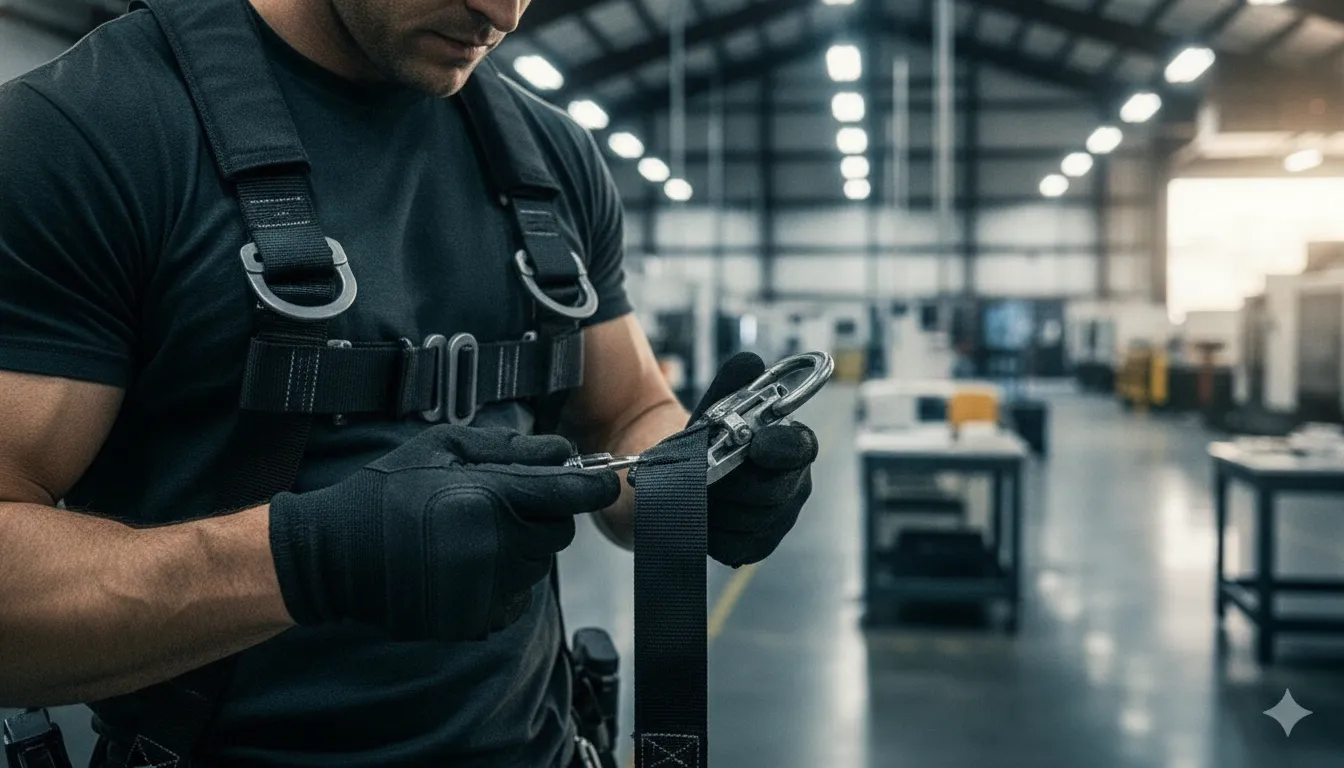
Require reports that identify the tested revision, materials, lot or serial information where applicable, test equipment, date, method, result, and reviewer. When an independent laboratory is involved, confirm the scope of the work and preserve the report with the configuration record. This evidence supports procurement decisions and makes later investigations more disciplined.
Which Standards and Compliance Controls Matter Before Procurement?
Before procurement, the partner should map each applicable standard and contract requirement to a specific design feature, process control, test, or record. Compliance is not a marketing label. It is a documented relationship between the buyer's requirement, the product configuration, the sourcing chain, and the evidence retained for review.
For load-bearing safety systems, the relevant reference set may include MIL-STD specifications, ANSI Z359 requirements for harnesses and connectors. OSHA fall-protection and PPE requirements, and selected EN, UIAA, CSA, or NFPA standards. The correct set depends on the application and contract. A partner should explain which requirements apply, which do not, and where a customer or authority must make the final determination.
Government sourcing adds another layer. Berry Amendment requirements can affect materials and manufacturing location, while TAA requirements involve country-of-origin rules. These are not interchangeable. Ask for a sourcing statement tied to the proposed bill of material, not a generic claim about a company or product line. Confirm whether custom work is needed to achieve the required domestic sourcing position.
Fusion Tactical lists confirmed TAA compliance, ISO 9001:2015 quality management, and AS 9100 aerospace quality principles. It also states that 100% U.S.-sourced materials are available for custom work for Berry Amendment requirements. Buyers should review the details of Berry Amendment compliant manufacturing against their own contract language.
A practical compliance review should produce a requirements matrix, standards list, material-origin record, test cross-reference, inspection plan, and approval record. The partner should identify open items rather than implying that a preliminary prototype is already certified or contract-compliant. That level of precision reduces avoidable procurement risk.
How Do Prototyping and U.S. Manufacturing Reduce Program Risk?
Prototyping reduces program risk when it is used to resolve engineering questions before production commitments are made. U.S. manufacturing adds value when the same partner can carry approved design decisions into repeatable production, quality control, and delivery without losing configuration visibility.
Ask what the prototype is intended to prove. A fit sample may answer interface or ergonomics questions, while a representative engineering sample may support material, stitching, hardware, and load-path evaluation. Those are different milestones. Define the acceptance criteria for each and record every requested change before the next sample is built.
Fusion Tactical lists initial prototype development at 3-5 days, with testing and validation requiring an additional 2-3 days, and standard soft-goods lead time at 1-2 weeks. These are listed reference timelines, not a promise for every program. Actual timing depends on requirements, materials, tooling, testing scope, approvals, and production volume.
The manufacturing environment matters as much as the calendar. Fusion describes its Chino facility as an integrated design, manufacturing, and distribution center with in-house cut-and-sew, hardware assembly, made-to-order production, and client showroom access. Its listed methods include laser cutting, multi-row stitching and bartacks, heat sealing, welding, custom color matching, and precision hardware mounting. Review the U.S. manufacturing capabilities to understand how those capabilities might support a defined configuration.
For procurement teams, the objective is not simply speed. It is controlled speed. A shorter feedback loop can expose an interface problem early, while made-to-order production can reduce unnecessary inventory for mission-specific configurations. Ask how the partner manages approved substitutions, nonconforming material, repeat orders, and changes after production release.
What Documentation Should Buyers Require Before Award?
Before award, require enough documentation to evaluate technical fit, compliance exposure, production readiness, and supplier responsibility. The exact package depends on the contract, but a credible partner should be able to explain what it can provide and which records remain the buyer's responsibility.
The core package should include a requirements matrix, controlled drawings or specifications, bill of material. Configuration and revision record, prototype acceptance criteria, test plan, test reports, inspection points, and a plan for handling nonconformance. For systems with load-bearing interfaces, request the rated direction and conditions, attachment assumptions, and any limitations that must appear in training or operating instructions.
Sourcing records deserve equal attention. If Berry or TAA requirements apply, request country-of-origin information for the proposed materials and components. The record should distinguish standard catalog configurations from custom configurations. Do not accept a broad domestic-manufacturing statement as proof that every component in every order meets a particular contract requirement.
Supplier credentials can support the review, but they do not replace product evidence. Fusion Tactical lists CAGE Code 0KQN1, active SAM.gov status, UEI JSR6VV16YGH5, and Small Business Certification #2011930. It also reports 40+ NAICS codes across tactical equipment, aerospace and defense manufacturing, safety and medical equipment, and drone or UAV capabilities. These details can help a government buyer frame a vendor review. Verify current status and applicability through the appropriate procurement systems before award.
Use the government and defense contracting capabilities page as a starting point for questions. The final decision should rest on a complete, current, project-specific evidence package, not on a credential in isolation.
How Can Program Teams Compare Partners Without Creating a Supply-Chain Gap?
A development partner should be evaluated on whether it can preserve engineering intent from requirements through production. A transactional vendor may be appropriate for a defined, repeatable catalog purchase. But it is a weaker fit when the program still needs design decisions, prototype learning, qualification evidence, or controlled scaling.
| Evaluation area | Development partner | Transactional vendor |
|---|---|---|
| Engineering ownership | Connects requirements, design reviews, prototypes, and release decisions. | Usually quotes an existing configuration and leaves integration to the buyer. |
| Test evidence | Plans tests around the final system, conditions, interfaces, and acceptance criteria. | May provide a general component rating without project-specific validation. |
| Compliance | Maps standards, sourcing, and quality records to the proposed configuration. | May require the buyer to assemble the compliance case from separate documents. |
| Prototype transition | Controls revisions and carries approved changes into production. | May treat prototypes, production, and substitutions as separate transactions. |
| Supply-chain control | Can coordinate made-to-order production, materials, hardware, and quality records. | May depend on multiple external vendors with less unified visibility. |
The comparison is not about choosing the largest supplier. It is about matching the operating model to the program's uncertainty and risk. If requirements are stable and fully validated, a conventional purchase may be efficient. If interfaces, loads, materials, or compliance evidence are still being resolved, a partner with engineering and manufacturing ownership can reduce handoff risk.
Ask each candidate to walk through one representative project using the same questions: What information is required at intake? Who controls the design? How are ratings established? Which tests are performed in-house or independently? How are Berry and TAA questions answered? What records accompany production? How are revisions and nonconformances controlled?
Then score the answers against the program's actual decision gates. A strong partner will identify unknowns, define the next evidence-producing step, and state what it cannot verify yet. That transparency is more valuable than a broad capability list.
- Confirm the mission, interfaces, loads, materials, and procurement constraints.
- Review the controlled design, test plan, ratings, and compliance mapping.
- Approve the prototype against written criteria before production release.
- Verify sourcing, quality records, revision control, and the production handoff.
Frequently Asked Questions About Development Partners
What does a load-bearing safety systems development partner do?
A development partner connects requirements analysis, engineering design, prototyping, testing, compliance mapping, production scaling, and quality documentation. The goal is a controlled path from mission need to a repeatable system, not simply the sale of an existing product.
What should a buyer ask about load ratings?
Ask which configuration was tested, how the load was applied, what fixtures and conditions were used, and whether the result applies to the complete assembly. Request reports tied to the tested revision and defined acceptance criteria.
Does a prototype prove compliance?
No. A prototype can answer specific design or performance questions, but compliance depends on the applicable contract and standards. The final configuration, required testing, sourcing, quality records, and the responsible authority's determination.
Why does U.S.-based manufacturing matter for government programs?
It can improve communication and production visibility while supporting domestic sourcing reviews. Buyers still need project-specific country-of-origin records and should distinguish available custom sourcing from the configuration actually proposed.
What documentation should a supplier provide?
Typical requests include a requirements matrix, controlled specifications, bill of material, revision history, test plan and reports, inspection criteria, material-origin information, nonconformance process, and production quality records. Contract requirements determine the final package.
When should a program use a development partner instead of a catalog vendor?
Use a development partner when the system requires new interfaces, mission-specific load paths, prototype learning, standards mapping, custom sourcing, or a controlled transition into production. A catalog vendor may be suitable when the configuration and evidence are already fully defined.
Bring your operating environment, interface requirements, expected loads, sourcing constraints, and required evidence to the conversation. Fusion Tactical USA can help program teams determine whether a custom engineering and made-to-order manufacturing path fits the project.


