

Law Enforcement Duty Belt Modular System Guide
A duty belt is not simply a place to attach equipment. For a law enforcement agency, it is a load-bearing interface that must keep essential tools accessible, stable, and compatible with the officer's movement throughout a shift. The configuration also affects fit, comfort, inspection, replacement, and procurement documentation.
A law enforcement duty belt modular system typically combines an inner belt, an outer belt, belt keepers, and configurable MOLLE/PALS attachment points. The right system distributes equipment deliberately while giving the agency a defined way to verify construction, hardware, compatibility, maintenance requirements, and manufacturer documentation.
That distinction matters because modularity alone does not establish performance. Agencies must evaluate how the architecture works when fully configured, how accessories attach, and which requirements apply to the intended duty environment. Start with the system's basic components and the role each one plays in stability and access.
Contact Fusion Tactical USA to discuss an agency duty-belt system.
What Is a Law Enforcement Duty Belt Modular System?
A law enforcement duty belt modular system is a configurable load-bearing platform that organizes essential equipment around the officer's working position. It typically combines an inner belt worn through the uniform belt loops with an outer belt secured by belt keepers. Allowing the loaded assembly to remain stable while also supporting efficient removal and re-donning. The modular element comes from configurable attachment points, such as MOLLE/PALS webbing, that let an agency place compatible pouches and accessories according to role and policy.
Unlike a single-purpose belt, the system should be evaluated as an equipment interface, not only as a strap around the waist. Its value depends on how the belt, keepers, attachment interfaces, and assigned equipment work together during movement, vehicle operations, training, and routine inspection.
How the inner and outer belts work together
The inner belt establishes the primary connection to the uniform and helps locate the outer assembly. The outer belt carries the working equipment and can be removed as one unit when the configuration uses compatible keepers. This separation gives agencies a practical way to standardize the belt platform while allowing officers to don the same approved setup for each shift.
Procurement teams should define the complete interface rather than approving an outer belt in isolation. Confirm the required belt width, keeper compatibility, adjustment range, closure design, and the way the system behaves when fully configured. Fit also matters. The belt should support the intended equipment without pinching, excessive movement, or pressure concentrated in one area.
What equipment zones does a modular system organize?
A typical duty configuration creates zones for the holster, magazines, radio, handcuffs, baton, medical equipment, and other agency-approved tools. Placement should reflect access priorities, handedness, vehicle seating, protective equipment, and any restrictions established by department policy. The objective is a repeatable arrangement that can be inspected quickly and understood by the officer and supervisors.
MOLLE/PALS webbing expands that configuration by providing attachment locations for compatible pouches. It can help agencies support different assignments without replacing the entire belt platform, but procurement staff should verify pouch dimensions, attachment methods, and the intended load before approval. Fusion Tactical's modular tactical belt system is one example of a product configuration agencies can examine when comparing belt architecture and attachment options.
For an agency, modularity is therefore a standardization tool. The department can define approved zones and interfaces, then adapt individual layouts to operational roles without losing control of fit, inspection, and replacement requirements.
How Should Inner and Outer Belts Share the Load?
The inner belt should establish a stable, comfortable foundation through the uniform belt loops, while the outer belt carries and positions the duty equipment. Belt keepers should secure the two layers so the outer belt does not rise, rotate, or shift during movement. The correct balance depends on fit, equipment distribution, and the officer's actual duty movements, not on a one-size-fits-all layout.
In practice, the inner belt supports consistent contact around the waist and hips. And the outer belt provides the attachment surface for the holster, magazine pouches, radio, cuffs, medical kit, and other mission-essential items. Select a size that fits snugly over the uniform without pinching, then test the fully loaded configuration in the same clothing used on shift. A belt that feels secure when empty may become unstable after equipment is installed.
Use the inner belt for stability, not equipment stacking
The inner layer should remain smooth enough to sit comfortably inside the outer belt and should not be overloaded with accessories that create pressure points. Its primary job is to keep the system located at the waist and provide a consistent mating surface. Belt keepers then connect the outer layer to that foundation at several points, limiting movement while preserving the ability to remove the outer assembly as one unit.
Keepers should be positioned so they secure the belt without forcing the outer layer into a fixed twist. During fitting, walk, sit in a vehicle, kneel, and perform common draw or radio-access movements. These checks reveal whether the belt is too loose, whether a pouch interferes with another item, or whether the buckle and keeper locations create pressure against the body.
Distribute equipment around the usable belt line
Place heavier or frequently accessed equipment where it remains stable and does not concentrate pressure on one hip. Avoid allowing the holster, radio, magazines, and medical equipment to compete for the same space. Equipment placement should preserve a clear movement path, maintain access with either hand where policy requires it, and account for seated patrol work.
Ergonomics is an operational concern. A CDC/NIOSH evaluation examined low back pain and duty-equipment wear configurations among police officers, while NIJ research addresses ergonomic load-bearing systems. Separate research indexed by PubMed found that police load-carriage systems can affect walking patterns and perceived comfort. These findings support agency fit testing rather than assuming that every officer should use the same placement.
Document the approved configuration, then let officers report pressure, restricted movement, or repeated shifting during realistic training and extended shifts. Adjust pouch positions or belt tension before changing the entire system. A well-fitted modular tactical belt system should support consistent access and stable load carriage without being treated as a fall-arrest or life-safety device.
Which Construction Features Matter in a Modular Duty Belt?
The strongest construction choices for a law enforcement duty belt modular system are material durability. Anti-sag reinforcement, controlled padding, secure stitching, and a buckle that balances retention with practical removal. These features support equipment stability and officer comfort, but they should not be confused with a certified fall-arrest or life-safety load rating. Agencies should require product-specific specifications and test records before approving a configuration.
Construction should be evaluated as a complete system. A rigid or reinforced belt can resist deformation, while the inner belt, padding, keepers, and attachment interfaces determine how that structure behaves during movement and extended wear.
| Feature | What to evaluate | Operational purpose |
|---|---|---|
| Material selection | Webbing type, durability, stiffness, abrasion resistance, and documented manufacturing specifications | Maintains shape under routine duty-equipment loads without unnecessary bulk |
| Layered anti-sag construction | How the layers reinforce one another and whether the design is identified for the specific product | Limits sagging, rolling, and equipment shift in a loaded configuration |
| Padding | Placement, thickness, breathability, and compatibility with the inner and outer belt | Improves contact comfort during long shifts without compromising fit |
| Stitching | Reinforcement at load points, stitch quality, edge finishing, and available test documentation | Helps preserve attachment integrity at pouches, keepers, and interfaces |
| Buckle and retention | Positive engagement, release procedure, adjustment range, and inspection access | Combines secure wear with controlled removal when the belt must come off quickly |
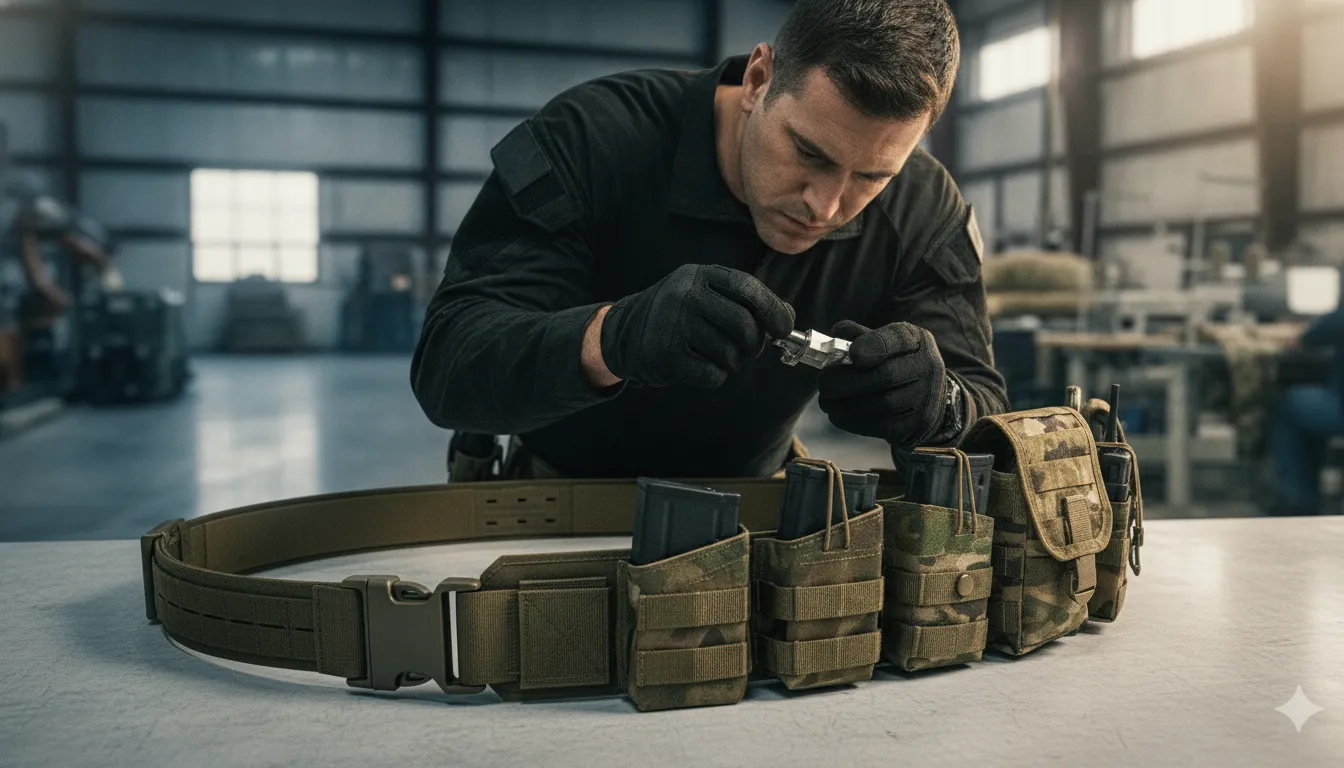
Material and anti-sag structure
Nylon is commonly selected for duty-belt applications because it can provide durability and a useful weight-to-strength ratio. The material alone does not determine performance. Agencies should examine the belt's core, layered construction, edge treatment, and the way the inner and outer components share tension. Fusion Tactical identifies a 3-layer anti-sag design on its modular tactical belt system. That is a product-specific construction claim, not a universal rating for every modular belt.
Padding, stitching, and buckle design
EVA foam padding appears in Fusion's three-piece modular belt system and can cushion the interface between the belt and the body. Padding should remain stable rather than bunching under movement. Stitching deserves equal attention at every concentrated load point, especially where pouches, keepers, or mounting hardware attach.
A quick-release buckle should engage positively, resist accidental opening, and provide a clear release action. Procurement teams should verify those functions through documented product testing and agency wear trials. Support features improve retention, comfort, and load distribution. They do not authorize the belt to be used as a fall-arrest, rescue. Or suspension device unless the manufacturer provides a separate certification for that exact product and use.
How Does MOLLE/PALS Affect Configuration and Interoperability?
Answer: MOLLE/PALS functions as an attachment interface that lets an agency position selected pouches and accessories on a common belt platform. It can support department-wide standardization while preserving role-specific adjustments, but interoperability depends on verified dimensions, spacing, attachment hardware, and the requirements of the individual accessory.
MOLLE and PALS are best understood as an interface, not a guarantee that every pouch, holster, or belt will fit every other product. The webbing pattern creates defined attachment points, allowing users to reposition equipment without replacing the entire belt. A patrol officer, tactical operator, supervisor, or medical-response specialist can therefore use the same general platform while carrying a different combination of magazine pouches. Radio equipment, medical kits, or other mission equipment.
For agencies, that flexibility is valuable when it is governed by a configuration standard. Procurement teams can establish approved zones for primary equipment, specify which accessories are authorized, and document the default placement for each assignment. Officers may then make limited, role-specific changes without creating avoidable variation during training, inspection, or team response. Standardization should cover the interface and the approved layout, not force every user into an identical load when duties differ.
What should buyers verify before approving compatible accessories?
Start with the physical interface. Confirm the belt's webbing width, row spacing, attachment direction, and usable attachment area. Then verify that each pouch or accessory is designed for that interface and can be secured without excessive movement, blocked closures, or interference with adjacent equipment. A product described as MOLLE-compatible still requires a fit check. Attachment straps, clips, snaps, and woven channels can vary in construction and may affect how securely an accessory sits.
Evaluate the assembled configuration, not only individual components. Check access to magazines, cuffs, medical supplies, and communications equipment while standing, seated, entering a vehicle, and moving through expected duty environments. Confirm that repositioning one pouch does not obstruct a holster, buckle, belt keeper, or other retention feature. Record the approved layout and include it in training and inspection procedures.
Fusion Tactical's modular battle belt with MOLLE/PALS illustrates this configurable approach. Agencies should still request current product specifications and verify accessory fit with the manufacturer before issuing a system. That step protects interoperability as equipment changes and keeps configuration decisions traceable.
What Hardware and Retention Checks Should Agencies Specify?
Agencies should specify a retention system that keeps the outer belt, holster, pouches, and attachment hardware secure during movement, while still allowing controlled removal when required. The acceptance criteria should cover buckle engagement, belt-keeper performance, attachment-point compatibility, pouch retention, and manufacturer documentation, rather than relying on appearance alone.
Every component should be evaluated as part of the complete law enforcement duty belt modular system. Confirm the intended equipment load, mounting interfaces, inspection process, and test records before approving a configuration for department-wide use.
Buckle engagement and belt-keeper security
Require a positive buckle engagement that is easy to verify by touch and sight. The release mechanism should resist unintended opening during routine movement, vehicle egress, kneeling, and contact with surrounding equipment. At the same time, authorized users must be able to release it deliberately without fighting the hardware or removing unrelated equipment. Fusion Tactical's Raptor system identifies a quick-release buckle as part of a modular belt design intended to combine security when engaged with ease of removal: review the documented quick-release belt configuration.
Specify the number, placement, and closure method of belt keepers. Keepers should prevent the outer belt from rising, rotating, or separating from the inner belt, while remaining compatible with the agency's uniform belt loops and duty-belt width. Test the complete assembly, not the buckle or keeper in isolation.
Attachment points and pouch retention
List every supported attachment interface in the agency specification. Check holster mounts, magazine pouches, handcuff cases, radio pouches, medical kits, and other mission equipment for fit, clearance, and positive retention. The belt should support these items without compromising structural integrity or creating movement that interferes with access. Do not assume that a pouch designed for one webbing dimension or mounting method will fit another.
Mounting geometry also affects officer movement. A PubMed study on thigh holster use evaluated changes in the kinematics and kinetics of active-duty police officers. Reinforcing the need to assess holster interfaces as part of the system rather than as a standalone accessory: see the thigh-holster interface research. During acceptance testing, assess seated movement, walking, running, vehicle transitions, and access to essential equipment.
Documentation and acceptance evidence
Require a component list, material specifications, stitch and seam details, buckle model, interface dimensions, care instructions, and defined inspection criteria. Ask the manufacturer to identify which tests apply to the buckle, webbing, stitching, and attachment interfaces. Do not assign a belt load rating from a buckle rating, and do not accept undocumented kN values for belts. Record approved configurations, replacement parts, authorized modifications, and removal-from-service triggers so procurement, training, and supervisors apply the same standard.
How Should Agencies Inspect and Maintain Modular Duty Belts?
Agencies should use a documented inspection workflow that checks the belt, hardware, attachment interfaces. And configuration before and after use, with periodic reviews based on agency policy and manufacturer instructions. Any component showing abrasion, fraying, deformation, corrosion, closure failure. Or an unauthorized modification should be removed from service until a qualified authority determines whether it can be repaired or must be replaced. The National Institute of Justice identifies regular inspection of buckles, D-rings, and webbing as essential to identifying wear before field failure. And recommends protecting synthetic materials and hardware from extreme heat and direct sunlight: NIJ ergonomic load-bearing systems guidance.
- Complete a pre-shift check. Examine the full belt assembly under adequate light. Look for cuts, abrasion, pulled or broken stitching, frayed webbing, crushed edges, distortion, or other changes in the belt's shape. Inspect MOLLE or PALS attachment points and every load-bearing connection for looseness or damage. Check the buckle and belt keepers for cracks, deformation, corrosion, contamination, and secure engagement. Operate the closure as intended. It should engage fully and release through its normal mechanism, without forcing it or relying on an improvised workaround. Confirm that holsters, magazine pouches, radio carriers, medical pouches, and other accessories are attached through approved interfaces and do not shift excessively.
- Perform periodic condition reviews. At the interval established by the agency's equipment program and the manufacturer's instructions. Inspect each belt in a controlled setting rather than relying only on an officer's quick check. Clean dirt, salt, and residue using approved methods, then allow synthetic materials to dry fully. Review hardware, D-rings, stitching, webbing, closures, and accessory attachment points again after cleaning. Compare the configuration against the approved issue or deployment setup. Flag unauthorized holes, cuts, sewn additions, altered hardware, unapproved adhesives, or other modifications because they can change how loads are carried and how components interface. Record the inspector, date, belt identifier, findings, corrective action, and return-to-service decision.
- Inspect after an incident or abnormal load. Remove the belt from routine use after a fall, vehicle collision, force event, snag, equipment drop, or other incident that could have imposed an unusual load. Do not rely on a clean appearance as proof that internal stitching, webbing, or closure components remain sound. Quarantine the assembly, document what occurred, and route it for manufacturer or agency-authorized evaluation. Replace or repair only through an approved process, and retain the inspection record with the equipment history.
- Store and disposition equipment correctly. Store belts clean and dry, away from extreme heat, direct sunlight, chemicals, and conditions that can degrade synthetic materials or hardware. If a belt is removed from service for abrasion, fraying, deformation, corrosion, failed closure function, or unauthorized modification, mark it clearly so it cannot return to circulation accidentally. Document the reason, date, belt identifier, evaluator, and final disposition, including repair, replacement, or destruction. Do not return equipment to service until the required review is complete.
What Should a Law Enforcement Procurement Checklist Include?
A complete checklist should define the agency's operational use, required load-bearing performance, interface compatibility, documentation, compliance needs, and support expectations before bids are evaluated. It should also include a controlled pilot, officer training, acceptance criteria, and a lifecycle plan. So a law enforcement duty belt modular system is judged on field performance rather than appearance alone.
Use the following categories to turn a general equipment request into a verifiable procurement specification.
Operational and construction requirements
- Mission profile: Identify patrol, tactical, transport, training, and specialty-unit use. List the equipment each configuration must carry, including the holster, magazines, radio, restraints, baton, medical kit, and other agency-approved items.
- Fit and load distribution: Specify sizing ranges, inner and outer belt construction, belt keepers, adjustment requirements, and how the system should remain stable during walking, vehicle entry, running, and seated work.
- Materials and workmanship: Require documented webbing, core, padding, buckle, edge-finish, and stitch construction. If an anti-sag design or cushioning layer is proposed, define the performance problem it must address instead of accepting a marketing label.
- Interface compatibility: Record the agency's holster, pouch, radio, and attachment standards. Confirm MOLLE/PALS dimensions, attachment methods, clearance, and compatibility with existing equipment before committing to a department-wide configuration.
Testing, compliance, and documentation
Ask each supplier for current material specifications, inspection instructions, test records, warranty terms, and traceability information. Separate belt-support claims from fall-arrest or life-safety ratings. Require the manufacturer to identify exactly which component each test applies to. DHS guidance recommends using relevant standards when selecting and purchasing responder equipment. It gives agencies a defensible framework for translating operational needs into procurement requirements: DHS responder-equipment purchasing guidance.
For federal or federally funded procurement, ask whether the proposed configuration and manufacturing plan meet the contract's Berry Amendment and Trade Agreements Act requirements. Confirm the answer in writing, along with country-of-origin documentation and any applicable CAGE Code information. These are procurement attributes that must be verified for the specific order, not assumed from a product category.
Pilot, acceptance, and lifecycle support
Run a representative pilot with officers from different assignments and body types. Evaluate donning, removal, retention, equipment access, vehicle compatibility, comfort across a full shift, cleaning, and configuration consistency. Document defects and require corrective actions before final acceptance.
Define training for fitting, attachment, buckle operation, inspection, and approved modifications. Establish replacement components, warranty response, inspection intervals, remove-from-service criteria, and record ownership. Accreditation resources can help agencies verify that procurement and maintenance procedures meet established benchmarks. For custom requirements or U.S.-manufactured agency systems, contact Fusion Tactical USA to review the specification with an engineering team.
Request a quote for a custom agency load-bearing system.
Frequently Asked Questions
What components make up a modular duty belt system?
A typical configuration includes an inner belt, an outer belt, belt keepers, a holster, magazine pouches, a radio carrier, handcuff pouch, and other mission-specific accessories. The inner and outer belts work together to stabilize the load while allowing the outer assembly to be removed as one unit. Confirm the component list against the agency uniform policy and duty equipment layout.
How does MOLLE compatibility enhance duty belt modularity?
MOLLE/PALS webbing allows agencies to position compatible pouches according to duty requirements, body fit, and access priorities. Before approval, verify webbing dimensions, pouch attachment hardware, clearance around the holster, and whether the selected accessories remain secure during movement. Standardized interfaces can support department-wide configurations while allowing limited individual adjustment.
What load-bearing ratings should agencies consider for tactical belts?
Ask the manufacturer for product-specific test records covering the belt materials, stitching, buckle, attachment points, and intended use. Do not assume a duty belt has a fall-arrest or life-safety rating, and do not transfer a rating from one component to the complete system. Procurement documents should distinguish equipment-support capacity from ratings intended for lifting, restraint, or fall protection.
How should a modular duty belt be inspected and maintained?
Inspect the buckle, belt keepers, D-rings, stitching, webbing, MOLLE rows, and accessory interfaces before use and at defined intervals. Remove equipment from service for fraying, abrasion, deformation, corrosion, failed closures, or unauthorized modifications. Store synthetic materials and hardware away from extreme heat and direct sunlight. NIJ guidance supports regular inspection and appropriate storage.
Are modular duty belt systems Berry Amendment compliant?
Not automatically. Berry Amendment status depends on the applicable contract, required components, country-of-origin rules, and documented sourcing. Agencies should request current origin and compliance documentation, identify which parts the claim covers, and confirm the requirement with their contracting authority before issuing an award. The same verification approach applies to TAA or other agency-specific procurement provisions.
Ready to Specify Your Agency Duty Belt System?
A well-defined modular duty belt specification helps your agency align equipment placement, retention, inspection, and procurement requirements before deployment. Fusion Tactical USA can help translate those operational needs into an agency-ready system or a custom load-bearing manufacturing consultation.
Contact Fusion Tactical USA through the contact page to discuss your requirements.


