

Tactical Rescue Harness vs. Industrial Fall Protection
A tactical rescue harness is a mission-system component, not simply a wearable fall-arrest device. Defense, aerospace, law enforcement, government, and rescue program managers must specify it around operational intent, load paths, connection interfaces, environmental exposure, inspection criteria, and the documentation required to support deployment and procurement.
Contact Fusion Tactical USA for mission-specific harness engineering.
A tactical rescue harness supports mission-specific movement, suspension, extraction, and equipment integration, while industrial fall protection is primarily configured to arrest falls within a defined workplace system. Fusion Tactical USA helps procurement and engineering teams evaluate load paths, hardware interfaces, standards applicability, testing evidence, and documentation before selecting or developing a harness system.
The distinction matters because two harnesses can use similarly rated components yet perform very differently once connected to an anchor, lanyard, rope system, extraction line, armor package, or other mission equipment. The following comparison explains the technical and procurement questions that should govern selection.
Tactical rescue harness vs. industrial fall protection at a glance
Industrial fall protection and tactical rescue equipment both manage life-safety risk, but their design assumptions are not interchangeable. Industrial systems commonly address predictable work-at-height exposures, controlled anchorage plans, and defined fall-arrest procedures. Tactical rescue systems may also need to support rope access, controlled suspension, rapid extraction, confined movement, aircrew operations, or integration with mission-worn equipment.
| Evaluation area | Tactical rescue harness system | Industrial fall protection system |
|---|---|---|
| Primary operational intent | Mission-specific positioning, suspension, rescue, extraction, or mobility | Fall restraint, positioning, or fall arrest in a defined workplace |
| System interfaces | Ropes, extraction systems, armor, packs, lanyards, and mission hardware | Approved anchors, connecting subsystems, and workplace PPE |
| Design emphasis | Interface compatibility, mobility, controlled access, and mission configuration | Work-at-height compliance and predictable fall-arrest configuration |
| Procurement evidence | Mission requirements, component ratings, test evidence, traceability, and configuration control | Applicable compliance records, inspection instructions, and authorized-use documentation |
| Operational risk | Snagging, incompatible connectors, unintended loading, restricted access, and extraction failure | Improper anchorage, excessive clearance demand, swing fall, and connector misuse |
Operational intent governs configuration
A harness should be evaluated by what it must enable and what it must prevent. An industrial worker using a personal fall-arrest system may operate within a documented anchorage and rescue plan. A tactical operator may need to transition between movement, restraint, suspension, and extraction while carrying other equipment. Those conditions change the required attachment locations, adjustment range, hardware access, and routing of webbing around the body.
Procurement teams should therefore avoid specifying a harness by broad category alone. A request for a "full-body harness" does not establish whether the system will be used for fall arrest, work positioning, rescue lifting, rope access, or extraction. The solicitation should define intended and prohibited uses, anticipated loads, user population, connected equipment, operating environment, and required records.
Load path matters more than a single component rating
A marked connector rating is important, but it does not describe the performance of the assembled system. The relevant load path runs from the anchor or extraction point through every connector, rope, lanyard, attachment point, structural webbing section, buckle, and body-support interface. A weak interface, an unintended loading direction, or an incompatible connection can undermine otherwise rated hardware.
Program managers should ask where force enters the system, how it is distributed across the harness, and whether every component remains correctly oriented during the intended maneuver. They should also evaluate potential off-axis loading, gate loading, rollout, webbing abrasion, hardware contact, and the effects of equipment worn above or below the harness.
Standards must be applied to the intended use
Standards and regulations establish critical requirements, but applicability must be determined for the actual operation. For example, OSHA 1915.159 specifies requirements for personal fall-arrest systems, including a minimum tensile strength of 5,000 pounds for D-rings and snaphooks. That requirement should not be treated as proof that any connector or harness is suitable for every tactical rescue operation.
Procurement documentation should identify the governing requirements, the use case covered by each requirement, and any mission-specific verification that remains necessary. References to ANSI Z359, OSHA rules, or component ratings should be precise. Buyers should request supporting records instead of relying on an unsupported standards statement in marketing copy.
How operational requirements change harness engineering
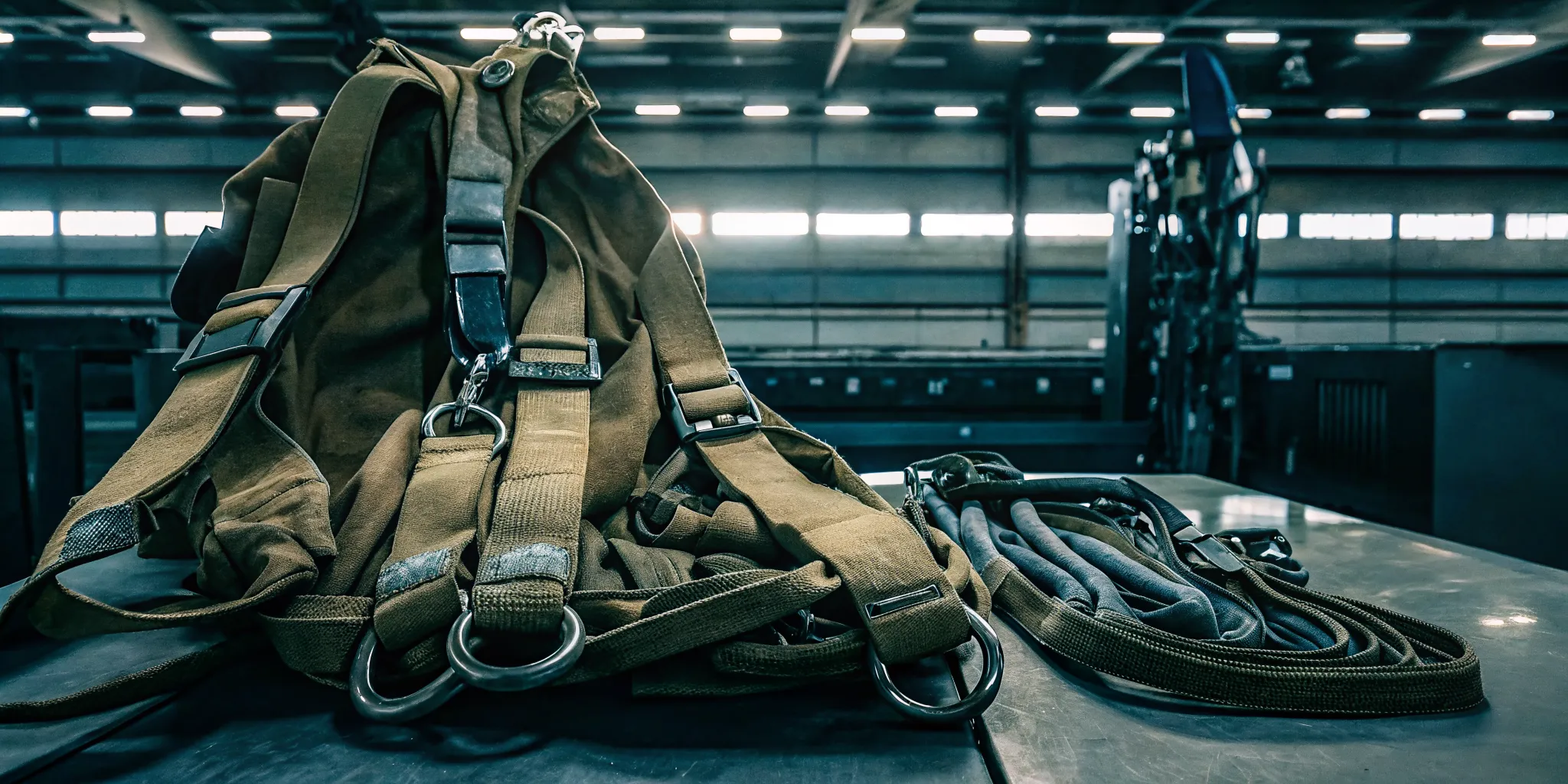
Harness engineering begins with a mission profile. Teams must document user tasks, duration of wear, expected transitions, environmental exposure, connected subsystems, and foreseeable misuse. This process converts an equipment request into measurable requirements that can be reviewed, tested, and traced through procurement.
Mobility and mission-equipment integration
A tactical rescue harness may need to coexist with body armor, load carriage, communications equipment, medical equipment, packs, or aircrew systems. Each interface can affect fit and access. A strap that functions correctly on an unloaded user may shift, bind, or become inaccessible when other equipment is added. Hardware that is easy to operate in a controlled setting may be difficult to reach while wearing gloves or working in a restricted position.
Evaluation should use the complete operational configuration, not an isolated harness. Teams should confirm that users can access required attachment points, adjust the harness without creating loose webbing hazards, and move through expected positions without displacing other critical equipment. They should also document which layers may be worn with the harness and whether configuration changes require renewed fit checks.
Body support and suspension consequences
The body-support design must correspond to how force may be applied. Fall arrest, controlled suspension, positioning, and extraction impose different demands on the user and the equipment. Attachment location affects body orientation, while strap geometry affects load distribution. Program requirements should address expected suspension duration, operator posture, rescue access, and the possibility that an incapacitated user cannot assist.
Comfort is not merely a convenience in extended operations. Poor load distribution can reduce operational effectiveness and may prompt users to loosen or misroute the system. However, padding or additional structure can increase bulk, retain contaminants, or interfere with adjacent equipment. Engineering teams must balance these factors against the mission rather than selecting features in isolation.
Hardware access and accidental-release risk
Buckles, D-rings, connectors, and adjustment hardware should be assessed for both deliberate operation and unintended activation. Existing Fusion Tactical USA configurations may incorporate hardware such as 18 kN Raptor buckles or triple-lock buckles, depending on the product and intended configuration. Procurement teams must verify the rating and function of the exact hardware specified, not assume that a feature applies across all models.
Hardware placement should reduce snag exposure and avoid contact that could load a gate or release mechanism incorrectly. Reviewers should consider operation with gloves, low visibility, restricted reach, and pressure from adjacent equipment. A secure mechanism that users cannot operate under realistic conditions can create a different operational hazard.
Interface compatibility is a system-level requirement
The harness cannot be approved independently from the system in which it will operate. Every connection needs sufficient strength, dimensional compatibility, correct orientation, and a defined inspection method. Substituting a connector, lanyard, or rope can alter the load path and invalidate assumptions established during evaluation.
Connectors, attachment points, and anchors
Connector compatibility involves more than fitting one item through another. A connector must close and lock as intended, remain correctly loaded, and resist conditions that could cause rollout or gate loading. Attachment points must be used only for their authorized function. Procurement records and training materials should identify which points support fall arrest, positioning, suspension, equipment carriage, or extraction.
The anchor strategy must also be compatible with the intended system. Industrial regulations may define requirements for a personal fall-arrest application, but tactical rescue operations can introduce different directions and sequences of loading. Engineers should document anticipated load directions and verify that the complete chain is appropriate for the scenario.
Ropes, lanyards, and extraction subsystems
Ropes and lanyards can be damaged by poor routing, sharp edges, rough hardware, heat, chemicals, or repeated abrasion. Contact surfaces should be reviewed for the expected motion and operating environment. The system must also control how connectors align as the user moves or transitions between attachment points.
An aircrew extraction harness configuration has different interface priorities from an industrial fall-arrest system. Similarly, the Fusion TAC Rescue Harness for rope access and STABO applications should be evaluated against the specific connected system and mission requirements. A product name or category does not replace system-level review.
Armor, packs, and adjacent equipment
Adjacent equipment can conceal attachment points, change strap routing, restrict adjustment, or introduce hard surfaces against webbing. It can also change the user's center of mass and affect body orientation under load. A compatibility review should use representative armor, packs, communications equipment, and tools in realistic positions.
Document the approved configuration and any restrictions. If users may change packs, armor carriers, or other equipment during the program lifecycle, configuration-control procedures should trigger a renewed interface assessment. This prevents unreviewed field changes from becoming hidden system risks.
Discuss interface compatibility and mission-specific testing with Fusion Tactical USA.

What procurement teams should require
A defensible procurement package translates operational need into requirements that bidders and reviewers can verify. It should make the approved use clear, define required evidence, and preserve traceability from solicitation through fielding. This is especially important for government, defense, aerospace, and law enforcement programs where equipment configuration and supply-chain records may be subject to formal review.
A mission and hazard statement
Start with a concise statement of the operation, users, environment, connected systems, and foreseeable hazards. Include whether the equipment will support fall arrest, restraint, positioning, suspension, rope access, lifting, extraction, or combinations of these functions. Identify constraints such as confined access, salt exposure, temperature, gloves, armor, or rapid donning.
The hazard statement should distinguish between required and prohibited uses. It should also identify assumptions about anchors, rescue capability, training, and inspection. This prevents a general-purpose description from being interpreted as authorization for an unsupported operation.
Configuration and interface requirements
Specify the necessary attachment points, adjustment range, hardware functions, and interfaces with mission equipment. Require bidders to identify the exact configuration proposed, including material and hardware substitutions that could affect performance. A harness model offered with different buckle or connector options should not be evaluated as a single undifferentiated item.
Where an existing product may be suitable, procurement teams can review configurations such as the Fusion TAC Rescue Steel 6-Point Rescue Harness, the Fusion TAC Rescue EVA Full Body Harness, or the STABO and rope-access rescue harness. Suitability still depends on the intended use and documented system review.
Standards, testing, and substantiation
State which regulations, standards, contract clauses, and agency requirements apply. Then request evidence that corresponds to those requirements. Appropriate evidence may include component ratings, test records, inspection instructions, material documentation, manufacturing records, and configuration identification. The exact package depends on the procurement and mission.
A test plan should define the article being tested, configuration, method, acceptance criteria, and resulting records. It should also distinguish qualification or design verification from routine production controls. Fusion Tactical USA provides custom engineering and testing capabilities for requirements that cannot be satisfied by an unmodified existing configuration.
Domestic sourcing and supplier documentation
Government procurement may require domestic sourcing documentation. Fusion Tactical USA is a California-based U.S. manufacturer with CAGE Code 0KQN1 and ISO 9001:2015 quality-system credentials already identified in the existing product context. Buyers should still determine which clauses apply to their specific procurement and request the corresponding records.
When the Berry Amendment applies, confirm required documentation and the relevant product configuration. Fusion Tactical USA provides additional information about Berry Amendment compliant gear made in the USA. A general domestic-manufacturing statement should not replace contract-specific compliance review.
Inspection, traceability, and lifecycle control
Selection is only the beginning of risk management. A fielded harness system needs inspection criteria, traceable identification, storage controls, training, and a process for removing equipment from service. Without these controls, even a correctly specified system can drift into an unknown or unsafe configuration.
Pre-use and periodic inspection
Inspection instructions should identify damage and conditions that require removal from service. Review areas commonly include webbing cuts, abrasion, heat or chemical damage, damaged stitching, deformation, corrosion, illegible markings, and connector or buckle malfunction. Inspectors must follow the manufacturer's instructions for the exact configuration.
Pre-use checks and periodic documented inspections serve different purposes. A user check identifies visible issues before deployment. A formal inspection process supports lifecycle decisions and creates a record of condition over time. Procurement planning should account for both, including personnel responsibilities and record retention.
Traceability and configuration control
Traceability connects a fielded item to its model, configuration, production information, inspection history, and applicable documentation. This supports informed action if a component changes, a defect is identified, or an agency updates its approved configuration. Markings must remain legible enough to support the required record system.
Configuration control is equally important for connected subsystems. Replacing a connector or adding an accessory may appear minor but can change geometry, access, or load behavior. Programs should establish who may authorize substitutions and what evidence is required before a change enters service.
Training and operational documentation
Training should cover fit, adjustment, approved attachment points, connector operation, inspection, storage, and prohibited uses. It should also address the complete mission configuration and the actions expected if equipment is damaged or subjected to an event that requires removal from service. Generic familiarization is not enough when a system has mission-specific interfaces.
Operational documents should remain aligned with the fielded equipment. If engineering changes alter hardware, routing, or authorized use, training materials and inspection procedures must be reviewed. This closed-loop approach protects the integrity of the procurement decision throughout the lifecycle.
When a custom tactical rescue harness is justified
A custom design may be justified when operational requirements cannot be met by an existing configuration, when mission equipment creates unresolved interface conflicts, or when the procurement requires a controlled combination of features and documentation. Custom work should begin with requirements and verification planning, not a list of preferred features.
Unresolved system interfaces
Examples include attachment points obstructed by armor, hardware that cannot be reached in the required posture, webbing that interferes with packs, or a load path that changes during extraction. These are engineering problems with measurable consequences. A development process can evaluate alternative geometry and hardware placement against representative equipment and users.
Special operating conditions
Temperature, maritime exposure, restricted spaces, gloved operation, or unusual transitions can create requirements beyond a standard configuration. The team should define the condition and its acceptance criteria, then verify the proposed solution. A special feature is useful only if it addresses a documented operational need without creating a new hazard.
Program-specific documentation and control
Some programs need tightly controlled configurations, traceable records, or a test package tailored to the intended use. In those cases, custom engineering can align the physical system with the procurement and lifecycle documentation. The objective is a supportable, reviewable system rather than an undocumented modification.
Frequently Asked Questions
How does a tactical rescue harness differ from a standard climbing harness?
A tactical rescue harness is configured around mission-specific rescue, extraction, suspension, mobility, and equipment interfaces. A standard climbing harness is designed for its stated climbing application. Procurement teams should compare authorized use, attachment points, load path, connected equipment, inspection instructions, and supporting test evidence rather than treating the categories as interchangeable.
Are tactical rescue harnesses suitable for industrial use?
Only when the exact harness and complete system satisfy the requirements applicable to the industrial task. Teams must verify intended use, anchorage, connectors, clearance, rescue planning, inspection instructions, and relevant OSHA or other requirements. A tactical label or high component rating alone does not establish suitability for industrial fall protection.
What weight ratings should be considered for a tactical rescue harness?
Use ratings and acceptance criteria derived from the intended operation and complete system. Review user and equipment loads, anticipated force directions, connectors, attachment points, anchors, and supporting test evidence. OSHA 1915.159 specifies a 5,000-pound minimum tensile strength for D-rings and snaphooks in its covered application, but that value does not by itself qualify an entire tactical rescue system.
Why is Berry Amendment compliance required for government tactical procurement?
The Berry Amendment can impose domestic sourcing requirements on covered Department of Defense procurements. Applicability depends on the contract, product, and purchasing context. Program managers should identify the governing clause and obtain product-specific documentation. Fusion Tactical USA provides information about its U.S.-made, Berry Amendment compliant gear for procurement review.
Build the procurement decision around the mission
A tactical rescue harness and an industrial fall-protection harness may share materials, hardware, or ratings, but they are not interchangeable by default. The defensible selection is the one supported by a defined mission, an understood load path, verified interfaces, applicable standards, inspection controls, traceability, and procurement evidence.
Fusion Tactical USA supports defense, aerospace, law enforcement, government, and rescue teams that need to evaluate existing configurations or define a mission-specific harness system. Begin with the operational requirements and connected equipment, then establish the evidence needed to approve, field, inspect, and sustain the system.


