

Tactical Medical Equipment Procurement: Building a Mission-Ready Package
Tactical medical equipment procurement begins with a mission question: what patient movement task must the equipment support, under which conditions, and with what interfaces? For teams evaluating patient transport equipment, a mission-ready package is more than a product list. It is a defined set of equipment, documentation, acceptance criteria, and sustainment responsibilities that can be reviewed before award.
Request a quote or engineering consultation
What should a mission-ready package define?
A package should connect the operational need to the equipment configuration and the evidence required to accept it. Start with the task and the user. Do not begin with a catalog description or a desired product name. State what the team needs to move, where the movement occurs, who will handle the equipment, and what other systems it must work with.
For a patient movement requirement, the scope may include the transport device, compatible attachment points, handling accessories, storage or carry provisions, inspection records, and user documentation. These elements are not interchangeable across missions. A short movement between adjacent work areas can impose different constraints from movement over uneven terrain, through a confined access route, or as part of an aircraft-related operation.
- Operational task: Define the movement scenario, operating environment, anticipated duration, and number of people expected to handle the system.
- Patient and handling assumptions: Specify the relevant patient dimensions or range, the number and positions of handlers, and the transfer method. Have qualified medical and operational personnel approve these assumptions.
- System interfaces: Identify the points of connection to other equipment, vehicles, storage systems, or procedures. Treat every interface as an item to verify, not an assumption.
- Deployment model: State whether the equipment is assigned to an individual team, a vehicle, a facility, or a deployable response package.
- Acceptance evidence: Define the records, inspection, fit checks, and functional demonstrations required before the package is accepted.
This creates a traceable line from a real task to a procurement requirement. It also helps teams separate essential requirements from preferences that do not affect the mission outcome.
How should teams translate the mission into requirements?
Write requirements so a supplier can respond clearly and an evaluator can verify the response. Avoid broad statements such as “rugged,” “lightweight,” or “mission capable” unless the solicitation defines how those terms will be measured. A requirement should identify the condition, the expected performance or fit, and the method used to confirm it.
For example, a team can state the access dimensions that the assembled equipment must pass through, the storage envelope available in the assigned vehicle, and the required cleaning or inspection information. If the system must connect to an existing restraint or transport interface, identify the interface configuration and request evidence of compatibility. Do not infer compatibility from a similar-looking connector or a product photograph.
| Procurement element | What the requirement should define | What the buyer can verify |
|---|---|---|
| Mission and user | Task, environment, users, handling sequence, and deployment location | Approved scenario statement and stakeholder sign-off |
| Equipment configuration | Included components, options, dimensions, interfaces, and any exclusions | Configuration list, drawings or product data, and a physical fit check |
| Performance and limits | Applicable operating limits and conditions, with their governing source | Traceable test or qualification documents tied to the proposed configuration |
| Acceptance | Required inspection, demonstration, records, and disposition of discrepancies | Acceptance checklist, completed records, and documented corrective actions |
| Lifecycle support | Inspection instructions, replacement components, training materials, and support contacts | Delivered manuals, parts information, and a named sustainment owner |
Include the configuration baseline in the solicitation or statement of work. Identify whether proposed substitutions require prior approval. Require the supplier to identify any deviations in a separate, visible section so evaluators are not left to find them in narrative text.
How can a requirement be made testable?
Use a simple testability check on every important sentence: can the supplier tell what to offer, and can the buyer tell what evidence closes the requirement? “Compatible with the assigned vehicle” is incomplete until the vehicle configuration, connection method, relevant dimensions, and verification step are named. “Supplied with documentation” is also vague until the required document types, delivery format, and point of delivery are defined.
A useful requirement record can include a unique identifier, the need being addressed, the exact proposed language, the verification method, the responsible reviewer, and the evidence reference. For instance, a storage requirement might identify a measured compartment envelope and require a fit demonstration using the final equipment configuration. A documentation requirement might name the user instructions and inspection records to be delivered with each package. This structure makes omissions visible early, when the team can still resolve them in the solicitation.
Keep the distinction between a requirement and an evaluation preference clear. If a feature is mandatory, state the threshold and how failure will be handled. If it is a scored preference, explain how it will be compared. Mixing the two can cause inconsistent evaluation and leave suppliers uncertain about what constitutes an acceptable offer.
Which interfaces need review before award?
Interface errors can make an otherwise suitable item difficult to deploy. Review the complete path from storage to use and back to storage. The review should cover physical fit, connection method, handling space, environmental exposure, cleaning, and the records needed to keep the equipment controlled.
Patient support and handling
Confirm how the patient is supported and secured under the intended procedure, and which personnel are responsible for each handling step. The requirement should state the approved configuration and the user-facing instructions the team needs. Any clinical or patient-care procedure must be established by the appropriate medical authority; a procurement document should not substitute for that authority.
Map the sequence in practical terms. Who prepares the transport device? Where does the initial transfer take place? Which roles control movement at transitions, such as a doorway, vehicle loading point, or change in elevation? Which checks occur before the team moves, and how does the team confirm that the equipment is ready for the next use? These are planning prompts, not a substitute for an approved patient-care procedure. Their purpose is to expose equipment and training needs that a product description alone would not reveal.
Connections to other equipment
List each attachment point and mating component by its actual specification or configuration identifier. Request interface drawings or other appropriate technical information, then review compatibility with the equipment already in the program. If a connection forms part of a load path or a fall-protection or rescue system, the responsible technical authority must confirm that the complete arrangement is suitable for its intended use. Do not combine components solely because their dimensions appear to match.
Depending on the mission, adjacent equipment may include a lanyard, or other rope and rescue components. Those categories are not substitutes for patient transport devices. They are potential interfaces to evaluate only when the actual operating concept requires them. The review should state whether the connected item is in scope, who owns its approval, and which configuration documents control the connection.
Stowage, access, and transport
Measure the available space and establish how the equipment will be secured when not in use. Confirm that the configuration can be removed, carried, and returned to its assigned location without obstructing other required equipment. If a rope or accessory bag is part of the selected configuration, verify the intended packing method and contents against the approved inventory; a product category such as a rope bag does not establish medical suitability.
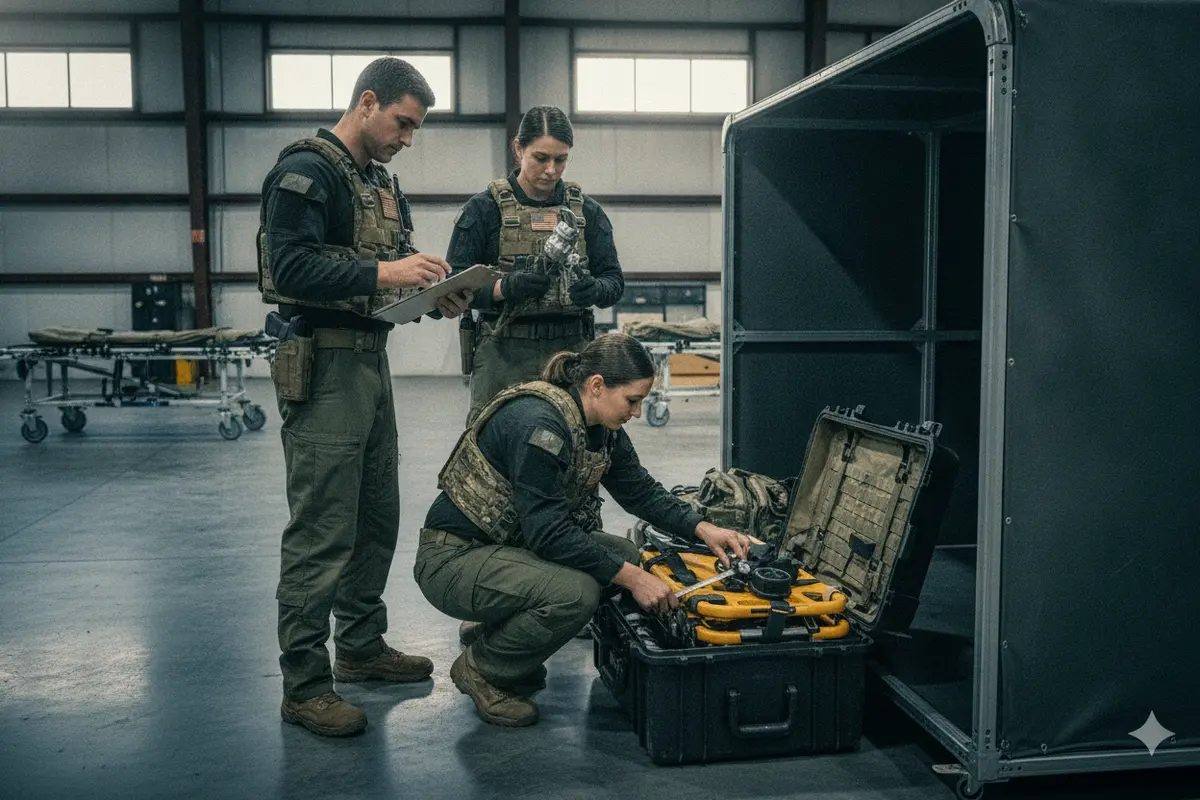
Check more than the stored dimensions. A package can fit in a compartment yet be impractical if users cannot reach the release, remove it without shifting adjacent equipment, or restore it to the marked location after inspection. Have representative users walk through the retrieval and return sequence with the approved mock-up or offered configuration. Record any clearance, reach, or sequencing issue and decide whether it requires a revised configuration or a procedural change.
What supplier evidence should buyers request?
Supplier review should focus on evidence tied to the exact offered configuration. A capability statement can help identify a supplier’s general scope, but it does not establish that a specific product, component, or proposed combination meets a particular requirement.
- Configuration identification: Request a bill of material or equivalent list that identifies each included item, model or part number, options, and proposed substitutions.
- Technical data: Ask for applicable drawings, dimensions, instructions, material or component information, and stated operating limits. The documentation should match the offered configuration.
- Test and qualification records: Identify the governing requirement and request records that show what was tested, under what conditions, and to which configuration. Do not treat a general statement of compliance as a substitute for the underlying evidence.
- Quality and change control: Ask how the supplier identifies and controls revisions, nonconformances, and approved changes. For government or regulated programs, confirm any required quality clauses and source documentation in the solicitation.
- Manufacturing and sourcing: Where domestic sourcing or a specific procurement clause applies, state the requirement and ask for the evidence needed to verify it. Do not infer compliance from a product’s country-of-origin statement alone.
- Delivery and support: Request a schedule, packaging details, user documentation, spare or replacement-part information, and the process for resolving defects or questions.
For a government purchase, contracting personnel should determine which clauses, representations, and documentation apply to the specific acquisition. A supplier’s registration or general statement about compliance does not answer every solicitation-specific requirement. Fusion Tactical describes U.S.-based manufacturing and government contract support; program buyers can review its equipment and procurement guidance and ask for documentation applicable to their solicitation.
Questions that expose evidence gaps
During market research or a clarification, ask the supplier to identify the exact configuration to which each document applies. Ask whether an evidence item covers the complete proposed assembly or only one component. Ask for the test condition, acceptance criteria, revision level, and any limitation that affects the intended use. If a record is proprietary or cannot be released with the proposal, determine whether a controlled review or another permitted method can satisfy the buyer’s evaluation rules.
Also ask what changes could occur between proposal and delivery. A material substitution, revised component, or alternate assembly method may affect the applicability of earlier data. The solicitation should define how the supplier reports changes and how the buyer approves them. This avoids accepting a package on the basis of one configuration and receiving another without an explicit review.
Supplier capability and item conformity are separate questions. A manufacturer may have relevant production capabilities, yet a particular offer still needs to meet the stated requirements. Conversely, an apparently complete product data sheet may not show whether the supplier can deliver the quantities, documentation, packaging, or support required by the program. Evaluate both dimensions and keep the findings separate.
How can buyers compare proposals on a consistent basis?
Use a compliance matrix that gives every offeror the same requirement, response field, and evidence request. A useful matrix records the requirement identifier, supplier response, evidence reference, evaluator finding, and any open issue. Mark requirements as met, not met, or requiring clarification based on the solicitation’s evaluation rules. Avoid turning unsupported claims into a pass simply because the proposal uses familiar technical language.
Separate mandatory criteria from scored preferences. If weight, dimensions, compatibility, or delivery timing matters, define the acceptable range and the verification method before proposals arrive. Keep exceptions visible and route technical questions to the designated evaluator. A written record of the rationale makes the selection easier to review and reduces the chance that an undocumented assumption becomes part of the accepted configuration.
Mission Ready Package resources offer a useful model for organizing a deployable resource: the EMAC Mission Ready Package guidance describes building a package in its system or using an Excel workbook. The Texas Military Department Mission Ready Package Catalog provides a catalog example. These references concern package development and cataloging, not a blanket technical approval for any patient transport item; the buyer still needs requirements and evidence specific to the intended use.
Before scoring, hold a short evaluator alignment review. Walk through sample evidence and agree what counts as responsive, what requires clarification, and which authority decides technical questions. This is especially helpful when reviewers come from different functions. A contracting specialist may focus on solicitation terms, a medical reviewer on approved use assumptions, and a technical reviewer on interfaces or configuration data. The group should apply the published criteria consistently rather than creating new standards during evaluation.
A practical comparison record can distinguish four outcomes: evidence directly demonstrates the requirement; evidence is incomplete but a clarification is allowed; the offer deviates from the requirement; or the offer provides no relevant evidence. Record the page, drawing, or document identifier supporting each finding. If the evaluation rules permit discussions, direct a specific question to the gap rather than asking a broad question that could lead to unequal treatment among offerors.
What should acceptance and deployment checks cover?
Acceptance is the point where the buyer confirms the delivered configuration against the contract, not the time to discover basic requirements. Prepare an acceptance plan before award and tie each check to a requirement. A practical plan can include:
- Identity and completeness: Match delivered items and quantities to the approved configuration list. Record serial, lot, or other identifiers when the contract requires them.
- Condition and documentation: Check for transit damage, required labels, manuals, inspection information, and certificates or reports identified in the contract.
- Fit and interface check: Verify key dimensions and connections using the approved mating equipment or a controlled mock-up. Record the configuration and outcome.
- Functional demonstration: Conduct only the demonstrations specified by the acceptance plan, using approved procedures and qualified personnel. Do not improvise tests that could damage equipment or expose personnel to risk.
- Discrepancy control: Log defects, missing records, or deviations, assign an owner, and document disposition before the package is released for operational use.
- Handoff: Identify the responsible custodian, storage location, inspection schedule or trigger, and the process for reporting damage or removing an item from service.
For each check, identify the person authorized to perform it, the equipment or reference needed, the record to retain, and the action if the result is unsatisfactory. A checklist that says “inspect” without specifying the inspection basis may produce inconsistent records. Use the contract, approved technical information, and program procedures as the basis. Keep acceptance observations distinct from any additional engineering analysis so that the record shows what was actually verified.
If the package includes a rope, descender, or other rescue interface, confirm that the relevant system authority has reviewed the intended configuration. Product references such as a descender category can help locate equipment, but a category page is not a substitute for technical compatibility review, qualification evidence, or an approved procedure.

How should the package be sustained after delivery?
Ownership should continue after acceptance. Assign a person or function to maintain the configuration baseline, records, and status of each assigned package. State how users report damage, how inspection findings are recorded, who can authorize repair or replacement, and how changes are approved. Define the response when required documents are missing or an item is no longer available in the approved configuration.
Keep the delivered technical documents with the asset record, including operating instructions, inspection guidance, applicable test reports, approved deviations, and change notices. When a supplier proposes a replacement component or design revision, review its effect on fit, compatibility, performance evidence, and training before incorporating it. A replacement that looks equivalent is not automatically an approved replacement.
Training should match the equipment and the approved use. Identify the people who need instruction, what tasks they are authorized to perform, and how competency or completion will be recorded under the program’s policy. Establish a refresher or retraining trigger when configuration or procedure changes. These steps help keep the package aligned with actual operating practice rather than relying on memory or informal handoffs.
Teams can make sustainment responsibilities concrete by defining an asset record for each package. Include the approved configuration identifier, custodian, assigned location, delivery and acceptance date, current status, and links to controlled records. Decide how often the record is reconciled with the physical equipment and who can change it. If multiple teams use the same baseline, establish how a local change or temporary replacement is reported so that it does not quietly become a new standard configuration.
Plan for issues that can interrupt readiness. If an item is damaged, what authority determines whether it can be inspected, repaired, or must be removed from use? If documentation is missing, who obtains a controlled copy and confirms its revision? If a replacement component is proposed, who checks compatibility and updates the inventory? These decisions should be recorded before a real discrepancy occurs. The objective is not to presume a particular service life or inspection interval, but to make the program’s approved process clear and traceable.
For programs with several package locations, use a consistent status vocabulary and report format. For example, a custodian can report whether a package is available, under review, awaiting a part, or restricted from use under local procedures. Define those terms in the program documentation. Consistent status reporting gives managers a useful view without implying that an item is ready merely because it is physically present.
How can a buyer plan the review in stages?
A staged review prevents late discovery of a requirement that should have been settled before award. The sequence below can be adapted to the acquisition process and the authorities involved.
- Frame the operational scenario. Record the task, users, location, conditions, and transitions the equipment must support. Confirm assumptions with end users and the responsible medical authority.
- Map interfaces and constraints. Inventory the vehicle, storage, connection points, procedures, and related equipment already in scope. Capture measurements or configuration identifiers rather than relying on memory.
- Draft verifiable requirements. For each need, state the expected result and verification method. Separate mandatory requirements from preferences and identify the responsible evaluator.
- Request and assess evidence. Ask suppliers to map their response to each requirement and identify the specific documents, configuration, exceptions, and open questions.
- Plan acceptance and sustainment. Before award, define delivery checks, discrepancy handling, record ownership, training responsibilities, and control of future changes.
This staged approach also helps distinguish different kinds of risk. A requirement may be technically clear but have an unresolved interface. A supplier may offer a suitable configuration but not provide the required evidence. A package may meet the purchase specification but lack an assigned custodian or a workable storage location. Assign each issue to the function that can resolve it rather than placing every open question in a general procurement log.
Frequently Asked Questions
What is included in a patient transport procurement package?
It depends on the approved mission and configuration. The purchase may define the transport device, compatible components, storage provisions, documentation, acceptance checks, training materials, and sustainment responsibilities. The solicitation should identify what is included and what the buyer will provide separately.
Can a supplier’s general compliance statement establish that an item is suitable?
No. Buyers should identify the applicable requirement and review evidence tied to the exact proposed configuration. General capability statements can inform supplier screening, but they do not replace technical data, required test records, interface verification, or contract-specific representations.
Should a procurement specification name a particular product?
Use performance and interface requirements where feasible, and follow the applicable acquisition rules. If a named configuration is necessary, document the operational reason and define the evidence and approval process for any proposed alternative.
Who should approve the operating requirements?
Involve the program owner, qualified medical personnel, end users, technical authorities for connected systems, and contracting staff. Each role addresses a different part of the requirement. Medical procedures and system safety decisions should be approved by the authority responsible for them.
What is the most common gap in package planning?
A common planning gap is defining the item but not the interfaces, acceptance evidence, or sustainment owner. Requiring those details before award helps the team evaluate the complete configuration and prepare it for controlled handoff.
How should teams handle a proposed substitution?
Compare the substitute with the approved requirement and configuration, then review any effect on dimensions, connections, evidence, instructions, and training. Follow the contract’s change-approval process, document the decision, and update controlled records if the change is accepted.
When should acceptance criteria be written?
Write them before award and align each check with a contract requirement. That gives the supplier notice of the evidence and demonstration expected, and gives the buyer a consistent basis for recording acceptance or a discrepancy.
Call Fusion Tactical to discuss your procurement requirements
A mission-ready package is built from a defined operational need, a controlled configuration, verifiable supplier evidence, and a clear plan for acceptance and sustainment. Use those elements to make the procurement decision traceable before equipment is assigned for use.


