

Confined Space Rescue Tripod Setup: Procurement Framework
A confined space rescue tripod setup is not just a frame placed above an opening. For a procurement team, the central question is whether the proposed equipment, supporting components, supplier evidence, and operating plan form a coherent system for the agency’s defined use. Verify those points before award, then make the acceptance criteria and records part of the purchase process.
Discuss your program requirements with Fusion Tactical
What should procurement verify before selecting a tripod system?
Start with the intended application and the boundaries of the procurement. A system for planned non-entry retrieval may have different interfaces and operating constraints from equipment used in a broader technical rescue plan. The term “tripod” alone does not establish suitability, capacity, configuration, or compliance. Ask the technical authority to define the use case in writing and identify who will approve the final configuration.
Before comparing suppliers, document the following:
- Use and environment: Identify the access geometry, expected worksite conditions, transport and storage needs, and whether the system is intended for non-entry retrieval or another defined function.
- People and roles: Name the organization’s equipment owner, technical reviewer, safety representative, operators, and receiving personnel. Confirm who is authorized to approve substitutions or changes.
- System boundary: List every component that must work together, including the tripod, attachments, rope or retrieval device, connectors, and any body-support equipment required by the written plan.
- Evidence required: Specify product identification, instructions, inspection guidance, traceability, applicable ratings, and other records that the supplier must provide.
- Acceptance method: State how the agency will verify delivered items, completeness, documentation, and configuration before placing the equipment into service.
These definitions prevent a common buying error: comparing a complete, documented system with a frame-only offer as if they were equivalent. They also give suppliers a clear basis for responding without guessing at the agency’s operating assumptions.
Turn each broad need into a question that can be answered and recorded. “Suitable for our team” is difficult to evaluate consistently. A more useful requirement identifies the intended task, the required interfaces, the documents that substantiate the offer, and the person responsible for technical acceptance. If a requirement cannot be verified from a proposal, a controlled document, or an agreed acceptance step, clarify how the agency will decide whether it has been met.
How should the buyer define the use case and system boundary?
Write a short operational description before requesting quotations. It should explain the access point, whether personnel enter the space, what function the equipment must perform, and which approved procedures govern use. Avoid turning a purchase specification into an improvised rescue procedure. The rescue authority and safety professionals should approve operating methods; procurement should translate those requirements into a clear, verifiable scope.
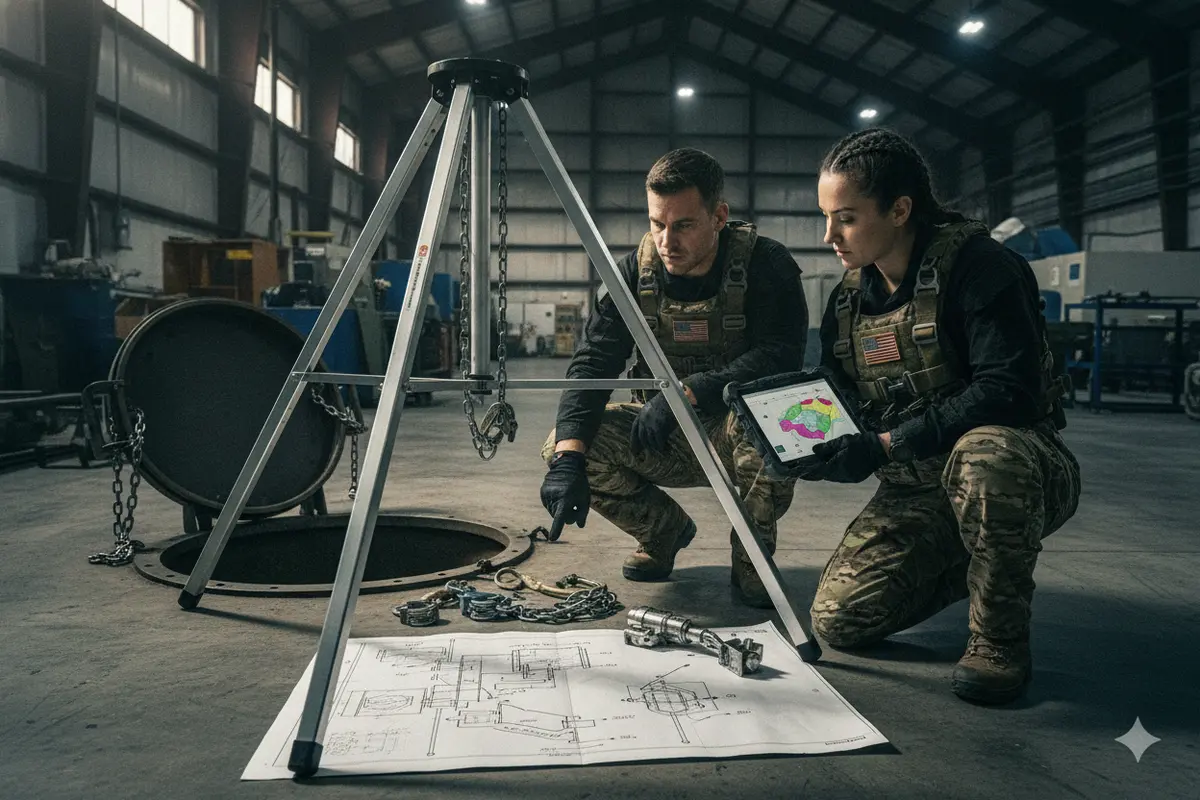
Next, map the complete load path and interfaces with the technical authority. Identify how the tripod connects to the selected retrieval equipment, where connectors attach, and which components are included in the supplier’s proposed configuration. Do not infer that compatible-looking parts are approved to work together. Request documentation for the exact components and combinations being offered, and record any limits or exclusions in the evaluation file.
A practical way to do this is to create a one-page system map. Begin at the structural support point and follow the intended connection sequence through the frame, attachment point, retrieval device, connector, line, and person-support component specified by the approved plan. For each interface, record the component identifier, connection method, source document, and responsible reviewer. The map is not an engineering approval by itself. It is a review aid that helps teams spot a missing component, an unverified interface, or a mismatch between proposal language and the planned use.
Fusion Tactical’s harness collection, lanyard range, and descender products can help buyers identify adjacent equipment categories for technical review. A product category page is not proof that an item is suitable for a specific confined-space configuration. Confirm intended application, specifications, compatibility, and required approvals with the responsible technical authority before including any component in a system.
Use a boundary list to distinguish the supplier’s delivery from items already owned by the agency or furnished by another contractor. For example, a proposal might include the frame and attachment but omit the retrieval device, connectors, or storage provisions. Another offer may show those items in an illustration without listing them in the price or bill of materials. Ask bidders to label each item as included, excluded, or supplied by the agency. Resolve any gap before award so that a low apparent price does not conceal a scope difference.
Which supplier evidence should be part of the evaluation?
Request evidence that lets reviewers connect the delivered equipment to its stated design, configuration, and instructions. A general capability statement can describe a supplier, but it does not replace product-specific documentation. Set the evidence list before solicitation so all vendors receive the same questions and reviewers can compare equivalent information.
- Identification and configuration: Request manufacturer, model or part number, revision where applicable, included components, and any configuration drawings or itemized bill of materials needed to identify the offer.
- Instructions: Obtain the current manufacturer instructions for setup, use, inspection, care, storage, and limitations. Establish which document revision will govern the delivered items.
- Technical data: Ask for applicable ratings and their basis, the intended use, environmental limitations, and any conditions that affect the stated performance. Have qualified reviewers determine whether the data meet program requirements.
- Inspection and service information: Request the manufacturer’s criteria for inspection, removal from service, maintenance, and return to service, if applicable. Clarify what the supplier is authorized to perform and what requires manufacturer direction.
- Traceability: Define the lot, serial, or other identification records required by the program, along with any certificates or manufacturing records specifically required by the contract.
- Change notification: Establish how the supplier will disclose substitutions, revisions, and changes that could affect fit, function, compatibility, or the approved configuration.
For government and industrial buyers, compliance language needs careful handling. Ask the supplier to identify the exact requirement, product, production scope, and supporting evidence behind each compliance representation. Do not treat broad claims about a company’s capabilities as automatic proof that every item in a proposed system meets a solicitation clause. Fusion Tactical describes its company and manufacturing background; procurement teams should still assess the specific product and contract evidence required for their own acquisition.
Review the evidence at the level of detail required by the acquisition. A certificate or declaration may be relevant to an organizational or production requirement, while a product manual may describe use and limitations. Neither should be treated as a substitute for the other. Build a cross-reference that pairs every solicitation requirement with the response and supporting record. If a document covers only part of a requirement, note the uncovered portion rather than marking the whole line item complete.
Document control matters as much as document presence. Record the title, identifier, revision or date, and the product configuration each document addresses. When a supplier sends an updated manual during evaluation, preserve both versions or clearly retain the controlling version and why it changed. This makes later acceptance easier: the receiving team can compare the delivered product and records against the same baseline the evaluators reviewed.
How can procurement compare offers consistently?
Use a common evaluation matrix. Separate mandatory requirements from scored preferences, and require each bidder to answer in the same format. This makes omissions visible and reduces the risk that attractive but non-comparable offers drive the decision. The table below is a starting point; the agency’s technical authority should tailor it to the application.
| Evaluation area | Question for each supplier | Evidence to review | Procurement decision |
|---|---|---|---|
| Intended use | Does the offered configuration address the defined operation and site conditions? | Product documentation, stated limitations, technical response | Accept for technical review, clarify, or mark nonresponsive |
| System completeness | Are all specified components and interfaces included and identified? | Itemized configuration, drawings where needed, component identifiers | Compare complete scope, not headline item alone |
| Ratings and requirements | Are applicable ratings and required standards supported for the exact items? | Product-specific technical records and required declarations | Record evidence and reviewer determination against each clause |
| Instructions and inspection | Can the agency obtain current use and inspection guidance for delivered items? | Manuals, inspection criteria, care and storage information | Confirm required documents are included and controlled |
| Traceability and changes | Can deliveries be identified and changes controlled? | Identification plan, delivery records, change-notification terms | Set contract and receiving requirements |
| Delivery and support scope | Does the offer state what is supplied and what is excluded? | Quotation, lead-time statement, service and support description | Resolve gaps before award; do not assume unlisted services |
Record the reason for each finding and the name or role of the reviewer. If an answer is incomplete, issue a written clarification to the supplier and apply the same process to comparable offers. Do not silently fill gaps using assumptions from another product, previous purchase, or informal conversation.
Keep pass/fail determinations separate from preferences. For instance, an agency may require a specific document or identified configuration as a condition of responsiveness, while ease of storage or the format of the supplied records may be evaluated as a preference. Define those categories before opening offers. Otherwise, evaluators may unconsciously treat an appealing feature as a substitute for a mandatory requirement or penalize one supplier for a preference that was never stated.
Price comparisons should use the same scope. If one offer includes an attachment, delivery documentation, or a requested service and another excludes it, record the difference and seek clarification under the procurement rules. Do not add assumed costs or make unsupported judgments about value. Instead, identify the missing element, ask for a comparable response where permitted, and preserve the final basis for comparison in the file.
A short reviewer worksheet can make the matrix practical. Give each requirement a reference number, a concise statement, an evidence location, a finding, and a reviewer note. Use “not provided” when evidence is absent, “clarification requested” while an issue remains open, and a specific disposition after review. This shared vocabulary makes it easier for procurement, safety, and technical staff to hand off the evaluation without losing the history behind a decision.
How should evaluators handle uncertainty and substitutions?
Separate a missing document from a failed technical requirement. A missing manual may be resolvable through a formal clarification if the solicitation permits it; evidence that a proposed configuration does not meet a mandatory requirement may call for a different disposition. The solicitation should establish how clarifications will be handled so the evaluation team applies the same rules to each offer.
When documentation uses different names for components or configurations, ask the supplier to map its terminology to the agency’s requirement. Keep the response with the technical review rather than relying on a verbal explanation. The record should show what was asked, what was answered, which version of the documentation was reviewed, and who made the determination.
For a proposed substitute, compare the offered item against the same interface, rating, use, and documentation requirements as the original. Do not assume that similar appearance or a matching catalog description establishes equivalence. Require approval from the designated technical authority before changing an accepted configuration, and update the controlled record so receiving staff can verify what is authorized.
It helps to classify open items by their effect on the decision. An administrative question may concern document naming or a missing cross-reference. A scope question may concern whether a needed component is included. A technical question may concern a stated rating, interface, operating limitation, or requirement. Assign each item to the right reviewer and set a clear disposition deadline within the procurement schedule. This avoids treating every unanswered question as equally serious while ensuring that a safety-critical uncertainty is not overlooked.
If a supplier proposes a change after award, ask for a written description of what changed, why it changed, which delivered items are affected, and what supporting documentation applies. Compare it with the approved configuration and contract terms. Do not accept a verbal assurance that the replacement is “equivalent.” The responsible authority should make and document the technical decision, while procurement records any required contract action before the changed item is accepted.
What should the purchase order and acceptance plan specify?
The purchase order or statement of work should make the approved configuration auditable. Identify the products and components, quantities, required documentation, delivery condition, and acceptance steps. Include only requirements the agency can verify and administer. If a specific standard, rating, country-of-origin rule, or quality-system condition applies, name it precisely and define the evidence needed to demonstrate it.
At receiving, compare delivered items with the award documents. Check identifiers and quantities, confirm that substitutions were approved, and verify that the requested instructions and records are present and match the delivered configuration. Route discrepancies to the designated technical authority. Do not place items into service simply because the shipment arrived or the packing list appears complete.
For equipment that will be stored before use, identify the responsible custodian and the record location. Define how the agency will preserve instructions, purchase records, inspection history, and configuration decisions. Set a process for reviewing a proposed replacement component or revised product documentation before it changes the approved arrangement.
Make acceptance steps specific enough for receiving personnel to perform without making technical judgments outside their role. A receiving checklist can ask staff to confirm the manufacturer and identifiers, match quantities to the award, note visible shipping damage, confirm that listed components arrived, and collect required documents. If the checklist reveals a mismatch in the configuration or a technical record, it should direct staff to hold the item for review rather than decide whether it is suitable.
Define what counts as complete documentation and how exceptions are handled. For example, the contract can state whether manuals must arrive with the equipment or may be delivered electronically, which identifiers must appear on records, and who receives any approved change notice. If a delivery is incomplete, the acceptance plan should identify how the discrepancy is recorded, who notifies the supplier, and who can authorize closure. Clear steps prevent an administrative receipt from being mistaken for technical release.
Before award, walk through a hypothetical delivery with procurement, the equipment custodian, and the technical reviewer. Ask what each person would inspect, what evidence they would need, where a discrepancy would go, and what condition must be met before the equipment is available to the program. This simple tabletop check often reveals unclear responsibilities, missing records, or acceptance language that sounds precise but cannot be applied at the receiving location.

What can a public training source confirm about tripod placement?
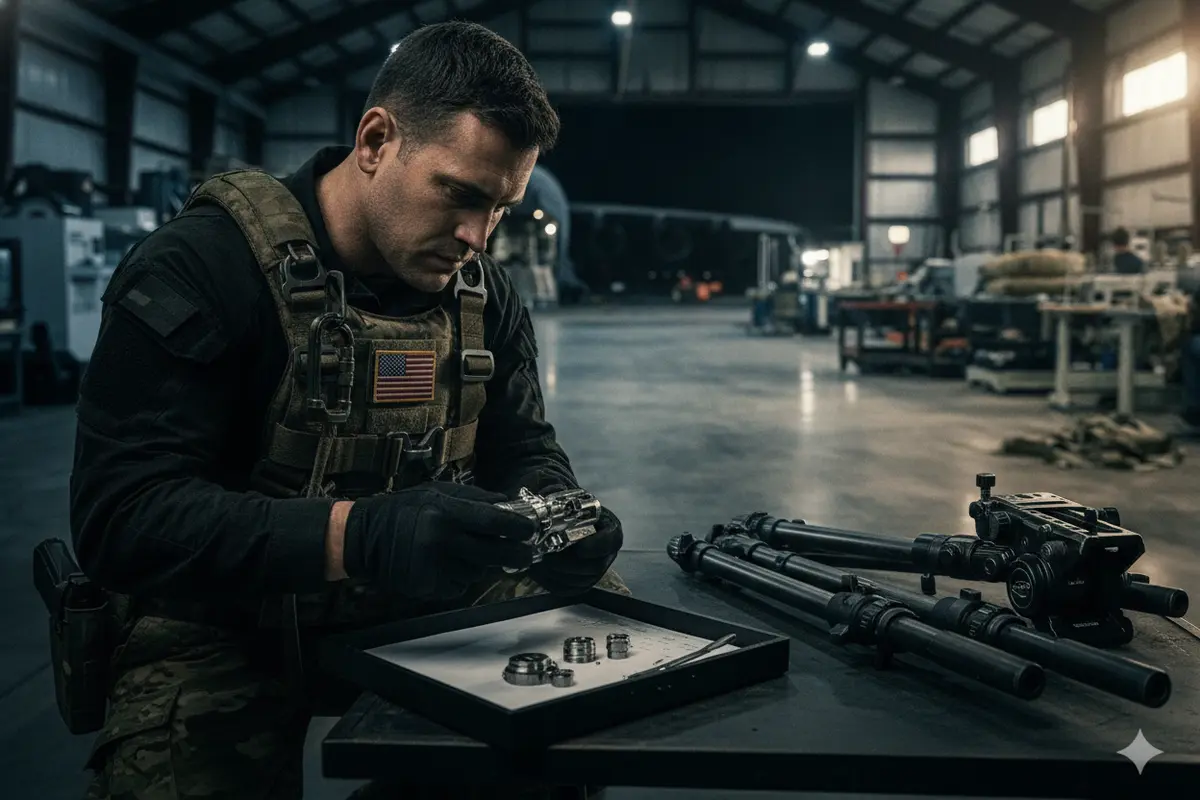
A Los Alamos National Laboratory confined-space training document says to position the tripod level and notes that legs may be adjusted to different lengths to accomplish this on the surrounding surface. That is a limited training point, not a complete setup procedure or a substitute for the manufacturer’s instructions and the agency’s approved plan. Use the source to frame a question for the technical reviewer: what site conditions and leveling checks must the selected system address? Read the confined-space nonentry rescue gear training document.
For procurement, translate such operating considerations into verifiable requirements only after the responsible authority has reviewed them. For example, the solicitation can request manufacturer instructions addressing the chosen equipment and define which delivery records or demonstrations are required for acceptance. It should not prescribe a procedure that conflicts with the approved training or equipment documentation.
Keep the source in its proper role. It provides a training observation that can prompt a review question, but it does not establish that every tripod has the same adjustment method, site constraints, or operating sequence. Reviewers should examine the manufacturer’s documentation for the proposed model and configuration, then reconcile it with the site assessment and the agency’s approved procedures. Where the source and product instructions differ in scope or detail, the agency’s qualified personnel should resolve the issue rather than treating a general training statement as a product-specific direction.
How should program teams manage lifecycle readiness?
Supplier selection is one stage of readiness, not the end of it. Establish ownership for inspection records, storage controls, operator access to current instructions, and review of changes. Keep the approved system configuration together with the procurement file so staff can identify what was evaluated and received. If components are replaced, require a documented review of compatibility and any effect on the approved plan.
Build a simple review schedule around the manufacturer’s instructions and the organization’s governing procedures. The schedule should identify who performs each review, where the evidence is retained, what conditions trigger removal from service, and who authorizes a return to service. Do not invent inspection intervals or service-life limits: use the applicable manufacturer documentation and the organization’s approved requirements.
Where the program also needs supporting equipment, assess each item against its role rather than adding products by category. The tactical leg rope bag and other storage options, for example, should be evaluated for the program’s organization and transport needs, not assumed to establish system performance. Buyers may review the company’s harness product information as a separate item, while confirming with technical staff whether any item belongs in their defined scope.
Lifecycle responsibility should be assigned before equipment arrives. Name the custodian who maintains the configuration record, the person or group responsible for inspection decisions, and the authority that approves changes. Provide a place to retain the purchase order, accepted configuration, manuals, delivery records, and subsequent review history. If personnel rotate, the record should make it possible for the next owner to identify the approved setup and the source of each requirement without relying on informal handover notes.
Consider how training and records intersect without confusing their purposes. Training records may show that staff completed an organizational program, while product instructions address the equipment’s stated setup, care, and limits. Keep those records linked to the relevant program but do not use one as a substitute for the other. When the equipment or instructions change, identify whether the program’s training materials or approval documents also need review.
Plan for controlled replacements and repairs. A missing component, damaged item, changed part number, or revised instruction can affect the approved arrangement. The organization should define who can quarantine or remove an item from availability, who contacts the supplier or manufacturer when needed, and who reviews a proposed return. Keep the disposition record with the equipment history. This does not require procurement to dictate technical inspection criteria; it requires a traceable process that points staff to the controlling manufacturer and organizational guidance.
What questions should buyers resolve before award?
- What exact operation is the proposed configuration intended to support, and what is outside its scope?
- Which parts are included, and how does the supplier identify each component and interface?
- Which product-specific records substantiate the ratings, requirements, and configuration claimed in the offer?
- Are current instructions and inspection criteria available for the exact items being supplied?
- How will the supplier document and obtain approval for substitutions or revisions?
- What will receiving personnel check before the equipment is accepted and released to the program?
- Who owns the lifecycle records and approves technical changes after delivery?
Unresolved answers should become written clarifications, contract requirements, or documented reasons for exclusion. A clean procurement record gives technical reviewers a traceable basis for the decision and gives receiving staff a practical checklist at delivery.
Before finalizing the award recommendation, hold a brief cross-functional review of the completed matrix. Procurement can confirm that responses are tied to solicitation requirements, while safety and technical reviewers confirm that open issues and product evidence have a documented disposition. The program owner can then verify that the selected scope is usable within the approved plan and that the receiving team has the information needed to verify delivery. This is a check on the decision record, not a substitute for technical approval.
Call Fusion Tactical to discuss a technical requirement
Frequently Asked Questions
Does a tripod by itself constitute a complete rescue system?
No. Procurement should define the full configuration, including required attachments, retrieval equipment, connectors, and supporting equipment. The responsible technical authority must confirm that the selected components and procedures work together for the defined use.
Can buyers use a supplier’s general capability statement as product evidence?
Not by itself. Ask for records tied to the exact product and configuration being offered, such as identification, applicable ratings, instructions, and limitations. Evaluate those records against the procurement’s stated requirements.
Should procurement staff write the operating procedure?
Procurement should state what equipment and records the acquisition requires. Qualified safety and rescue personnel should approve operating methods and site-specific procedures, which should align with the equipment instructions and the organization’s governing plan.
What should receiving personnel do if an item differs from the award?
Hold the discrepancy for review, document the delivered identifier and the difference, and route it to the designated technical authority. Do not accept a substitution on the assumption that it is equivalent; use the contract’s approval process.
What does the cited training document establish about setup?
It notes that the tripod should be level and that leg lengths may be adjusted to achieve this on the surrounding surface. It does not replace product instructions, a site assessment, or an agency-approved rescue plan.
A disciplined confined space rescue tripod setup procurement begins with a defined use case, evidence tied to the exact configuration, and acceptance criteria the agency can verify. Bring procurement, safety, and technical reviewers together before award so the selected equipment and its records support the program’s approved plan.


