

Personal Retention Lanyard Safety for Helo Teams
One unchecked connector can turn a routine helicopter insertion into a preventable retention failure. For SWAT and military aviation teams, disciplined equipment checks protect operators before the aircraft ever leaves the ground.
A personal retention lanyard connects an operator harness to a rated aircraft anchor during helo operations. Safe use depends on compatible locking hardware, approved anchors, disciplined inspection, controlled slack, and documented removal rules after loading or damage.
This guide answers how aviation units should select anchors and hardware, inspect the full retention system, and complete operational safety checks before flight. The path begins with a common baseline for every mission.
Personal retention lanyard basics for aviation teams
Purpose in the aircraft
A personal retention lanyard helps keep a crew member connected to an approved aircraft anchor during open-door or exposed operations. It supports movement inside the working area while limiting the chance of an unintended exit. It is a retention link, not a complete safety system by itself.
SWAT, military aviation, and public safety teams may use the system during observation, rescue support, or tactical work. Each team must define the allowed task, connection method, and movement range in its procedures. The operating setting must guide equipment choices.
The complete retention path
The retention path has four linked parts: the operator harness, personal retention lanyard, connector hardware, and aircraft anchor. The harness spreads force across the operator's body. The lanyard sets the working reach, while connectors join the lanyard to the harness and anchor.
- Harness: Must fit the operator, worn equipment, and assigned task.
- Lanyard: Must provide useful reach without allowing access beyond the safe work zone.
- Connectors: Must match the intended attachment points and resist unintended opening.
- Aircraft anchor: Must be approved for the planned connection and kept clear of conflicting loads.
Every part depends on the next. A strong lanyard cannot correct a poor harness fit, mismatched connector, or unsuitable anchor. General fall protection guidance states that connectors must sustain a minimum tensile load of 5,000 pounds. It also calls for automatic locking connectors that need two separate movements to open. Teams can review these connector and anchorage requirements as a procurement benchmark, while applying their aviation-specific rules.
Procurement and configuration control
Procurement should begin with the mission profile, not a preferred hook or webbing style. Buyers should document crew roles, aircraft type, approved anchor locations, working reach, carried equipment, and expected connection sequence. They should also define required records for load ratings, testing, country of origin, Berry Amendment status, and TAA status.
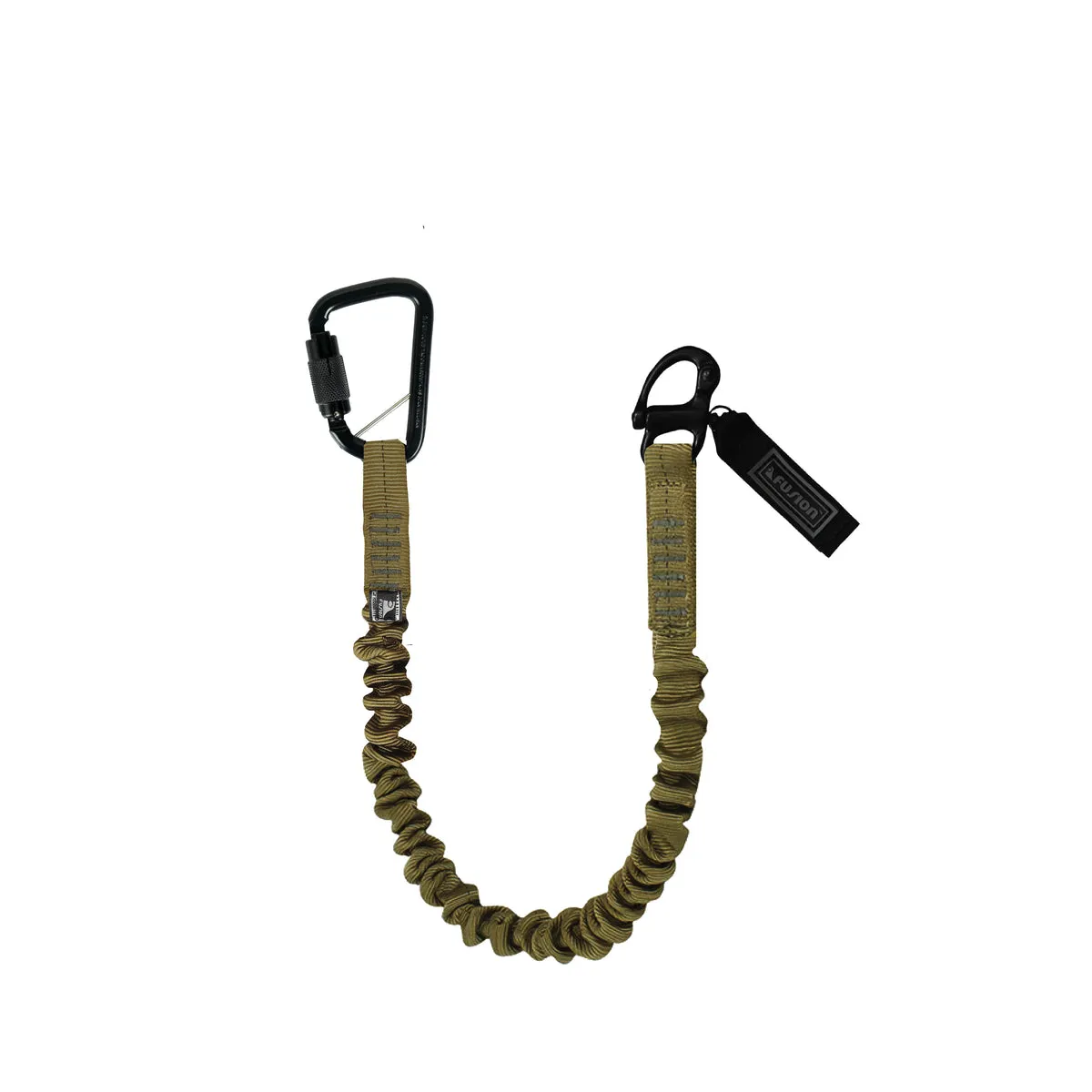
Connector choice affects both security and ease of use. Teams should test whether gloved operators can connect, confirm lock status, and release hardware under expected working conditions. A triple-locking carabiner retention setup illustrates one configuration, but selection must follow the approved system plan.
Configuration control continues after purchase. Agencies should track the issued harness, lanyard, connectors, and approved anchor as one operating system. They should also set inspection steps and clear removal rules. OSHA requires any lanyard subjected to in-service loading to be removed from employee safeguarding service, making event reporting and equipment quarantine key parts of readiness.
How should retention anchors be evaluated before flight?
Fusion Tactical USA recommends evaluating retention anchors by confirming the approved aircraft hard point, tracing the full load path, checking connector fit, and rejecting any setup that creates side loading, gate pressure, sharp-edge contact, or undocumented tie-ins.
A personal retention lanyard is only as dependable as the point holding it. Before flight, crews should confirm that each planned attachment point is approved for the aircraft, mission, and expected operator position. The check should also cover the full connection, not just the visible anchor.
Approved anchors and aircraft guidance
Start with the aircraft manufacturer's guidance, the approved mission configuration, and the unit's procedures. These sources should define which hard points may support personal retention. If a point is not named or clearly approved, crews should not treat its location or sturdy appearance as proof.
Aircraft structures, seat frames, cargo fittings, and cabin rails can serve different purposes. A fitting approved for one use may not be approved for operator retention. As a useful baseline, personal fall protection guidance calls for anchors that are independent from points used to suspend workers or platforms. Aircraft crews must still follow the guidance that applies to their platform.
Load path and tie-in review
Next, trace the load path from the operator's harness through the personal retention lanyard and connector to the approved aircraft hard point. Every part should align with its intended loading direction. The route should avoid sharp edges, pinch points, moving controls, and places where the lanyard may snag.
Improvised tie-ins can hide weak links. Knots, loose wraps, and connections around unapproved structures may change how force reaches the aircraft. They can also make inspection harder. Crews should reject any setup that depends on an assumed load path or undocumented field fix.
- Confirm the anchor appears in approved aircraft or mission guidance.
- Check the hard point and nearby structure for damage, wear, corrosion, or obstruction.
- Verify the connector can close and lock without side loading or contact with an edge.
- Make sure the lanyard route does not interfere with movement, equipment, or emergency exit.
Connector fit and final verification
The connector must fit the approved anchor without binding, forced closure, or pressure on its gate. Connector choice should match the authorized setup and unit procedure. Fusion Tactical USA's triple-locking carabiner retention configuration shows one type of purpose-built connection, but product selection alone does not approve an aircraft anchor.
Before boarding or takeoff, a qualified team member should verify the planned tie-in against the mission brief. The review should account for normal work positions, cabin movement, and emergency actions. Any conflict between the setup and approved guidance should stop use until the proper authority resolves it.
Crews should also know the removal criteria for every part of the system. OSHA states that a lanyard subjected to in-service loading must be removed from employee safeguarding service. Aircraft-specific inspection and replacement rules may impose further limits.
Snap hooks, carabiners, shackles, and shock packs compared
Hardware choice should start with the aircraft anchor, harness attachment, task, and approved operating procedure. A connector can have a high load rating yet still be wrong for the intended interface. Teams should also test each option with the gloves worn during the mission.
For systems covered by fall protection rules, snap hooks and carabiners must lock automatically and require two separate opening movements. Connectors in those systems must also sustain a 5,000-pound tensile load. These requirements are detailed in Portland Community College's fall protection requirements. The mission's governing standard and qualified authority must determine which rules apply.
Connector tradeoffs
| Hardware | Operational strength | Main concern | Inspection focus |
|---|---|---|---|
| Snap hook. | Fast, familiar connection. | Gate interference or poor fit. | Gate, lock, nose, and wear. |
| Kong Frog style connector. | Direct attachment to a suitable ring. | Interface size and access. | Jaws, cable, pivot, and closure. |
| Triple-locking carabiner. | Added opening sequence. | Slow or incomplete glove operation. | Sleeve, gate return, and body. |
| Shackle. | Secure semi-fixed connection. | Loose or damaged pin. | Pin seating, threads, and bow. |
| Shock pack. | Manages load through the lanyard design. | Deployment or cover damage. | Stitching, cover, labels, and webbing. |
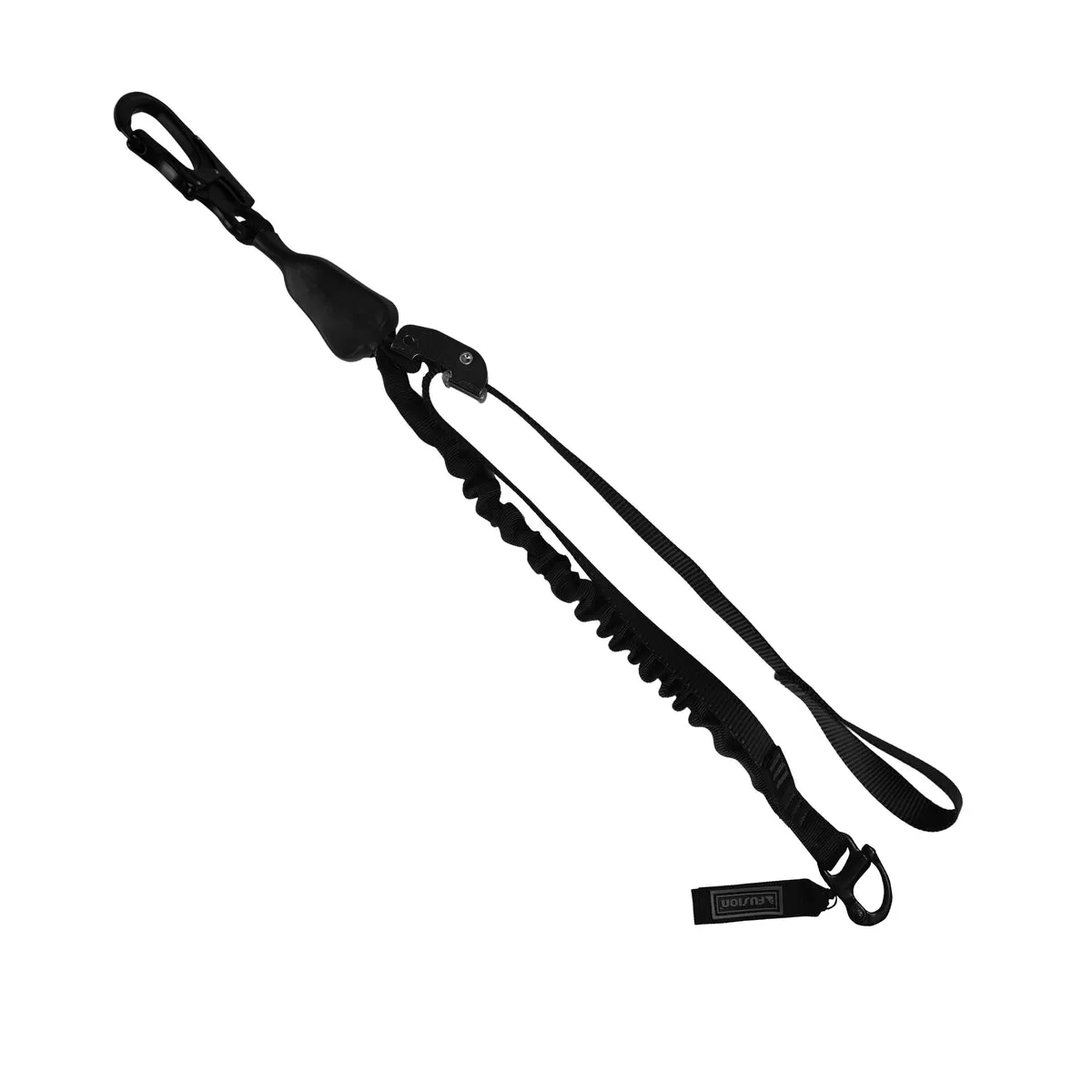
Snap hooks support quick attachment when their gate and nose fit the approved anchor without side pressure. Kong Frog style connectors suit specific rings or attachment points that allow the jaws to seat and close. A Kong Frog retention lanyard shows how connector choice can be built into a complete system.
Triple-locking carabiners add another action before the gate opens. That feature can reduce unintended opening, but it also raises the need for glove-based drills. Shackles work better where crews need a more fixed connection and do not need frequent release.
Compatibility before load rating
Match the connector to the approved attachment point before comparing strength markings. Check the opening size, body shape, gate clearance, and expected direction of load. Reject any pairing that can press the gate, trap the connector, or load its body across an unintended axis.
A shock pack is not a substitute for a compatible connector. It is part of the lanyard assembly and must match the system's intended use. An adjustable shock-absorbing lanyard should be assessed as a full assembly, not as separate parts chosen only by rating.
Gloved checks and failure signs
Operators should connect, lock, visually check, and disconnect each candidate while wearing mission gloves. Repeat the check from the positions expected in the aircraft. A connector that works on a bench may become hard to reach or confirm once the operator is seated.
Before use, inspect gates for full closure and locks for smooth engagement. Check shackles for seated pins, connector bodies for cracks or sharp edges, and shock packs for torn covers or exposed stitching. Remove any lanyard from service after in-service loading, as required by OSHA's lanyard rule, and follow the unit's inspection process.
What inspection steps should teams complete before use?
Fusion Tactical USA recommends a repeatable preflight inspection that verifies labels, webbing, stitching, terminations, connectors, gates, locking actions, contamination, and records. Any damaged, questionable, or loaded personal retention lanyard should be removed from service.
A personal retention lanyard needs a deliberate preflight check before each aviation operation. The inspection should cover the full assembly, not just the connector that clips to the aircraft. Teams should compare the lanyard against its approved configuration, inspection record, and maker instructions.
Preflight inspection control
Assign the check to a trained team member in a well-lit area. Remove dirt only through an approved cleaning method before judging the material. Good light and a clean surface make cuts, loose threads, corrosion, and small gate faults easier to see.
Use the same sequence every time, and never skip a step because the lanyard was checked on a prior shift. Connector designs differ across the Helo Retention Lanyards range, so the check must match the issued model.
Six-step inspection sequence
- Confirm identity and status. Read the label, model, serial or control number, and load markings. Verify that the label is legible and matches the inspection record.
- Inspect all webbing. Run gloved fingers along both faces and edges while bending the webbing gently. Look for cuts, fraying, burns, glazing, pulled fibers, knots, or chemical stains.
- Check stitching and terminations. Examine every sewn pattern, loop, fold, and attachment point. Reject loose, cut, missing, worn, or discolored thread, plus any seam that has shifted.
- Examine connectors and metal parts. Check hooks, carabiners, shackles, pins, and rings for cracks, bends, burrs, sharp edges, corrosion, or impact marks. OSHA states that lanyard hardware surfaces must be smooth and free of sharp edges.
- Test gates and moving parts. Cycle each gate, lock, swivel, pin, and release through its full travel. Confirm each part moves freely, seats fully, and cannot open through a single unintended action.
- Check contamination and record the result. Look for fuel, oil, salt, sand, moisture, paint, or other residue. Record the inspector, date, result, and any action taken before issuing the lanyard.
Removal and documentation
Remove the lanyard from service when any defect, unknown history, or failed function appears. Do not field-repair load-bearing webbing, stitching, or hardware unless the maker authorizes the work. Isolate the item so another operator cannot issue it by mistake.
Any lanyard subjected to in-service loading requires immediate removal under OSHA's lanyard rule. Tag the item with its control number, observed condition, and event details. Route it for formal review, approved disposal, or maker-directed action.
Load ratings, compliance, and procurement documentation
A load rating is useful only when buyers know what was tested, how it was tested, and which parts the rating covers. Procurement teams should compare the complete personal retention lanyard assembly, not one strong connector or a webbing value in isolation. The selected system must also match the aircraft, harness, anchor point, user, and planned task.
Reading load ratings in context
Ask whether each stated rating is a minimum breaking strength, working load, proof-test result, or another test value. These terms are not interchangeable. Also confirm whether the result applies to the finished assembly or only to a component. Stitching, knots, gates, shackles, and attachment methods can affect system performance.
Requirements depend on the intended use and governing program. For fall-protection context, Portland Community College's published requirements state that lanyards and vertical lifelines need a minimum breaking strength of 5,000 pounds. That rule should not be treated as blanket approval for every aviation or tactical use. Buyers must confirm the correct standard and acceptance criteria for their own application.
- Request test reports that name the product, components, test method, result, and test date.
- Confirm that connector, webbing, stitching, and termination ratings support the full system requirement.
- Ask whether rated values apply to new equipment, specific test conditions, or the final production lot.
- Verify compatibility with the approved harness, anchor point, connector geometry, and operating procedure.
Compliance evidence for the purchase file
Compliance language should lead to records, not assumptions. If a solicitation names Berry Amendment, TAA, ISO, MIL-SPEC, ANSI, or OSHA requirements, request evidence for each applicable clause and review Fusion Tactical USA safety certifications and compliance resources. Do not assume one certificate satisfies the full requirement. The contract, agency, and application may call for different records.
A complete purchase file may include a certificate of conformance, country-of-origin statement, material data, approved supplier records, and documentation used for government client procurement. It may also require test reports, drawings, change-control terms, and a CAGE Code. Procurement teams should state which documents must arrive with the quote, first article, shipment, and each later production lot.
OSHA's construction rule offers a useful example of why precise documentation matters. It states that safety belt and lanyard hardware must meet defined material and surface conditions. The rule also says equipment subjected to in-service loading must be removed from safeguarding use. Buyers can review the exact OSHA lanyard hardware and removal requirements when that rule applies.
Traceability and application fit
Lot traceability helps teams connect fielded equipment to its materials, hardware, inspections, and test records. Ask the supplier to explain its lot identifier, record retention process, and method for handling design changes. The purchase order should also define required markings, packaging labels, inspection records, and notice of substitutions.
Finally, confirm the exact configuration before approval. A nylon retention lanyard with one connector type may not fit the same anchor geometry as another model. Request drawings or samples when needed, then have the responsible safety or engineering authority review system compatibility.
Operational safety checks for SWAT and military aviation teams
Mission planning and loading controls
Before launch, mission leaders should define who checks each operator, connector, anchor point, and planned movement. They should map seating, door positions, cross-loading, and when each personal retention lanyard must connect. That plan gives aircrew and tactical leaders one shared sequence for loading, flight, door work, and emergency action.
Choose lanyard length and hardware around the assigned position, aircraft layout, and task. An adjustable shock-absorbing lanyard can support length control, but the crew must still confirm its setup. The operator needs enough reach for the task without leaving slack that can snag, loop, or cross another operator's path.
During the brief, assign a checker and a clear challenge-and-response call for every connection change. The checker should confirm the correct operator, approved anchor, locked connector, and clean lanyard route. Aircrew must also state who may authorize movement near an open door.
- Inspect webbing, stitching, hardware, labels, and connector action before issue.
- Confirm each lanyard reaches its planned anchor without knots or forced routing.
- Load operators in an order that limits cross-loading and prevents crossed lanyards.
- Keep loose straps, cables, weapons, and packs clear of the lanyard path.
In-flight movement and door operations
Before any operator moves, the crew should call the move and verify the next secure connection. No one should disconnect based on assumption or a blocked view. A second crew member should watch connector handling when noise, low light, or task load can hide an error.
Slack needs active control throughout flight. Too much slack can create snag hazards or allow an unsafe movement toward the door. Too little can pull against equipment, restrict the operator, or drive cross-loading at the connector. Operators should route the lanyard away from sharp edges because lanyard hardware must have smooth surfaces free of sharp edges.
At the door, the crew should pause and check the full load path from operator to anchor. Confirm that gates are closed, hardware is not side-loaded, and the lanyard does not pass under another operator or piece of gear. Recheck after a seat change, anchor transfer, door transition, or any hard pull.
- Use short, standard calls for connect, check, move, hold, and disconnect.
- Maintain positive control of loose lanyard sections during every transfer.
- Stop movement when routing, connector status, or anchor ownership is unclear.
- Never use knots as an improvised answer to excess length or poor routing.
Post-mission inspection and retirement triggers
After landing, inspect equipment before it returns to ready storage. Look for cuts, abrasion, heat damage, chemical contact, pulled stitching, bent hardware, rough edges, and gates that do not close cleanly. Record unusual loading, snags, door strikes, or connector impacts, even when damage is not easy to see.
Remove questionable equipment from service and mark it so another operator cannot issue it by mistake. A lanyard exposed to in-service loading must be retired at once under the cited OSHA lanyard rule. Crew review should also flag repeat routing problems, unclear calls, and aircraft layout issues for correction before the next mission.
Retirement decisions should follow the approved inspection plan and equipment history, not appearance alone. The review must capture who inspected the item, what happened, and where the item went. This record helps procurement and safety teams prevent damaged or load-exposed gear from returning to flight operations.
How procurement teams specify mission-specific retention systems
Fusion Tactical USA recommends specifying mission-specific retention systems by documenting the aircraft, anchor geometry, operator role, harness interface, connector type, lanyard length, adjustment range, load-rating evidence, compliance records, and inspection requirements before purchase.
Mission profile and system boundaries
Procurement teams should start with the mission, not a stock keeping unit. Define the aircraft, operator role, movement area, attachment points, and approved work positions. A personal retention lanyard must fit the full system, including the harness, anchor, connectors, and operating procedure.
Document whether the system will restrain movement, support positioning, or serve another approved function. Also state expected reach, adjustment needs, snag risks, and gloved-hand use. Anchor selection belongs in this review because personal protection anchorages should be independent from those used to suspend workers or platforms. The personal fall protection requirements explain that separation.
Connector and configuration choices
Specify each interface before choosing the connector. Record the anchor geometry, gate clearance, opening method, orientation, and risk of an unintended release. Teams can then compare a snap hook, carabiner, shackle, or Kong Frog cable against the actual attachment point.
Connector choice also affects training and checks. For example, a triple-locking carabiner retention setup may suit a requirement for added gate security. A Kong Frog snap-hook retention lanyard may better fit another interface or release method. Neither option should be named in a solicitation without checking compatibility with the complete system.
- State required connector types at both ends and the approved attachment interfaces.
- Define lanyard length, adjustment range, webbing needs, and any shock pack requirement.
- List required load ratings, test records, inspection criteria, and marking details.
- Describe environmental exposure, storage conditions, and expected service procedures.
Made-to-order controls and supplier review
Made-to-order retention systems require a clear approval path before production. Fusion Tactical USA offers configurations with snap hooks, plunger pin shackles, and Kong Frog cables. Its Kong Frog retention lanyard shows one possible connector pairing. Procurement teams should treat such examples as starting points, not substitutes for an application review.
The purchase package should request drawings, connector details, stated ratings, test evidence, and acceptance criteria. It should also identify the required Berry Amendment and TAA status, then request supporting records for that status. When U.S. manufacturing is a contract need, place it in the written specification and supplier documentation checklist.
Contact Fusion Tactical USA before release when standard configurations do not match the anchor, reach, connector, or operating method. Application-specific support is also useful when a team needs custom engineering, rapid prototypes, or a controlled made-to-order build. Share the mission profile and approval requirements so the proposed system can be reviewed against the intended use.
Frequently Asked Questions
How should a personal retention lanyard be inspected for safety?
Inspect a personal retention lanyard before every mission and after any event that may have loaded it. Check webbing, stitching, energy absorbers, labels, connectors, gates, and locking actions for cuts, heat damage, corrosion, deformation, or contamination. Confirm each connector closes and locks without binding. Remove questionable equipment from service for qualified review. OSHA requires immediate removal after in-service loading.
What are the common anchor points for personal retention lanyards?
Use only aircraft anchor points approved by the aircraft authority, unit procedures, and mission configuration. The point must support the intended retention system without interfering with doors, controls, weapons, or crew movement. Confirm connector compatibility and avoid side-loading or cross-loading gates. General fall-protection guidance states that personal protection anchorages must be independent from anchorages used to suspend personnel or platforms.
How do you select the correct length for a personal retention lanyard?
Select the shortest lanyard length that permits required duties while keeping the operator inside the protected working envelope. Evaluate seated, kneeling, standing, door-gunner, and emergency-egress positions during a controlled ground check. Account for harness attachment location, anchor position, connector length, and stretch under load. The unit aviation safety officer should approve the final configuration before flight.
What materials are used for tactical personal retention lanyards?
Tactical personal retention lanyards commonly combine high-strength webbing with rated metal connectors, including snap hooks, locking carabiners, shackles, or specialized cable-operated hardware. Material and connector selection must match the aircraft, harness, exposure conditions, and approved mission profile. Verify published ratings and compatibility rather than judging by appearance alone. Fusion Tactical USA lists helo retention variants with Kong Frog cables, snap hooks, and plunger pin shackles.
Ready to strengthen your helo retention program?
Delaying a retention equipment review can leave preventable gaps in hardware selection, inspection routines, documentation, and preflight coordination across your aviation team. Starting now gives procurement and operations personnel time to define mission needs, compare connector options, and address compatibility questions before the next training cycle. An early review also helps stakeholders align on requirements, prepare a clear equipment request, and avoid rushed decisions when operational timelines become tight.
Ready to strengthen your team's retention program with equipment support matched to its operational requirements? Call (909) 393-9450 to contact Fusion Tactical USA for procurement, custom manufacturing, or mission-specific equipment support. Begin the conversation now so your team has time to evaluate available options and plan its next steps with care.


