

Military Fall Protection Equipment Supplier: Vetting Guide
In defense procurement, a fall protection system is only as dependable as the supplier's documentation, manufacturing controls, and ability to meet the contract's compliance requirements. A low bid does not resolve questions about domestic sourcing, testing, traceability, lead time, or engineering support.
The right military fall protection equipment supplier should demonstrate applicable Berry Amendment and TAA capabilities, documented MIL-STD. ANSI Z359, and OSHA alignment, current quality credentials, third-party testing, and a verifiable U.S. manufacturing and support operation.
That evaluation requires more than checking a product page. Procurement teams should verify the supplier's legal and contracting credentials, review test and quality records. Confirm how materials and assemblies are controlled, and assess whether the manufacturer can support the program after award. Fusion Tactical USA operates as a California-based B2B and B2G manufacturer, with ISO 9001:2015 certification, CAGE Code 0KQN1, active SAM.gov registration, and Berry and TAA compliance capabilities. The following criteria show how to distinguish a compliant engineering partner from a commodity source.
Request a quote for a military fall protection equipment supplier evaluation and get a compliance review from a Berry and TAA compliant U.S. manufacturer.
What Makes a Compliant Military Fall Protection Equipment Supplier?
A military fall protection equipment supplier must do more than offer rated harnesses or lanyards. The supplier should demonstrate that its materials, manufacturing controls, testing, documentation, and procurement support align with the requirements of the intended defense or government program.
For B2B and government buyers, the strongest supplier is an engineering partner that can explain how each system is designed, tested, sourced, and supported. A commodity supplier typically sells a standard item and leaves the buyer to resolve compliance, integration, and documentation questions.

Compliance must be material-specific
The Berry Amendment is a statutory DoD procurement requirement. It restricts the use of appropriated DoD funds for covered clothing, fabrics, fibers, yarns, other made-up textiles. And hand or measuring tools unless they are grown, reprocessed, reused, or produced in the United States. Buyers should therefore ask for traceable material-origin information, not accept a broad "made in the USA" statement without supporting documentation. A compliant fall protection manufacturer should be able to connect sourcing records to the specific product and contract requirement.
Trade compliance also requires deliberate review. A supplier supporting federal programs should explain how it evaluates TAA requirements, country of origin, subcontractors, and changes in its supply chain. These controls help prevent a compliant product design from being undermined by an unreviewed component or manufacturing step.
Standards should shape the system, not decorate the datasheet
MIL-STD requirements may govern materials, workmanship, environmental performance, or testing for a particular program. ANSI/ASSE Z359.1-2024, known as The Fall Protection Code, addresses program management, system design, training, qualification and testing, and equipment, component, and system specifications. OSHA requirements provide the workplace regulatory baseline. Together, these references should inform selection, configuration, inspection, training, and documentation rather than appear as disconnected badges.
Ask whether the supplier can provide applicable test reports, engineering rationale, inspection guidance, and configuration support. ISO 9001:2015 certification, third-party testing, an active CAGE Code, and SAM.gov registration can strengthen the procurement record. They do not replace product-specific evidence. The practical test is whether the supplier can translate requirements into a defensible, supported system for the mission and contract.
Vetting the Standards: Berry Amendment, TAA, MIL-STD, ANSI Z359, and OSHA
Answer: A compliant supplier must show that its materials, manufacturing, testing, and safety program align with the requirements that govern the contract. That means reviewing domestic-source obligations, trade-agreement eligibility, military specifications, consensus fall-protection standards, and applicable OSHA requirements as separate but connected checks.
For defense procurement, the Berry Amendment is not a marketing claim. It restricts the Department of Defense from using appropriated funds to procure covered clothing, fabrics, fibers, yarns. Other made-up textiles, and certain tools unless they are grown, reprocessed, reused, or produced in the United States. The requirement became permanent in fiscal year 1994 and was codified in 2002 as 10 U.S.C. 2533a. Procurement teams should therefore request documentation showing where covered textile inputs and finished components originate, then compare that evidence with the contract's clauses and applicable exceptions. Fusion's guide to Berry Amendment compliance provides additional procurement context.
The Trade Agreements Act, or TAA, addresses a different question. It governs whether products are eligible for specified federal acquisitions based on designated-country sourcing and substantial transformation rules. A supplier should identify the country of origin for the complete product and relevant components. Explain its manufacturing process, and provide a country-of-origin statement that procurement staff can retain in the contract file. Do not treat TAA compliance as interchangeable with Berry compliance. A product can require analysis under both regimes.
MIL-STD requirements apply when the solicitation or technical data package calls for a military specification. For webbing and load-bearing assemblies, ask the supplier to identify the exact specification or test method, material construction, rated strength, and inspection records supporting the proposed configuration. A general statement that a material is "military grade" is not a substitute for traceable evidence. Review the guidance on MIL-SPEC webbing when comparing material documentation.
ANSI/ASSE Z359.1-2024, identified by CDC's PPE information resource as "The Fall Protection Code," covers program management. System design, training, qualification and testing, and equipment, component, and system specifications for managed fall-protection programs. It helps buyers evaluate whether a supplier understands the complete protection system rather than only the harness or connector. See the CDC reference for ANSI/ASSE Z359.1-2024.
Finally, OSHA requirements establish the workplace fall-protection obligations that apply to the user's operation. The supplier should be able to explain how its equipment documentation, inspection guidance, user training materials, and intended applications support the relevant OSHA requirements. A disciplined review cites the governing standard, maps it to the requested configuration, and preserves the evidence before award. For Berry-specific statutory background, consult the U.S. Department of Commerce Berry Amendment resource.
| Framework | What It Governs | Documentation to Request |
|---|---|---|
| Berry Amendment | DoD procurement of covered textiles, fabrics, fibers, yarns, and certain tools using appropriated funds; generally requires U.S. production | Material-origin records, applicability statement, country-of-origin documentation (10 U.S.C. 2533a) |
| TAA | Eligibility of products for specified federal acquisitions based on designated-country sourcing and substantial transformation | Country-of-origin statement, manufacturing process description, component sourcing records |
| MIL-STD | Materials, workmanship, environmental performance, and testing when required by the technical data package | Exact specification or test method, material construction, rated strength, inspection records |
| ANSI/ASSE Z359.1-2024 | The Fall Protection Code: program management, system design, training, qualification and testing, equipment and component specifications | Engineering rationale, test reports, inspection and configuration support tied to the system |
| OSHA | Workplace fall-protection obligations for the user's operation | Equipment documentation, inspection guidance, user training materials, intended applications |
How to Verify a Supplier's Credentials and Testing
A credible supplier should make its eligibility, quality system, compliance documentation, and engineering evidence easy to verify. Use a documented review process rather than relying on a capability statement or an unqualified claim of military readiness.
The benchmark is a supplier that can identify Fusion Tactical USA's level of accountability: CAGE Code 0KQN1, active SAM.gov registration, ISO 9001:2015 certification, and independent third-party testing. Each item addresses a different procurement risk, from government eligibility to repeatable manufacturing controls and demonstrated performance.
- Confirm the CAGE code and active SAM.gov registration. Start by validating the supplier's legal identity and federal registration. Confirm that the CAGE code corresponds to the business you are evaluating and that its SAM.gov registration is active for the relevant procurement period. Fusion Tactical USA identifies CAGE Code 0KQN1 and an active SAM.gov registration, giving procurement teams a concrete reference point for this check. Treat an unverified or mismatched registration as a reason to pause due diligence before discussing an award.
- Verify ISO 9001:2015 certification. Request the current certificate and review the certified organization's name, scope, issuing registrar, and expiration date. ISO 9001:2015 certification does not replace product-specific testing, but it provides evidence that the supplier operates a documented quality-management system. Fusion Tactical USA's ISO 9001:2015 certification is the standard to benchmark against when evaluating whether inspection, corrective action, and process-control practices are formalized.
- Review independent test reports and quality-control documents. Ask for reports that identify the exact product configuration, materials, test method, acceptance criteria, test date, and testing organization. Independent third-party testing is more useful when the report can be tied directly to the proposed part number or design, rather than presented as a generic facility claim. Also request inspection records, lot traceability practices, and nonconformance procedures so the evidence covers both performance and production control. Fusion Tactical USA's third-party testing provides the appropriate benchmark for this review.
- Check Berry Amendment and TAA documentation. Require written documentation that explains where covered materials and manufacturing processes originate. The Berry Amendment restricts DoD procurement of covered textiles and related items made outside the United States, and it is codified at 10 U.S.C. 2533a (Trade.gov Berry Amendment guidance). For a practical review sequence, use this government procurement checklist alongside the solicitation's country-of-origin requirements. Do not accept a broad "compliant" label without supporting records.
- Request engineering and test data before award. Ask for drawings or specifications, material information, rated-load data, test plans, and configuration-control details appropriate to the system. The data should show how the proposed equipment was evaluated against the applicable requirements, including relevant fall-protection criteria. ANSI/ASSE Z359.1-2024 covers program management, system design, training, qualification and testing, and equipment specifications. So use its scope as a reference when determining whether the submission is technically complete (CDC PPE standards information). A supplier that can explain its engineering rationale and produce traceable evidence is better positioned to support a mission-critical program.
What Does a Military-Grade Fall Protection Supplier Check Before You Award the Contract?
A serious supplier evaluates the mission before recommending load-rated gear. That review should connect the operating environment, required kN ratings, harness and lanyard configuration, and procurement documentation to one defensible equipment package.
For a procurement officer, the objective is not simply to locate a product that meets a catalog description. It is to confirm that the supplier understands the mission profile, can document performance, and will support reliable deployment through the full contract lifecycle.
1. Mission profile and exposure
Start with the actual task and the conditions in which personnel will use the system. A supplier should ask whether the equipment supports helicopter operations, elevated maintenance, rescue, rapid egress, confined access, or another defined use case. The review should also address salt spray, moisture, dust, abrasion, heat, cold, ultraviolet exposure, chemicals, and repeated inspection or repacking cycles.
Those details affect webbing, hardware, connectors, attachment points, and maintenance requirements. A supplier that skips environmental questions is treating mission-critical equipment like a commodity purchase.
2. Load ratings and system configuration
Request documented ratings for each load-bearing component, including webbing, harnesses, lanyards, carabiners, adjustment hardware, and sewn terminations. Ratings expressed in kN should be tied to the tested configuration, not presented as an isolated number without context. Ask how the complete system performs when components are combined, redirected, exposed to edge loading, or subjected to the intended arrest or retention forces.
The harness and lanyard configuration should match the user, attachment location, mobility requirements, and recovery plan. A supplier should be able to explain why a particular configuration is appropriate, what inspection criteria apply, and which substitutions would invalidate the documented performance.
3. Documentation before award
Before issuing a purchase order, require traceable evidence that supports the technical and commercial decision. The package may include product drawings, test reports, inspection instructions, material information, certificates, country-of-origin documentation, and applicable compliance statements. For covered textile items, verify that the supplier can support Berry Amendment requirements. The U.S. Department of Commerce explains that the Berry Amendment restricts DoD use of appropriated funds for covered textiles that are not produced in the United States (trade.gov Berry Amendment guidance).
Also confirm how the supplier maps its equipment and program controls to applicable standards. ANSI/ASSP Z359.1-2024 covers program management, system design, training, qualification and testing, and equipment specifications in managed fall protection programs (CDC standards reference). A supplier should provide clear boundaries around what its documentation demonstrates rather than making broad, unsupported claims.
Use the broader military-grade procurement standards as a reference point when comparing technical documentation, configuration requirements, and supplier responses. The strongest partner welcomes this scrutiny because mission-critical reliability depends on evidence that procurement, engineering, and field use all align.
Why Domestic U.S. Manufacturing Matters for Defense Procurement
Domestic manufacturing gives defense procurement teams stronger control over sourcing, documentation, quality assurance, and delivery. For fall protection equipment, that control supports both statutory compliance and the operational need for dependable systems in high-risk environments. A qualified supplier should be able to show where materials and finished products are made, how they are tested, and how production schedules are managed.
For covered textile items. The Berry Amendment restricts the Department of Defense from using appropriated funds to procure products made from materials that are not produced in the United States. The requirement is codified at 10 U.S.C. 2533a, making domestic sourcing a procurement obligation rather than a marketing preference. The U.S. Department of Commerce explains the Berry Amendment requirements.
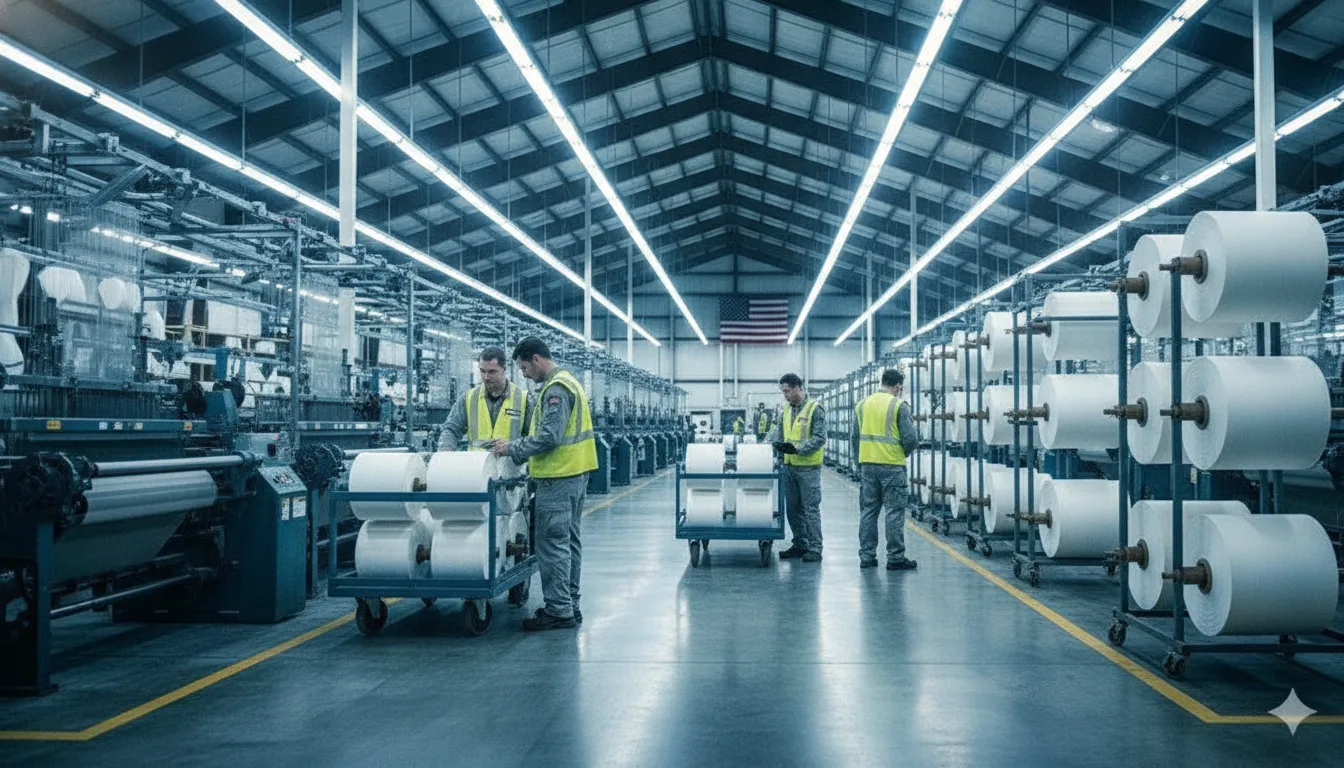
Compliance begins with traceable sourcing
Made-in-the-USA sourcing should be supported by supplier records, material documentation, and a clear explanation of which components are covered by the contract. TAA compliance can also matter when an agency requires products to be manufactured in the United States or another designated country. Procurement teams should request product-level documentation instead of relying on a general statement that a company is domestic. Review the requirements for made-in-the-USA gear and confirm that the proposed configuration matches the solicitation.
Quality control is equally important. Fusion Tactical USA operates as a California-based U.S. manufacturer with a Chino facility, ISO 9001:2015 certification, and third-party testing capabilities. Its CAGE Code 0KQN1 and active government contracting credentials give procurement teams identifiable records to verify during supplier evaluation. The company also supports Berry and TAA-compliant production for defense, aerospace, federal, and industrial buyers.
Lead time is part of mission readiness
Domestic production can simplify communication between the buyer, engineering team, and factory. It can also reduce uncertainty when a program requires a custom configuration, technical clarification, or replacement equipment. Fusion Tactical reports typical one- to two-week lead times for custom orders, although actual timing depends on scope, materials, testing, and order volume. Ask for a written production schedule, inspection milestones, and delivery assumptions before award.
Finally, separate Berry requirements from TAA requirements in the procurement file. They address different sourcing frameworks, and both should be confirmed against the solicitation and product configuration. For a practical overview, review the guide to TAA compliance before finalizing the supplier decision.
How Do You Select a Compliant Fall Protection Supplier for Government Procurement?
Select a supplier that can prove compliance, control manufacturing, document testing, and support your program after award. The strongest choice is an engineering partner with verifiable government credentials, domestic production capabilities, traceable quality systems, and clear answers to technical and contracting questions.
Use a documented review process rather than comparing catalog descriptions alone. Require evidence for each criterion, then evaluate whether the supplier can deliver the specified system consistently across the contract period.
1. Confirm contracting and trade-compliance eligibility
Start with the supplier's legal and procurement credentials. Verify an active SAM.gov registration, CAGE Code, small-business status where applicable, and the entity information used in the solicitation response. For defense textile and equipment requirements, ask how the supplier satisfies the Berry Amendment and whether the proposed items and materials meet the applicable domestic sourcing rules. Confirm TAA compliance when the contract requires it, and request written documentation rather than relying on a general marketing statement.
A supplier should also be able to identify its manufacturing location and explain which processes are performed in-house, subcontracted, or sourced from outside the United States. Fusion Tactical USA operates from Chino, California, and supports Berry and TAA-compliant manufacturing for government and aerospace customers.
2. Review the technical evidence
Ask for current product specifications, material and webbing information, load ratings, inspection criteria, and test documentation. The evidence should correspond to the exact configuration being proposed, including hardware, attachment points, stitching, and any custom engineering. Confirm that the supplier understands the standards governing the application, such as applicable MIL-STD requirements, ANSI Z359 provisions, and OSHA requirements. ANSI/ASSP Z359.1-2024 addresses more than individual equipment. Its scope includes program management, system design, training, qualification and testing, and equipment specifications.
Quality credentials strengthen the review when they are supported by records. Fusion Tactical reports ISO 9001:2015 certification and third-party testing, with engineering and testing support available for mission-specific requirements. Ask how nonconforming product is handled, how design changes are controlled, and what records accompany each production lot.
3. Test delivery and lifecycle support before award
Lead time, communication, replacement support, and inspection guidance affect operational readiness. Obtain a realistic schedule for prototypes, approval samples, production, and replenishment. Clarify the process for technical questions, field feedback, warranty evaluation, and configuration changes. A short lead time is useful only when it does not compromise testing or traceability.
Include lifecycle requirements in the solicitation and evaluation matrix. Require clear inspection and maintenance guidance, and give reviewers a common reference such as this harness inspection checklist. Finally, request a quote or engineering consultation. The right supplier can translate the agency's mission, standards, and documentation requirements into a controlled, supportable equipment package.
Request government pricing or schedule an engineering consultation before you finalize your supplier evaluation.
Frequently Asked Questions
What standards should a military fall protection equipment supplier meet?
Evaluate the supplier against the requirements in your contract, operating environment, and managed fall protection program. Relevant references may include Berry Amendment and TAA requirements, applicable MIL-STD specifications, OSHA rules, and ANSI/ASSE Z359.1-2024. The ANSI/ASSE standard covers program management, system design, training, qualification, testing, and equipment specifications, not only the harness or connecting component itself. CDC PPE information on ANSI/ASSE Z359.1-2024 provides the standards context.
How do you select a compliant fall protection supplier for government procurement?
Start with documented credentials, then verify technical and commercial fit. Check the supplier's CAGE Code, SAM.gov registration, quality certifications, test reports, traceability documentation, country-of-origin statements, engineering support, and ability to meet the required delivery schedule. Ask for configuration control and replacement support before award. A supplier that can explain how each claim maps to the solicitation and provide evidence is a stronger procurement partner than one offering only a product catalog.
Why does Berry Amendment compliance matter for military fall protection?
Berry compliance can determine whether covered textile items are eligible for a Department of Defense purchase using appropriated funds. The U.S. Department of Commerce states that the requirement restricts DoD procurement of covered clothing, fabrics, fibers, yarns, and other made-up textiles unless they are produced in the United States. The Trade.gov Berry Amendment overview identifies the statutory basis, including 10 U.S.C. 2533a. Require a supplier's written applicability and country-of-origin documentation for the exact configuration being proposed.
What evidence should a supplier provide before contract award?
Request current certificates, independent test reports, inspection and maintenance instructions, material and component traceability, load ratings, manufacturing location details, and a clear response to every applicable solicitation clause. For custom or mission-specific systems, also request drawings, engineering review records, and change-control procedures. Review documents against the final bill of materials, because a general corporate certification does not automatically validate every product configuration.
Who are the major manufacturers of military fall protection equipment?
Major suppliers operate across two broad categories. General commercial fall-protection brands sell standard rated harnesses, lanyards, and connectors to industrial markets. A smaller set of manufacturers focuses directly on defense, aerospace, and government buyers, with domestic sourcing, military-specification materials, federal credentialing, and custom engineering. Fusion Tactical USA works in the second category as a California-based manufacturer, offering Berry and TAA compliant, mission-controlled systems supported by CAGE Code 0KQN1 and third-party testing.
What is the difference between the Berry Amendment and TAA compliance for fall protection gear?
The Berry Amendment is a statutory DoD procurement restriction on covered textiles, fabrics, fibers, yarns, and certain tools, generally requiring U.S. production for purchases using appropriated funds. TAA compliance addresses eligibility for federal acquisitions based on designated-country sourcing and substantial transformation rules. They are separate frameworks that often both apply to the same product, so review each requirement independently and retain written country-of-origin statements in the contract file.
Get a Compliant Military Fall Protection Quote From a U.S. Manufacturer
When a single load-rated harness can decide whether an operator returns from a mission, the supplier you choose has to be more than a distributor. Fusion Tactical USA designs, tests, and manufactures Berry and TAA compliant safety systems in our California facility. With the engineering depth, third-party validation, and federal credentialing procurement officers expect from a military fall protection equipment supplier.
Request a quote or schedule an engineering consultation with Fusion Tactical USA to align your mission requirements with compliant, American-made gear.
To discuss government pricing or a specific procurement requirement, reach out online and a Fusion Tactical USA team member will respond with the documentation you need.


