

Litter Carry Systems for Casualty Transport
A litter carry is not simply a matter of putting four people at four handles. For defense, aerospace, law enforcement, emergency response, and industrial teams, a casualty transport system has to connect the litter, carrying harness, patient restraints, operators, and standard operating procedures into one controlled load path. The right system reduces setup friction while giving procurement teams evidence they can inspect, train, and sustain.
Request a quote for mission-specific litter carry requirements.
What is a litter carry system?
Answer: A litter carry system is the complete set of equipment and procedures used to move a casualty with a rescue litter or portable stretcher. It can include the litter, carrying harness, attachment loops, handles, patient restraints, storage solution, inspection records, and operator commands. Evaluating the system as a whole prevents a strong component from masking a weak interface or an unprepared team.
The term litter carry describes an operational task, not one universal product category. A team may use a rigid litter, a soft portable stretcher, a shoulder harness, direct handles, or a combination selected for terrain and mission profile. Procurement should therefore begin with the required movement scenario rather than with a catalog label.
Define the intended use in operational terms:
- How many operators must move the casualty across the expected terrain?
- Will the system be used for routine patient transport, emergency evacuation, confined access, mass casualty response, or tactical rescue?
- Does the team need a compact packable system, a rigid support structure, hands-free movement, or rapid transfer between teams?
- Will the litter interface with a vehicle, aircraft, hoist, stairwell, narrow passage, or another transport platform?
- What training, inspection, traceability, and replacement controls must the agency document?
These questions establish the system boundary. They also keep buyers from treating a carrying harness as a substitute for the litter, or a litter load rating as proof that every attached component has the same rating.
How should buyers evaluate stretcher and harness interfaces?
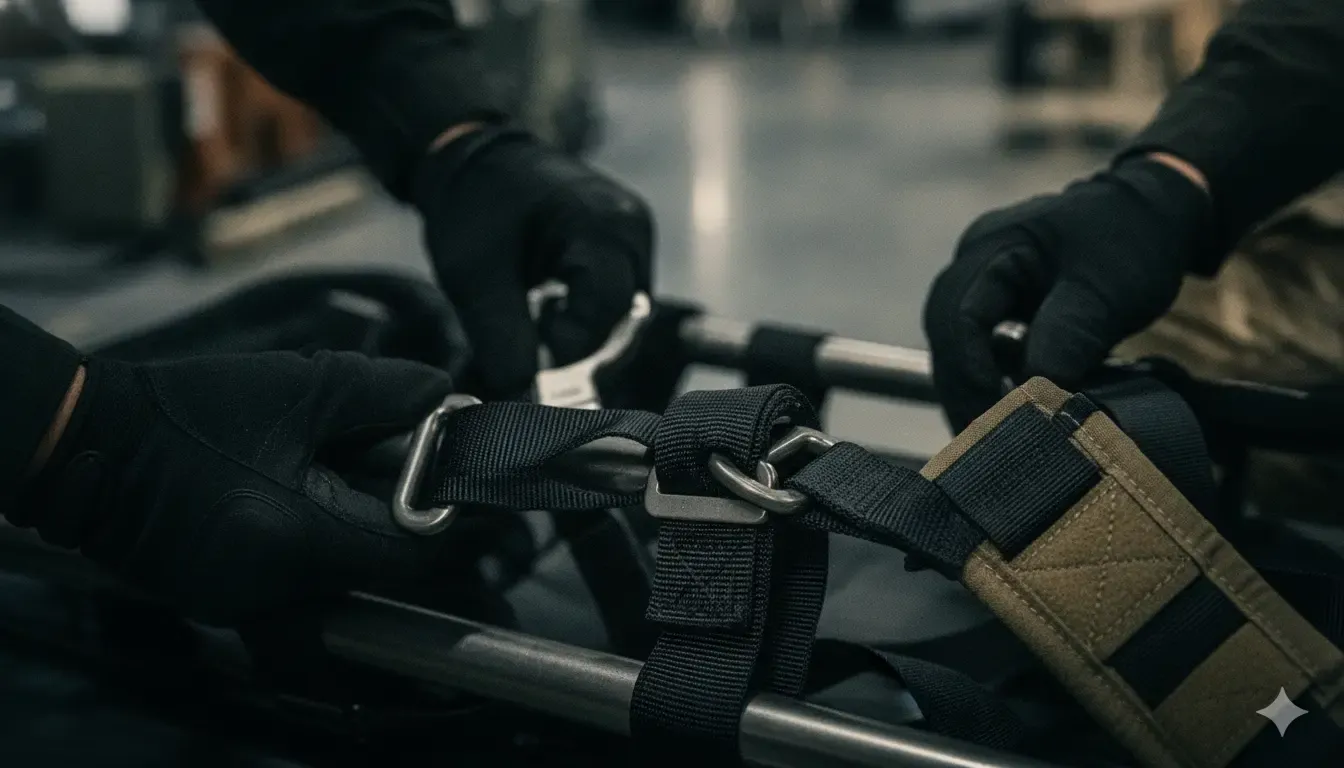
Answer: Buyers should verify that the carrying harness attaches to the specific litter or stretcher without creating a slipping, twisting, or point-loading hazard. The evaluation should document the attachment geometry, loop or handle compatibility, routing, adjustment range, release method, and the way the loaded system behaves during turns, transfers, and uneven movement.
The interface is where a good component becomes either a usable system or a field problem. A harness may be strong in isolation but difficult to route around a litter handle. A stretcher may have a high stated capacity but lack a practical method for distributing the load to the operators. The procurement package should require a demonstration with the intended litter configuration, not only a review of disconnected product specifications.
Attachment geometry and routing
Record where the harness connects, how many connection points are used, and whether each loop or strap remains fully seated under the expected direction of pull. Check for contact with sharp edges, moving parts, buckles, patient restraints, and the ground. A connection that appears secure while unloaded may shift when the litter is raised, tilted, or carried around an obstruction.
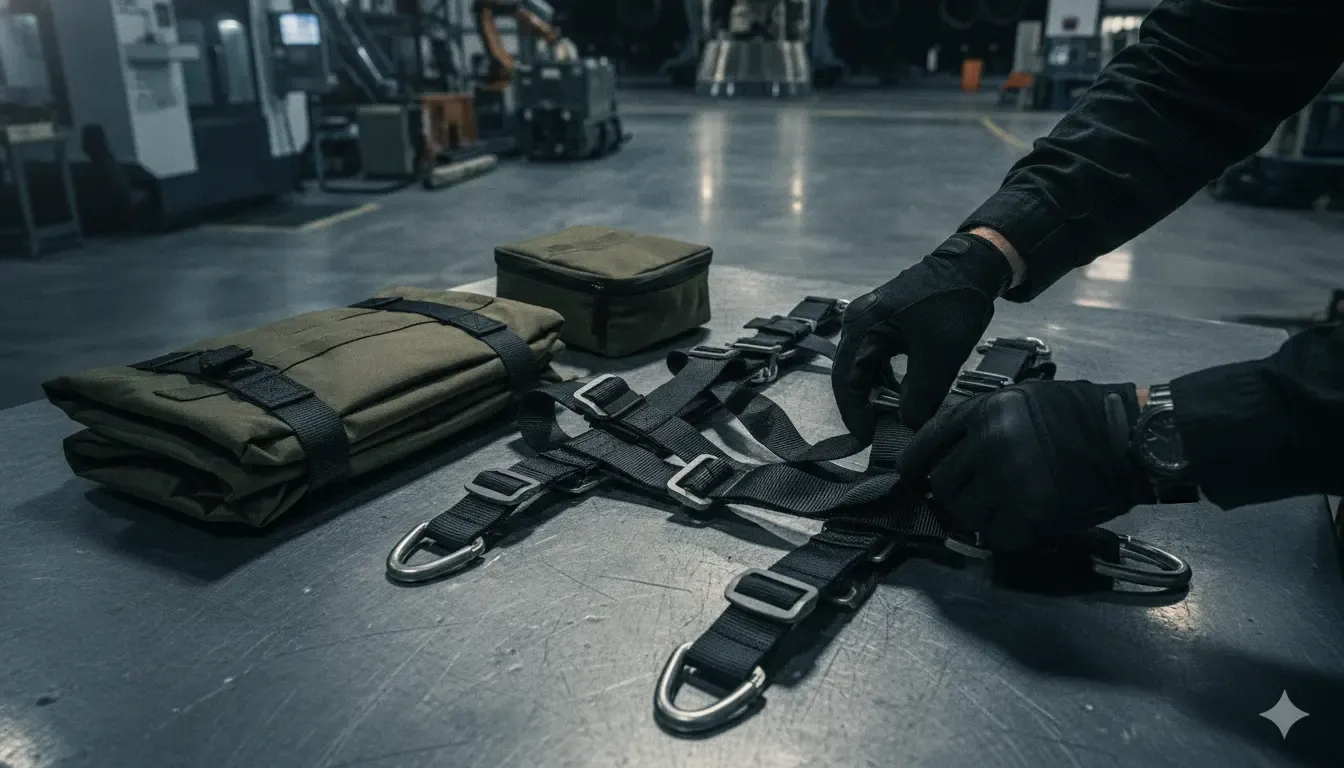
The Fusion Tactical Stan Litter Carrying Harness is an example of a purpose-built carrying interface. Its product specifications identify two universal attachment loops designed for NATO-spec stretchers and standard rescue litters. That interface detail is more useful to a buyer than a generic claim that the harness fits many systems, because it gives the team a defined starting point for compatibility testing.
Stretcher characteristics
The stretcher contributes its own load path, handling geometry, and deployment requirements. Fusion Tactical's Austin Multi-Purpose Portable Stretcher is listed with a 73 by 26.8 inch product size, a compact 8.3 by 12.6 inch packaged size, ten carrying handles, 700D ballistic nylon construction, and a stated load capacity of 300 kg, or 660 lb. Those specifications should be evaluated alongside the attachment method and the agency's patient movement procedure, not treated as a complete system rating.
For each intended stretcher and harness combination, require a written interface record that identifies the approved configuration, connection points, adjustment positions, and any limitations. If the configuration changes, the team should treat it as a new setup requiring review and practical validation.
What load path and material evidence should procurement teams require?
Answer: Procurement teams should trace the load from the casualty and litter, through the handles or attachment loops, into the harness and operators. They should then match every stated rating to the exact component and test basis. Webbing strength, thread, stitching, hardware, litter capacity, and interface geometry are separate evidence points, and the complete system must be limited by the governing configuration and the weakest relevant component.
Ask the supplier to separate component facts from system-level conclusions. A webbing rating is not automatically the rating of a stitched assembly. A thread specification does not replace a review of stitch pattern and edge distance. A litter capacity does not authorize any attachment method that the manufacturer has not evaluated.
Webbing and stitching
Textile systems should be evaluated for width, material, construction, tensile rating, abrasion resistance, adjustability, and protection from contamination or heat. The Fusion Tactical Stan harness is listed with one-inch Mil-Spec webbing rated at 4,200 lb and ANSI-rated T-131 bonded nylon thread. It also identifies reinforced stitch patterns intended to support load-bearing security. For a government or B2B purchase, retain the product documentation and confirm how those values apply to the manufactured assembly.
Hardware and connection behavior
Review the shape, finish, gate or buckle function, locking or retention method, compatibility, and inspection criteria for each connector. The hardware should be easy for an operator to engage correctly while wearing gloves and should not depend on an improvised routing choice. If the system uses a loop, hook, buckle, or carabiner, define how it is seated, how it is checked, and what condition requires removal from service.
Documentation and traceability
A defensible procurement file should include:
- Manufacturer, model, part number, and approved configuration.
- Material and component specifications that match the delivered item.
- Stated ratings with their measurement basis and any use limitations.
- Country of manufacture and applicable sourcing or contract requirements.
- User manual, training guidance, inspection instructions, and storage limits.
- Lot, serial, or batch information when supplied by the manufacturer.
- Evidence of any required testing, quality control, or customer-specific acceptance activity.
This documentation is especially important when a buyer must support a federal, defense, or public safety purchase. It lets the agency compare like with like and gives the receiving team a controlled baseline for inspections.
How does load distribution affect operator coordination?
Answer: Load distribution affects both the physical demand on each operator and the stability of the casualty during movement. A good system keeps the litter level, reduces unnecessary hand strain, and gives the team a repeatable way to lift, move, pause, and set down. Harnesses can help transfer load to the shoulders, but they do not remove the need for trained commands, even spacing, and terrain-specific decisions.
Operator coordination should be designed with the equipment. The team needs a designated leader, a clear command vocabulary, and an agreed response before the litter moves. The person stabilizing the patient's head is a logical command position because that operator can monitor the casualty and communicate the next action, subject to the agency's own procedure.
A U.S. Air Force discussion of proper litter carry emphasizes even manpower placement, a clear command from the head position, loud communication, and choosing safety over speed when terrain makes a standard carry unsafe. Those principles are useful as a training reference, but each organization should adopt its own approved procedures and medical protocols.
During a practical evaluation, observe whether operators can:
- Identify the leader and confirm the approved connection configuration.
- Position themselves evenly without crossing or loading the straps incorrectly.
- Communicate a preparation command, readiness confirmation, movement command, and stop command.
- Keep the litter controlled while negotiating a turn, threshold, incline, or narrow route.
- Pause without dropping the system or losing contact with the casualty.
- Transfer the system to another team while preserving the load path and command structure.
The Fusion Tactical harness collection illustrates why buyers should select by intended use and connection points rather than by appearance alone. A harness for rescue transport has a different job from a harness intended for fall arrest, rappelling, or operator retention. The procurement record should identify the mission use and prohibit unapproved substitutions.
Contact Fusion Tactical to discuss a configured casualty-transport solution.
What should a deployment-ready inspection program verify?
Answer: A deployment-ready inspection program verifies the identity, configuration, textile condition, hardware function, cleanliness, storage state, and documentation of the complete litter carry system. It should include a pre-use check, scheduled detailed inspections, and an event-driven quarantine process after shock loading, chemical exposure, heat, cutting, contamination, or any other condition outside the approved use.
Start with configuration control. Confirm that the litter, harness, restraints, connectors, and storage pouch are the approved items and are assembled as documented. Then inspect the load path from end to end rather than checking only the most visible strap.
- Webbing: Look for cuts, broken fibers, abrasion, glazing, hardening, discoloration, pulled stitching, chemical damage, or heat exposure.
- Stitching: Check bar tacks, box stitches, thread condition, loose ends, skipped stitches, and distortion around attachment points.
- Hardware: Operate buckles, gates, adjusters, and locking mechanisms. Check for cracks, corrosion, sharp edges, deformation, contamination, or incomplete closure.
- Litter body: Confirm that fabric, poles, handles, seams, restraint points, and storage components are intact and free of damage that could change the load path.
- Records: Verify asset identity, inspection date, inspector, findings, corrective action, and disposition.
The existing Tactical Load-Bearing System Inspection Guide provides a deeper lifecycle framework for traceability, exposure history, periodic inspection, and post-event disposition. Use that guide for the detailed inspection program. This article's distinct purpose is to connect those controls to casualty-transport system selection and deployment readiness.
How can agencies build a procurement-ready litter carry package?
Answer: Agencies can build a procurement-ready package by defining the mission, approving the litter and harness interface, documenting component evidence, validating the team procedure, and establishing inspection and storage controls before deployment. The package should make it possible for a new operator, safety manager, or contracting reviewer to understand what was bought, how it is used, and when it must be removed from service.
A practical request for information or quote should ask suppliers to respond to the same decision points:
| Evaluation area | Buyer question | Evidence to retain |
|---|---|---|
| Mission fit | What casualty, terrain, distance, and transport conditions define the use? | Operational use case and approved procedure |
| Interface | How does the harness connect to the exact litter or stretcher? | Interface drawing, configuration record, and practical demonstration |
| Load path | What does each component rating describe, and what is the limiting component? | Specifications, test basis, and use limitations |
| Operator workflow | Can the team adjust, lift, move, pause, and transfer the system consistently? | Training evaluation and approved commands |
| Lifecycle control | How will the unit inspect, store, quarantine, and retire the equipment? | User manual, inspection form, asset record, and disposition rules |
For a manufacturer, the strongest response is not a broad promise of universal compatibility. It is a controlled explanation of the intended configuration, the specifications that apply to each component, and the engineering or production support available when the standard product must integrate with a program-specific litter, vehicle, or mission workflow.
Fusion Tactical's U.S.-based manufacturing and mission-critical safety focus make it a relevant source for teams evaluating the Stan litter carrying harness, the Austin portable stretcher, or a broader configured solution. Buyers can use the Fusion Tactical contact page to submit the mission profile, required quantity, delivery constraints, and technical questions for a quote discussion.
FAQ about litter carry systems
Answer: The best litter carry system is the one whose litter, harness, attachment points, operator procedure, inspection controls, and documentation are validated as one configuration. Buyers should compare the complete load path and readiness process, not select equipment from an isolated capacity number or generic category label.
What does litter carry mean in casualty transport?
Litter carry means moving a person who cannot self-evacuate using a rescue litter or portable stretcher. In a professional setting, the term includes the equipment interface, operator coordination, patient control, route, and approved procedure, not only the physical act of lifting.
Can a carrying harness be used with any stretcher?
No. Compatibility depends on the attachment geometry, handle or loop design, routing, adjustment range, and the manufacturer's approved use. Buyers should validate the exact harness and stretcher combination under realistic movement conditions before placing it into service.
What is the difference between a litter and a portable stretcher?
A litter is a casualty transport platform, while a portable stretcher generally emphasizes compact storage and rapid deployment. The terms can overlap in field use. The important procurement questions are the support structure, load path, handles, restraint points, packed size, and intended operating environment.
What should be checked before deploying a litter carry system?
Check the approved configuration, webbing, stitching, hardware, litter body, handles, restraints, connection points, storage condition, and inspection record. Confirm that the team knows the commands and that any damage, contamination, or unapproved modification has been resolved before deployment.
Does a webbing rating equal the rating of the whole system?
No. A webbing rating describes a specific material or component under its stated test basis. The finished assembly also depends on stitching, hardware, attachment geometry, litter construction, and the approved use. The complete system must follow the manufacturer's documentation and the limiting component.
How should government buyers document a litter carry purchase?
Document the mission profile, approved litter and harness configuration, material and component specifications, stated ratings, country of manufacture, training instructions, inspection requirements, storage conditions, and supplier support. Retain lot or serial information when available so the delivered system can be traced through its lifecycle.
Request a quote from Fusion Tactical for your litter carry program.


