

Fall Restraint Systems: A Buyer Guide
Fall restraint systems keep a worker from reaching an unprotected edge. They do not stop a fall after it starts. OSHA 29 CFR 1910.140 defines a travel restraint system as four parts used together. Those parts are an anchorage, an anchorage connector, a lanyard or other connection, and a body support. Their job is to keep the worker from going over the edge. Procurement teams should specify that complete system, then prove the installed length still matches the site.
Request an engineering consultation or call (909) 393-9450 before you lock a restraint specification.
What fall restraint systems do that arrest does not
A restraint system removes the fall. A fall arrest system manages a fall that has already begun. OSHA defines a personal fall arrest system as a body harness, anchorage, and connector used to arrest a fall from a walking-working surface. The connection may be a lanyard, a deceleration device, a lifeline, or a combination of those parts. That definition assumes free fall, deceleration, and enough clearance below the worker.
A work-positioning system is a third category. OSHA describes it as equipment that, with a body harness or body belt, supports a worker on an elevated vertical surface so both hands stay free. Positioning holds the worker at the work point. It is not a substitute for restraint, and a positioning lanyard is not automatically a fall-arrest lanyard.
The buying mistake is to treat those three names as one catalog family. A short tether that prevents the worker from reaching a roof edge does not need the energy absorber required to limit arresting force. The same tether becomes the wrong part if the task moves past the edge. Restraint no longer describes that hazard. Write one function into the solicitation. Prevent access to the fall hazard, support the worker at a vertical surface, or arrest a fall.
Program managers should also name who may change that function. A maintenance crew can start the day in restraint on a flat roof and finish it in arrest on a ladder or an open platform. If both modes are possible, the file needs both systems and a rule for which one is clipped at each station. Leaving the choice to the worker at the D-ring is how a restraint line ends up used as an arrest line.
| Function | What the system must do | Typical connection | Evidence to request |
|---|---|---|---|
| Travel restraint | Stop the worker before the unprotected edge. | Use a fixed or adjustable tether short enough for the measured reach. | Record edge distance, tether length, anchorage location, and a reach test. |
| Work positioning | Support the worker on a vertical surface with both hands free. | Use a positioning lanyard on a harness or body belt. | Record the work position, the backup method, and the positioning rating. |
| Fall arrest | Stop a fall after it starts and limit the force on the body. | Use a full-body harness plus an energy absorber, SRL, or lifeline. | Record free-fall distance, clearance, anchorage strength, and a rescue plan. |
OSHA's definitions are in 29 CFR 1910.140. Use them as the contract language, not as a brand comparison.
Which four interfaces belong in a fall restraint system
Specify the anchorage, the connector, the tether, and the body support as one load path. A rated carabiner does not make an unrated beam into an anchorage. A harness does not set the tether length. Each interface has a job, and the purchase file should name the part that does that job.
- Anchorage. OSHA defines an anchorage as a secure point of attachment for lifelines, lanyards, or deceleration devices. For restraint, name the structure, the attachment height, and whether the point is fixed or can be relocated. Do not share it with a hoist or another load unless a qualified person designed that combined use.
- Anchorage connector. This is the strap, bracket, or beam device that joins the tether to the structure. Ask for the connector model, its orientation limits, and proof that it fits the beam, eyebolt, or post on the drawing.
- Tether or restraint line. OSHA calls the travel restraint line the rope or wire rope that transfers force from the body support to the anchorage. Fixed webbing, rope, and cable each change how the worker moves. Adjustable lines need a lock that cannot creep longer in service.
- Body support. A body harness distributes load across the torso. OSHA also allows a body belt for travel restraint and positioning. A belt is a poor choice when the same worker may later need arrest, because arrest requires a body harness. State which D-ring is the restraint attachment so the dorsal arrest ring is not used by habit.
Connector rules still apply. OSHA requires connectors to be drop-forged, pressed, or formed steel, or an equivalent material, with a corrosion-resistant finish and smooth edges. Snaphooks and carabiners must be automatic locking and need two separate, consecutive movements to open. D-rings, snaphooks, and carabiners must sustain 5,000 pounds (22.2 kN). They must also be proof tested to 3,600 pounds (16 kN) without cracking or permanent deformation. Do not accept a connector hooked to webbing, to another connector, or to a shape that can press the gate open.
Fusion Tactical builds and supplies load-rated rescue and safety harnesses and mission lanyards for defense, rescue, and industrial buyers. Match the harness attachment and the tether hardware to the restraint drawing rather than to a general catalog photo. For a separate review of anchor hardware, see the rescue anchor system guide.
What the purchase line should name
A usable line item is more specific than "restraint lanyard." Name the body support, the attachment ring, and the tether material. Also name the maximum deployed length, the connector gate type, and the anchorage connector. State the environment too. A plated steel connector that is fine indoors may be the wrong finish on a ship, a flight line, or a chemical plant. If the user wears armor, a flotation vest, or a tool belt, say so, because that bulk changes both fit and reach.
Ask the supplier for a compatibility statement across the four interfaces. The statement should say the tether end fitting is sized for the harness ring and for the anchorage connector. It should also say the parts were not qualified by mixing brands on a bench unless that mix was the tested configuration. Mixed connectors that look alike can still press a gate open.
How to set tether length so the edge stays out of reach
Measure the worker's reach, then make the tether shorter than the distance to the edge. Restraint fails in the field when a correct lanyard is anchored too close to the hazard, or when an adjustable line is left at full length. The calculation belongs in the specification, not in a toolbox talk after delivery.
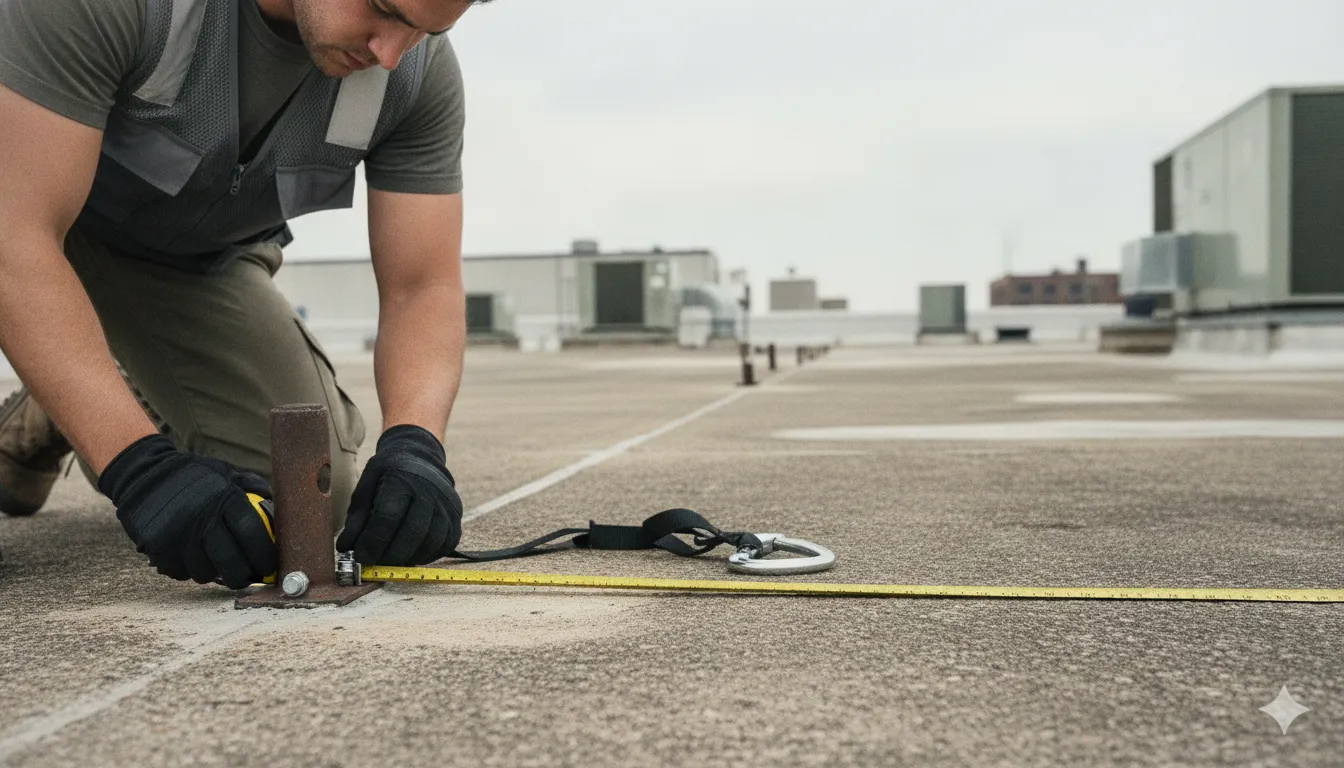
- Mark the unprotected edge and every opening the worker could step through.
- Place the anchorage where the work actually happens, not where a beam is easiest to clip.
- Measure from the anchorage to the edge along the path the tether will follow, including corners that shorten or lengthen the line.
- Add the worker's reach beyond the harness D-ring with an arm extended. A line that ends at the edge still lets the torso cross it.
- Select a fixed length, or a locked adjustable length, that stays shorter than that distance in every permitted anchorage position.
- Repeat the check with the tallest and shortest authorized users, and after any anchorage move.
Write the result as a maximum deployed length for each anchorage. If one anchor must serve two edges, give each edge its own limit. An adjustable tether needs a positive lock and a way for the inspector to see the set length. A knot is not a substitute unless a competent or qualified person has inspected that knot against the applicable line-strength rule before use.
Restraint is the wrong system when the task requires the worker to lean over or pass the edge. At that point the program needs a personal fall arrest system, clearance below the walking surface, and a rescue plan. Aircraft-specific harness qualification is a different problem. It is covered in the aviation fall restraint harness supplier guide.
Edges that defeat a catalog length
A straight roof edge is the easy case. Skylights, hatches, conveyor openings, and inside corners are not. The tether can catch on a curb or a pipe and then slip free, which adds sudden slack. Measure the path the line actually takes, including the slack that appears when the line slides around a corner.
Leading edges and fragile surfaces need an extra decision. Restraint can keep a worker away from a skylight only if the tether is short enough and the worker cannot step onto the cover. If the cover is the walking surface, the control is a stronger cover or a different system, not a longer lanyard. Record that decision next to the length so a later buyer does not correct a short tether by ordering a longer one.
Which standards and tests belong in the file
Ask for the standard that matches the function, then ask for the test record that matches the part. OSHA 1910.140 is the general-industry performance rule for personal fall protection systems. Its general rules cover connectors, line strength, and incompatible connections. Additional rules for personal fall arrest systems and positioning systems sit in the arrest and positioning paragraphs. Travel restraint does not inherit an arrest clearance calculation.
Lanyards and vertical lifelines need a minimum breaking strength of 5,000 pounds (22.2 kN). A self-retracting device that limits free fall to 2 feet or less must sustain 3,000 pounds (13.3 kN) when fully extended. Those figures answer a strength question. They do not prove that a short tether will keep a named worker away from a named edge.
ANSI/ASSP Z359.3-2019 is the American National Standard for safety requirements for lanyards and positioning lanyards. Its foreword and scope, as published in the ASSP preview, state that the standard covers lanyards used for travel restraint, work positioning, and fall arrest. It became effective September 1, 2020. A component marked only as a fall-arrest lanyard is not evidence that it was evaluated as a restraint or positioning lanyard. Ask the supplier which Z359.3 function the label claims.
Keep military and contract requirements separate. A Berry Amendment, MIL-STD, or program drawing can add materials, traceability, and test methods. It does not replace the site geometry check. Government buyers who need a supplier-qualification method can use the supplier qualification guide alongside this system specification.
How to read a test sheet
A useful test sheet names the part number, the function tested, the load, the direction of pull, and the pass-fail result. A tensile number on a connector does not describe the harness stitch pattern or the adjustable buckle. Ask which sample was tested and whether production units are traceable to that setup.
Reject three weak substitutes. A catalog sentence that says the product meets applicable OSHA and ANSI standards does not name the section or the function. A certificate for a different length or a different end fitting does not cover the part you are buying. A photo of a label is not a test record. Put the accepted document number in the purchase order so receiving can match it.
What to accept before the system goes into service
Accept the installed configuration, not a carton of compatible-looking parts. The receiver should be able to rebuild the approved system from the file: anchorage ID, connector model; tether model and maximum length, harness or belt model, attachment point, and the edge measurement for that workplace.
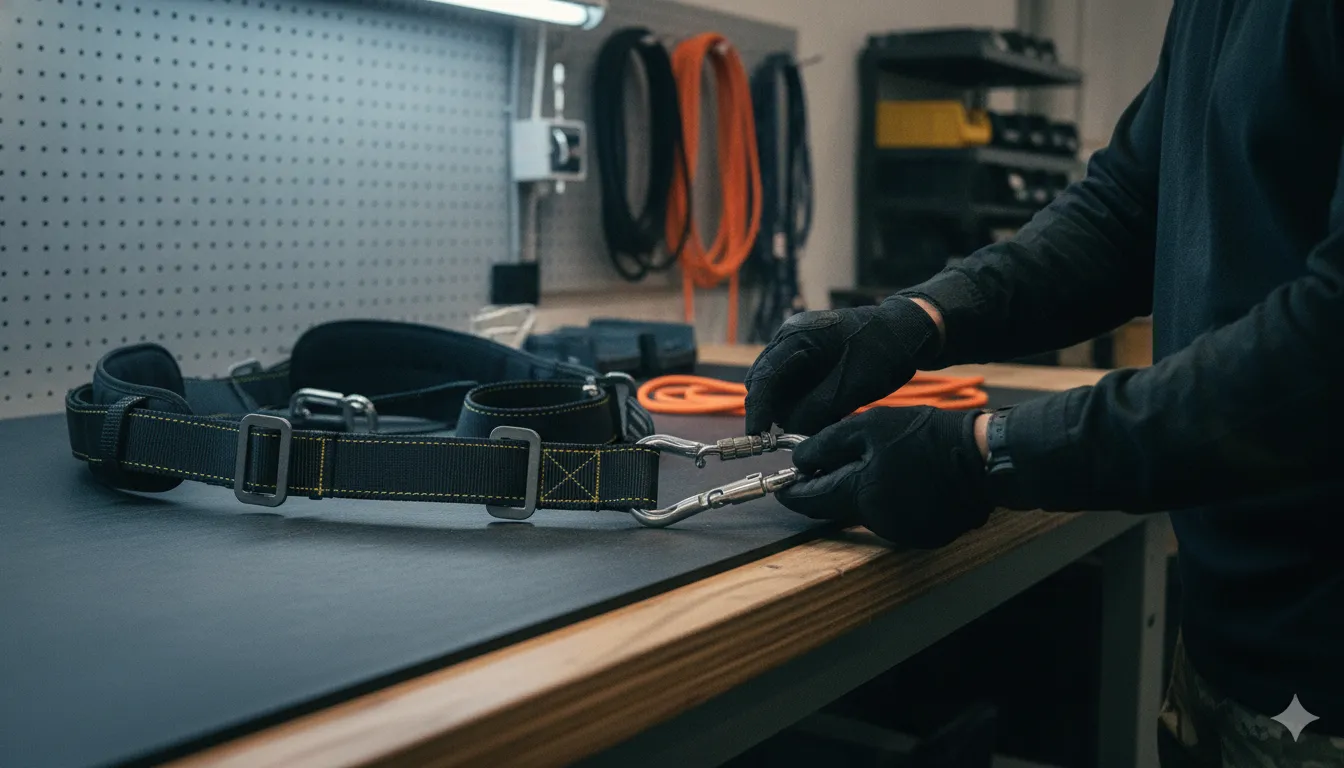
Use a short acceptance sequence.
- Confirm the delivered parts match the approved models and that connectors lock with two deliberate motions.
- Install the tether at the specified anchorage and set it to the approved maximum length.
- Have an authorized user don the body support, connect to the specified ring, and walk the work area. The torso and an extended arm must remain short of every edge.
- Record the date, the anchorage, the measured length, the user range checked, and the person who witnessed the test.
- Remove any longer lanyard from that workstation so the arrest line cannot be clipped in place of the restraint line.
Inspection after acceptance is a condition check. Look for cut or glazed webbing, pulled stitching, corrosion, a gate that does not close, a lock that slips, and a line that has stretched or been re-rigged longer than the record. Retire a component that has arrested a fall, even if the original purchase was restraint, because the load history is no longer the one you accepted. Train users that moving the anchorage, adding an extension, or working beyond the marked area cancels the acceptance until the geometry is measured again.
For the broader purchasing record, the technical rescue equipment list shows how to separate mandatory evidence from preferred features. Restraint evidence is mandatory when the hazard control depends on length. Color, padding, and extra gear loops are not.
What to keep after award
The configuration record should travel with the equipment. Keep the approved length, the anchorage ID, the compatibility statement, and the reach-test note where the next inspector can find them. When a tether or harness is replaced, repeat receiving against the same line item. Do not assume a newer catalog number has the same end fitting or the same maximum length.
Review the record when the workplace changes. A new parapet, a moved pipe rack, or a different work platform can make a previously safe tether too long. The annual check is a comparison of the site with the file, not only a look at the webbing. If the comparison fails, tag the station out until the tether or the anchorage is reset and walked again.
Frequently Asked Questions
Are fall restraint systems the same as fall arrest systems?
No. Restraint prevents the worker from reaching the edge. Fall arrest stops a fall after it starts and needs a body harness, deceleration, clearance, and a rescue plan.
Can a body belt be used for travel restraint?
OSHA allows a body belt for travel restraint and positioning. If the same worker may be exposed to a fall, specify a full-body harness, because arrest requires one.
How short should a restraint tether be?
Shorter than the distance from the anchorage to the edge, after you subtract the worker's reach beyond the attachment ring. Verify it by walking the area, not by the catalog length alone.
Does a 5,000-pound rating prove a restraint system fits the site?
No. The 5,000-pound (22.2 kN) figure is a strength requirement for lanyards, vertical lifelines, and listed connectors. Fit still depends on anchorage location and deployed length.
When should the buyer switch from restraint to arrest?
Switch when the work requires the person to reach, lean over, or pass the unprotected edge. Restraint cannot control a hazard the tether was designed to reach.
Talk with Fusion Tactical about a fall restraint specification or call (909) 393-9450.


