

Riggers Belt Selection: Fit, Load Path, and Government Buyer Questions: Emergency Medical Supplies
Emergency medical supplies are only useful to a response team when they can be carried, accessed, and replenished as the mission requires. For teams evaluating a rigger belt as part of that system, the decision should begin with fit, intended loads, and approved use—not appearance or a broad product label. A belt can organize equipment, but it is not automatically a fall-arrest, lifting, or patient-transport component.
Discuss your equipment requirements
What job should the belt perform?
Start by describing the work in operational terms. A procurement file that says only “rigger belt” leaves important questions unanswered. Is the belt intended to support a configured set of pouches, provide a stable interface for a duty system, carry a limited medical load, or connect with another piece of equipment? These are different requirements, and each affects fit, attachment spacing, total carried mass, and the evidence a buyer should request.
Define the user group and operating conditions as well. Note whether personnel wear the belt over a uniform, under outer layers, or with a separate carrier or harness. Record expected movement, the time spent wearing the configuration, climate and moisture exposure, and whether users must don or remove it while wearing gloves. If equipment is shared across a team, specify the range of user sizes and the adjustment method needed for assignment and return.
- Purpose: List the tasks the belt supports and the tasks it does not support.
- Configuration: Identify each intended pouch, tool, and attachment, including its location.
- Use environment: Describe clothing layers, weather, work surfaces, and cleaning expectations.
- Interfaces: Record compatibility needs with the team’s other approved equipment.
- Limits: State whether the belt is excluded from fall protection, hoisting, or patient handling.
This definition prevents a common procurement error: selecting a belt for one feature and later assigning it duties that were never part of its documented purpose. If the work calls for an approved personal-protection or rescue system, specify that system independently and verify its own documentation and compatibility.
How should buyers evaluate fit?
Fit affects comfort, access, and whether the configuration remains in its intended position during routine movement. It should be evaluated with the clothing and equipment that personnel will actually use. A belt measured over a thin base layer may fit differently over a duty uniform or insulating layer. The wearer should be able to fasten and adjust it without excessive slack, pressure points, or interference with required equipment.
Ask the supplier for the sizing method and adjustment range. Compare the stated measurement point with the agency’s measurement procedure, and decide whether the ordering unit is a single size, a range, or multiple sizes. Do not infer fit from a nominal waist size alone. A pilot evaluation should include representative users at the ends of the expected size range, not just one convenient sample.
During evaluation, check whether the buckle or closure can be operated reliably with the expected gloves. Inspect whether the belt stays positioned when users bend, kneel, sit, and move between work positions. Confirm that the edges and hardware do not create avoidable pressure or catch points with the clothing and adjacent equipment. Record observations against consistent criteria so that one user’s preference does not become an undocumented acceptance standard.

Fit must also account for the planned load arrangement. A belt that closes comfortably while empty may shift or press differently once pouches and tools are installed. Evaluate the actual configuration, using representative equipment or equivalent inert training items. Include the planned attachment positions, because a concentrated load on one side can change how the belt sits and how easily the wearer reaches other equipment.
What does the load path need to show?
“Load path” means the route through which force travels from an item or attachment into the belt and, if applicable, onward to another component. For a carried equipment setup, the buyer should understand how pouches attach and how their weight is distributed. For a life-safety task, the buyer must not assume that a similar-looking attachment point makes the belt suitable for that task. The exact component, connection, user instructions, and evaluated system all matter.
Map the proposed configuration before acceptance. Start with each item and its attachment method. Note where the item’s force enters the belt, whether the attachment is compatible with the belt’s construction, and whether other equipment blocks or distorts that interface. Then ask which component is intended to carry force and for what stated purpose. If documentation does not clearly establish the required use, treat that use as unverified.
| Evaluation area | Question for the buyer | Evidence or check |
|---|---|---|
| Carried equipment | Which items attach, and where? | Configuration drawing or itemized layout checked against the actual belt. |
| Attachment interface | How is each pouch or accessory retained? | Supplier instructions and a hands-on fit check of the specified interfaces. |
| Stated capacity or rating | Does a rating apply to this exact component and intended use? | Current product documentation identifying scope, conditions, and limitations. |
| Life-safety use | Is the proposed task expressly within the evaluated system’s intended use? | System-level documentation, instructions, and agency qualification approval. |
| Wearer fit | Does the loaded setup stay positioned across representative users? | Recorded evaluation with actual layers and representative equipment. |
A number on a component does not establish the capacity of an assembled system. Ratings may apply to a particular part, direction, configuration, or use condition. Do not add component values together, assume that the strongest component determines system performance, or convert a carried-equipment description into a life-safety claim. If a specification uses kilonewtons (kN), ask the supplier to identify exactly what is rated, how that rating is defined, and which conditions or restrictions apply.
Where the proposed task involves fall protection, suspension, lifting, or rescue, make that a separate engineering and qualification decision. Identify the applicable agency requirements and system documentation before purchase. OSHA’s occupational safety resources are a starting point for locating workplace requirements; buyers should confirm the rules applicable to their operation and have the responsible safety authority review the specific system. A general equipment description is not a substitute for that review.
How should the belt support emergency medical supplies?
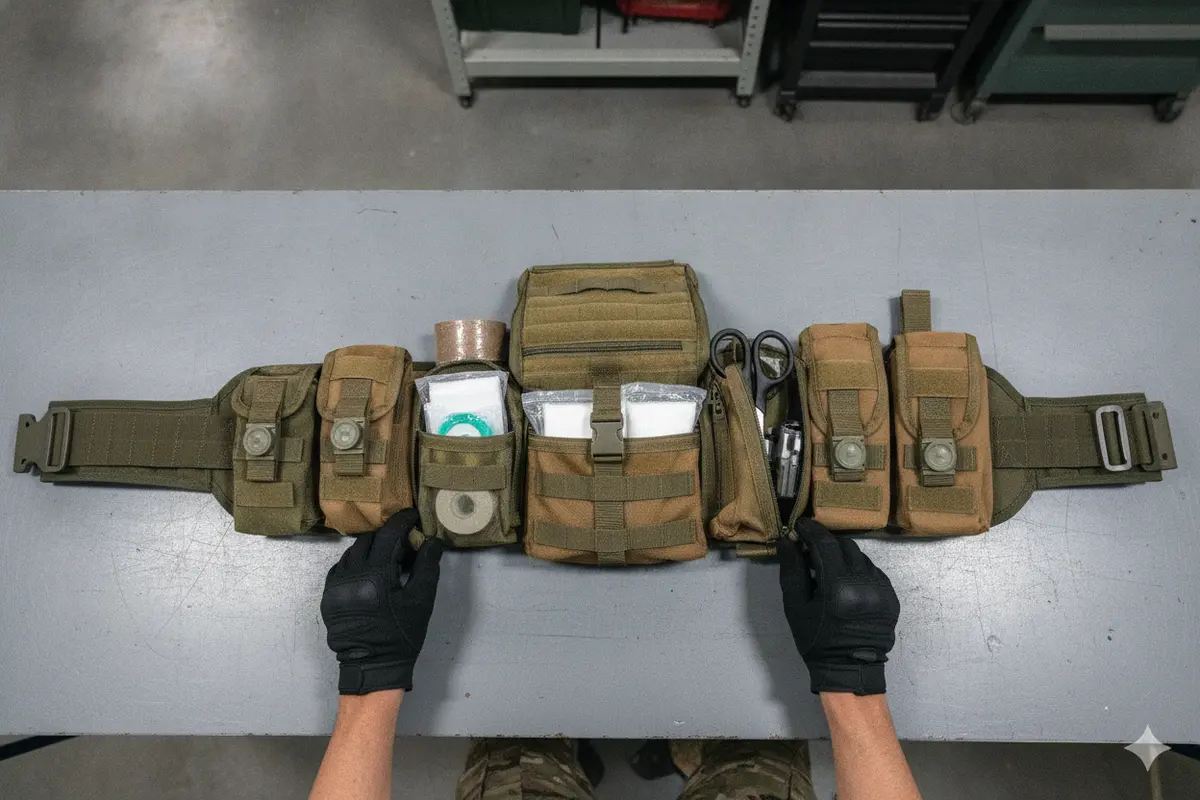
Plan the belt as one part of a broader medical equipment arrangement. First identify which items must be immediately accessible on the person and which can be carried in a pack, vehicle, or team cache. Avoid placing every item on the belt simply because an attachment is available. Extra bulk can impede movement, complicate access, and make the configuration harder to inspect or standardize.
For each item assigned to the belt, write down its role, expected access frequency, retention method, and responsible user. Group items according to the team’s procedure rather than an arbitrary visual pattern. Confirm that the wearer can identify and reach the item without dislodging adjacent equipment. For shared configurations, use the same item locations across users where operationally practical, then document authorized exceptions.
Do not assume the belt is a sterile or protective storage solution. Determine whether the item needs packaging, environmental protection, controlled temperature, or another storage condition, and choose a container designed for that need. The belt’s role is the interface for approved carried equipment; the medical item’s own packaging and storage requirements remain in force.
Use a simple layout record to capture the accepted setup. The record can name the item, location, attachment type, inspection point, and replacement trigger. Include a configuration identifier or revision date so that a changed pouch or substitute item receives review before fielding. If the team needs separate belt configurations for distinct roles, document each one rather than calling them interchangeable.
Which documents should procurement request?
Ask for documents that answer the use question, rather than collecting broad marketing statements. A clear supplier response should let procurement connect the offered item to its intended application, configuration, and limits. The buyer should preserve the version reviewed so that later substitutions can be compared with the accepted basis.
- Product identification: Model or item designation, material or construction information provided for the item, and current product instructions.
- Use statement: Intended tasks, excluded tasks, and any restrictions stated by the manufacturer.
- Rating detail, when applicable: The component covered, the meaning and scope of the rating, relevant test or use conditions, and any required mating parts.
- Interface information: Attachment methods, compatible accessories, and instructions for assembly and adjustment.
- Inspection guidance: What to examine, conditions that require removal from service, and how to report damage or uncertainty.
- Configuration control: Product revision, approved options, and a process for notifying the buyer about changes.
- Procurement information: Origin and compliance documentation required by the solicitation, contract, or agency policy.
Not every purchase requires the same package. The solicitation and intended application determine what is necessary. Government buyers should define those requirements before quote evaluation, then ask suppliers to respond in a consistent format. Where a contract requires origin, domestic sourcing, or other compliance evidence, state the applicable clause or requirement and request documentation that addresses it. Do not treat a general claim as proof of a specific contract obligation.
How can procurement compare offers consistently?
Use a requirement matrix that separates mandatory conditions from preferences. For example, a mandatory condition may be an attachment interface required by the team’s approved configuration. A preference might be a particular adjustment feature. The evaluation should show whether each offer meets the requirement, what evidence supports that finding, and any exceptions that need technical review.
| Requirement | Offer A | Offer B | Disposition |
|---|---|---|---|
| Fits defined clothing layers and size range | Evidence cited or gap recorded | Evidence cited or gap recorded | Pass, exception, or open question |
| Supports the approved attachment layout | Interface and configuration checked | Interface and configuration checked | Pass, exception, or open question |
| Use and rating claims match the task | Scope and limitations reviewed | Scope and limitations reviewed | Technical authority review if needed |
| Documentation meets solicitation needs | Required records identified | Required records identified | Compliance review |
| Inspection and change controls are clear | Instructions and revision recorded | Instructions and revision recorded | Acceptance condition defined |
Keep price comparisons tied to equivalent configurations. An offer with a different set of attachments or documentation is not directly comparable until the scope is normalized. Record whether quoted items are included, optional, or supplied separately. Avoid filling evidence gaps with assumptions based on a product name or a similar model.
A supplier may not have every document in the exact format requested. Make the gap visible and decide whether alternate evidence is acceptable under the solicitation and technical review process. If a required safety claim remains unclear, do not resolve it by lowering the requirement informally. Route the question to the responsible engineering, safety, or contracting official.
What should a team check during acceptance?
Acceptance should verify the delivered item against the order and the approved basis. Check model identification, size or adjustment range, quantity, configuration, and the documents specified in the award. Inspect the belt and attachment interfaces for visible damage or discrepancies before issuing it. Follow manufacturer instructions; do not create improvised proof tests or loading procedures.
For a pilot issue, give evaluators a written checklist. Ask them to use the intended clothing layers and equipment, then record whether the belt stays positioned, whether intended items remain accessible, and whether interfaces interfere with one another. Capture the user’s role, configuration revision, and any observed issue. The purpose is to test fit and usability under controlled agency procedures, not to exceed stated use or create a new capacity claim.
Set a change-control rule for later replacement parts, pouch substitutions, or alterations. A visually similar component may have a different interface or instructions. Require a review against the accepted configuration before changes are distributed. Store the product documentation, purchase record, evaluation notes, and approved layout together so that supervisors and procurement staff can trace what was fielded.
How should teams manage inspection and replenishment?
Define routine checks around the equipment’s actual use and the manufacturer’s instructions. The check should identify the belt and configuration, confirm that the closure and attachment interfaces are intact, and note any condition that requires quarantine or technical review. Do not invent a universal inspection interval or service life when the manufacturer’s instructions or agency procedure set the appropriate control. Keep the source of each inspection rule in the equipment record.
Make the process practical for the people who issue and return equipment. A short checklist can prompt the user to confirm the correct configuration, inspect for visible damage, and report a missing or substituted component. A designated supervisor or equipment custodian can reconcile the report with the configuration record. If a belt has been altered, exposed to an event covered by the instructions, or found with uncertain damage, follow the specified removal and review process before it is reissued.
Replenishment planning should distinguish consumable medical items from the belt and reusable attachments. Set the reorder point and responsible role according to the team’s own supply policy, and keep replacement items compatible with the approved layout. A substitute pouch, buckle, or attachment should not be treated as equivalent solely because it fits physically. Review substitutions for retention, access, instructions, and any effect on the approved use.
Track configuration revisions with clear identifiers. For example, a simple record can state the belt model, approved attachment positions, authorized accessories, review date, and document revision. When a new version is issued, communicate what changed and whether users need a new fit check or familiarization. This makes it easier to distinguish an approved update from an informal field modification.
What questions should buyers ask a supplier?
- What exact task is this belt designed to support, and which tasks are outside its intended use?
- How should the buyer measure users, and what adjustment range is available?
- Which attachment interfaces are intended, and what configuration details affect compatibility?
- If the offer states a load rating, which exact component and application does it cover?
- What documentation describes limitations, inspection, care, and removal from service?
- Can the proposed layout be reviewed with the team’s actual equipment and clothing layers?
- What product changes or substitutions would require a fresh compatibility review?
- Which origin or compliance records can be supplied for the specific procurement requirement?
Request direct answers with supporting documents where the question concerns use, ratings, or compliance. A concise written response is easier to review and retain than an informal assurance. If the offer requires a custom layout or integration, send a requirements list and ask the supplier to identify assumptions and open decisions before the order is finalized.
How does a rigger belt fit into a larger equipment plan?
A rigger belt is one component in an equipment architecture. The team may also need a different belt configuration, a patrol belt option, or dedicated rigger belt components, depending on the defined task. Product category names alone do not establish compatibility. Verify the dimensions, interfaces, instructions, and intended role of each selected item.
When the belt is part of a team-wide procurement, standardization can simplify training and replenishment, but only if it reflects the users and tasks involved. Keep a controlled record of the approved layout, accessories, and required evidence. If the mission changes, revisit the fit and use case instead of assuming that the existing selection remains suitable.
For broader supplier context, review Fusion Tactical’s company information and its manufacturing capabilities. Buyers with an application-specific question can use the contact page to share the intended use, required configuration, and procurement documentation needs. For related equipment context, see the lanyard collection and hardware collection; evaluate these items separately for their defined purpose and approved system interfaces.
Send your configuration and procurement questions
Frequently asked questions
Can a rigger belt carry emergency medical supplies?
It may be selected as an interface for a defined set of carried items when its design, fit, attachment method, and intended use support that configuration. Confirm item retention and access with the actual setup, and follow storage requirements for each medical item. Do not assume that carrying supplies makes the belt suitable for patient handling or another life-safety task.
Does a rigger belt automatically qualify as fall-protection equipment?
No. A product name or resemblance to other equipment does not establish qualification for fall protection, lifting, or rescue. Verify the intended use, system documentation, applicable requirements, and agency approval for the exact task and configuration.
What should a buyer do when a supplier lists a kN value?
Ask which specific component the value describes, what application and conditions it covers, and which instructions or limitations apply. Confirm that the evidence pertains to the offered item and proposed use. Do not treat a component value as a rating for a complete assembly unless the documentation expressly supports that conclusion.
How should agencies evaluate belt fit before a larger order?
Use a documented pilot with representative users, clothing layers, and the proposed equipment layout. Check adjustment, stability, access, and interference during routine movements. Record findings against the same criteria for every sample and resolve open issues before acceptance.
A well-defined purchase connects the belt’s intended role to fit, configuration, evidence, and limits. That process helps teams carry the equipment they need while keeping life-safety decisions anchored to the specific systems and approvals required for the work.


