

TAA Compliant Tactical Gear: Federal Procurement Requirements Guide
Federal procurement departments face severe penalties if their safety equipment violates Trade Agreements Act standards. Non-compliant gear can trigger contract termination, financial penalties, or suspension from federal bidding.
Get a verified TAA compliant tactical gear quote from Fusion Tactical USA for your next federal procurement contract.
Acquiring TAA compliant tactical gear is a strict legal requirement for federal agencies purchasing through GSA Multiple Award Schedule contracts. Under the Trade Agreements Act of 1979, all federal contract products must be manufactured or substantially transformed within the U.S. or a designated country. This guide provides purchasing teams with the exact verification steps needed to maintain complete compliance for all mission-critical safety equipment.
Navigating the complex landscape of federal sourcing requires a thorough understanding of these strict statutory frameworks. Ensuring complete alignment with federal guidelines is the essential first step to securing compliant, mission-ready supply chains.
Understanding TAA Compliance for Federal Tactical Equipment
The Trade Agreements Act requires federal agencies to purchase goods made or substantially transformed in the United States or a designated country. For tactical safety equipment, this means every harness, lanyard, and load-bearing system must meet strict country-of-origin rules to qualify for GSA Schedule contracts.
Federal agencies need to source reliable gear that meets strict legal standards. For government buyers, purchasing TAA compliant tactical gear is not just a preference. It is a strict legal requirement under federal procurement law. Sourcing compliant safety systems, harnesses, and retention lanyards ensures your agency remains aligned with federal rules.
What Is the Trade Agreements Act
The Trade Agreements Act of 1979 (TAA) controls how the federal government buys goods and services. Under this law, the U.S. government must only buy products made in the United States or in designated countries. The law aims to support fair and open international trade. You can read more about these rules on the GSA Trade Agreements Act compliance page.
To meet these standards, a product must be wholly grown, produced, or manufactured in the U.S. or an approved country. If the product uses parts from other places, it must undergo a major change within a designated nation. Sourcing gear from a trusted U.S. manufacturer helps you avoid common compliance issues.
Requirements for GSA Schedule Contracts
The General Services Administration (GSA) manages the Multiple Award Schedule (MAS) program, a main path for federal buyers to get tactical gear. TAA compliance is a core requirement for MAS contracts. Every vendor on the GSA Schedule must certify that their goods meet these strict rules.
If a vendor sells non-compliant goods on the GSA Schedule, they can face big fines. The government can also cancel their contracts. Buyers must check vendor details to make sure all tactical harnesses, belts, and lanyards are fully compliant. Sourcing U.S.-sourced tactical equipment directly from rated domestic manufacturers reduces these contract risks.
Defining Substantial Transformation
Some tactical gear uses parts made in countries that are not on the approved list. For these items to meet TAA rules, they must undergo what the law calls substantial transformation. According to the GSA Vendor Support Center rules on substantial transformation, a product must experience a fundamental change in name, character, or use due to processing in an approved nation.
In tactical gear manufacturing, simple assembly is not enough. Screwing two parts together or packing items in a new box does not count. The work must involve complex engineering, stitching, and testing that creates a new life-safety product. When a U.S. plant weaves high-strength webbing and rated hardware into a certified rescue harness, a substantial transformation has occurred.
TAA Compliance vs. Berry Amendment: Key Differences for Procurement
TAA compliance permits sourcing from the U.S. or designated partner countries for all federal agency contracts. The Berry Amendment requires 100% domestic content for Department of Defense textile purchases. Understanding which standard applies to your contract prevents costly compliance violations.
Federal procurement officers must navigate strict domestic sourcing laws when purchasing tactical and safety gear. The two most common frameworks are the Trade Agreements Act (TAA) and the Berry Amendment. While both laws aim to protect federal supply chains, they apply to different types of contracts, agencies, and products. Sourcing officers must know these differences to avoid compliance violations.
Different Sourcing Rules for GSA and DoD Contracts
The Trade Agreements Act of 1979 applies broadly to GSA and other federal procurement programs. Under DFARS 252.225-7020, contractors must certify that their end products are made or substantially transformed in the United States or an approved designated country. This framework allows federal agencies to source from a wide network of international allies. For procurement teams looking for TAA compliant tactical gear, this broad sourcing pool offers flexibility without sacrificing supply chain security.
In contrast, the Berry Amendment is much more restrictive. Codified under 10 U.S.C. 2533a, this 1941 law applies specifically to Department of Defense (DoD) funds. The Berry Amendment requires textiles, clothing, food, and hand tools to be 100% produced in the United States. Understanding these differences is vital when choosing between U.S.-sourced tactical equipment and allied-nation goods.
Direct Comparison of Compliance Frameworks
To help procurement teams make correct purchasing decisions, the table below highlights the key operational differences between TAA compliance and the Berry Amendment.
| Criteria | Trade Agreements Act (TAA) | Berry Amendment |
|---|---|---|
| Primary Authority | Trade Agreements Act of 1979. | 10 U.S.C. 2533a. |
| Applicable Agencies | All federal agencies (including GSA). | Department of Defense (DoD) only. |
| Sourcing Requirement | U.S. or designated partner countries. | 100% United States origin. |
| Material Scope | Broad range of goods and services. | Textiles, clothing, food, hand tools. |
| Enforcement Style | Prohibits non-compliant goods entirely. | Strict prohibition with narrow waivers. |
Consequences of Sourcing Violations
The penalties for non-compliance differ significantly between these laws. According to GSA and Trade.gov guidelines, standard Buy American Act rules apply a price penalty to foreign goods. However, the TAA prohibits the purchase of non-compliant goods entirely for covered contracts. Violating TAA or Berry Amendment rules can lead to contract termination or suspension from federal bidding. For this reason, many agencies prefer to work with dual-compliant manufacturers who can provide both types of certified gear from a single production facility.
Contact Fusion Tactical USA for government pricing on dual-compliant tactical equipment for your federal contracts.
Why Is TAA Compliance Required for GSA Schedule Contracts?
TAA compliance is mandatory for GSA Schedule contracts because the Trade Agreements Act prohibits federal agencies from purchasing goods from non-designated countries. Every MAS vendor must certify country of origin for each product line, and non-compliance triggers contract termination, financial penalties, or suspension.
Federal buyers must follow strict rules when purchasing gear for government agencies. For most large contracts, the Trade Agreements Act of 1979 sets the standard. Under GSA Multiple Award Schedule (MAS) contracts, vendors must supply goods made or substantially changed in the United States or a designated partner country. This rule ensures that government funds support trusted trade partners.
Federal Procurement and MAS Contractor Obligations
Contractors on the GSA Schedule face strict duties during the solicitation process. To list items on the schedule, a vendor must sign a document to certify the country of origin for each product. Offering non-compliant items can lead to contract loss or federal fines. For agencies seeking reliable gear, working with a vendor that has verified TAA compliant manufacturing setup is the safest path to avoid supply chain disruptions.
GSA Advantage and Country of Origin Indicators
Federal buyers use the GSA Advantage portal to search for and purchase approved gear. The platform displays a clear American flag icon next to products made in the United States. This visual cue helps procurement officers quickly find compliant options. Products that do not meet these standards do not receive this label.
Supply Chain Security Under FAR Part 40
Recent federal rules place a stronger focus on supply chain safety. Federal Acquisition Regulation (FAR) Part 40 requires deep checks of all hardware and soft goods to prevent the purchase of gear from high-risk foreign sources. Buying TAA compliant tactical gear ensures each load-bearing harness or safety lanyard comes from a verified, secure manufacturing pipeline.
How Do You Verify TAA Compliance in Tactical Gear Vendors?
Verify TAA compliance by checking SAM.gov registration and active CAGE codes, requesting DFARS 252.225-7020 certificates. Confirming physical manufacturing locations, and tracing sub-tier supplier origins for components like webbing and hardware. Each step builds an auditable compliance trail.
Federal procurement officers must use care when buying mission critical equipment. Acquiring tactical gear requires a clear process to ensure all items meet Trade Agreements Act standards. If a vendor supplies non-compliant gear, it can lead to contract termination or legal penalties.
Check SAM.gov and CAGE Codes
The first step in verification is to search the System for Award Management. You must check that the contractor has an active record on SAM.gov and verify their Commercial and Government Entity code. Fusion Tactical USA operates under CAGE Code 0KQN1 with an active, compliant profile.
Request Country of Origin and DFARS Certificates
Do not rely on simple product labels. You must request a formal Trade Agreements Certificate under DFARS 252.225-7020. If a vendor offers TAA compliant tactical gear, they should provide written proof of where raw materials are processed and assembled.
Review Manufacturing Locations and Sub-tier Suppliers
Ask the vendor for the physical address of the facility where items are made. A U.S. manufacturer should show where substantial transformation occurs. You should also request documentation regarding sub-tier suppliers. True U.S.-sourced tactical equipment relies on clear supply chain tracing from webbing and hardware to the final stitched product.
To build a complete verification process, follow these steps for every tactical equipment procurement:
- Check SAM.gov Registration: Confirm the vendor is active and search for their unique CAGE Code.
- Request the DFARS Certificate: Ask for the DFARS 252.225-7020 certificate to verify compliance for every line item.
- Verify the Production Facility: Confirm the physical address where the gear is assembled.
- Trace the Sub-tier Supply Chain: Request proof of origin for components like high-strength webbing and load-rated metal hardware.
- Document Vendor Declarations: Keep all signed country-of-origin papers in your contract file for audit safety.
Designated Countries and Substantial Transformation in Tactical Manufacturing
Designated countries include WTO GPA signatories, free trade agreement partners, and least developed nations. Products using non-designated components must undergo substantial transformation in an approved country, changing the part's name, character, or use through complex manufacturing processes.
To supply federal agencies with TAA compliant tactical gear, items must originate from the United States or a designated country. The federal government defines these origins based on specific trade pacts.
Understanding Designated Countries
Under the Trade Agreements Act, designated countries include free trade agreement partners, Least Developed Countries, and nations participating in the World Trade Organization Government Procurement Agreement. As outlined by the General Services Administration, goods from approved nations can be purchased for federal contracts when specific dollar thresholds are met.
Federal buyers cannot procure tactical equipment from non-designated countries like China or Russia. When a vendor imports parts, those parts must undergo specific processes to meet legal standards.
The Rule of Substantial Transformation
Many tactical products use parts from several countries. For these items to qualify, they must undergo a substantial transformation. According to the GSA Vendor Support Center, a product must undergo a fundamental change in name, character, or use due to processing within a designated country.
Simple assembly or basic packaging does not meet this standard. The work must turn separate parts into a new, distinct article of commerce. Sewing imported fabric into a tactical vest in a designated country is a substantial transformation. However, merely attaching a buckle to an imported belt does not qualify.
Applying the Standard to Tactical Hardware and Webbing
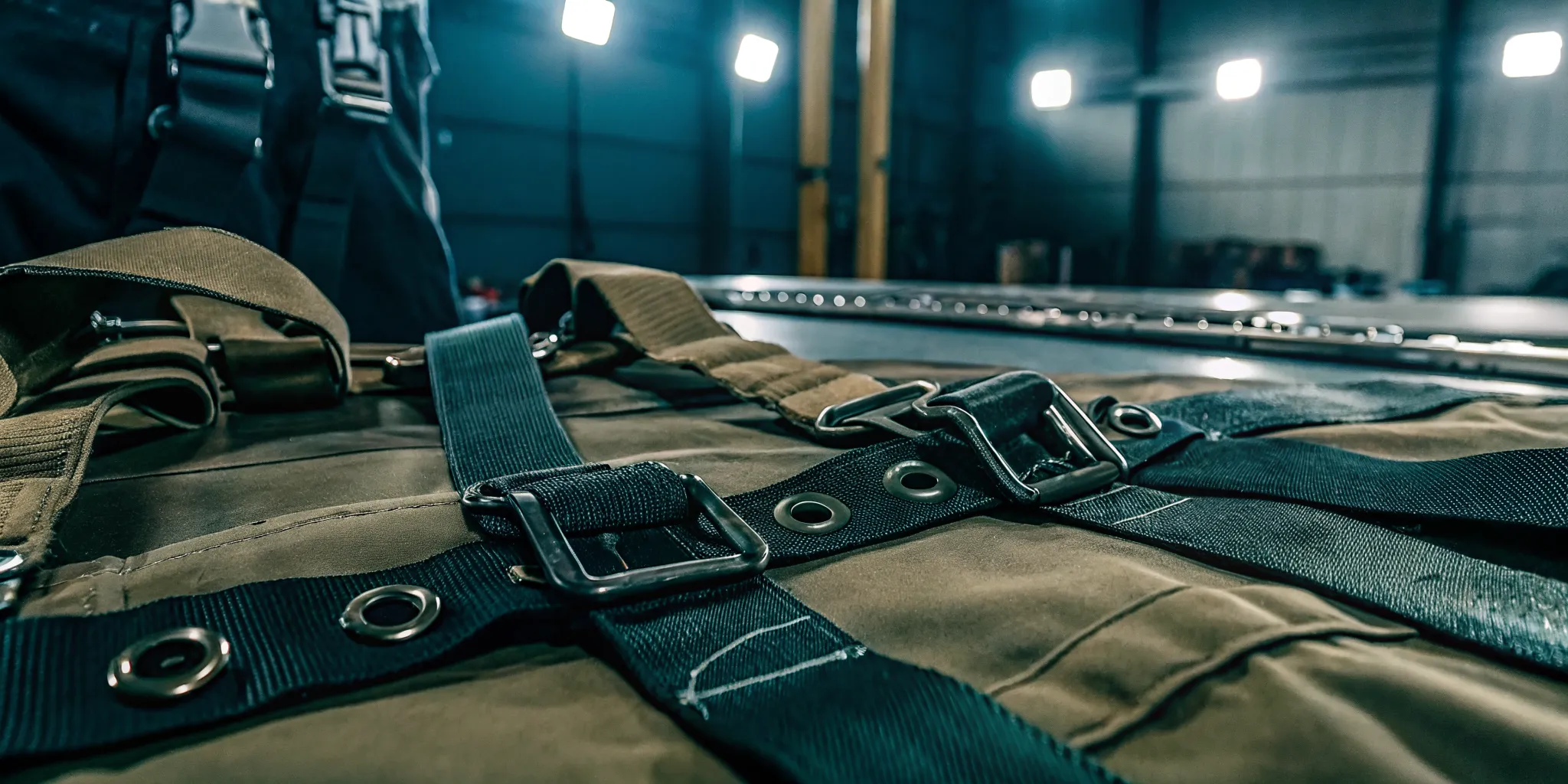
In load-bearing equipment, substantial transformation often occurs during heavy assembly. At Fusion Tactical USA's California manufacturing facility, raw webbing and metal hardware are transformed into life-safety systems. While some raw components may come from foreign sources, the engineering, weaving, and final stitching create a brand-new product.
Consider a personal retention lanyard. The raw webbing, snap hooks, and thread are separate items with unique uses. When they are stitched together using automated computerized bar-tack patterns, they become a single rated safety system. This process changes the name, the physical character, and the end-use of the parts, satisfying the federal standard.
TAA Compliance Certification: What Procurement Officers Need to Document
Procurement officers must collect CAGE Code verifications, Trade Agreements Certificates under DFARS 252.225-7020, country of origin declarations, third-party load test reports, and ISO quality certifications. A complete compliance folder protects against audit failures and contract penalties.
Federal procurement officers face tight rules when they buy tactical equipment. Under GSA Multiple Award Schedule rules, every vendor must certify the country of origin for their goods. Buyers must build a solid paper trail to prove compliance during audits.
Supply Chain Security and FAR Requirements
Federal Acquisition Regulation (FAR) Part 40 sets strict standards for supply chain security. Contracting officers must check vendor credentials before signing a contract. This includes verifying active status on SAM.gov and checking the CAGE Code. For tactical safety equipment, buyers should also request a written Country of Origin (COO) declaration.
For defense contracts, procurement teams must look for a Trade Agreements Certificate under DFARS 252.225-7020, requiring vendors to certify that each end product is U.S.-made or from a qualifying country. Buyers must collect these certificates for every line item in the contract.
Technical Quality and Traceability Files
Paper certificates are only the first step. True compliance requires proof of quality and material origin. Contracting officers should request quality management records from tactical gear makers. A top manufacturer will hold ISO 9001:2015 certifications or use AS9100 aerospace engineering principles. These standards ensure every part is fully tracked throughout the manufacturing process.
For life-safety items like rescue harnesses or lanyards, buyers should ask for third-party test reports confirming load ratings under real-world stress. When procurement teams buy Berry compliant gear, they should also request sub-tier supplier declarations tracking raw materials down to the domestic yarn or steel source.
Key Documents for the Procurement File
To avoid audit issues, contracting teams should keep a complete compliance folder for every buy. At a minimum, this folder must contain:
- CAGE Code verification and active SAM.gov status.
- Trade Agreements Certificate under DFARS 252.225-7020.
- Country of Origin (COO) declaration for each product line.
- Third-party load test sheets verifying kN ratings.
- ISO 9001:2015 or AS9100 quality certifications.
Fusion Tactical USA: Dual TAA and Berry Compliant Manufacturing for Federal Contracts
Fusion Tactical USA offers dual-compliant manufacturing meeting both TAA and Berry Amendment standards from its Chino, California facility. With CAGE Code 0KQN1, Small Business Certification #2011930, and ISO 9001:2015 quality systems, the company serves defense, aerospace, and government buyers.
Federal procurement officers need reliable tactical equipment that meets strict laws. Fusion Tactical USA serves as a premier partner by offering dual-compliant production. Operating out of Chino, California, we specialize in making mission-critical safety systems. Our team delivers both Berry Amendment and TAA compliant tactical gear to defense, aerospace, and government buyers. We hold CAGE Code 0KQN1 and Unique Entity ID (UEI) JSR6VV16YGH5 with an active SAM.gov status.
U.S. Manufacturing and Verification Credentials
Meeting federal procurement rules requires full supply chain clarity. Fusion Tactical USA holds Small Business Certification #2011930 and operates under more than 40 NAICS codes. We build gear under strict ISO 9001:2015 quality standards and follow AS9100 aerospace principles. Our U.S.-based facility handles made-to-order contracts with standard 1-2 week lead times.
Trusted Partner for Defense and Aerospace Programs
Our track record includes custom engineering projects for high-profile agencies. We are proud of past work with the NASA emergency egress team. Every U.S. military branch, including the Army, Air Force, Navy, Coast Guard, and USSOCOM, uses our tactical gear. By choosing our dual compliant manufacturing, contracting officers secure hardware that meets both DoD textile rules and GSA Schedule trade laws.
Engineering Consultations and Procurement Support
We do more than just ship finished gear. Fusion Tactical USA provides the technical help and paperwork procurement teams need to pass compliance audits. We offer custom engineering consultations, rapid prototyping, and full material test reports to verify exact kN load ratings. Whether you need standard retention lanyards or specialized rescue harnesses, we back our products with complete compliance files.
Call (909) 393-9450 to speak with our engineering team in Chino, California for a TAA compliant tactical gear quote or federal pricing consultation.
Frequently Asked Questions
What is the difference between Berry Amendment compliance and TAA compliance?
The Berry Amendment requires 100% domestic content for DoD textile purchases. TAA compliance permits sourcing from the U.S. or designated partner countries for all federal agency contracts. The Berry Amendment is stricter, applying only to defense contracts, while TAA governs broader federal procurement through GSA Schedule programs.
How do I verify if tactical gear is TAA compliant?
Check the vendor SAM.gov registration and active CAGE code, then request a Trade Agreements Certificate under DFARS 252.225-7020. Ask for the physical manufacturing address, trace sub-tier suppliers for key components, and collect third-party load test reports to build a complete auditable compliance file.
Does TAA compliance apply to all federal government contracts?
No, TAA rules only govern contracts exceeding specific dollar thresholds, currently starting at $183,000 for supply contracts. Below that threshold, the Buy American Act applies instead. For contracts above the threshold, the government must block purchases of goods from non-designated nations.
Which countries are designated for TAA compliant manufacturing?
Designated nations include WTO GPA signatories, free trade agreement partners, least developed countries, and Caribbean Basin nations. Major manufacturing partners like Taiwan, Japan, and most European nations qualify. You can view the full list on the GSA portal.
What documentation do procurement officers need for TAA compliance audits?
Procurement officers need CAGE Code verification, a Trade Agreements Certificate under DFARS 252.225-7020. Country of origin declarations, third-party load test reports, ISO 9001:2015 quality certifications, and sub-tier supplier declarations. Keeping these files ready ensures full audit preparedness.
Ready to secure TAA compliant tactical gear for your agency?
Delays in federal procurement can halt mission readiness and put your budget at risk. Sourcing tactical gear that does not comply with trade acts can disrupt your schedule and trigger compliance reviews. Partnering with an experienced domestic manufacturer ensures your equipment meets every legal requirement on day one.
Call (909) 393-9450 to request a quote or schedule an engineering consultation with Fusion Tactical USA in Chino, California.


