

Quick Release Harness Tactical Design Guide
A quick-release harness is not defined by how fast it opens in a demonstration. Its value depends on whether the release mechanism, load path, attachment points, and user procedures remain appropriate for the mission and the exact equipment configuration.
A quick release harness tactical buyer should first verify the intended use, primary retention path, release behavior, compatibility with connected hardware, and controls against accidental actuation. Product-specific ratings, certifications, and inspection requirements must come from the applicable manufacturer documentation, not from a component label or a similar-looking harness.
Research on quick-release systems shows that designs can differ in actuator position, the number of attachment points released, and how the assembly separates. Evidence may not support treating those approaches as interchangeable (review of quick-release system design). That makes a disciplined verification sequence essential, beginning with the system boundary and the buyer's operational requirements.
Request a technical discussion about your harness requirement
What should a quick release harness tactical buyer verify first?
Start with the mission profile, the user, the expected load case, the purpose of the release, and the boundary of the complete system. A quick-release feature does not by itself establish a harness's rating, compatibility, or suitability for helicopter operations, rescue, fall protection, or another high-risk application. Buyers should verify the exact model documentation and intended configuration before approving equipment.
First, define the mission rather than beginning with the buckle or release hardware. Is the harness intended for operator retention, technical rescue, controlled access, evacuation, load-bearing support, or another task? The answer determines which attachment points, retention features, movement requirements, and failure consequences require review. A harness selected for one duty should not be treated as interchangeable with equipment designed for another.
Next, identify the user and operating environment. Procurement teams should account for the people who will wear, adjust, inspect, and release the equipment. Consider clothing and other worn gear, gloves, restricted visibility, water or contamination exposure, temperature, lighting, and whether the user must actuate the release while under stress. These conditions should be addressed through documented requirements and practical training, not assumptions about how a mechanism will behave.
The load case is equally important. Ask what forces the complete assembly may experience, where those forces enter the harness, and which connected components share the load. A webbing or hardware rating is not automatically a rating for the finished harness. The complete assembly, stitching, interfaces, adjustment configuration, and intended direction of loading must be evaluated together. Product-specific ratings should come from the manufacturer's technical documentation for the exact model.
Clarify what the release is meant to accomplish. It may support rapid doffing, equipment transfer, medical access, or separation from a particular interface. Verify whether release is permitted under load, what conditions must be present before actuation, and what primary retention remains engaged. Never infer that "quick release" means immediate or safe separation in every operating condition.
Finally, define the system boundary. Review the harness, connectors, anchor or vehicle interface, compatible accessories, inspection requirements, and user instructions as one operational system. Fusion Tactical's engineering and testing resources and custom harness configuration support can help procurement teams translate a mission profile into verifiable technical requirements. This process also keeps tactical and rescue equipment distinct from consumer, recreational, or animal harnesses that were not designed for the same operational context.
How does the release mechanism affect the harness load path?
The release mechanism is one part of a complete load path, not an isolated buckle or convenience feature. In a properly evaluated quick release harness tactical system, force travels from the operator into the harness webbing. It then passes through sewn interfaces and hardware into the designated attachment point or vehicle interface. The release assembly must remain compatible with that path and with the conditions under which the harness is intended to be fitted, loaded, adjusted, and released.
Buyers should therefore verify the complete model and configuration rather than assume that a release component establishes the rating or behavior of the entire harness.
Trace the force through the complete assembly
Start at the operator contact points. The harness transfers load into its webbing and structural stitching, then into buckles, rings, connectors, or other specified hardware. From there, the load reaches the intended attachment interface. Each transition can affect alignment, movement, abrasion exposure, and force distribution. A component rating, such as a webbing or hardware value listed separately. Should not be presented as a rating for the complete harness unless the exact product documentation supports that conclusion.
The release interface deserves the same scrutiny. Its position, orientation, adjustment range, and relationship to the primary retention components can affect how the user dons the harness and how the assembly behaves during normal operations. Do not infer that a quick-release design permits release under load, releases in a particular direction, or remains operable in every loaded or contaminated condition. Those behaviors must be established by the manufacturer for the specific model.
Verify compatibility before approving the interface
Compatibility includes more than whether the hardware can be physically connected. Confirm that the harness, attachment hardware, vehicle or platform interface, and operating procedure were evaluated as a working system. Check the approved configuration, intended use, adjustment method, connection points, and any limitations in the product instructions. A release assembly that fits one model or mission profile may not be appropriate for another.
For a model-specific reference, review the Fusion Tactical quick-release harness product page, then request the current technical documentation for the exact configuration under consideration. Fusion Tactical's engineering and testing capabilities include technical specification development, custom hardware configurations, hardware assembly, and load testing. Those capabilities support a documented review, but they do not replace product-level verification.
Procurement teams should retain the approved model identification, configuration, instructions, and compatibility evidence with the equipment record. That documentation gives operators and inspectors a common reference and helps prevent substitutions that alter the load path or release behavior.
Which accidental-release controls matter in tactical and rescue use?
Accidental-release control is a system question, not a buckle question. Buyers should verify how the release interface behaves during movement, contact with equipment, contamination, adjustment, and connection to the rest of the harness. The objective is deliberate actuation by the user under the intended operating conditions, while primary retention remains effective until the release sequence is intentionally completed. Exact behavior must be confirmed for the specified model, configuration, and mission profile.
The procurement review should examine the control itself, its surrounding hardware, and the evidence supporting the complete assembly. A component rating or general description does not establish the performance of a quick-release harness tactical system. Ask for drawings, operating instructions, compatibility limits, test documentation, and inspection criteria. The following table provides a practical verification framework.
| Control or design feature | Procurement verification question | Failure concern |
|---|---|---|
| Deliberate actuation | What action releases the interface? Can the user perform it intentionally while wearing gloves or mission equipment? | Unintended contact, snagging, or confusion with an adjacent adjustment can trigger release or prevent the user from operating the mechanism as intended. |
| Guarding and placement | Is the release protected from foreseeable contact with structure, rescue hardware, clothing, webbing, or tools? | External objects can press, pull, obstruct, or mask the control. A well-designed interface still requires clearance and placement limits. |
| Secondary retention | What retention path remains engaged before and during the release sequence, and is it documented for the complete harness configuration? | Reliance on a single interface can create a hazardous loss of retention if the release is partially actuated, damaged, or improperly secured. |
| Contamination tolerance | Which cleaning, storage, and inspection instructions address expected service contaminants? | Contamination may restrict movement, conceal damage, increase friction, or prevent full engagement. Do not assume field conditions match laboratory conditions. |
| Adjustability | Which adjustments affect fit, load path, or release access? How does the user verify each adjustment? | Loose, misrouted, or over-tightened webbing can change fit and alignment, interfere with operation, or create an unverified configuration. |
| Compatibility | Was the interface evaluated with the specified attachment points, connectors, clothing, seat systems, and adjacent equipment? | Mixed components can interfere with movement or create load paths and operating conditions outside the manufacturer's stated design basis. |
For complex programs, request engineering, testing, and technical specification development support before approval. The final decision should be tied to documented use conditions, training, inspection, and the exact configuration placed into service.
How should buyers evaluate materials, ratings, and standards?
Buyers should evaluate a quick-release harness tactical system as a complete, configured assembly, not as a collection of impressive component numbers. Start with the mission profile, identify every load path and attachment interface, then request model-specific evidence for materials, assembly strength, traceability, and applicable standards. A webbing, buckle, connector, or D-ring rating is not automatically the rating of the finished harness.
Match materials to the operating environment
Material selection should reflect the actual exposure and duty cycle. Ask whether the webbing, thread, hardware, padding, and release components are appropriate for abrasion, contamination, moisture, temperature variation, ultraviolet exposure, and repeated handling. The answer should be supported by a technical specification or approved configuration, not by a generic material label. Procurement teams should also confirm whether substitutions are controlled, because changing hardware or textile components can alter the load path and compatibility of the assembly.
Fusion Tactical USA describes capabilities that include textile cut-and-sew, hardware assembly, precision hardware mounting, technical specification development, and load testing. Those capabilities can support a documented configuration review, but they do not replace the requirement to verify the exact product and intended use. For custom requirements, review the engineering, testing, and technical specification development process with the supplier.
Ask for assembly-level evidence
Request the rated direction, test method, sample configuration, acceptance criteria, and report or certificate supporting any stated strength value. If a document lists a component rating in pounds or kilonewtons, ask how that value relates to the complete harness, including stitching, interfaces, adjustment points, and release hardware. Do not add component ratings together, and do not treat the strongest part as representative of the system.
Useful questions include: Is the stated kN value a minimum breaking strength, a working load limit, or another measure? Was the finished assembly tested in the configuration being procured? Are the test samples traceable to production materials and hardware? What changes require requalification? A credible technical package should make those boundaries clear.
Verify standards before treating them as requirements
Standards names should trigger a scope review, not an assumption of compliance. Ask whether ANSI Z359.1 is relevant to the equipment and use case, whether ANSI Z359.11 applies to the harness design, and whether ANSI Z359.12 governs any connecting components. Confirm the exact edition, product scope, test basis, and certification status. OSHA requirements should likewise be mapped to the intended workplace activity and employer procedures rather than presented as a universal harness rating.
"MIL-SPEC" is also a verification question. Request the applicable military specification number, revision, requirement, and evidence that the supplied configuration was evaluated against it. For a procurement-ready decision, retain the approved drawing, bill of materials, test evidence, inspection requirements, and traceability records together. Fusion's certifications and compliance information can be a starting point for that discussion, while the final determination should remain specific to the harness model, configuration, and mission.
What inspection and training program supports safe deployment?
A safe deployment program combines a documented pre-use check, periodic inspection based on the equipment instructions and operational exposure, post-event evaluation, controlled storage, and task-specific user training. The exact method and interval must come from the harness manufacturer, applicable standards, and the employer's procedures, not from a universal calendar rule.
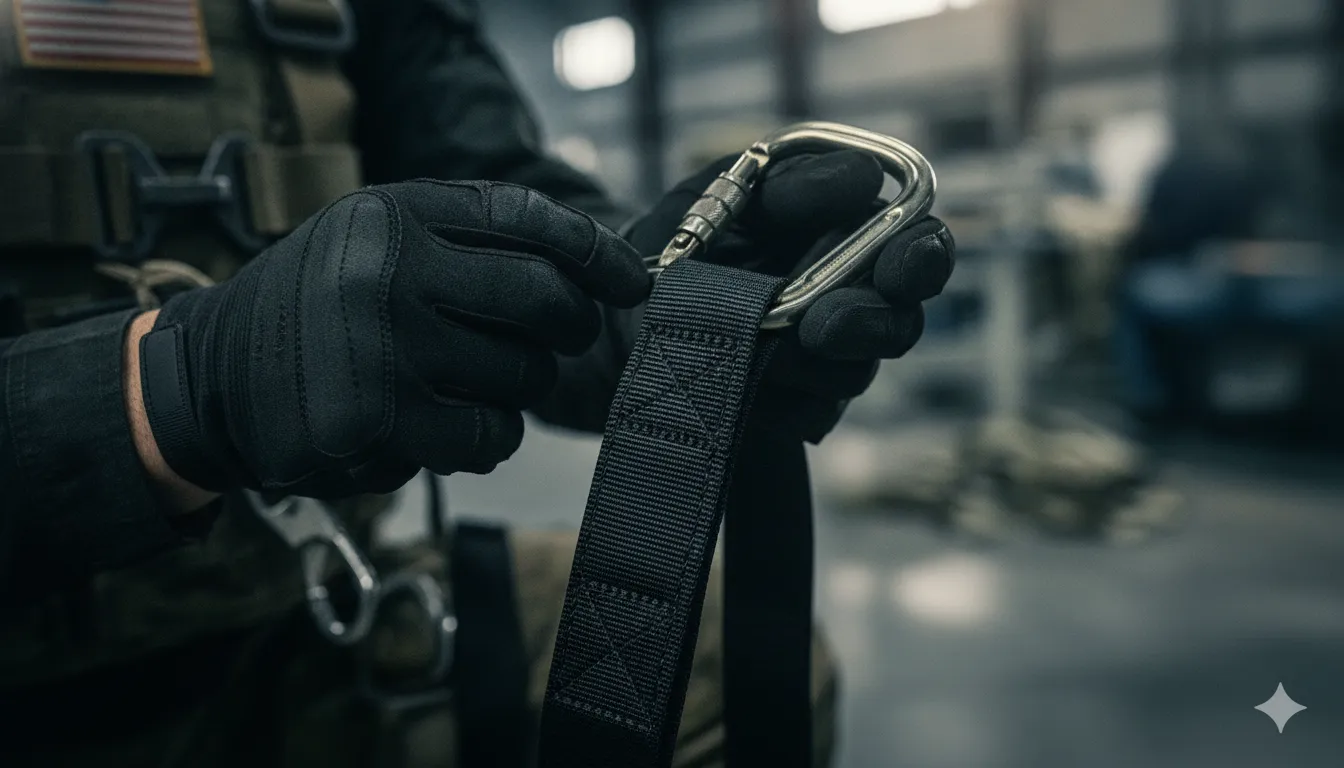
For a quick-release harness tactical program, the objective is to identify damage, configuration errors, contamination, and loss of user competence before they affect retention or release behavior.
- Perform a pre-use inspection. Before each use, the assigned user or qualified inspector should examine webbing, stitching, seams, hardware, attachment points, release components, adjustment areas, and labels. Look for cuts, abrasion, pulled or broken stitching, deformation, corrosion, contamination, heat or chemical damage, unauthorized modification, and any condition that could change fit or function. Confirm that the harness is configured for the intended mission and that all required components are present. If a defect or uncertainty is found, remove the equipment from service pending evaluation.
- Schedule periodic inspections from documented requirements. A competent person should conduct a more detailed review at the interval specified by the manufacturer, governing standard, employer program, and actual exposure history. High-cycle use, saltwater, dust, chemicals, repeated loading, transport, and harsh storage conditions may require a different approach than lightly used equipment. Record the inspector, date, equipment identifier, findings, disposition, and any corrective action. Do not substitute a generic annual interval for product-specific instructions.
- Inspect after an event or suspected overload. Any fall, arrest, hard loading, emergency extraction, uncontrolled release, impact, or exposure outside the design conditions should trigger quarantine and evaluation. Do not return a harness to service because it looks acceptable from a quick visual check. Follow the manufacturer's disposition process and preserve the inspection record, especially where the equipment may be connected to an incident investigation.
- Control cleaning, maintenance, and storage. Use only cleaning and maintenance methods authorized for the materials and hardware. Keep equipment away from unnecessary heat, moisture, ultraviolet exposure, chemicals, sharp edges, and compression that can deform components. Store it clean, dry, protected, and identifiable. Do not repair, replace, or reconfigure a release component with an unapproved substitute. Warranty guidance may apply, but it does not replace the product instructions or the responsible equipment program.
- Train users on the complete system. Training should cover donning, adjustment, fit, attachment points, load paths, release controls, compatibility limits, pre-use inspection, removal from service, and emergency procedures for the actual mission profile. Users should practice under qualified supervision and demonstrate the required tasks, rather than relying on a briefing alone. Retraining is appropriate after equipment changes, procedural changes, observed misuse, extended non-use, or a significant incident.
- Maintain records and review the program. Tie each harness to an identifier and retain inspection, training, configuration, maintenance, incident, and disposition records. Program managers should review recurring defects, missed inspections, fit issues, and user questions with the manufacturer or qualified technical authority. Fusion Tactical provides engineering, testing, and technical specification development for teams that need to reconcile equipment configuration with operational requirements.
How can procurement teams verify a supplier before approval?
Procurement teams should approve a quick-release harness supplier only after reviewing a complete, model-specific evidence package. That package should connect the intended mission and configuration to drawings, materials, ratings, test results, quality controls, traceability, delivery expectations, and post-delivery support.
The central question is not whether a supplier offers a quick-release harness tactical product. It is whether the supplier can document how the complete assembly is designed, produced, tested, controlled, and supported for the way the customer will use it.
Start with the requirement and configuration
Give the supplier a defined use case before evaluating a proposal. Describe the operational environment, users, attachment points, expected loads, movement, release requirements, environmental exposure, and any integration with aircraft, vehicles, rescue systems, or other equipment. Request drawings or configuration records that identify the harness geometry, hardware, webbing, stitching, adjustment points, and release interface.
Ask for material specifications and model-specific ratings. A rating for one buckle, connector, webbing type, or other component should not be treated as the rating of the complete harness. The assembly, intended configuration, and documented test method govern what the system can support. If ANSI Z359.1, Z359.11, Z359.12, or another standard is relevant, ask the supplier to identify the exact product-level scope and evidence rather than assuming broad compliance.
Review evidence of production control
A credible procurement package should include applicable test reports, inspection criteria, revision-controlled drawings, and records showing how materials and hardware are traced through production. Ask how nonconforming parts are handled, how engineering changes are approved, and how the supplier prevents an unauthorized substitution from entering a delivered configuration. Clarify whether testing is internal, third-party, or both, and whether the method reflects the intended use.
Quality-system information matters because repeatability is part of operational readiness. Fusion Tactical describes ISO 9001:2015 quality-management certification, internal and third-party testing, and capabilities that include textile cut-and-sew, hardware assembly, load testing, and quality control. Buyers can review the company's engineering, testing, and technical specification development capabilities, then request the records applicable to the specific harness and configuration.
Confirm lifecycle and supply support
Before approval, document lead time, production capacity, inspection and training guidance, replacement-part support, warranty terms, and the process for future configuration changes. U.S.-based manufacturing may also support communication, traceability, and program coordination, but it should be verified against the actual contract and delivery requirements. Fusion Tactical manufactures in Chino, California and offers U.S.-based manufacturing capabilities.
When the standard catalog configuration does not match the mission, use a documented requirements review rather than forcing a near match. A supplier's custom solutions process can help procurement and engineering teams define the required configuration before approval.
When is a quick-release harness the wrong interface?
Direct answer: A quick-release harness may be the wrong interface when the mission depends on a different load path. A certified fall-arrest function, a hoisting or extraction connection, or compatibility that has not been verified for the complete assembly. It is also unsuitable when field modifications have changed the documented configuration.
The term "quick release" describes an interface feature, not a complete performance category. Selection should begin with the expected event and load direction. If the system must retain an operator during helicopter movement, support a rescue hoist, arrest a fall, restrain movement. Or connect to an extraction device, those requirements may call for different attachment points, hardware, webbing paths, or system documentation. A release mechanism should not be treated as interchangeable with a primary retention, fall-arrest, or lifting interface.
When the load case does not match
Fall arrest and restraint are not the same use case. Restraint limits access to a hazard, while fall arrest is designed to manage the forces associated with a fall through a specifically evaluated system. A quick-release buckle or connector that helps with donning or doffing does not, by itself, establish fall-arrest suitability. Confirm the intended function, attachment point, energy-management requirements, and applicable product documentation before approval.
Hoisting and extraction create another boundary. These operations may require a dedicated connection with defined orientation, hardware, and compatibility requirements. Do not assume that a convenient quick-release point can carry the same function as a hoist or extraction interface. The complete harness configuration and the equipment instructions must govern that decision.
When compatibility or configuration is uncertain
Compatibility concerns include mating hardware, attachment geometry, load direction, clearance, release access, and interaction with adjacent equipment. Unapproved substitutions, added components, removed retainers, altered webbing paths, or undocumented sewing and hardware changes can invalidate the original evaluation. If a team cannot identify the approved configuration and its supporting records, the correct action is to pause selection and obtain technical confirmation.
Procurement teams can compare requirements against the tactical and rescue harness collection, then request model-specific documentation for the intended mission. Fusion Tactical supports custom hardware configurations, technical specification development, prototyping, and load testing. Which can help clarify whether a quick-release architecture fits or whether another interface is more appropriate.
Request a quote or engineering consultation
Frequently Asked Questions
What should a procurement team request before approving a quick-release harness?
Request model-specific drawings, materials, intended-use limits, load-path documentation, compatibility requirements, inspection guidance, and recognized test-performance data. The complete harness configuration matters more than any isolated buckle, webbing, or connector rating. OSHA recommends obtaining supplier test-performance information before purchasing a personal fall protection system: OSHA guidance.
Can a quick-release mechanism be treated as the primary load-bearing connection?
Only when the manufacturer documents that function for the exact harness and configuration. Buyers should identify which components carry operational loads, how forces transfer through the webbing and hardware, and whether the release can be actuated under tension. Do not assume a quick-release feature is suitable for fall arrest, hoisting, retention, or rescue simply because it appears mechanically robust.
How can teams reduce the risk of accidental release?
Verify the mechanism's locking sequence, protection from snagging or unintended actuation, compatibility with clothing and adjacent equipment, and any required pre-use function checks. Training should cover system limits, proper attachment methods, inspection, and storage. OSHA specifically emphasizes training on equipment limitations and pre-use inspection: OSHA guidance.
When should a tactical harness be removed from service?
Remove it when inspection identifies cuts, tears, abrasion, contamination, damaged hardware, altered components, malfunctioning parts, or other conditions that could affect effectiveness. Equipment subjected to impact loading should also be removed until a competent person determines that it is undamaged and safe for the intended use. Follow the product instructions and the governing program requirements.
How often should a quick-release harness be inspected?
Perform a documented pre-use inspection at the frequency required by the applicable equipment instructions, operational program, and governing standard. For personal fall protection systems, OSHA states that inspection is required before initial use in each workshift. Additional inspections may be appropriate after an event, harsh exposure, repair, or configuration change.
Ready to discuss your harness requirement?
A technical discussion can help your team clarify the mission profile, load paths, interface requirements, inspection expectations, and documentation needed for a tactical or rescue harness procurement. Share the intended application and key requirements so the conversation starts with the right engineering context. Contact Fusion Tactical USA to request a technical discussion with the team.


