

DFARS Compliant Tactical Equipment: Buyer Guide
Federal tactical safety-equipment procurement rarely turns on a vendor label alone. Contracting teams must connect the solicitation, applicable clauses, supplied item, materials, and required records before accepting a compliance claim.
That distinction matters because DFARS, the Defense Federal Acquisition Regulation Supplement, can impose obligations that are separate from domestic sourcing rules or federal procurement eligibility.
In practice, dfars compliant means the relevant product and supply chain satisfy the DFARS provisions that apply to the specific solicitation or contract, supported by verifiable supplier evidence.
It does not automatically mean that an item is Berry Amendment compliant, TAA eligible, or covered by a universal product certification.
Request a procurement documentation review from Fusion Tactical
For buyers, the defensible approach is clause-specific review followed by documentation that can be tied to the order.
That includes asking what requirement applies, who must perform it, and which records demonstrate conformity. The sections that follow establish the scope first, then connect DFARS language to the evidence procurement and supply-chain teams should retain.
What Does DFARS Compliant Mean for Tactical Equipment Buyers?
DFARS compliant means that a product, supplier, or contract performance meets the specific Defense Federal Acquisition Regulation Supplement clauses that apply to a DoD solicitation or contract. It is not a universal product badge, and the phrase alone does not identify which requirements have been satisfied.
For tactical equipment buyers, the controlling question is not whether a supplier uses the phrase dfars compliant. The question is which DFARS provisions are incorporated into the procurement, what obligations they create, and what evidence demonstrates compliance for the applicable item, order, and supply chain.
DFARS is a contract and acquisition framework
DFARS supplements the Federal Acquisition Regulation for Department of Defense acquisitions. Its provisions and clauses address different subjects, so applicability depends on the solicitation, contract type, item or service, and the circumstances of performance. A buyer should review the solicitation and incorporated clauses before setting a supplier requirement or evaluating a response.
For example, DFARS 252.204-7012 addresses safeguarding covered defense information and cyber incident reporting. Other clauses address subjects such as safeguarding controls or restrictions involving specialty metals. Those obligations are materially different from a general claim about a piece of hardware being compliant.
What should buyers ask a supplier?
Start by identifying the exact clause language and its flow-down requirements. Then ask the supplier to map its responsibilities to the product and order being quoted. Useful evidence may include certificates of conformity, product-specific test reports, material and process traceability, and records supporting the required manufacturing or sourcing conditions.
U.S. manufacturing, Berry Amendment capability, TAA status, ISO certification, CAGE registration, or a MIL-STD designation may be relevant procurement information. None of those facts, standing alone, proves that every product or order is DFARS compliant. Requirements should be confirmed against the governing solicitation and documented for the specific procurement.
That clause-specific approach gives contracting teams a defensible file and helps prevent a broad marketing label from being mistaken for contract compliance.
Which DFARS Requirements Can Affect Safety-Equipment Procurement?
DFARS requirements can affect a safety-equipment purchase through the specific clauses included in the solicitation, contract, or flow-down terms. The relevant issue may involve protection of covered defense information, cyber incident reporting, specialty-metal restrictions, or the composition of a particular article. A product should not be described as universally dfars compliant without confirming the applicable clause language and the evidence required for that order.
For procurement purposes, buyers should map each clause to the product, supplier, material, data environment, and contract obligation it actually governs. Use the current solicitation and contract as the controlling references, and obtain contracting or legal guidance for interpretation when needed.
- Check whether covered defense information controls apply. DFARS 252.204-7008 addresses compliance with safeguarding controls for covered defense information. DFARS 252.204-7012 addresses safeguarding covered defense information and cyber incident reporting. These clauses can make information handling, supplier systems, incident response, and subcontractor practices relevant to the procurement, even when the item itself is a physical safety component. Review the clause text and any incorporated requirements at 252.204-7008 and 252.204-7012.
- Determine whether specialty-metal restrictions apply. DFARS 252.225-7008 establishes a restriction concerning the acquisition of specialty metals. DFARS 252.225-7009 addresses certain articles containing specialty metals. If either clause applies, buyers should identify the affected articles and materials, confirm the required sourcing or qualifying exceptions, and retain supplier documentation that supports the determination. Review the current provisions at 252.225-7008 and 252.225-7009.
- Separate clause compliance from general supplier credentials. A supplier's domestic manufacturing capability, quality certifications, or prior defense work may support due diligence, but those facts do not automatically establish compliance with every DFARS clause. Ask for product-specific material, process, testing, and conformity records that match the solicitation's requirements. If a requirement is unclear, ask the contracting officer to confirm its scope before purchase or substitution.
- Document the procurement decision. Record the clauses reviewed, the applicable product or material scope, supplier representations, supporting records, and any approved exception or clarification. Reconfirm the requirements for each new solicitation because clause applicability and contract language can change. This section is procurement guidance, not legal advice, and buyers must confirm the current solicitation language and applicability before relying on a compliance determination.
How Should Buyers Verify a Supplier's DFARS Evidence?
Answer: Buyers should verify a DFARS-related claim against the exact solicitation, clause, product configuration, and order. A credible evidence package connects the requirement to traceable certificates, test reports, material records, and controlled production documentation.
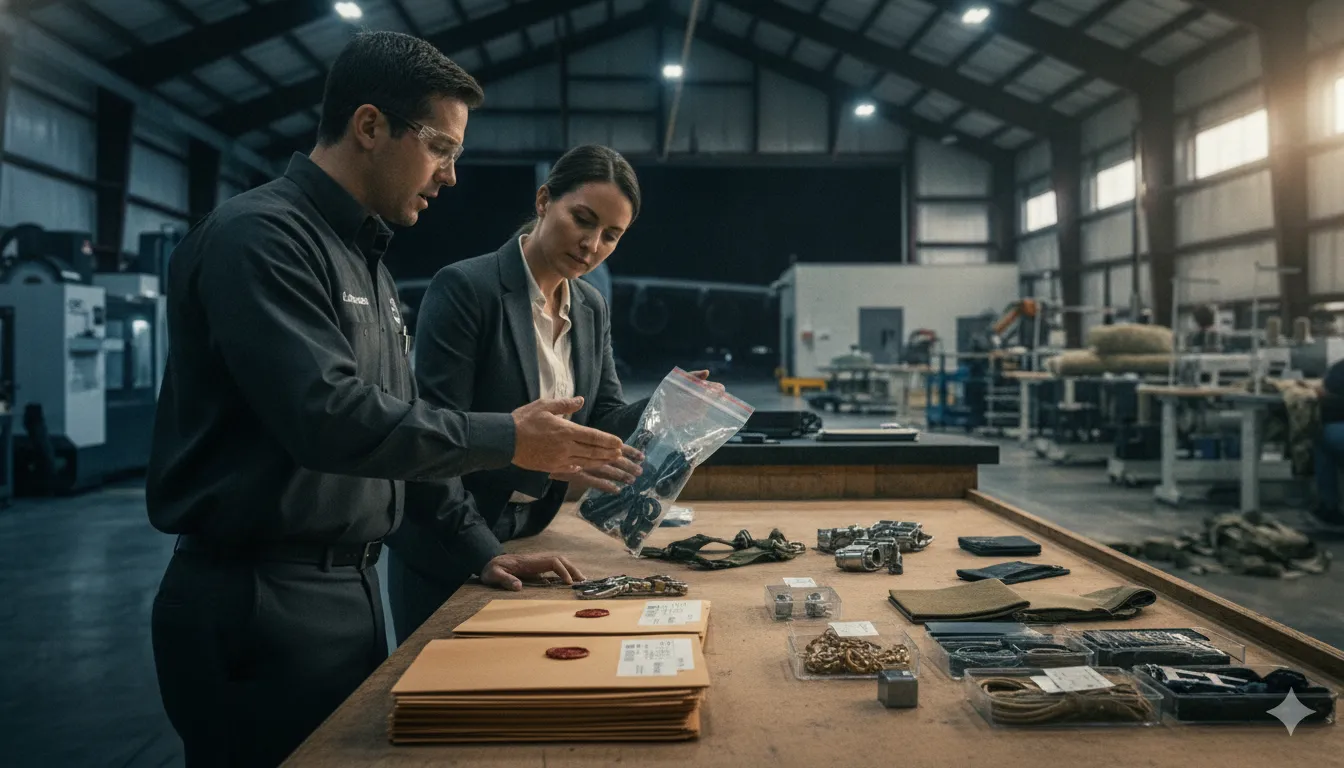
Buyers should verify DFARS evidence against the exact solicitation, contract clauses, product configuration. And order rather than accepting a general claim that an item is "dfars compliant." The strongest supplier package connects each applicable requirement to specific records. Identifies who issued or approved those records, and preserves enough traceability for an auditor or contracting officer to follow the item back through its materials and production history.
A practical review should include the following steps:
- Map the applicable clauses. Start with the solicitation, contract, purchase order, and all incorporated flow-down terms. Record the clause number, the requirement it creates, the affected item or process, and the party responsible for providing evidence. Do not assume that a supplier's Berry Amendment capability, TAA status, ISO certification, CAGE registration, or MIL-STD designation independently proves DFARS compliance.
- Request certificates of conformity. Ask for a certificate tied to the specific product, part number, revision, order, or lot. It should identify the supplier, the applicable specification or purchase requirement, the date, and the responsible signatory. A generic company brochure or undated policy statement is useful background, but it is not a substitute for an order-specific declaration.
- Review product-specific testing. Request test reports that match the delivered configuration and the performance requirement being evaluated. Check the sample identification, test method, laboratory or tester, test date, acceptance criteria, and disposition of any failure or deviation. Fusion Tactical's documented capabilities include product-specific reports and in-house strength, material, environmental, and batch testing, with independent verification available where applicable. Buyers should confirm which evidence applies to their item and order.
- Trace materials and processes. Evidence should connect material certifications, approved suppliers, manufacturing steps, process records, inspections, and final release documentation. Ask how the supplier controls revisions, substitutions, nonconforming material, and rework. Document control and material or process traceability are more useful than an unsupported statement that a product is compliant.
- Match records to the lot or order. Confirm that certificates, test results, inspection records, and shipping or release documents reference the same part number, revision, lot, serial number, or purchase order. If the supplier offers custom production, clarify whether the requested configuration was produced under the same controlled requirements and whether complete traceability is available for that order.
- Confirm flow-down responsibilities. Ask the supplier to identify which requirements must pass to subcontractors, material vendors, or lower-tier manufacturers. Obtain confirmation that the necessary terms were communicated and that supporting records can be produced if requested. Keep the evidence package with the procurement file, and document any exception, waiver, alternate material, or customer approval.
For a focused review, see Fusion Tactical's certifications and compliance documentation and engineering and testing support. These resources can help identify available records, but the buyer must still determine which evidence satisfies the applicable contract clauses.
How Is DFARS Different From Berry Amendment and TAA?
DFARS, the Berry Amendment, and the Trade Agreements Act (TAA) are distinct procurement frameworks. They may apply to the same purchase, but one does not automatically establish compliance with the others. The controlling solicitation, contract clauses, product scope, origin rules, and requested supplier records determine what a buyer must verify.
For that reason, a claim that a product is dfars compliant should be tied to the applicable contract requirements and item-specific evidence, not used as a universal label.
| Framework | Primary procurement question | What it addresses | What it does not prove by itself |
|---|---|---|---|
| DFARS | Which Defense Federal Acquisition Regulation Supplement clauses apply to this DoD contract? | Defense-specific contract obligations. Depending on the solicitation and clause flow-downs, requirements may concern cybersecurity, covered information, specialty metals, or other defined areas. | It does not create one universal certification covering every product, order, or supplier. |
| Berry Amendment | Are applicable items and materials sourced and manufactured as required for the defense purchase? | Domestic sourcing and manufacturing requirements for covered items, when the rule applies. | U.S. production or Berry capability alone does not establish compliance with every DFARS clause or TAA origin rule. |
| TAA | Does the product meet the applicable federal procurement country-of-origin requirements? | Federal procurement and, where applicable, GSA eligibility considerations tied to designated-country origin rules. | TAA status alone does not prove Berry sourcing, defense-clause compliance, or fulfillment of a particular DoD contract. |
These distinctions matter when reviewing supplier statements. Fusion Tactical's knowledge base describes Berry Amendment-compliant custom production using 100% U.S.-sourced materials and domestic manufacturing when specified, while also noting that standard products may include non-U.S. components. It separately identifies TAA capability for federal procurement. Those claims must still be matched to the product configuration, order, and solicitation.
Procurement teams can review the company's Berry Amendment sourcing requirements and its government contracting capabilities, then request the records needed for the specific purchase. Useful evidence may include certificates of conformity, product-specific test reports, and material or process traceability. None should be treated as a substitute for reviewing the contract clauses that govern the acquisition.
What Should a Federal Buyer Put in the Procurement File?
Answer: A defensible procurement file should connect the solicitation and contract clauses to the exact product. Configuration, supplier representations, origin evidence, testing records, and quality controls used for the purchase. Because dfars compliant is not a universal product certification, retain evidence that is specific to the applicable requirement and order.
Use the following checklist as an operational starting point. Contracting officers should apply the solicitation, agency procedures, and applicable acquisition guidance rather than treating this list as legal advice.
- Preserve the requirement baseline. Save the solicitation, statement of work, specifications, amendments, contract clauses, and any flow-down requirements that affect the equipment, materials, cybersecurity, sourcing, testing, or delivery. Record the product part number, revision, quantity, configuration, and contract line item so later records can be matched to the purchase.
- Capture supplier representations. Keep the supplier's signed representations, certificates, and responses to the solicitation. Separate claims about U.S. manufacturing, Berry Amendment capability, TAA eligibility, quality systems, and product-specific requirements. Each representation should identify its scope, effective date, covered item, and supporting record.
- File origin and traceability evidence. Retain country-of-origin documentation, material certifications, lot or batch identifiers, bills of material where appropriate, and records showing how materials and processes were controlled. Do not substitute a general "made in USA" statement for the evidence required by the applicable contract language.
- Attach testing and conformity records. Include the applicable product specification, certificate of conformity, product-specific test report, inspection results, and any independent or third-party verification. Fusion Tactical states that certificates of conformity, product-specific test reports, and material or process traceability can be provided upon request. Confirm that each record identifies the product and order covered.
- Document quality and change controls. Retain nonconformance dispositions, corrective actions, approved deviations, inspection records, and configuration approvals when relevant. Establish a review trigger for supplier, material, manufacturing-location, design, or process changes, and refresh representations and origin evidence at renewal or recompete.
For additional context, review the guidance on U.S.-based manufacturing and contact Fusion Tactical to request documentation for a specific product, order, or procurement requirement.
Frequently Asked Questions
What does DFARS compliance mean for a tactical equipment purchase?
It means the purchase is evaluated against the DFARS clauses incorporated into the applicable solicitation or contract. DFARS is not a universal product label. The buyer should identify the relevant clauses, then confirm that the item, materials, supplier, and required records satisfy those specific obligations. For example, some clauses address safeguarding covered defense information, while others address specialty metals. See the applicable Acquisition.gov clause text, including DFARS 252.204-7012 and 252.225-7008.
Who needs to comply with DFARS requirements?
Compliance responsibilities can flow from the prime contract to subcontractors and suppliers when the relevant clauses apply. Contracting officers and prime contractors should review the solicitation, contract, and flow-down language rather than assuming that every federal purchase has identical requirements. A supplier should be prepared to identify which product and order records support the applicable obligation.
What evidence should a supplier provide?
Request product- and order-specific evidence such as certificates of conformity, material and process traceability, test reports, and applicable manufacturing or inspection records. The evidence should match the purchased configuration and the contract requirement. A general quality credential or a supplier statement alone does not establish that a particular item is DFARS compliant.
Is Berry Amendment compliance the same as DFARS compliance?
No. Berry Amendment requirements generally concern U.S. sourcing or domestic manufacturing for applicable covered items. DFARS is the broader DoD acquisition supplement, and a specific DFARS clause may impose a different obligation. A Berry-capable supplier still needs to evaluate the solicitation and provide evidence for the actual purchase.
Is TAA compliance enough for a DFARS purchase?
No. TAA status addresses federal procurement country-of-origin rules and eligibility in applicable purchasing channels. It does not by itself prove compliance with a DFARS clause, specialty-metal restriction, cybersecurity requirement, or other contract term. Treat TAA, Berry sourcing, and DFARS as separate checks in the procurement file.
Ready to discuss your procurement evidence needs?
When a solicitation includes DFARS-related requirements, a clause-specific review can help align product documentation, testing records, and supplier evidence with the buyer's request. Fusion Tactical can discuss your solicitation and documentation needs in the context of the applicable contract requirements.
Contact Fusion Tactical to discuss your procurement evidence needs.


