

Aircraft Maintenance Fall Protection
Aircraft maintenance puts workers around fuselages, wings, stabilizers, open panels, stands, platforms, and transitions where a single generic control may not fit every task. A useful buyer guide therefore starts with the work process, not a catalog page. The objective is to select controls that match worker movement, available clearance, anchor geometry, rescue capability, inspection practice, and supplier documentation.
Request a quote for an aircraft maintenance safety system
Effective aircraft maintenance fall protection begins with a task-specific hazard assessment. The assessment then separates restraint from fall arrest based on whether the worker can be kept away from the exposure or must be protected if a fall occurs. The program should also define compatible anchors and lifelines, inspection records, training, rescue planning, and the technical evidence required from suppliers.
This approach addresses personal equipment and program implementation without treating a harness, lanyard, or anchor as proof that a hangar-wide system is properly engineered. The first step is identifying the hazards created by each maintenance activity and transition.
What Hazards Should an Aircraft Maintenance Fall Protection Program Address?
An aircraft maintenance fall protection program should address the specific exposure created by each maintenance task, not treat the aircraft or facility as one uniform work area. Evaluate access to fuselages, wings, stabilizers, stands, platforms, open panels, and transitions, then match controls to the worker's movement, connection point, and ability to complete the task safely. This task-level assessment is central to both equipment selection and work planning.
The U.S. Air Force Fall Protection Field Guide identifies hazard assessment, equipment use, rescue planning, and training as program controls. Those controls become more useful when they are applied to the actual aircraft surface and work sequence.
Fuselage and upper-surface access
Fuselage work can expose technicians to changing edge conditions as they move along curved or elevated surfaces. The assessment should identify where a worker mounts or leaves an access platform, where the usable walking surface narrows, and whether tools or components change the worker's posture. A connection arrangement that works at one service point may restrict movement or create a poor line of travel at another.
Inspectors and maintenance planners should also account for open panels, removed access covers, and temporary work areas. These openings can change the exposure during a single job. The work instruction should state when protection is required, where the worker connects, and how the opening or edge is controlled while the task progresses.
Wings, stabilizers, and changing work positions
Wing and stabilizer tasks often require technicians to reach, reposition, or move around structures with limited working room. The hazard review should cover the full route, including the approach to the aircraft, movement across the work surface, and exit from the area. It should not assess only the point where the hands-on repair occurs.
Consider the position of leading and trailing edges, control surfaces, surface transitions, and nearby obstructions. A worker may face a different exposure while climbing onto a stand than while servicing a component from the stand. The selected equipment and procedure must support the required movement without encouraging workers to disconnect, bypass a control, or work outside the protected area.
Stands, platforms, and transitions
Work stands and platforms introduce their own edges, gaps, access ladders, and transfer points. Review the handoff between a platform and the aircraft, between adjacent platforms, and between a platform and the floor. Transitions deserve explicit attention because they are often where a worker changes body position, connection method, or direction of travel.
Program records should connect each task assessment to the applicable equipment, inspection criteria, training, and rescue plan. A repeatable fall protection harness inspection process can support readiness documentation, but it does not replace the task hazard assessment. The objective is a usable maintenance workflow in which the protection method remains compatible with the aircraft, the access equipment, and the work being performed.
How Should Maintenance Teams Choose Restraint Versus Fall Arrest?
Choose restraint when the system can reliably prevent the worker from reaching the fall exposure. Choose fall arrest only when the task requires access beyond that boundary and the complete system can limit the fall within the available clearance. The decision must also account for movement, anchor geometry, and how the worker will be rescued after a fall.
For aircraft maintenance, this is a task-level decision rather than a blanket rule for an entire hangar. A technician working near a fuselage edge, stabilizer, wing, open panel, or an elevated platform may need a different control based on the work position and the direction of travel. The U.S. Air Force Fall Protection Field Guide identifies available clearance, movement, anchor geometry, and rescue capability as factors in selecting the approach.
| Consideration | Restraint | Fall arrest |
|---|---|---|
| Primary purpose | Prevents the worker from reaching the exposure. | Allows a fall, then limits its consequences through a compatible system. |
| Clearance | Requires enough control range to keep the worker on the safe side of the edge. | Requires verified clearance for the fall and the system's stopping action, with no lower-level impact hazard. |
| Movement and geometry | Anchor location and connection length must restrict travel in the direction of the exposure. | Anchor position, connection path, and potential swing must be evaluated for the actual work area. |
| Emergency planning | Still requires a response plan for injury, equipment failure, or an unexpected event. | Requires a defined rescue plan because a suspended worker may need prompt assistance. |
Clearance can decide the selection
A fall-arrest setup is not automatically suitable because an anchor is available. The team must determine whether the distance below the work surface is sufficient for the system to function without contact with a lower level or aircraft structure. For example, assume a technician's attachment point is 18 feet above the hangar floor, the selected connector and absorber require 4 feet for the system's stopping action, the harness and worker movement allowance is 3 feet, and the planned swing or setup allowance is 2 feet. The preliminary clearance budget is 9 feet, leaving 9 feet before the floor or aircraft structure, but the competent person must verify the actual equipment instructions, maximum arrest distance, worker dimensions, anchor deflection, swing-fall geometry, and any applicable OSHA requirements and ANSI Z359 system criteria before authorizing the task. If the required clearance cannot be demonstrated, restraint may be the more appropriate control, provided it still permits the work to be completed safely.
Movement changes the risk
Maintenance work rarely occurs at one fixed point. A technician may move around a wing, transition between a stand and an aircraft surface, or reach across a work area. The anchor arrangement must control the relevant direction of travel. A connection that works at one position may allow the worker to reach an exposure after repositioning. Teams should evaluate the full task path, not only the initial setup.
Documentation should state the intended use, compatible components, rated capacity or strength, installation requirements, inspection criteria, limitations, and available test or compliance evidence. Those records support a defensible selection, but they do not replace a site-specific hazard assessment or rescue plan. Avoid assuming that every aircraft task requires fall arrest, and avoid treating restraint as adequate when the worker must deliberately cross the exposure to perform the job.
Which Anchors and Lifelines Fit Aircraft Maintenance Tasks?
The right anchor or lifeline depends on the maintenance task, the worker's travel path, the aircraft geometry, and the documented load path. Portable anchorage and task-level systems can serve changing work locations, while fixed overhead rails or enclosed-track systems may be appropriate where repeatable work occurs in a defined bay. Selection should be based on a documented assessment, not on a generic preference for one equipment type.
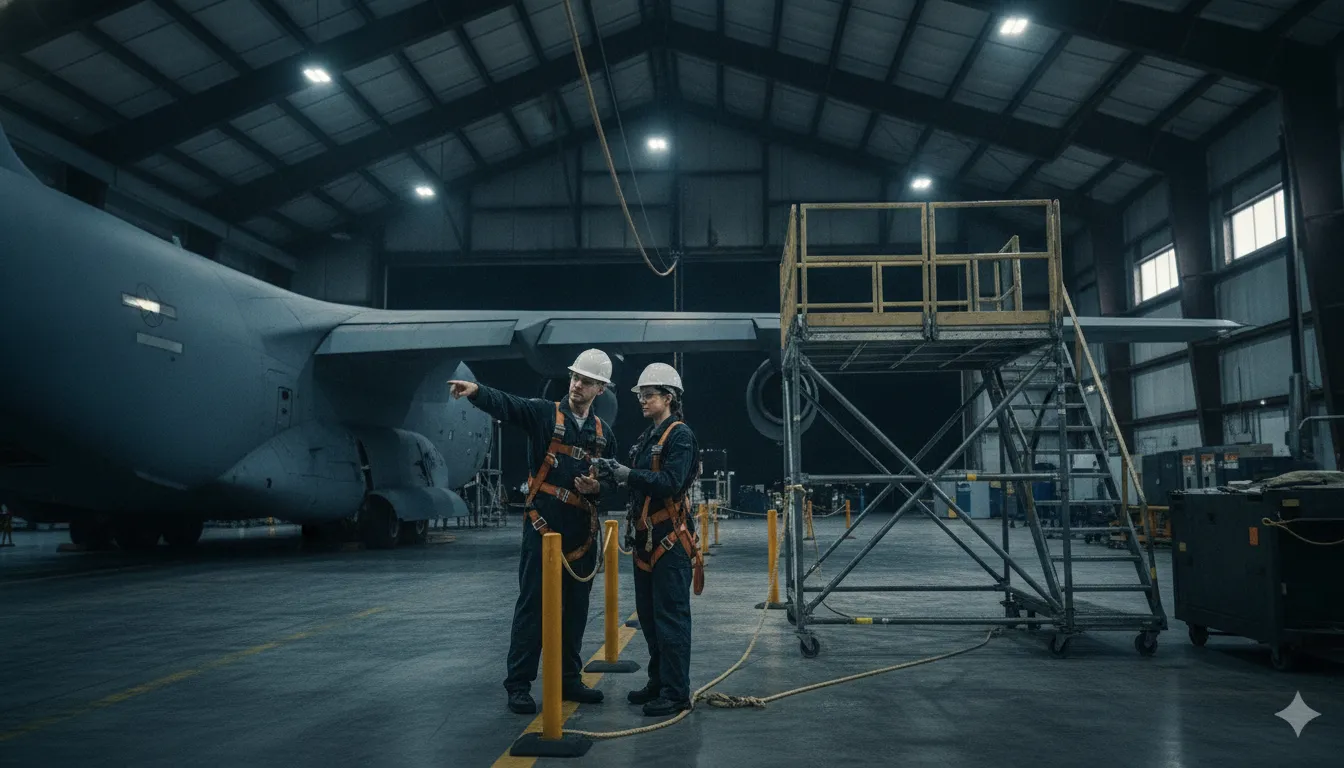
Aircraft maintenance fall protection must account for the shape and access points of the aircraft. Work on a wing, fuselage, stabilizer, work stand, open panel, platform, or transition can create different movement and clearance requirements. A connection that works beside a fuselage may restrict access around a vertical stabilizer or introduce an awkward swing path near an open panel. Map the worker's actual route before choosing the anchor location and connector arrangement.
Match the system to the travel path
Fixed overhead systems, including rigid rail and enclosed-track configurations, are designed for recurring movement along a planned route. They can support predictable maintenance tasks when the installation geometry, clearance, and access points are known. A mobile or portable system is more suitable when crews move between aircraft, work zones, or temporary maintenance positions. Portable anchorage can reduce infrastructure requirements, but it still requires verification that the supporting structure, setup, and connection method are appropriate for the task.
Do not treat portability as a substitute for engineering. A portable device must be evaluated for where it will be placed, how it will be secured, and whether the worker can remain connected while moving around the aircraft. Supplier documentation should identify intended use, compatible components, rated capacity or strength, installation requirements, inspection criteria, and limitations. Those details allow safety managers and procurement teams to compare equipment against the work package rather than selecting from a product name alone.
Separate maintenance equipment from hangar-wide architecture
A task-level anchor or lifeline solves a specific access and movement problem. It does not automatically define the design of an entire hangar. Hangar-wide systems require broader decisions about structural integration, coverage, multiple work positions, traffic patterns, rescue planning, and ongoing inspection. For that larger design question, see the aircraft hangar fall protection systems guide, then return to the maintenance task to verify the component-level requirements.
Finally, require a clear load path from the worker connection through the anchor, supporting structure, and any intermediate components. The procurement record should preserve the system's intended configuration and installation limits. The maintenance team should know which components are compatible and which conditions require removal from service. This approach keeps aircraft maintenance fall protection aligned with the aircraft's geometry, the crew's workflow, and the evidence needed to operate the system responsibly.
How Do Inspection Records and Worker Workflow Make the System Usable?
A usable aircraft maintenance fall protection program connects the equipment to the work sequence, the assigned worker, and the rescue plan. Inspection records show whether equipment remains suitable for service, while a documented briefing confirms that workers understand the task-specific hazards, limits, and response actions. The U.S. Air Force Fall Protection Field Guide treats hazard assessment, equipment use, rescue planning, and training as connected program controls: the field guide.
- Assess the task before assigning equipment. Identify the actual work area and movement required, including access to the fuselage, wings, stabilizers, work stands, open panels, platforms, and transitions. Determine whether the selected approach keeps the worker from reaching the exposure or requires a fall-arrest arrangement. Record anchor geometry, available clearance, potential swing exposure, and the practical route for rescue. A maintenance task should not inherit a generic control simply because it occurs in the same hangar as another job.
- Assign compatible equipment and a defined user. Match the equipment to the task, the worker's required movement, and the approved anchor or lifeline arrangement. Supplier documentation should identify intended use, compatible components, rated capacity or strength, installation requirements, inspection criteria, limitations, and relevant test or compliance evidence. Record the equipment identifier and assignment so the pre-use review is tied to the actual configuration, not only to a general inventory count.
- Complete and retain inspection records. The worker or designated competent person should examine the equipment in accordance with the applicable instructions and site procedure before use. Record the inspection date, equipment identity, condition, findings, and disposition. Any item with damage, an uncertain history, or a condition outside the documented limits should be removed from service pending an authorized determination. Records create traceability across recurring maintenance tasks and help supervisors identify patterns that a single visual check may miss.
- Brief the worker at the point of work. Cover the task boundary, access route, connection method, equipment limitations, movement restrictions, and what to do if conditions change. The briefing should confirm that the worker knows which anchor or lifeline is approved for the task and how to summon assistance. Training is not a substitute for a task-specific briefing, particularly when aircraft configuration or access conditions differ from the previous job.
- Confirm rescue readiness before exposure. Identify who will respond, what access route they will use, and which equipment or communication method supports the response. Do not treat rescue planning as paperwork completed after an incident. The plan should be practical for the aircraft position and work area, and the team should know when to stop work and escalate an unexpected condition.
- Close the record after the task. Document the completed work, equipment condition, defects or near misses, changes to the setup, and any follow-up required. Feed those findings into the next hazard assessment and equipment review. This closes the loop between field use and program control, allowing the maintenance organization to improve assignments, briefings, inspection criteria, and supplier requirements over time.
What Should Procurement Teams Require From a Fall-Protection Supplier?
Procurement teams should require more than a harness or lanyard datasheet. A suitable supplier must show that the equipment matches the maintenance task. That the complete load path and anchorage assumptions are documented, and that workers can inspect, use, and recover with the system as intended. The supplier should also provide traceability, compliance evidence, training support, and responsive engineering assistance.
For aircraft maintenance fall protection, the buying decision should connect equipment documentation to the actual work process. Do not treat a product certification or component rating as proof that an entire aircraft maintenance system is suitable without site-specific engineering and hazard assessment.
Require task-specific technical documentation
Start with intended use. The supplier should identify whether each component supports restraint, positioning, fall arrest, or another defined function, along with compatible connectors, anchor geometry, movement limits, clearance requirements, and rescue considerations. Documentation should state rated capacity or strength where applicable, installation requirements, limitations, inspection criteria, storage guidance, and the conditions that require removal from service.
Ask for the load path to be explained from the worker and connectors through the anchor and supporting structure. If the solution includes a fixed or portable anchorage, lifeline, or interface with existing aircraft or facility equipment, require installation instructions and confirmation of compatibility. A competent person or qualified engineer must still evaluate the work area, structure, clearance, and rescue plan. Supplier literature cannot replace that review.
Require evidence that supports procurement and quality review
A complete submittal package should include current user instructions, inspection forms or criteria, lot or serial traceability where provided, test or compliance evidence, and written clarification of applicable standards. The U.S. Air Force Fall Protection Field Guide identifies hazard assessment, equipment use, training, rescue planning, and program controls as connected responsibilities. Your supplier should be able to support those responsibilities without implying that a product alone makes the program compliant.
For government and aerospace buyers, confirm the supplier's manufacturing location, quality processes, and ability to provide documentation required by the contract. Fusion Tactical supports aerospace, defense, government, and industrial buyers from its California manufacturing operation, with in-house engineering, testing, and technical specification development. Its stated capabilities include Berry Amendment and TAA support, but procurement teams should request current project-specific evidence rather than assume every configuration carries the same status. Review the company's engineering, testing, and validation support and Berry Amendment compliant manufacturing information as part of due diligence.
Evaluate support after the purchase
Ask how the supplier handles configuration questions, training, inspection interpretation, replacement parts, changes in scope, and rescue-system integration. A responsive engineering partner can help reconcile custom dimensions, hardware configurations, prototypes, and production requirements before a mismatch reaches the hangar floor. Procurement teams should also define who owns inspection records, worker training, equipment quarantine, and recurring technical reviews.
Use a fall protection harness inspection process to test whether the supplier's documentation is usable by the people performing pre-use checks. The strongest supplier is not simply the one with the most specifications. It is the one that can demonstrate a defensible connection between the task, the equipment, the supporting structure, the records, and the people responsible for safe use.
Request a quote for aircraft maintenance fall protection
Frequently Asked Questions
How should a maintenance team assess each aircraft task?
Start with the actual work position, access route, exposed edges, openings, aircraft geometry, movement required, and the consequences of a fall. Identify whether guards or other controls can eliminate exposure before selecting personal equipment. Applicable OSHA requirements and project or service rules should be checked for the specific work environment, and those requirements may be more stringent than a baseline program.
What is the difference between restraint and fall arrest?
Travel restraint is intended to prevent the worker from reaching a fall hazard. Fall arrest permits exposure and limits the effects of a fall after it begins. The choice depends on the task, compatible equipment, anchorage, available clearance, and rescue plan. Treat travel restraint, positioning, and personal fall arrest as distinct control categories in the written program.
How should teams evaluate anchors and lifelines?
Evaluate the aircraft or facility structure, allowable connection points, line travel, swing-fall exposure, clearance, and interference with maintenance work. Confirm compatibility among the harness, connectors, lifeline, and anchorage through current manufacturer documentation. Do not assume that a portable anchor or an existing lifeline is suitable without site-specific engineering and verification.
What should inspection records include?
Records should identify the equipment, inspection date, person performing the inspection, findings, disposition, and any corrective action. Workers should inspect equipment before use and at required intervals defined by the applicable program and manufacturer instructions. Remove questionable equipment from service and retain traceability, user instructions, and relevant test or service documentation.
How should clearance and rescue be addressed before work begins?
Calculate the potential fall distance and verify that the system will not contact the aircraft, floor, structure, or another hazard. Establish a practical rescue method, responsible personnel, communications, and access before authorizing work. Fall arrest systems require training and a rescue procedure; a qualified safety professional should validate the task-specific plan.
What supplier documentation should a buyer request?
Request current datasheets, user instructions, applicable standards information, inspection guidance, traceability records, and test or quality documentation tied to the specified equipment. For government or aerospace procurement, also confirm manufacturing location, configuration control, and any required Berry Amendment or TAA evidence. Product claims should be supported by written manufacturer documentation, not a general certification alone.
Schedule an Engineering Consultation
Aircraft maintenance safety systems must fit the work, the equipment, and the documentation expectations of your operation. A focused engineering discussion can help your team define practical requirements for restraint, arrest, anchors, lifelines, inspections, and supplier records before procurement.


