

Modular MOLLE Belt Professional Grade Buyer Guide for Teams
For defense, law-enforcement, and public-safety teams, a modular belt is not simply a platform for attaching pouches. It is one part of a load-bearing system that must preserve fit, retention, mobility, and configuration control as mission requirements change. Excess weight and poorly matched components can undermine the value of an otherwise durable belt.
A modular MOLLE belt professional grade system should be evaluated through its complete integration. That includes precise MOLLE or PALS compatibility, appropriate stiffness and load distribution, reinforced construction, compatible hardware, maintainable configuration, and documentation that supports the intended procurement. It should also be treated as equipment carriage unless product documentation specifically establishes a different safety application.
Request a quote for a professional modular MOLLE belt configuration
The most reliable buying decision starts with a defined evaluation matrix rather than a feature checklist. That means examining how the belt carries weight, how accessories attach and retain, and how the construction supports inspection and team-level standardization.
What Makes a Modular MOLLE Belt Professional Grade?
A professional-grade modular MOLLE belt is evaluated as part of a complete load-bearing system, not as an isolated accessory. It must support the team's equipment plan with controlled weight, resilient construction, compatible attachment geometry, and documentation that matches the intended mission and contract.
That definition matters because a modular belt can carry equipment without being fall-protection or life-safety equipment. Unless the product documentation specifically supports those applications, buyers should keep equipment carriage and life-safety restraint in separate specification categories.
Evaluate the system, not just the belt
Military load-bearing research has long treated equipment integration as a system problem. One study notes that excessive carried loads can limit combat effectiveness and identifies light, resilient load-bearing systems as a development objective. That makes weight more than a comfort issue. It affects mobility, fatigue, access to essential equipment, and how the belt works with the rest of the user's kit.
For a procurement team, the evaluation should cover MOLLE precision and spacing, belt stiffness, load distribution, stitching and bartacks, hardware compatibility, retention, sizing, inspection, maintenance, and traceability. A belt that appears durable in isolation may still be a poor fit if pouch placement creates pressure points, hardware conflicts with the existing platform, or the sizing range does not match the issued population.
Use a design matrix for mission fit
A design matrix gives buyers a practical way to compare competing requirements instead of selecting on material name or appearance alone. Score each configuration against the mission load, expected movement, environmental exposure, attachment needs, maintenance process, replacement strategy, and required documentation. Shoulder suspension may also deserve separate consideration when the load or operating pattern requires more than waist-belt support.
This approach is different from a general setup guide for a heavy-duty inner outer belt system, which focuses on configuration, fit, retention, and placement. Here, the buyer is deciding whether the modular platform itself is suitable for team-level integration and repeatable procurement.
Look for evidence behind resilience claims
Professional construction should be evaluated through observable manufacturing details and supplier evidence. Fusion Tactical describes in-house laser cutting for precise MOLLE patterns, multi-row stitching with five-row bartacks, heat sealing, and welding. Its material capability includes MIL-SPEC Type 13 webbing, ballistic nylon, Cordura, technical fabrics, and Berry-compliant materials when specified. Those capabilities do not replace application-specific testing, but they give a buyer concrete questions to ask about construction, inspection, and documentation.
How Should MOLLE Geometry and Attachment Compatibility Be Evaluated?
Evaluate MOLLE compatibility as a measured interface, not as a label on a product page. Confirm that the panel geometry, row and slot alignment, belt width, and accessory attachment method work together under the intended configuration. A quick-release feature also requires verification of its actual retention and release behavior, because the term describes a design objective rather than a guaranteed performance claim.
MOLLE and PALS are closely related terms in military equipment design. MOLLE refers to the broader modular load-carrying system, while PALS describes the attachment ladder arrangement used by compatible pouches and components. In procurement reviews, the practical question is whether the belt and the accessories present a consistent, usable interface. A panel can appear compatible while still creating interference, uneven spacing, or poor engagement if the rows and slots do not align with the selected pouch hardware. Research on a redesigned tool-holder treated quick release as an engineering problem that had to retain compatibility with the current MOLLE system. Rather than as a feature to assume from the name alone: review the attachment-system research.
Check the belt width before approving a configuration. One documented MOLLE mount is designed for 1-3/4-inch rigger belts, but that specification should not be generalized to every belt, sleeve, or buckle combination. Verify the actual belt circumference range as well as the width, because sizing and interface fit are separate procurement checks. If a modular panel or sleeve is sold as an individual component, confirm what additional belt, buckle, or mounting hardware the team must procure. This distinction matters when replacing a field component or standardizing equipment across multiple users.
Laser-cut construction can provide precise MOLLE patterns and can support integration with other equipment elements. But precision still needs to be evaluated against the accessories selected for the program. Lower slots may be intended for accessories that attach directly to the belt, while other configurations may provide features for suspender mounting. Map those attachment points before issuing a purchase order, especially when the belt must carry different pouch layouts across teams. Fusion Tactical's tactical belt collection can help buyers compare available belt configurations before defining a custom interface.
- Confirm MOLLE or PALS terminology, row spacing, slot alignment, and pouch engagement.
- Match belt width, circumference range, sleeve dimensions, and buckle clearance.
- Identify whether laser-cut panels support the intended direct accessories or suspenders.
- List each component included, sold separately, or requiring a replacement interface.
- Request evidence for quick-release retention, release action, compatibility, and inspection requirements.
For a professional modular system, document the complete belt-and-accessory combination rather than approving each item in isolation. That record gives operators, maintainers, and procurement staff a common reference when configurations change.
Which Materials and Reinforcement Details Control Load Distribution?
A professional modular MOLLE belt distributes equipment through coordinated material layers, belt architecture, sizing, and reinforced attachment points. The right construction is not defined by fabric weight alone. Buyers should evaluate how the complete assembly transfers load, resists deformation, and documents its intended use.
Start with the interface between the belt and the equipment. A panel or sleeve must remain stable under the expected carriage pattern, while the underlying belt must fit the wearer and support the selected hardware. Fusion Tactical's reinforced nylon duty-belt construction provides useful context for evaluating webbing, stitching, buckles, and load distribution together.
| criterion | what to inspect | procurement evidence | failure risk |
|---|---|---|---|
| Material layers | Webbing, ballistic nylon, Cordura, laminates, padding, and edge finishing matched to the application. | Material specification, origin or traceability statement, and configuration drawing. | Stretch, abrasion, layer separation, or uneven transfer of equipment weight. |
| Belt architecture and sizing | Stiffness, waist interface, panel coverage, belt circumference range, and compatibility with the intended inner belt or suspension. | Dimensioned size chart, interface requirements, sample fit review, and approved configuration. | Localized pressure, shifting equipment, poor retention, or an assembly that cannot be fitted consistently. |
| Stitching and bartacks | Multi-row stitching, seam placement, bartack density, stress-point reinforcement, and consistent workmanship. | Construction specification, inspection criteria, and representative production sample. | Seam distortion, stitch pullout, or gradual failure at high-use attachment zones. |
| Load-path integration | How MOLLE rows, webbing, buckles, and attachment points connect across the complete belt. | Load plan, test method, component list, and documented limits for the intended carriage role. | Uneven loading, hardware migration, or damage caused by treating one component rating as the rating of the whole system. |
Material selection should remain application-specific. Fusion Tactical identifies MIL-SPEC Type 13 webbing, 600D and 1000D ballistic nylon, Cordura, technical fabrics, and Berry-compliant materials when specified. Those labels describe available material categories, not a universal performance guarantee. A buyer should request the exact material, layer construction, and intended configuration for the contract.
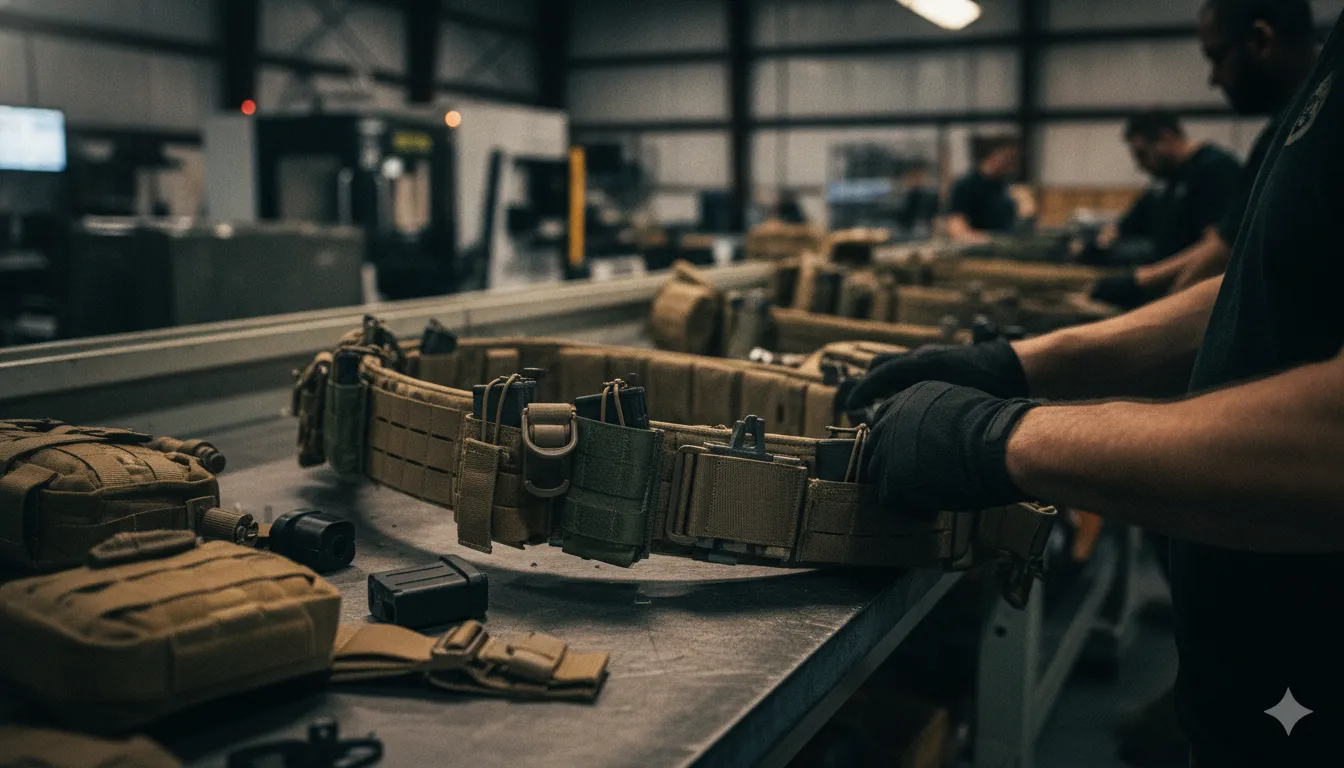
Reinforcement details deserve the same discipline. Fusion Tactical's manufacturing capabilities include precise laser-cut MOLLE patterns, multi-row stitching, five-row bartacks, heat sealing, and welding. These processes can support consistent geometry and durable stress distribution, but the relevant question is whether they are applied at the belt's actual load paths. Review seam locations around attachment rows, buckle interfaces, adjustment zones, and any concentrated accessory loads.
Finally, avoid converting an isolated webbing or hardware value into a blanket belt rating. A professional buyer should request assembly-level test documentation and defined use limits, then compare those records against the team's load plan. This approach separates measurable construction evidence from assumptions based on a material name or a single component specification.
How Should Buyers Select Hardware Without Confusing Carriage With Life Safety?
Select hardware by matching each buckle, D-ring, connector, and mounting point to its documented function, expected load path, and inspection method. A modular MOLLE belt professional grade system should provide controlled equipment retention and reliable carriage, but it is not automatically fall-protection or life-safety equipment.
That distinction should appear in the specification, evaluation matrix, and training documentation before procurement. If a program requires restraint, fall arrest, or another life-safety application, the buyer must require product-specific documentation supporting that use. Do not infer suitability from a strong buckle, a metal ring, or a tactical appearance.
Separate retention from attachment hardware
Hardware integration is a system decision. Buckles establish closure and adjustment. D-rings and connectors may support defined attachment functions, while mounting components position pouches or other modules on the belt. Their presence does not, by itself, establish a rated anchor or authorize a life-safety application. Ask the supplier to identify the intended function of each component, the compatible belt architecture, and any limitations on orientation, loading, or use.
Retention should also be evaluated at the interface, not only at the component. Confirm that the buckle remains secured during expected movement. Confirm that connectors are compatible with the webbing and mounting geometry. Check that accessories do not interfere with closure or adjustment. Fusion Tactical identifies aluminum buckles, steel D-rings and connectors, Raptor buckles, precision mounting, load testing, and modular system integration among its hardware capabilities: engineering and testing support.
Require evidence that can be inspected
Professional buyers should request drawings or configuration records that show hardware locations, attachment points, and the intended load path. They should also ask how the manufacturer verifies assembly quality, including stitching, bartacks, mounting, and any specified testing. Fusion Tactical describes inspection, retention, hardware compatibility, testing, and maintenance as part of professional-grade evaluation criteria. Those criteria turn a feature list into evidence a program manager can review and maintain.
Inspection should cover buckle operation, D-rings and connectors, damaged or distorted mounting points, loose stitching, abrasion, contamination, and changes to the configured load. Remove questionable hardware from service until its condition and replacement path are established. A supplier that can move from requirements analysis through prototype testing and quality assurance can help define those acceptance and inspection criteria for the actual configuration.
How Do Teams Configure, Inspect, and Maintain a Modular Belt?
A modular belt should be configured as part of a load-bearing system, then managed through a documented cycle of fit checks, inspection, maintenance, and controlled changes. Suspenders, belt-mounted accessories, and accessory spacing should support the mission without creating pressure points, interference, or an assumption that the belt provides fall protection or life-safety restraint.
The most reliable approach is to record the approved configuration and inspect the actual assembly used by each team. A modular platform may be adapted for different users and missions, but each change should be evaluated for fit, retention, load distribution, and compatibility.
- Capture the requirements. Define the mission, carried equipment, user population, clothing layers, mobility demands, retention needs, and any contract or documentation requirements before selecting components. Treat shoulder suspension as a distinct design consideration rather than an afterthought. Research on military load-bearing systems identifies shoulder suspension as a separate integration issue. And Fusion Tactical supports custom dimensions, sizing, colors, hardware configurations, and branding through requirements analysis, prototyping, and quality assurance. See the custom belt configurations pathway for this type of planning.
- Confirm fit and accessory placement. Check the user's measured circumference against the supplier's stated range, and verify that the belt remains stable across the intended movement and clothing configuration. Place high-use accessories where they can be reached without obstructing movement or neighboring pouches. If the design includes lower slots for accessories attached directly to the belt, confirm that those attachments do not create concentrated pressure or interfere with the belt's closure. Add suspenders only when their mounting points, adjustment range, and interaction with the belt have been evaluated as a system.
- Inspect the complete assembly. Before use, and whenever the team's established inspection process requires it, examine MOLLE spacing, stitching, bartacks, webbing, panels, closures, hardware, direct attachments, and suspender interfaces. Look for fraying, loosened stitching, deformation, cracked or damaged hardware, distorted slots, contamination, and changes in fit or retention. Do not invent a universal inspection interval. Set the interval through the product documentation, operating environment, usage level, and organizational procedure.
- Maintain records. Record the belt or configuration identifier, user or unit assignment, inspection date, findings, repairs, component replacements, and disposition. Maintenance records support traceability and help teams identify recurring wear at high-load or high-contact locations. They also provide evidence when a component, size, or accessory layout needs to be reviewed.
- Control configuration changes. Treat a new pouch layout, belt size, suspender arrangement, buckle, or direct attachment as a configuration change. Recheck fit, retention, load distribution, and compatibility before returning the assembly to service. Keep the approved configuration documented, and use prototype testing or engineering review when the change alters system behavior or introduces new hardware integration requirements.
This process keeps modularity useful without treating interchangeability as proof of suitability. A professional-grade system is one that teams can configure, inspect, and maintain with clear evidence of what was approved and why.
What Should Government Buyers Request From a Belt Manufacturer?
Government buyers should request more than a product page and a general statement that a belt is made in the USA. A procurement-ready supplier should provide clear information about manufacturing location, material origin, traceability, testing, quality records, and the compliance requirements supported by the specific order or contract.
For a modular MOLLE belt professional grade program, the evidence should connect the stated configuration to the agency's operational, documentation, and sourcing requirements. That makes the belt easier to evaluate during acquisition and easier to support throughout its service life.
Confirm manufacturing and material origin
Ask where design, cutting, sewing, inspection, and distribution occur, and request the supplier's documented manufacturing scope. Fusion Tactical's Chino, California facility combines design, manufacturing, and distribution, with in-house capabilities that include precise MOLLE laser cutting. Multi-row stitching, five-row bartacks, heat sealing, welding, and custom color matching. Review the company's U.S. manufacturing capabilities when comparing suppliers.
Material origin should be addressed at the component level. Relevant records may identify the webbing, ballistic nylon, Cordura, hardware, and other technical fabrics used in the configuration. Berry-compliant materials can be specified, but buyers should not assume that every standard product is automatically Berry compliant. Fusion Tactical states that custom Berry Amendment production can use 100% U.S.-sourced materials with domestic manufacturing and traceability, while standard products may include non-U.S. components. Review the supplier's Berry Amendment sourcing information and confirm the requirement for the actual purchase order.
Make compliance contract-specific
Berry Amendment and Trade Agreements Act, or TAA, requirements are procurement considerations, not interchangeable marketing labels. The solicitation, contract clauses, funding source, and end use determine what documentation is necessary. Request a written statement identifying which requirements the proposed configuration is intended to meet, the applicable country-of-origin basis, and any exceptions or component limitations. Confirm those details before award rather than relying on a generic compliance claim.
Request test evidence and quality records
A complete supplier package should explain the tests performed, the configuration tested, acceptance criteria, and whether results came from in-house or independent facilities. Fusion Tactical's quality and testing context includes ISO 9001:2015, AS 9100 aerospace quality principles, in-house strength and material testing, and independent testing facilities. Ask for records appropriate to the contract, such as inspection documentation, material traceability, lot or batch identification, approved drawings, revision control, and nonconformance handling.
Buyers should also clarify what the test evidence does not establish. A modular load-bearing belt is not automatically fall-protection or life-safety equipment. The scope of any load or retention claim must match the documented application. For a broader procurement framework covering traceability, testing, compliance, integration, and scalable contracts, review the load-bearing belt platform supplier guide.
What Is the Best Way to Specify a Professional Modular MOLLE Belt?
The best specification treats a modular MOLLE belt as a load-bearing system, not an isolated accessory. Use a design matrix to compare fit, integration, materials, hardware, testing, maintenance, and documentation against the mission before selecting a configuration.
For a modular MOLLE belt professional grade requirement, define the operating environment and carried equipment first. Then convert those needs into measurable requirements that a manufacturer can prototype, validate, and reproduce.
Buyer checklist for a complete specification
- Requirements: Identify the users, mission profile, carried equipment, expected duty cycle, environmental exposure, quantity, replacement needs, and contract documentation requirements.
- Geometry: State belt circumference range, belt width, MOLLE or PALS spacing, pouch interface, panel layout, access priorities, retention needs, and whether suspenders or other support elements are required.
- Materials: Specify the webbing, ballistic nylon, Cordura, technical fabric, padding, edge treatment, and color requirements. If domestic sourcing matters, state the required traceability and procurement standard rather than assuming it.
- Hardware: Define buckle type, connectors, mounting points, adjustability, corrosion considerations, and compatibility with the team's existing equipment. Hardware integration may include buckles, D-rings, connectors, precision mounting, and modular interfaces.
- Testing: Request the applicable inspection method, prototype testing plan, load or material testing scope, acceptance criteria, and records. A quality claim should identify what was tested and for which configuration.
- Maintenance: Document inspection intervals, cleaning limits, repair or replacement criteria, component interchangeability, and configuration-control requirements so field changes do not create unknown risks.
- Documentation: Confirm drawings, bill of materials, revision control, material records, test reports, quality records, and contract-specific Berry Amendment or TAA requirements. Those requirements must be confirmed for the specific order or contract.
Custom dimensions, sizing, colors, hardware configurations, prototype testing, scaled production, and quality assurance can be developed through custom belt configurations. When the checklist is complete, provide the intended quantity, delivery context, equipment interface. And required documentation with the request so the manufacturer can evaluate the configuration accurately and prepare a quote.
Contact Fusion Tactical to confirm your requirements before procurement
Frequently Asked Questions
How should buyers confirm MOLLE and PALS compatibility?
Confirm the attachment spacing, panel geometry, belt width, pouch interface, and any quick-release requirements against the equipment already in service. MOLLE and PALS are related attachment-system terms, but compatibility should be verified through the actual component design rather than assumed from a product label. Research on MOLLE and PALS interoperability describes quick-release development as a design and validation problem.
How do teams choose the correct belt size?
Measure the circumference where the belt will sit with the intended clothing and equipment, then compare that measurement with the supplier's range. Account for padding, adjustment room, and the final pouch layout. A belt that fits on paper may still be unsuitable if its loaded configuration shifts, restricts movement, or concentrates weight at one point.
Is a modular MOLLE belt suitable for fall protection?
Not automatically. A modular MOLLE belt is generally an equipment-carriage platform, not fall-protection or life-safety equipment. Use it for those applications only when the specific product documentation, design, testing, and applicable requirements explicitly support them. Do not infer a safety rating from the presence of load-bearing materials or hardware. Review engineering and testing support for application-specific questions.
Does Berry Amendment or TAA compliance apply to every belt?
No. Berry Amendment and TAA requirements depend on the specific order, contract, materials, components, and documentation. Confirm the requirement before purchase and request traceability evidence for the configuration being quoted. Fusion Tactical states that custom Berry production can use U.S.-sourced materials and domestic manufacturing, while standard products may include non-U.S. components: review the sourcing guidance.
What information should a team provide when requesting a quote?
Provide the belt circumference range, intended users, required MOLLE layout, pouch and hardware interfaces. Load and mobility priorities, colors, quantity, delivery constraints, and any contract-specific sourcing or documentation requirements. Include whether the team needs suspenders, custom dimensions, prototype validation, inspection records, or a scaled production plan. These inputs let the manufacturer evaluate the complete system rather than quote an isolated belt.
Ready to Specify Your Modular MOLLE Belt?
A clear configuration brief helps your team evaluate compatibility, fit, load distribution, and documentation requirements before selecting a professional belt system. Share your belt dimensions, attachment needs, operating environment, and procurement requirements with Fusion Tactical.
Request a quote for your modular MOLLE belt configuration
For direct assistance, call (909) 393-9450.


