

Emergency Patient Transport Equipment: A System Selection Guide
Emergency patient transport equipment should be selected as a coordinated system, not as a collection of individually suitable items. A stretcher, patient restraint, connecting hardware, supporting line or vehicle interface, and operator procedure must work together for the intended route and patient condition. This guide gives government, rescue, and industrial buyers a practical framework for defining those needs, reviewing interfaces, and controlling equipment through inspection and storage.
Discuss your transport-system requirements
What should the transport system accomplish?
Begin with the operational task. “Move a patient” is not a complete requirement. The team should establish where the patient starts, the route, the destination, the expected environment, and whether movement is horizontal, vertical, confined, or vehicle-based. A system used for a short transfer across a level floor has different interfaces and handling demands from a system intended for a constrained industrial access route.
Document the full use case before comparing products. Include:
- Patient population and anticipated range of body sizes, while relying on clinical and operational policy for patient-care decisions.
- Route characteristics, such as clearances, turns, changes in elevation, surface conditions, and access limitations.
- Transport mode and any connection to a vehicle, hoist, rope system, or other supporting equipment.
- Environmental exposure, including moisture, dirt, temperature, chemicals, and likely cleaning methods.
- Number of operators, their positions, communications method, and any handoff points.
- Deployment frequency, expected service life, and who will inspect and maintain each component.
Separate essential requirements from preferences. For example, a defined attachment interface or verified compatibility may be mandatory, while a particular storage format may be preferred. This helps procurement compare offers on the same basis and identify gaps instead of letting a persuasive product description stand in for evidence.
How should buyers define the system boundary?
Draw the system from the patient outward. At minimum, identify the patient-support surface, restraint method, stretcher attachment points, connecting components, and the structure or equipment that ultimately supports the load. Add any operational accessories only when they affect the task. Make clear which items are supplied together and which are expected to be furnished by the agency.
A boundary diagram is useful because compatibility often fails at the joins. A stretcher may be fit for its stated purpose, and a connector may have a marked capacity, yet the combination may not have been evaluated as an assembly. Buyers should request the limits and conditions that apply to the complete configuration, not infer them from isolated component labels.
For each interface, record the connector type, geometry, orientation, method of closure, and any restriction on how it is loaded. Identify whether attachment is direct or uses an intermediate component. Require the supplier to identify approved configurations and to flag combinations that are not covered by the supporting documentation.
Fusion Tactical lists the Austin multi-purpose portable stretcher as a product offering. Buyers considering it should confirm its intended application, configuration, instructions, rated limits, and compatibility with all proposed accessories directly against current product documentation. A product name alone does not establish suitability for a specific operational scenario.
Which load paths and interfaces need review?
Follow the load path step by step: patient to restraint or support, support to stretcher structure, stretcher to attachment component, and attachment component to the final support. At every transition, ask what carries the force, in what direction, and under what conditions. Include dynamic effects and foreseeable off-axis loading in the engineering review rather than assuming that a static, centered load describes field use.
Do not calculate a system capacity by simply adding component ratings. The configuration may be limited by its weakest component, but geometry, direction of loading, attachment method, wear, and manufacturer restrictions can lower the usable capacity further. Require documented ratings for the relevant configuration and have qualified personnel determine whether the evidence covers the planned use.
Review the following interface points before award:
- Patient-to-support: How is the patient positioned and retained for the intended movement? What limitations or instructions govern the restraint?
- Support-to-frame: Where are approved load points, and can the attachment shift, rotate, or bear against an edge?
- Frame-to-connector: Does the connector fit the point without cross-loading, gate interference, or unintended opening?
- Connector-to-support system: Is the connection compatible with the hoist, line, vehicle, or other system in the actual orientation?
- Operator interface: Can personnel reach the intended controls and maintain the prescribed handling positions throughout the route?
Ask for drawings, instructions, test or qualification records as appropriate, and explicit configuration limits. These records should identify product model and revision, materials or component references where relevant, and any exclusion that affects deployment. Where an interface is unique to an agency, document the design basis and obtain review before relying on it in the field.

How do stretcher and harness interfaces differ?
A stretcher supports the patient and provides a structure for handling or connection. A harness or restraint addresses a different function: maintaining patient position or connecting a person to a system, according to its intended design and instructions. These functions should not be treated as interchangeable. A harness that is not designed or approved for the planned patient-transport configuration should not be improvised as a stretcher attachment.
Buyers should define what each element is expected to do. Is the patient secured to the support for a particular route? Does the stretcher provide the only approved attachment points? Is a separate connection intended to support, guide, or restrain? Clear role definitions help prevent an accessory from being asked to perform a function outside its documentation.
Request an interface schedule showing each component, its intended role, the mating part, and the governing instructions or evidence. If more than one configuration is needed, list each one separately. A system matrix can expose a mismatch early, such as a connector that fits physically but is not approved for a particular direction or use.
How should operator coordination be designed?
Equipment selection and procedure design belong together. The chosen configuration should permit operators to understand their positions, responsibilities, and communication cues before movement begins. A written procedure should cover preparation, patient securing under approved clinical protocol, equipment connection, route clearance, movement commands, pauses, handoffs, and contingencies.
Map the movement from start to finish. Note where operators can stand, where they may lose sight of each other, and where the stretcher or connectors could contact an obstruction. Establish who gives commands and how the team confirms readiness. If a communication method fails or a route becomes blocked, the team needs a defined stop-and-assess process rather than a rushed improvisation.
Conduct practical evaluation with representative operators and the intended configuration. Use a controlled setting and an appropriate training surrogate when evaluating handling. Observe whether users can inspect connections, maintain control, pass through route constraints, and perform planned handoffs. Record the configuration, participants’ roles, conditions, findings, and corrective actions. A demonstration can inform usability, but it does not replace required engineering evidence or product instructions.
What should the procurement comparison include?
Use a common comparison structure so that proposals answer the same operational questions. The table below is a starting point; tailor the entries to the program’s approved requirements and request supporting documents for every critical claim.
| Review area | Questions for the buyer | Evidence to request |
|---|---|---|
| Patient support | Does the equipment suit the defined task, route, and patient range? | Instructions, intended-use statement, configuration limits |
| Load path | Are all load-bearing components and transitions identified? | Ratings, drawings, test or qualification records as applicable |
| Compatibility | Are the actual mating components approved for the proposed arrangement? | Compatibility list, connector details, approved configuration |
| Human factors | Can the assigned team use and inspect the setup in the planned route? | Evaluation plan, observed findings, procedure and training needs |
| Inspection | Can users identify damage, wear, contamination, or missing parts? | Inspection criteria, intervals, removal-from-service rules |
| Lifecycle control | Can the agency track identity, revision, use, and maintenance? | Traceability information, records, storage and care instructions |
Score compliance separately from preference. A proposal that does not provide evidence for a mandatory interface should not receive the same evaluation as one that documents the configuration. Record exceptions and assumptions. If the supplier proposes an alternate connection or accessory, require the revised assembly evidence and repeat any affected review.
How should inspection and acceptance work?
Acceptance should verify that the delivered equipment matches the approved configuration and that the records are complete. Compare model, revision, components, markings, and supplied accessories against the purchase specification. Check that instructions are present and that personnel can identify the applicable limitations. Document discrepancies and resolve them before operational release.
Establish inspection responsibilities at receipt, before use, after use, and at any additional interval required by instructions or agency policy. Inspection criteria should address visible damage, abrasion, cuts, distortion, corrosion, contamination, illegible identification, compromised closures, missing parts, and evidence of unauthorized modification. The manufacturer’s instructions and applicable program requirements govern inspection and removal from service.
Set a clear quarantine process. A component with uncertain history, damage, altered configuration, or questionable identification should be removed from availability until a designated authority determines its status under the applicable instructions. Do not return questionable equipment to service merely because it appears usable after cleaning or adjustment.
Fusion Tactical’s warranty information can be reviewed as part of lifecycle planning, but warranty terms do not replace inspection, maintenance, or operational qualification. For program-specific needs, buyers can also review the company’s manufacturing capabilities and request supporting details for the proposed system.
What records should remain with the equipment?
Maintain a controlled record set that lets a future user determine what the system is, what it is approved to do, and whether it remains within its limits. The file should be accessible to procurement, safety, maintenance, and operations personnel, with controlled revisions and a clear owner.
- Approved requirement and configuration baseline, including component identifiers and revisions.
- Supplier instructions, ratings, limitations, compatibility evidence, and applicable qualification documentation.
- Receipt inspection, acceptance decision, and any documented exceptions or corrective actions.
- Inspection and maintenance history, with dates, findings, inspector identity, and disposition.
- Training and procedure references, including change notices that affect use.
- Storage location, status, and traceability details needed to prevent mix-ups.
When a component changes, review the whole affected configuration. A replacement part that appears similar may differ in geometry, material, rating, or permitted use. Record the change, determine whether the original evidence still applies, and update drawings, training, and inspection criteria as needed.
How should storage and readiness be managed?
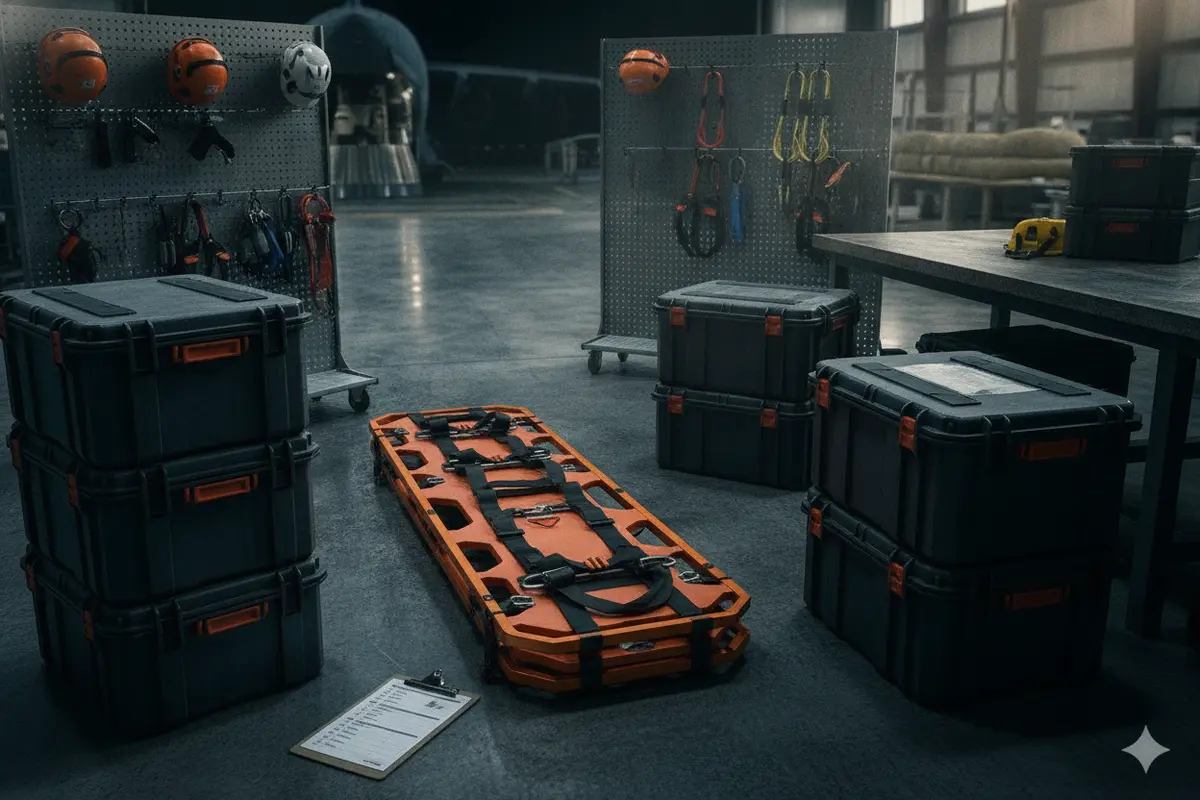
Storage must preserve condition and make the correct configuration easy to identify. Follow manufacturer instructions for cleaning, drying, environmental limits, and packaging. Avoid storing equipment where it can be crushed, exposed to damaging substances, or mixed with unapproved components. Use controlled locations and clear status marking so that serviceable, quarantined, and incomplete assemblies cannot be confused.
Plan readiness checks around the actual deployment model. A response team may need a pre-deployment confirmation that the stretcher, connectors, and associated equipment are present, identified, and within inspection status. A sealed kit can reduce omissions, but only if the contents list is current and the seal process does not hide required inspection needs. Define who opens, checks, and restores the kit after use.
Transport planning also includes any clinical equipment that must accompany the patient. The exact package depends on patient needs and the responsible clinical team; do not treat a stretcher specification as a substitute for that assessment. The Guidelines for the transport of the critically ill adult state that appropriate transport equipment, including monitors, ventilators, and syringe pumps, must be available for the relevant transport context. Buyers should therefore coordinate the physical transport configuration with clinical leadership and the approved care protocol, rather than assume one standard kit serves every mission.
Before deployment, verify that the equipment list reflects the actual task and that any required accessories can be carried without interfering with patient access or the approved attachment arrangement. Assign responsibility for checking batteries, consumables, and other mission-specific items under the relevant equipment instructions. Keep clinical equipment requirements distinct from the load-bearing equipment evidence, while ensuring the two plans do not conflict at the interface or during handling.
How should the team assess route and handling constraints?
A paper review should be followed by a route-based assessment. Measure the limiting openings, turning areas, vertical transitions, and staging locations that matter to the operation. Include the equipment in its deployed configuration, not only its packed dimensions. If the route can change between sites, identify the range of conditions the system must accommodate and the process for approving exceptions.
Review likely contact points along the path. A narrow passage can bring the stretcher frame or connectors against a wall; a change in elevation can alter the direction of force and operator positions. Identify where a team can pause safely, how the patient remains supported during a pause, and who has authority to stop movement. Do not use an informal handling demonstration to validate a load rating or an unapproved modification.
Human factors evaluation should include access to inspection points and connections. Operators need to see whether a closure is engaged and whether components are routed as intended. If visibility is limited by the patient, carried equipment, or the route, determine whether the procedure supplies a reliable check before movement. Record any difficulty, the proposed corrective action, and whether the change affects the original configuration or technical evidence.
Also examine the transition between teams and transport modes. Define who accepts responsibility at a handoff, what must be checked again, and which configuration details travel with the equipment. A simple handoff record can prevent an arriving team from relying on assumptions about a connection made elsewhere. The system should make a safe, controlled pause possible when information is missing.
How can a team run a staged selection review?
- Describe the operation. Define route, environment, transport mode, patient-support need, operators, and expected handoffs.
- Set measurable requirements. Identify mandatory capacity, interface, environmental, traceability, and documentation needs. Avoid requirements that cannot be evaluated.
- Map the assembly. Show every component and transition from patient support to final support. Identify approved configurations and boundaries.
- Screen evidence. Compare supplier documentation against requirements. Log missing information, assumptions, and exceptions rather than filling gaps by inference.
- Evaluate handling. In a controlled setting, assess access, communication, visibility, route fit, and inspection usability with representative operators.
- Approve and baseline. Obtain the required technical and operational review, record the selected configuration, and control revisions.
- Receive and sustain. Verify the delivered set, train users, track inspections, and review changes before returning altered equipment to service.
Each stage should have an owner and an exit condition. For instance, procurement can own the evidence log, an engineering authority can review load-path documentation, and operations can assess handling and procedure fit. The precise roles depend on agency policy, but decisions and unresolved risks should be visible in one controlled record.
What questions should buyers ask suppliers?
- What is the intended use and limitation of each component?
- Which complete configurations are documented, and which are excluded?
- What ratings apply to the actual orientation and interface proposed?
- What evidence supports the assembly, and what are its test conditions and boundaries?
- Which instructions govern inspection, cleaning, storage, maintenance, and retirement?
- How are revisions and replacement components identified and controlled?
- What information will be supplied for acceptance, training, and lifecycle records?
- Can the supplier identify any assumptions that require agency verification before deployment?
For a program using a stretcher or related rescue equipment, compare the proposed configuration with the available fire and rescue equipment and rope storage options only where they match the operation. Product category pages are starting points for inquiry, not proof of a system’s suitability. For other system questions, the equipment and safety resource library may help teams frame their review.
Frequently asked questions
Can a component rating establish the capacity of the full system?
No. Individual markings do not by themselves establish the capacity of a complete assembly. Review the documented limits, configuration, orientation, and instructions for the system as used, and obtain qualified technical review where needed.
Should a buyer specify a single stretcher configuration?
Specify each approved configuration the program expects to use. If the team needs alternatives, document them separately and confirm that the evidence and procedures cover each one.
What if a proposed connector fits but is not listed in the instructions?
Do not assume that physical fit establishes compatibility. Request authoritative confirmation and supporting evidence for the exact configuration before acceptance or operational use.
How should inspection intervals be chosen?
Follow the manufacturer’s instructions and applicable agency requirements. The program should define who performs each check, what findings trigger removal from service, and how the decision is recorded.
Does product acceptance replace operator training?
No. Acceptance verifies the delivered configuration against procurement requirements. Operators also need the approved procedures, role assignments, and training required by their organization.
Contact Fusion Tactical about equipment requirements
A documented system boundary, verified interfaces, trained operators, and controlled lifecycle records give procurement and response teams a sound basis for selecting emergency patient transport equipment.


