

Aircraft Hangar Fall Protection Systems Guide
Aircraft hangar fall protection systems must protect maintenance, inspection, and service teams without disrupting aircraft access, tooling, or controlled work sequences. A sound procurement decision starts with the hangar, aircraft surfaces, work positions, anchor structure, fall clearance, and rescue plan, not with a catalog harness chosen in isolation.
Request a quote from Fusion Tactical USA for an aircraft hangar fall protection system review.
What should an aircraft hangar fall protection system accomplish?
Short answer: The system should control exposure to fuselage, wing, tail, platform, edge, and opening hazards throughout the maintenance workflow. It should also provide documented anchorage performance, compatible connecting equipment, usable clearance, inspection controls, training requirements, and a practical rescue method.
Aircraft maintenance creates a moving work environment. The technician may transition from a platform to a wing, move around a fuselage, reach a tail assembly, work near an open access panel, or reposition beneath an overhead structure. The best solution follows those work positions while keeping the connection path predictable.
For procurement teams, the deliverable is not simply a harness or lifeline. It is a controlled system that connects:
- The hazard assessment and work-at-height procedure
- The hangar structure and engineered anchorage
- The aircraft fleet, parking pattern, and maintenance positions
- The worker interface, connecting device, and movement limits
- The required fall clearance and swing-fall controls
- The inspection, training, rescue, and recordkeeping program
That system-level view is especially important for defense, aerospace, government, and industrial programs where the buyer must demonstrate not only that equipment was purchased, but also that the configuration was evaluated, accepted, maintained, and traceable.
How do fall restraint and fall arrest differ in a hangar?
Short answer: Fall restraint prevents a worker from reaching a fall hazard, while fall arrest allows the worker to enter the work area and stops a fall after it begins. The procurement choice affects anchor location, connector length, energy management, clearance, rescue, training, and the documentation supplied with the system.
Fall restraint is often the preferred first consideration when the work geometry allows it. A properly configured restraint system limits travel so the worker cannot reach an unprotected edge or slip hazard. It can reduce the consequences of a fall by preventing the event rather than relying on post-fall arrest.
Fall arrest is used when the technician needs access that cannot be achieved through restraint alone. It must be designed around total fall clearance, maximum arrest distance, deceleration, harness fit, anchor deflection, worker height, and the possibility of a swing fall. A system that stops a fall but allows contact with the aircraft, hangar floor, tooling, or another obstruction is not adequate for the actual work position.
OSHA's general industry rule at 29 CFR 1910.28 addresses fall protection for walking-working surfaces at or above the applicable trigger, including unprotected sides and edges at 4 feet or more above a lower level in the general case. The rule also identifies guardrails, safety nets, and personal fall protection systems as possible methods, subject to the specific work condition. A site safety professional must apply the current regulation to the actual hangar and task.
| Decision point | Restraint | Arrest |
|---|---|---|
| Primary purpose | Prevents access to the fall hazard | Stops a fall after it starts |
| Key design question | Can the worker reach every required task without reaching the hazard? | Is there enough clearance to stop the fall before impact? |
| Typical risk control | Limit travel with a correctly positioned connection | Manage arrest forces, deflection, clearance, and rescue |
| Procurement evidence | Work envelope, connector length, anchor location, and compatibility | Rated system design, calculations, testing, inspection, and rescue plan |
Do not use the terms interchangeably in a specification. The supplier should identify which mode the system is intended to provide and explain any configuration that combines restraint and arrest.
Which hangar hazards should the design team map first?
Short answer: Start with every elevated work position and every transition between positions. Map unprotected edges, wing and fuselage surfaces, open panels, platforms, ladders, docks, maintenance stands, overhead obstructions, falling-object exposure, vehicle traffic, and locations where a worker could swing into an aircraft or structure.
A useful hazard map follows the maintenance workflow rather than a single photograph of the hangar. Review scheduled inspection tasks, heavy maintenance, engine or component work, cleaning, fueling interfaces, paint or coating operations, and line-service activity. Note which work occurs with an aircraft present, which work requires repositioning, and which work takes place outside the hangar.
Overhead and elevated-surface hazards
Aircraft wings, fuselages, horizontal stabilizers, and tail assemblies can combine height, curvature, limited footing, sharp transitions, and restricted hand placement. A connection that works from a straight maintenance platform may create slack, a lateral pull, or an awkward swing when the technician moves around a curved surface.
Edge, opening, and transition hazards
Open access panels, temporary platforms, maintenance stands, dock edges, and changes in elevation deserve separate treatment. The plan should show when workers connect, disconnect, transfer, or pass through an opening. It should also identify whether guardrails or other passive controls can remove the exposure before personal equipment is considered.
Clearance and swing-fall hazards
Clearance is not the distance from the worker to the floor alone. It can include connector length, device deployment, harness stretch, anchor deflection, worker height, platform height, and the shape of the aircraft or equipment below. An anchor placed far to the side may create a pendulum path into the wing, fuselage, hangar steel, or another worker position. The design should keep the connection overhead and close to the line of travel where the workflow permits.
Contact Fusion Tactical USA to discuss your hangar hazards, work positions, and required coverage.
Which system architecture fits the hangar workflow?
Short answer: Fixed overhead rails, bridge systems, horizontal lifelines, portable anchors, and access platforms each solve different coverage and mobility problems. Select the architecture after reviewing aircraft dimensions, parking patterns, roof structure, clearance, user count, bypass needs, and whether the work area is permanent or changing.
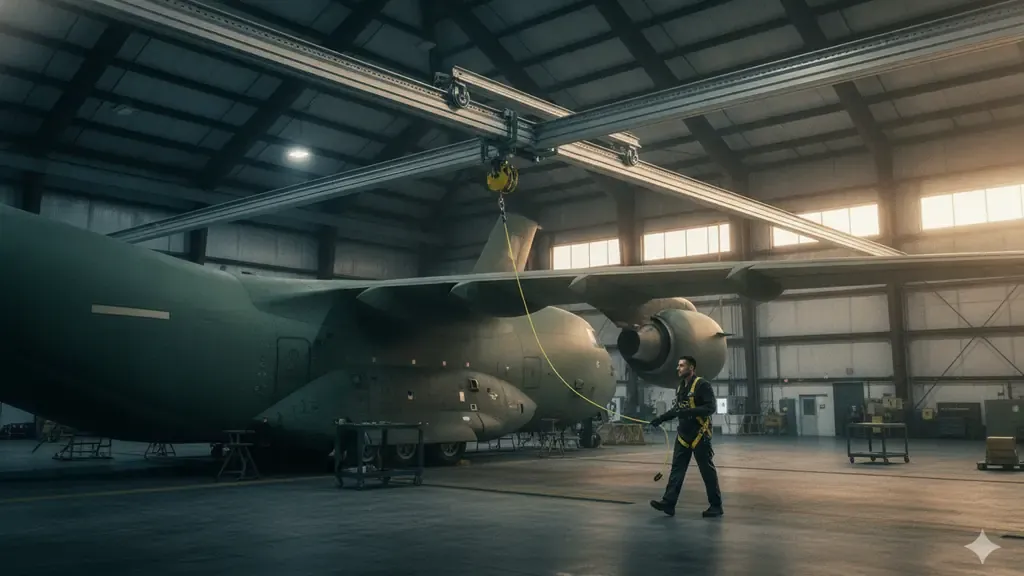
Overhead rigid rail and track
Rigid rail keeps the traveler on a defined path and can reduce lateral movement during normal work. It is useful where aircraft position and work zones are stable, clearance is limited, or the maintenance team needs a direct overhead connection. The specification should address track supports, trolley behavior, end stops, transitions, user loading, corrosion control, inspection access, and expansion.
Overhead bridge or coordinate systems
A bridge or two-axis system can cover a larger hangar footprint when aircraft parking positions change. The buyer should confirm the actual travel envelope, bridge interference points, maintenance access, fall clearance at every position, and whether more than one technician can work in the bay without creating incompatible travel paths.
Horizontal lifelines
Horizontal lifelines can provide travel along a long bay, but their performance depends on span length, sag or deflection, anchorage, end and intermediate supports, connector selection, and the number of users. A pass-through device may reduce disconnect points, but it does not remove the need to evaluate corners, transitions, rescue access, and the full arrest path.
Portable and freestanding systems
Portable anchors, freestanding frames, mobile gantries, and temporary systems can support flight-line or changing work. They require disciplined placement, setup verification, ground or floor assessment, exclusion zones, and clear ownership of inspection before each use. Portability is valuable only when the setup process is controlled well enough to preserve the design assumptions.
Access platforms and passive controls
Platforms, guardrails, stairs, and other passive controls can reduce the need for personal fall protection in some positions. They can also work with an active system to give technicians stable access while the connection manages residual exposure. The procurement package should identify which hazards are removed by the platform and which remain for the personal system.
What should an aircraft hangar system specification include?
Short answer: A defensible specification defines the work envelope, system type, design loads, user count, compatible components, clearances, structural interfaces, inspection rules, training, rescue, and acceptance evidence. It should be detailed enough for the supplier, installer, safety team, and contracting officer to evaluate the same configuration.
At minimum, request a system submittal with the following sections:
- Application and coverage: aircraft types, hangar bays, aircraft positions, maintenance tasks, elevated surfaces, and required travel paths.
- Hazard controls: restraint, arrest, positioning, passive protection, edge controls, openings, falling objects, and swing-fall conditions.
- Structural interface: support points, substrate assumptions, load paths, fasteners, corrosion environment, and responsibilities for building-structure verification.
- Performance data: rated users, design loads, maximum arrest distance, clearance requirements, deflection, compatible connectors, and limits of use.
- Aircraft interface: stand-off distances, wing and fuselage clearance, tooling conflicts, FOD controls, and restrictions near sensitive aircraft surfaces.
- Operations: connection and transfer procedures, aircraft movement coordination, lockout or exclusion requirements, and emergency egress.
- Inspection and maintenance: pre-use checks, periodic inspection criteria, component retirement rules, replacement parts, and record retention.
- Rescue and training: suspension trauma planning, rescue equipment, response roles, user training, competent-person or qualified-person responsibilities, and drills.
- Acceptance package: drawings, calculations, installation records, test reports, manuals, serial or lot traceability, inspection forms, and as-built documentation.
For a government or aerospace program, the package should also identify country-of-origin requirements, contract clauses, quality-system expectations, configuration control, change notification, and the evidence required at source inspection or acceptance.
Which OSHA and ANSI references belong in the procurement review?
Short answer: Start with the applicable OSHA walking-working-surface and personal-fall-protection requirements, then use the relevant ANSI/ASSP Z359 documents to structure equipment, system design, managed programs, testing, and user controls. Standards references do not replace site-specific engineering or the employer's written program.
OSHA 29 CFR 1910.28 is the primary starting point for the general industry duty to provide fall and falling-object protection. The procurement team should read the current rule with the applicable requirements in Subpart D and any task-specific provisions. The system must also be used under an employer program that addresses training, inspection, and rescue.
The ANSI/ASSP Z359 fall protection and fall restraint standards cover multiple parts of a complete program, including the Fall Protection Code, managed programs, harnesses, connecting components, energy absorbers, self-retracting devices, lifelines, rescue, design of active systems, and qualification or verification testing. The relevant documents should be selected based on the architecture and components being procured, not listed as generic marketing language.
Ask the supplier to map each referenced standard to a specific component, design activity, test, or program control. Also ask which requirements are mandatory for the contract, which are design criteria, and which are recommended practices. That distinction keeps the procurement record accurate and prevents a standards list from obscuring a missing calculation or inspection procedure.
How should buyers qualify a supplier for aerospace and government programs?
Short answer: Qualify the supplier on engineering competence, manufacturing controls, documented testing, traceability, compliance evidence, installation support, and program responsiveness. The strongest supplier can explain how its design becomes a controlled, inspectable, maintainable system for the exact hangar and aircraft workflow.
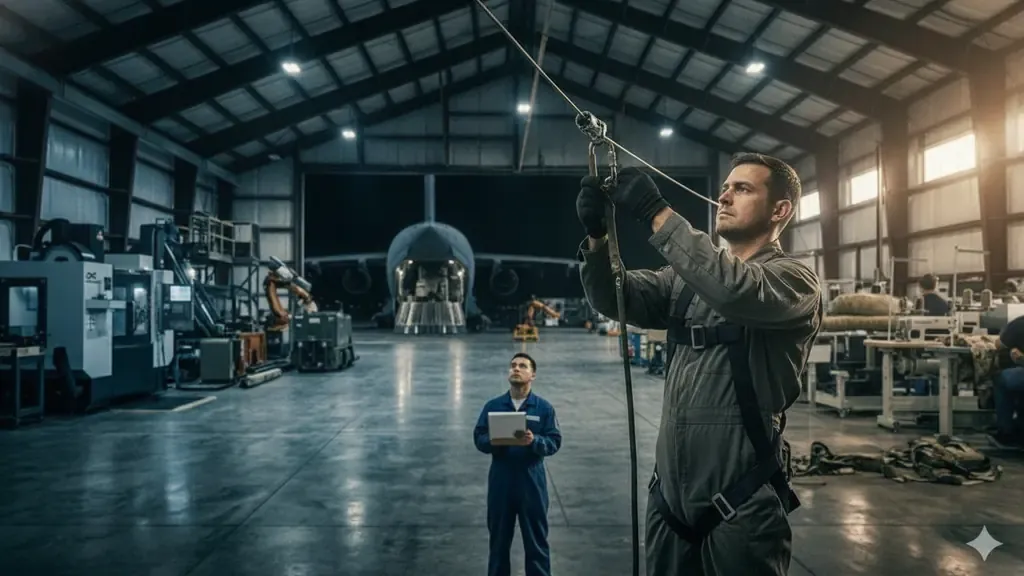
Engineering and integration capability
Ask how the supplier evaluates the hangar structure, aircraft fleet, work envelope, clearances, support geometry, and transitions. Request examples of drawings, calculations, load-path reviews, installation details, and acceptance criteria. A product catalog cannot answer those questions by itself.
Manufacturing and quality controls
Review material control, lot or serial traceability, inspection points, nonconformance handling, change control, and final release records. For aerospace and government buyers, ask how the supplier preserves configuration identity when components, materials, or processes change. Verify ISO 9001:2015 or other quality claims directly against current certification evidence when they are part of the requirement.
Compliance and domestic sourcing
When Berry Amendment, Trade Agreements Act, or other domestic sourcing provisions apply, require the supplier to identify the relevant contract clause and provide supporting origin documentation. Do not accept a broad compliant label without knowing which products, materials, processes, and subcontractors it covers. Fusion Tactical USA positions its U.S.-based manufacturing and Berry and TAA capabilities for government and aerospace procurement, with custom engineering and rapid prototyping support.
Support after installation
Qualification should include installation supervision, commissioning, training, inspection forms, replacement-part support, and response after a system event. Ask who owns periodic inspection, how records are retained, how a fall or overload is handled, and what evidence is needed before a system returns to service.
Fusion Tactical USA's aviation fall restraint harness supplier guide explains why the body-worn interface and supplier evidence must match the aircraft application. Its aircraft crew retention systems guide covers a different aircraft-use case centered on insertion and extraction. The distinction matters: this article addresses fixed-wing hangar infrastructure and maintenance workflows, while those resources address aircraft crew interfaces.
What inspection records and readiness controls should the buyer require?
Short answer: Require a repeatable record that identifies the system, inspection date, inspector, components reviewed, findings, corrective action, and release decision. The record should tie the installed configuration to the drawings, manuals, component identifiers, operating limits, and training program.
A practical readiness program should define:
- Who performs pre-use and periodic inspections
- Which defects require immediate removal from service
- How anchor, rail, trolley, cable, connector, and harness conditions are documented
- How overload, fall, impact, corrosion, contamination, or unauthorized modification is handled
- Where inspection forms, training records, drawings, and test reports are stored
- How configuration changes are reviewed and approved
- How rescue equipment and emergency contacts are checked
- How expired, damaged, or mismatched components are quarantined
Inspection is not a substitute for system design. A clean visual check cannot prove that an anchor is attached to the intended load path, that a cable has acceptable deflection, or that the available clearance matches the approved configuration. Those questions belong in engineering review, installation acceptance, and the qualified-person process.
For adjacent guidance on maintaining tactical equipment, see Fusion Tactical's tactical load-bearing equipment inspection and maintenance article. That resource is a supporting maintenance reference, not a replacement for a hangar-specific system inspection plan.
Frequently Asked Questions
What are aircraft hangar fall protection systems?
Aircraft hangar fall protection systems are engineered combinations of anchors, rails, lifelines, connectors, harnesses, access equipment, procedures, and records that protect personnel working around aircraft at height. The system is designed around the hangar structure, aircraft positions, maintenance tasks, fall clearance, and rescue requirements.
Does every aircraft hangar need an overhead rail?
No. An overhead rail may fit a stable bay with predictable aircraft positions, but bridge systems, horizontal lifelines, portable anchors, platforms, guardrails, or combinations may better fit other workflows. The decision should follow a documented hazard and coverage assessment.
Is fall restraint safer than fall arrest?
Fall restraint can prevent the worker from reaching a fall hazard, which may eliminate the need to arrest a fall. Fall arrest is necessary when the work requires access that restraint cannot provide. The correct choice depends on the work envelope, connection geometry, clearance, and the employer's fall protection program.
What does OSHA require for general industry fall hazards?
OSHA 29 CFR 1910.28 generally requires protection for employees exposed to an unprotected side or edge 4 feet or more above a lower level, subject to the rule's specific provisions and exceptions. Employers must evaluate the actual work surface and select protection that meets applicable OSHA criteria.
What should be included in a supplier submittal?
Request application drawings, structural assumptions, design calculations, load and clearance data, component compatibility, installation instructions, inspection criteria, training materials, rescue guidance, testing records, traceability, and acceptance documentation. Government programs may also require origin, quality-system, configuration-control, and subcontractor evidence.
Can Fusion Tactical USA support a custom aerospace safety system?
Fusion Tactical USA provides U.S.-based manufacturing, custom engineering, rapid prototyping, rated hardware, and mission-critical safety equipment for defense, aerospace, law enforcement, government, and industrial buyers. Contact the company to discuss the aircraft, hangar, work positions, performance requirements, and procurement evidence needed for your program.
Contact Fusion Tactical USA to request a procurement and engineering consultation.


