

Special Operations Harness: Mission-Fit Buyer Guide
A special operations harness has to do more than fit an operator. It must support the intended load path, keep required equipment accessible, interface with approved connectors, and remain inspectable after repeated training and deployment cycles. For procurement teams, the right choice is not the harness with the longest feature list. It is the system with a documented mission fit, clear limits, controlled configuration, and evidence that can survive technical and contract review.
Discuss a mission-specific harness requirement with Fusion Tactical USA
Start With the Mission, Not the Product Name
“Special operations” is a mission context, not a single equipment specification. An aircraft crew member, rescue specialist, maritime team, and ground operator may all need a harness, but their attachment points, movement patterns, emergency actions, and exposure to equipment interfaces can be very different. A sound procurement process turns those differences into written requirements before a supplier is asked to recommend a configuration.
Begin by documenting the task, the user, the load, and the consequence of a failed interface. Separate primary retention from positioning, fall arrest, rescue, and load carriage. Those functions can coexist in one integrated system, but they should not be treated as interchangeable merely because they use similar webbing or metal hardware.
| Mission question | Requirement to define | Evidence to request |
|---|---|---|
| What movement is expected? | Seated, standing, climbing, hoisting, rappelling, or mixed movement. | Use-case description, interface drawing, and user trial method. |
| What must the harness retain? | Operator, connected equipment, or both. | Load-path diagram, rated component list, and limits of use. |
| What happens during an emergency? | Egress, extraction, casualty handling, or transfer. | Emergency procedure, release sequence, and training record. |
| How will readiness be proven? | Inspection interval, markings, lot control, and acceptance checks. | Inspection form, traceability record, and acceptance test plan. |
This approach also protects the buyer from vague requests such as “heavy duty” or “combat ready.” Those phrases do not identify a load, a standard, a test method, or a usable acceptance threshold. A mission-fit requirement should state what the harness must do and how the buyer will verify it.
Special Operations Harness Load Paths
The key question is where a force enters the system, travels through the harness, and transfers to an approved interface. Map that path for each task. Include the attachment point, webbing or structural member, stitching or hardware, connector, and final anchorage.
Do not assume that a component marked with a strength value gives the entire assembly the same capacity. The rating may apply to a specific component, direction, configuration, or test condition. A complete review should identify the weakest link, the direction of loading, any gates or buckles that can be loaded, and the conditions that invalidate the claim.
For fall-protection applications covered by OSHA, 29 CFR 1910.140 includes requirements for connectors, anchorages, inspection, and removal from service after impact loading. Its cited values are useful regulatory anchors for covered systems, but they are not a universal rating for every special operations harness or mission. The procurement document must identify the governing application and the applicable specification.
Separate retention from fall arrest and rescue
Retention keeps the operator within a defined operating position. Fall arrest limits the consequences of a fall. Positioning supports a work posture. Rescue and extraction move or support a person during an emergency. A harness may be designed to support more than one function, but the buyer should require a separate description, rating basis, connector path, and procedure for each one.
This distinction is especially important when a team connects equipment through a side ring, rear point, belt interface, or accessory loop. An accessory attachment may be useful for organization without being approved for personnel support. The supplier should identify every approved attachment point, its direction of use, and the equipment that may connect to it.
Fusion’s full-body harness comparison guide provides a useful starting point for separating coverage and use-case questions. For a special operations program, expand that review into a task-specific load-path drawing and an acceptance test witnessed by the buyer.
Evaluate Interfaces Under Real Mission Conditions
A harness can meet a paper requirement and still fail a mission-fit review if its interfaces are difficult to use with gloves, body armor, survival equipment, or aircraft seating. Evaluate each interface in the posture and clothing system in which it will be used. The evaluation should cover reach, visibility, adjustment, connector orientation, accidental release resistance, and the ability to identify the correct attachment point under stress.
Start with the primary connection. Confirm the connector type, gate behavior, locking method, permitted loading direction, and compatibility with the receiving point. An automatic-locking connector can still be misapplied if the receiving geometry permits cross-loading, gate contact, or unintended disengagement. Require the supplier to state incompatible connections and provide an interface drawing when geometry matters.
Then review adjustment and retention. Webbing should route in a way that is easy to check. Buckles should not be hidden by mission equipment. The user should be able to confirm that the harness is fully seated without relying on color alone. Adjustments should resist migration during the intended movement cycle, while still allowing a controlled fit process for different users and clothing configurations.
Use representative equipment during the trial. A harness tested over a base layer may behave differently over armor, a flotation device, or an aircraft restraint system. Record the equipment configuration, user population, sizes, and environmental conditions. If the program has multiple body profiles, test the full range rather than accepting one successful demonstration as universal proof.
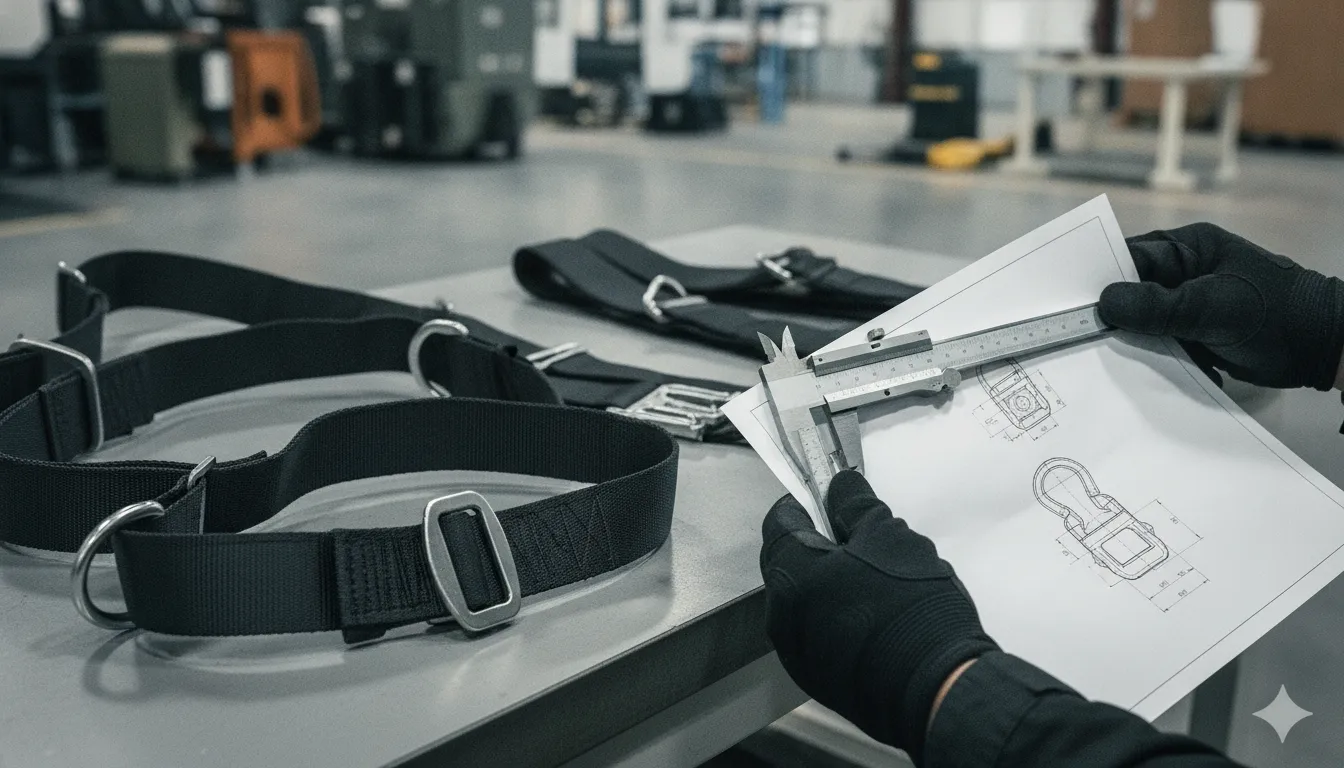
Interfaces should also support team procedures. Markings should make it clear which points are for retention, positioning, rescue, or equipment management. If an emergency release exists, the program should define when it may be used, what it releases, and what secondary action is required. A release that is easy to operate is not automatically safe; it must be controlled by procedure and training.
For connecting components, compare the harness interface with the component’s intended use rather than with a generic strength claim. Fusion’s ANSI Z359.12 connecting-components guide can support that review, while the project-specific technical data should control the final selection.
Make Inspection and Traceability Part of the Design
Special operations equipment moves through storage, training, deployment, cleaning, transport, and repair. A harness that cannot be inspected quickly is difficult to manage at scale. Procurement criteria should therefore cover the condition of the webbing, stitching, labels, hardware, adjustment points, and attachment interfaces, along with the records that connect each item to its approved configuration.
Define what the user checks before each use and what a competent or qualified person checks at a scheduled interval. The inspection form should identify damage that requires immediate removal from service, including cuts, burns, chemical attack, abrasion, pulled stitching, distorted hardware, damaged gates, missing labels, unauthorized modifications, or evidence of impact loading. The form should not rely on the reviewer’s memory or on a generic “pass” box without a defect description.
Traceability should connect the serial number, lot or batch, manufacturing date, material specification, approved drawing revision, inspection history, and any repair or disposition record. If a supplier makes a configuration change, the buyer needs a defined notification and approval process. Substitution of webbing, thread, buckle, connector, label, or finish can affect the validated assembly even when the replacement appears similar.
Storage and maintenance requirements belong in the technical data package. State how the harness is cleaned, dried, packed, protected from contamination, and transported. Define prohibited chemicals and environmental exposures when the supplier has supporting data. If a harness is exposed to a known event that exceeds its normal use, the disposition process should be clear. Do not return an impact-loaded system to service solely because no visible damage is found.
For a related inspection model, see Fusion’s tactical load-bearing system inspection guide. The special operations version should add mission-specific interfaces and the records required by the program’s quality system.
Specify the Evidence Package Before Requesting Quotes
A procurement package should tell suppliers exactly what evidence is needed and how it will be reviewed. Ask for controlled technical data rather than marketing claims. At minimum, the offer should identify the product configuration, approved uses, prohibited uses, materials, hardware, markings, inspection criteria, test methods, and quality records available for the delivered lot.
Standards references must be precise. Name the standard, edition, applicable section, product scope, and test evidence. The ANSI/ASSP Z359.7 page identifies the 2019 edition and describes qualification and verification testing for products covered by the Z359 code. Confirm the edition named in the contract before relying on the reference. A supplier statement that a harness is “ANSI tested” is not enough by itself. The buyer should confirm which product standard applies, what configuration was tested, who performed the test, and whether the delivered configuration matches the tested configuration.
Government buyers may also need a military or agency specification. For example, the DLA ASSIST record for A-A-59867, Harness, Safety, Full Body, Crossover identifies a commercial item description for a defined full-body harness use case. That record illustrates why a buyer should cite the exact document and revision. Avoid broad phrases such as “military specification.” A document applicable to one platform or operation does not automatically govern another.
Evidence to place in the supplier file
- Configuration-controlled drawing or technical data sheet with revision and date.
- Material and hardware identification, including substitutions that require approval.
- Test report or certificate that names the sample configuration, method, load direction, and result.
- Inspection and acceptance instructions that identify reject conditions.
- Lot, batch, serial, or date-code traceability for the delivered equipment.
- Care, storage, service-life, repair, and disposition instructions.
- Supplier quality certifications and the scope of the processes they cover.
- Change-notification terms and a process for approving deviations.
Ask for a sample evidence package during source selection. This reveals whether the supplier can provide usable records before the program is committed to a purchase order. It also gives evaluators a consistent basis for comparing offers without assigning unsupported product rankings.
Use a Repeatable Fit and Acceptance Trial
Acceptance should test the harness as a system in the mission configuration, not as an isolated item on a table. The test plan should identify users, clothing and equipment, connectors, anchor or receiving points, environmental conditions, and the records that prove each step was completed.
- Confirm configuration. Match the delivered markings, drawing revision, materials, hardware, and serial or lot records to the approved purchase documents.
- Perform a controlled fit check. Record sizing, adjustment range, routing, retention, interference points, and the user’s ability to verify the fit.
- Exercise every intended interface. Connect approved components in the specified direction and confirm that incompatible or prohibited connections are obvious.
- Run mission movements. Reproduce the relevant seated, standing, climbing, transfer, hoisting, or extraction movements without treating a training demonstration as a proof of unbounded use.
- Test emergency actions. Verify the defined release, transfer, casualty, or egress sequence and document any loss of access caused by clothing or equipment.
- Complete the inspection record. Capture defects, corrective actions, photographs when appropriate, and the final acceptance decision against the written criteria.
Training should include more than donning and doffing. Users need to recognize approved points, understand what each connection does, identify prohibited configurations, perform pre-use inspections, and report damage or unusual loading. Instructors should use the same terminology as the technical data package so that field reports map back to procurement and quality records.
When a program includes aircraft crew retention equipment or other connected systems, review the harness together with those interfaces. Fusion’s aircraft crew retention procurement guide provides related questions for documenting connection paths, acceptance criteria, and supplier evidence.
Compare Offers by Risk and Evidence, Not Feature Count
A supplier comparison matrix can keep the evaluation objective. Score whether each offer answers the requirement and provides evidence, not whether it uses the most technical-sounding language. A missing document should remain visible rather than being converted into a generous assumption.
| Evaluation area | Acceptable evidence | Procurement warning |
|---|---|---|
| Mission fit. | Task-specific configuration and use limits. | Generic harness description with no mission boundary. |
| Load path. | Drawing, rated component list, and test basis. | One assembly rating with no loading direction. |
| Interfaces. | Connector compatibility, orientation, and prohibited uses. | “Universal” fit language without geometry or procedure. |
| Inspection. | Pre-use and scheduled inspection criteria. | Visual inspection claimed but no reject conditions. |
| Configuration control. | Revision, lot traceability, and change notification. | Substitutions allowed without buyer approval. |
| Training. | Fit, movement, emergency, and inspection curriculum. | Product familiarization offered without task validation. |
Use a clarification log for unresolved items. Require the supplier to answer each question against the same configuration and revision. If a supplier cannot substantiate a claim, record it as an open requirement rather than filling the gap with a rating from an adjacent product or a different use case.
That discipline is valuable when a team must defend a source-selection decision. The final file should show the requirement, the evidence reviewed, the acceptance result, and any approved limitation. It should be possible for a future reviewer to understand why the configuration was selected without relying on informal conversations.
For a mission-specific review of harness requirements, interfaces, and supplier evidence, contact Fusion Tactical USA or call (909) 393-9450.
Frequently Asked Questions
What makes a harness suitable for special operations?
Suitability comes from documented mission fit, not a label. The harness should have defined load paths, approved interfaces, clear use limits, inspectable construction, traceability, and training that matches the operating procedure. The buyer should verify those points in the intended equipment and clothing configuration.
Does OSHA compliance prove that a harness is suitable for every mission?
No. OSHA requirements apply to the covered fall-protection application and components described by the regulation. A procurement team must still identify the mission function, applicable specification, interface geometry, loading direction, and acceptance method. A regulatory value should not be presented as a universal rating for unrelated uses.
Should a harness be rated for every attachment point?
Every attachment point should have a defined purpose and approved use. The supplier should state whether it supports personnel, equipment management, positioning, retention, rescue, or another function. Do not infer a personnel-support rating from the presence of a ring, loop, buckle, or accessory point.
What records should a government buyer request?
Request controlled drawings, material and hardware identification, test evidence, inspection criteria, lot or serial traceability, care instructions, service-life guidance, change-notification terms, and approved deviations. The exact package depends on the contract and governing specification, but the buyer should be able to connect the delivered configuration to the evidence reviewed.
How should a team validate fit before purchase?
Use representative users, clothing, equipment, connectors, and postures. Observe adjustment, reach, visibility, interference, emergency actions, and inspection steps. Record the configuration and acceptance criteria. A single successful demonstration is not enough when the program has multiple user profiles or mission configurations.
Build the Requirement Around Verifiable Use
The strongest special operations harness procurement is a controlled system decision. It starts with the mission and load path, defines interfaces and emergency actions, specifies inspection and traceability, and requires evidence that matches the delivered configuration. That framework lets B2B, aerospace, government, and tactical buyers compare suppliers fairly while keeping unsupported ratings and vague claims out of the file.
Fusion Tactical USA supports mission-specific safety equipment requirements with U.S.-based technical manufacturing and procurement-oriented documentation. Use the contact page to start a requirements discussion before requesting a final configuration or quote.


