

Personal Helicopter Safety Lanyard Load Rated Guide
In helicopter operations, operator retention is not a place for a generic fall-protection specification. Turbulence, rapid maneuvers, emergency egress, sustained tension, and the combined mass of the operator and equipment can create forces well above a static load. The lanyard must be selected and verified as part of the complete retention system, including its webbing, hardware, attachment points, and inspection program.
A personal helicopter safety lanyard load rated for helo operations is engineered and tested to manage the operator's total carried load plus the dynamic forces generated in flight. With documented strength and compatibility for the intended harness and mission. Static capacity alone is not enough.
That distinction matters during procurement because a higher number on a label does not automatically establish suitability. The rating should be traceable to the right test basis. Expressed clearly in terms such as kilonewtons and minimum breaking strength, and evaluated against the system's actual operating conditions. The first step is understanding what load rated means in practical engineering terms.
Request a quote for a load-rated retention system engineered for your mission.
What Does It Mean for a Helicopter Lanyard to Be Load Rated?
A load-rated helicopter lanyard has a documented capacity for carrying the operator and equipment under the forces expected in rotorcraft operations. That capacity must account for the total suspended or restrained mass, dynamic acceleration, and the strength of the complete retention path, not just the webbing. In practical terms, a personal helicopter safety lanyard load rated for flight duty is specified and validated for the conditions in which operator retention and emergency egress may be required.
Load rating is commonly expressed in kilonewtons (kN), a unit of force, and may also be listed in pounds-force (lbf). Procurement teams should confirm what each published value represents, how it was tested, and whether it applies to the assembled lanyard, its hardware, or only a component.
What MBS and kN Actually Describe
Maximum breaking strength (MBS) is the force at which a component or assembly fails during a defined test. It is not a recommended operating load. A specification such as 30 kN indicates a force threshold. But it does not by itself establish that the lanyard is suitable for every aircraft, attachment point, operator configuration, or maneuver. The rating must be considered alongside the connector, harness interface, stitching, termination, and installation method.
For reference, 1 kN is approximately 225 lbf. Converting units helps procurement teams compare proposals, but the underlying test method and configuration remain more important than a larger number printed on a datasheet. A rating should be traceable to engineering documentation and manufacturer guidance.
Why Static Capacity Is Not Enough in a Helicopter
A static calculation treats the load as steady. Helicopter operations can introduce abrupt acceleration, turbulence, aircraft movement, and emergency stops that create force well above the resting weight of the operator and gear. Experimental dynamic studies of lanyard prototypes found that peak forces can significantly exceed static load capacity in fall-arrest scenarios, supporting the need for high-rated materials and assemblies (PMC7037010).
The engineering question is therefore not simply, "How much does the operator weigh?" It is closer to: total operator and equipment weight multiplied by the applicable dynamic factor. With an appropriate design margin and a compatible retention system. The same research identifies this relationship as central to operator retention and emergency egress stability (PMC7037010).
For buyers, a credible load-rated specification should make those assumptions visible. Request the MBS, tested configuration, connector ratings, applicable dynamic conditions, and inspection or service-life requirements. This documentation allows a program manager or aviation safety officer to evaluate the lanyard as part of the full retention system rather than treating one component rating as a complete safety claim.
What a Load-Rated Personal Helicopter Safety Lanyard Must Deliver
A load-rated personal helicopter safety lanyard must preserve operator retention through the combined effects of body weight, carried equipment, maneuver loads, sustained tension, and emergency movement. A procurement-ready specification therefore needs more than a single strength number. It must identify the webbing construction, hardware rating, minimum breaking strength (MBS), working-load limits, test basis, and intended attachment system.
The central question is whether the complete lanyard system can manage the loads generated in its actual aviation use case. Not merely whether one component appears strong in a static pull test.
Specify the Webbing for Aviation Service
Start with the webbing because it carries load across the primary length of the lanyard and remains exposed to abrasion, contamination, ultraviolet radiation, temperature changes, and repeated flexing. A procurement specification should identify the material, construction, width, treatment, and applicable military specification rather than accepting an undefined claim such as "heavy duty." For mission-critical retention equipment. Rated MIL-SPEC webbing such as MIL-W-5664E provides a more meaningful basis for review than generic commercial webbing language.
The webbing also needs to tolerate sustained dynamic tension. During flight, the lanyard may remain loaded as the operator shifts position or encounters turbulence, then experience a sharper force during an unexpected movement. Research on aerospace safety materials emphasizes the value of advanced webbing that maintains structural integrity under sustained tension and environmental exposure (PMC10258374). The specification should therefore address material validation and service conditions, not only nominal tensile strength.
Match the Hardware to the Rated System
Hardware must not become the weak link. The connection should use a rated, triple-locking carabiner or equivalent life-safety connector with a clearly documented high-kN rating. Procurement teams should verify the major-axis rating, gate and locking behavior, compatibility with the harness or approved anchor, and whether the published rating applies in the installed orientation. A high-strength webbing assembly paired with an under-rated connector is not a load-rated system.
Fusion Tactical's SPIE lanyard provides a field-proven example of this specification approach. Its stated configuration includes 31 kN webbing, 60 kN MBS, and a 50 kN carabiner, with Berry and TAA compliance. These figures are Fusion Tactical product specifications, not a substitute for confirming the requirements of a particular aircraft, unit, or government program.
Separate MBS From the Working Load
MBS is the force at which a new component or assembly fails under the defined test method. It is not the force an operator should routinely apply in service. A working-load limit must account for the operator, equipment, attachment geometry, dynamic acceleration, wear, and the required factor of safety. Procurement documents should require both values, define the test configuration, and state whether the rating applies to the complete assembly or only to individual components.
This distinction matters when comparing products or setting approval thresholds. A lanyard with a high MBS may still be unsuitable if its working-load guidance, connector orientation, or attachment point does not match the mission. Teams reviewing options can use Fusion Tactical's guide to selecting rated retention lanyards without reducing the evaluation to a single kN figure.
Load Rated Lanyard Standards and Compliance: MIL-STD, ANSI Z359, and OSHA
A compliant helicopter retention lanyard must be evaluated for the actual aviation mission, not selected solely because it carries an industrial fall-protection label. The relevant procurement question is whether the complete retention chain, including webbing, hardware. Attachment geometry, and harness interface, has documented strength, fatigue resistance, and suitability for dynamic flight loads.
ANSI Z359 and OSHA provide an important reference point for industrial fall protection, but they do not automatically establish that a lanyard is appropriate for helicopter operator retention. Aviation programs should pair applicable standards with mission-specific testing, engineering documentation, and clear limits of use.
Request a quote for a load-rated retention system engineered for your mission.
How aviation requirements differ from industrial fall protection
Industrial fall-protection lanyards are commonly designed around a single worker and a controlled fall-arrest scenario. Fusion Tactical uses approximately 5,000 lbf as a familiar reference for single-person industrial lanyard ratings associated with ANSI Z359 and OSHA applications. That reference should not be treated as a helicopter specification. External-load and open-cabin operations introduce sustained tension, vibration, turbulence, emergency maneuvers, abrasion, and repeated loading that can create different failure modes.
Research on helicopter safety equipment notes that standard fall-arrest systems may not account for sustained loading and fatigue in aeronautical applications. See the analysis of these aviation-specific failure considerations in the cited academic research. The CDC also identifies certified load-bearing equipment and strict safety protocols as foundational controls for helicopter external-load operations: CDC helicopter external-load guidance.
What procurement documentation should establish
A procurement package should identify the intended operator weight range, carried equipment, attachment points, expected dynamic factors, environmental exposure, inspection requirements, and replacement criteria. It should distinguish minimum breaking strength from working load limits and show how the complete assembly was validated. A high webbing number alone is not enough if a connector, stitching pattern, harness interface, or anchor point carries a lower rating.
Flight-service components that carry tension also require fatigue and material validation. NIST documentation on failed helicopter strap components reinforces the need for rigorous fatigue testing of tension-bearing parts: NIST helicopter component examination. Every component in the retention chain must support the intended load path, with test records and engineering controls available for program review. For a deeper explanation of measurement and terminology, review kN strength ratings for life-safety gear.
Where U.S. manufacturing and sourcing controls fit
For defense, aerospace, law enforcement, and government buyers, technical performance is only one part of compliance. Fusion Tactical USA supports procurement requirements through U.S. manufacturing, Berry Amendment and TAA-compliant capabilities, applicable MIL-STD considerations, and an ISO 9001:2015 quality-management framework. Its CAGE Code 0KQN1 provides an additional identifier for government sourcing and program documentation.
These credentials do not replace application-specific qualification. They establish a stronger foundation for traceability, domestic sourcing, engineering review, and made-to-order production. Program teams should request the applicable test evidence, material specifications, inspection criteria, and configuration records before approving a personal helicopter safety lanyard load rated for operational use. Fusion's Berry-compliant U.S. manufacturing overview provides additional procurement context.
Load-Rated Helo Lanyard vs Standard Industrial Fall-Protection Lanyard
A load-rated helo retention lanyard is engineered for the forces, attachment conditions, and mission profiles of rotorcraft operations. A standard industrial fall-protection lanyard is generally designed around a single worker arresting a vertical fall. The two products may look similar, but they are not interchangeable.
The practical answer is that a personal helicopter safety lanyard load rated for aviation must be evaluated as part of a complete retention system. Not selected from an industrial fall-arrest catalog by length or connector alone. Its breaking strength, load path, hardware, and service environment must match the aircraft mission and the operator's total carried load.
| Specification | Load-rated helo retention lanyard | Standard industrial fall-protection lanyard |
|---|---|---|
| Maximum breaking strength | Designed for substantially higher aviation loads. For example, Fusion Tactical's SPIE extraction lanyard uses 31 kN webbing and lists a 60 kN minimum breaking strength, with a 50 kN carabiner. | Commonly specified around 5,000 lbf, approximately 22 kN, for a single-person fall-arrest application. The rating must be confirmed from the manufacturer's documentation. |
| Shock absorber | Typically static for operator retention, hoist, or extraction duties where controlled positioning and a stable load path are required. The system must be engineered for its defined aviation use. | Normally incorporates an energy absorber to limit arrest forces during a fall. That behavior and deployment distance may be unsuitable where controlled retention or clearance is required. |
| Primary load profile | May involve dynamic rotorcraft movement, emergency maneuvers, extraction activity, and, where specifically engineered, multi-person or mission-equipment loads. | Primarily a single-person vertical fall-arrest load with defined assumptions about the worker, anchor, clearance, and arrest event. |
| Governing framework | Mission-specific engineering, military specifications, documented testing, and procurement requirements such as Berry Amendment and TAA compliance may apply. | Typically evaluated against industrial fall-protection requirements such as ANSI Z359 and applicable OSHA rules. Those requirements do not automatically establish suitability for helicopter retention. |
| Application | Operator retention, helicopter ingress and egress, external operations, hoist support, or extraction systems when specified and approved for that mission. | Construction, maintenance, and other industrial work where the lanyard's certified fall-arrest configuration matches the task. |
Industrial fall-arrest certification is not a substitute for aviation qualification. Research on aeronautical applications notes that traditional fall-arrest systems can develop failure modes under sustained loading and fatigue that standard industrial tests do not account for. See the discussion in this aviation safety study.
Procurement teams should compare the complete load chain, including harness attachment points, connectors, webbing, anchor geometry, and inspection criteria. A higher number on one component does not make an incompatible system safe. For a deeper review of documented performance values, see Fusion Tactical's SPIE extraction lanyard load ratings.
Why Operator Retention Demands a Rated, High-Factor-of-Safety Design
A retention lanyard must keep the operator connected to the aircraft anchor while preserving controlled movement during insertion, extraction, turbulence, and emergency maneuvers. The design must account for the combined operator-and-gear mass, dynamic acceleration, attachment geometry, and the strength of every component in the retention chain.
In practical terms, a high factor of safety provides reserve capacity between expected working loads and the system's rated strength. That reserve is essential because peak forces can exceed static loads, while aviation exposure can introduce sustained tension, abrasion, fatigue, and environmental degradation.
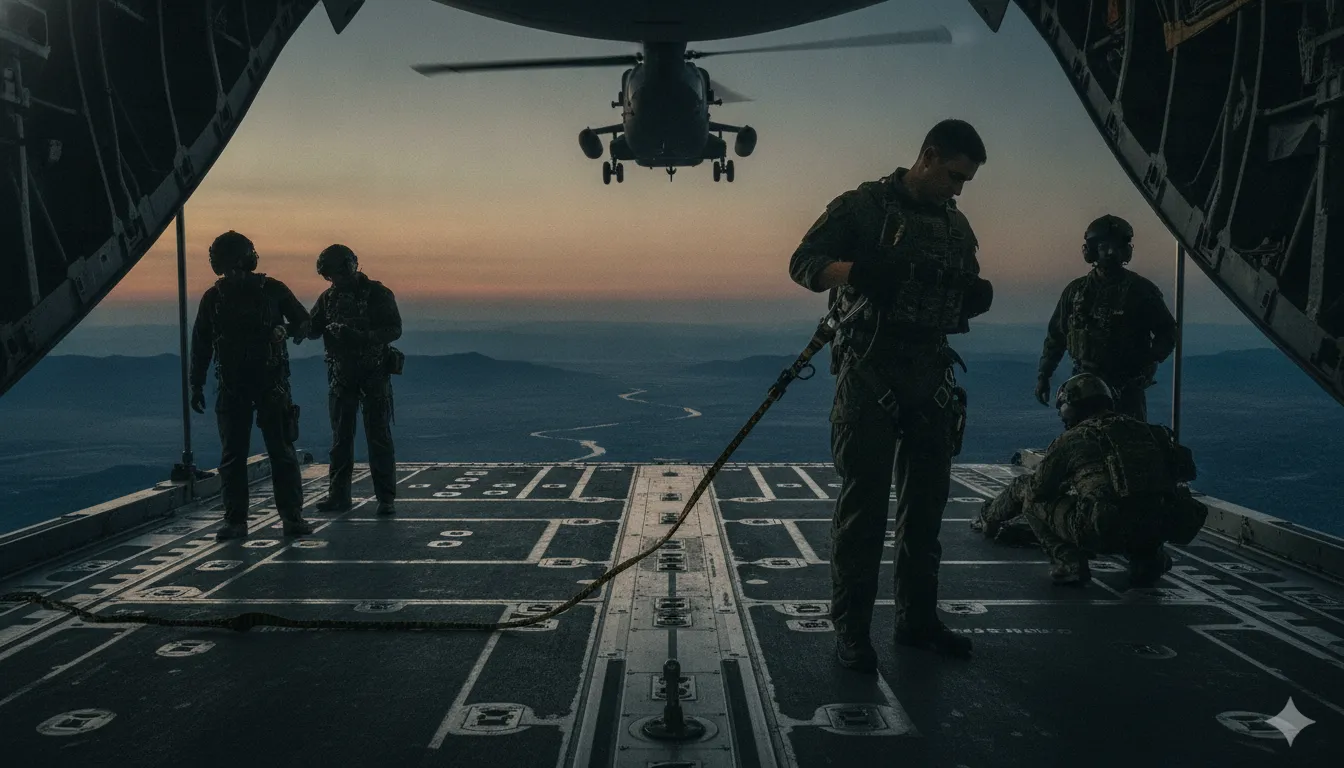
Dynamic loads change the engineering problem
Static body weight is only the starting point. A procurement or engineering team evaluating a personal helicopter safety lanyard load rated should calculate the expected load from the operator's weight plus equipment. Then apply the dynamic factors associated with aircraft motion and the intended operating profile. Research on lanyard performance shows that peak forces can significantly exceed static load capacity during fall-arrest conditions, reinforcing the need for high-rated materials and validated testing. Research on dynamic lanyard forces provides the underlying technical context.
This distinction matters during abrupt aircraft movement or an emergency stop. The lanyard, anchor, connector, harness interface, stitching, and webbing all receive load through the same event. A high rating on the lanyard alone does not compensate for a weaker anchor or incompatible connector. The complete system must be evaluated as a chain, with attachment geometry selected to avoid concentrated stress and unintended loading.
Materials must retain strength throughout service
High-strength webbing is selected not only for its initial breaking strength, but also for its ability to maintain structural integrity under sustained tension and environmental exposure. Aerospace safety research identifies advanced webbing materials as a preferred approach for load-rated applications because service conditions can include vibration, contamination, temperature changes, ultraviolet exposure, and repeated handling. See the aerospace materials and fatigue research for documented considerations.
That is why a rated design should be supported by clear material specifications, traceable testing, and inspection criteria. Teams should verify the rated strength and intended use of the webbing, hardware, terminations, and aircraft interface rather than relying on a generic lanyard designation. The result is a retention system designed for mission requirements, not a repurposed fall-protection product assumed to perform the same way in flight.
For procurement teams, the key question is whether the documented rating reflects the complete operational system and leaves appropriate reserve capacity for dynamic events. That evidence supports safer deployment decisions, more consistent inspection planning, and a defensible equipment specification when failure is not an option.
How Often Should a Personal Helicopter Safety Lanyard Be Inspected?
A personal helicopter safety lanyard should receive a hands-on inspection before every flight or use. Followed by scheduled inspections at the interval specified by the manufacturer and operating program. Any lanyard exposed to a shock load, abnormal loading, contamination, or suspected damage should be removed from service immediately, regardless of its calendar age. Consistent maintenance and scheduled inspections are necessary to keep retention equipment within manufacturer-specified structural limits, as documented in aviation safety research (source research on inspection and maintenance).
The inspection interval is not a substitute for a serviceability decision. Flight crews, safety officers, and procurement teams should define who performs each inspection, what findings require quarantine, and how records are retained. The procedure should cover the complete assembly, including webbing, stitching, connectors, attachment points, labels, and any adjustment or energy-management components.
Pre-flight inspection points
Before connecting the lanyard, examine the webbing from end to end under adequate light. Look for cuts, pulled or broken fibers, fraying, abrasion, glazing, melted areas, discoloration, stiffness, chemical staining, and distortion. Pay particular attention to sections that contact cabin structure, door hardware, seat fittings, or other edges during normal movement. Heat damage can change the appearance or hand of the webbing without creating an obvious hole.
Inspect every stitch pattern for broken thread, loose sections, pulled bar tacks, or separation between layers. Check the identification label for legibility and confirm that the assembly remains within its approved configuration. If the load rating, serial number, inspection status, or manufacturer information cannot be verified, treat the item as unavailable until qualified personnel resolve the discrepancy.
Hardware and attachment-point checks
Operate each connector as designed. The gate or locking mechanism should move smoothly, close fully, and remain secure. Reject hardware showing cracks, sharp deformation, excessive wear, corrosion, burrs, damaged threads, or unintended gate movement. Inspect the connection point on the harness or aircraft for concentrated wear, looseness, deformation, and incompatible interfaces. A sound lanyard cannot compensate for a damaged anchor or an incorrect connection.
UV exposure, temperature changes, moisture, fuels, oils, and cleaning chemicals can accelerate material degradation. Storage should protect the lanyard from unnecessary sunlight, heat, contamination, and compression. Follow the manufacturer's cleaning, drying, storage, retirement, and recertification instructions. Do not attempt field repairs, dye the webbing, or return a quarantined assembly to service based on appearance alone.
Scheduled inspection and removal from service
A competent, manufacturer-authorized, or otherwise designated inspector should perform the periodic examination required by the operating organization and equipment instructions. Record the date, inspector, equipment identity, findings, corrective action, and next inspection due. Increase review frequency when the lanyard sees intensive flight hours, abrasive contact, harsh environments, repeated decontamination, or unusual loading.
When any defect is found, tag and isolate the lanyard so it cannot be returned to the aircraft by another crew member. The same discipline applies after a fall, emergency maneuver, hard arrest, or other event that may have imposed loads beyond normal retention service. For a complete maintenance workflow, review this guide to helicopter lanyard inspection and apply the manufacturer's written limits.
Speak with an engineer about a rated retention system and inspection plan.
Frequently Asked Questions
What defines a load-rated safety lanyard for helicopter operations?
A load-rated lanyard has documented performance for its webbing, stitching, connectors, and attachment configuration under specified loads. For helicopter operations, evaluation must account for the operator, carried equipment, dynamic forces, and the complete retention chain, not the lanyard in isolation. Aviation safety research emphasizes validated structural integrity and fatigue resistance for tension-bearing components. NIST testing guidance provides relevant context.
Why is a load-rated helicopter safety lanyard critical for operator retention?
Helicopter maneuvers, turbulence, and emergency events can create peak forces that exceed static loads. A properly rated system helps maintain operator connection and egress stability when those forces occur. The rating should reflect total operator and gear weight multiplied by the dynamic factors expected in the mission, as discussed in the published lanyard research.
What is the minimum breaking strength of a safety lanyard?
There is no universal breaking-strength value that makes every lanyard suitable for helicopter retention. The required value depends on the mission, attachment geometry, total system load, dynamic exposure, and the manufacturer's documented test basis. Procurement teams should compare minimum breaking strength with working limits and verify that every connector and harness interface is rated for the same application.
Can you connect a lanyard to a self-retracting lifeline?
Do not combine a lanyard with a self-retracting lifeline unless the equipment manufacturer and the governing procedure specifically approve that configuration. Adding components can change clearance, connector loading, arrest behavior, and attachment geometry. Treat the lanyard, lifeline, harness, and anchor as one engineered system, and obtain written compatibility guidance before fielding it.
How often should you inspect your personal helicopter safety lanyard?
Inspect it before every use or flight, and follow the manufacturer's scheduled inspection and replacement requirements. Check webbing, stitching, hardware, connectors, contamination, abrasion, corrosion, and any impact or overload history. Scheduled inspections are necessary because fatigue and environmental exposure can degrade load-bearing equipment before obvious failure appears. See the aviation safety research for the importance of maintenance and fatigue evaluation.
Ready to Specify Load-Rated Helicopter Retention Equipment?
Mission requirements, operator loads, connection hardware, and procurement standards should align before a retention lanyard enters service. A focused engineering review can help your team translate those requirements into a practical specification for helicopter operations, including quote development and government pricing considerations.
Contact us to request an engineering consultation or government pricing.


