

kN Strength Ratings for Life-Safety Tactical Gear
When a tactical connection point, lanyard, or load-bearing component is specified in pounds alone, an important part of the safety picture may be missing. Field equipment can experience shock, arrest, extraction, and other dynamic loads that are not captured by the static mass of the person or payload.
When reviewing kN strength ratings, the numbers express force rather than simple weight, which makes them useful for evaluating life-safety hardware under dynamic loading. One kiloNewton is approximately 225 pounds of force, but the number must be interpreted alongside the component's loading direction, configuration, test method, and applicable standard.
For procurement and engineering teams, the practical question is not whether a larger number is always better. It is whether the rating represents the intended mission, has been tested under controlled conditions, and remains valid when the equipment is deployed as designed. That starts with understanding what a kiloNewton measures and why the distinction matters.
What Is a kN Strength Rating and Why Does It Matter for Life-Safety Gear?
A kN strength rating tells a procurement team how much force a component is designed to withstand under a defined loading condition. The rating is not a simple statement of how much equipment weighs or how many pounds an operator can carry. It describes force, which becomes especially important when a person, load, or aircraft-connected system accelerates, stops, swings, or transfers load suddenly. For that reason, kN strength ratings provide a more useful technical language for comparing life-safety hardware than a pounds-only specification.
How does kN physics apply to tactical hardware?
A kiloNewton, written as kN, is a unit of force. One kN equals 1,000 Newtons, and one Newton is approximately 0.225 pounds-force. In practical terms, 1 kN is approximately 225 pounds-force. This conversion is useful for translating specifications into familiar units, but it should not be treated as a direct equipment weight limit. The rating describes the force applied to the component, not the mass of an object sitting motionless on it.
Manufacturers use kN because life-safety hardware must be evaluated against measurable loads. A connector, webbing assembly, or lanyard can have a high nominal rating while still requiring a specific orientation and configuration to achieve it. For example, a carabiner's published strength generally applies along its major axis with the gate fully closed and locked, as described in this hardware rating reference. The number only has meaning when the test condition and use condition match.
Why are force and mass different in a life-safety application?
Mass describes how much matter an object contains. Force describes the push or pull acting on that object. A stationary 200-pound load can generate a very different demand from the same load moving rapidly and stopping over a short distance. That sudden deceleration can multiply the force transferred through attachment points, stitching, hardware, and the surrounding structure.
This distinction is why tactical teams and equipment buyers should review the complete rating basis rather than comparing pound values in isolation. A component rated for a particular force may be suitable only for a specified axis, gate position, attachment method, or system configuration. The rating should be read alongside the applicable standard, test documentation, inspection requirements, and operating environment. In high-consequence work, understanding what the number measures is the first step toward selecting equipment that can manage the forces a mission actually creates.
Why Force Ratings Matter More Than Weight Limits in Tactical Load-Bearing Equipment
A pounds-only specification describes a static load at rest. Tactical equipment rarely operates in that condition. During a fall, hoist, abrupt aircraft movement, or hard arrest. The system must manage force generated by acceleration and deceleration, not simply support the mass of a person or payload. That distinction is why procurement teams should evaluate rated force, expressed in kN, alongside working-load limits and the intended loading direction.
Dynamic loading changes the engineering requirement
Static weight is relatively straightforward: a 200-pound load applies approximately its own gravitational force while suspended without movement. A dynamic event adds acceleration, stopping distance, geometry, and impact timing. A short, abrupt stop can transmit substantially more force through a connector, lanyard, harness, or anchor than the same load would create while stationary. In practical terms, a person does not need to weigh thousands of pounds to generate thousands of pounds of arrest force.
Fall factor is one way engineers and safety professionals describe this exposure. It compares the distance fallen with the length of system available to absorb the event. Higher fall factors generally create more severe loading. As a useful industry reference. Lead falls with fall factors of approximately 0.2 to 0.7 have been reported to generate roughly 2 to 5 kN on the upper piece of equipment. Although actual results depend on the system and event conditions (fall-factor and kN rating context).
The same principle applies to rotorcraft and rescue operations. A retention system may experience sudden aircraft movement, operator repositioning, hoist transitions, or extraction loads. These events require a force-rated system selected for the complete load path, rather than a product chosen only because its advertised weight limit exceeds the operator's body weight.
What happens when gear is underspecified?
When equipment is underspecified, the weakest component can become the failure point. A connector may be strong along its major axis but significantly less capable when cross-loaded, when the gate is open, or when the gate contacts an edge. Ratings are conditional, so the assembly must preserve the manufacturer-specified orientation and locking configuration.
High-risk vertical and extraction work therefore uses components engineered beyond ordinary single-person fall-safety assumptions. Fusion Tactical's SPIE extraction lanyard documentation describes equipment built for demanding vertical operations and stronger requirements than standard fall-safety tools (SPIE extraction lanyard load ratings). Procurement specifications should state dynamic use cases, occupant or payload count, connection geometry, and required kN performance before a supplier is selected.
How kN Strength Ratings Vary by Product Class
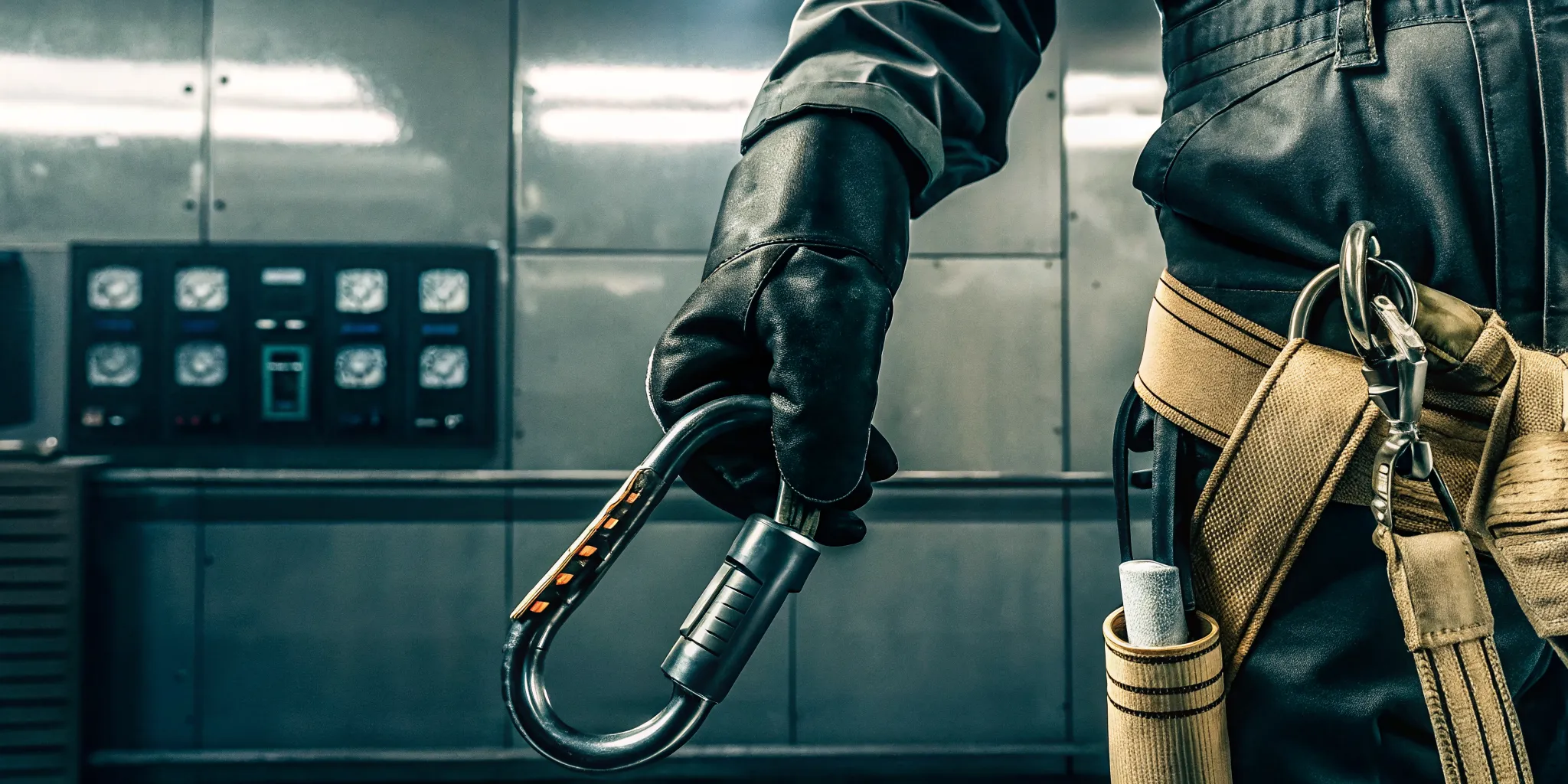
Product-class comparisons are useful only when the rating, test condition, and intended application are read together. The values below provide procurement context, not permission to substitute one component for another. A rated value generally applies along the component's major axis with the gate closed and locked, where applicable. Off-axis loading, an open gate, damaged webbing, or incompatible connectors can materially reduce performance.
| Product class | Representative rating | What the rating means |
|---|---|---|
| Rated carabiners | 20-30 kN major axis | Typical professional-grade range, approximately 4,500-6,750 lbf, when loaded correctly. |
| Carabiner or snap-hook gate | 16 kN minimum | ANSI Z359.1 specifies a 3,600 lbf, approximately 16 kN, minimum gate strength for personal fall-arrest equipment. |
| Fall-protection anchors | Approximately 22.2 kN | Commonly specified at 5,000 lbf for fall-arrest anchor points. Confirm the governing standard and installation conditions. |
| MIL-SPEC Type 13 webbing | Approximately 5,000 lbf tensile | A webbing tensile value describes the material or assembly test. It is not automatically a complete system rating. |
| SPIE extraction lanyard | 31 kN webbing, 60 kN MBS, 50 kN carabiner | These component and minimum breaking strength values support a purpose-built extraction application and require correct rigging. |
The distinction between a material rating and an assembly rating is critical. Webbing may test at one tensile value, while stitching, adjusters, terminations, and connectors determine the strength of the completed lanyard or harness. Minimum breaking strength is also not the same as a permitted working load. Buyers should request the manufacturer-defined limit and application-specific test evidence rather than converting a peak number into an operational allowance.
For deeper product-specific context, review Fusion Tactical's SPIE extraction lanyard load ratings. Procurement teams can also review the company's rated hardware and match connector geometry, gate type, and loading direction to the system design. In high-consequence work, the correct question is not which component has the largest number. It is whether every load path, interface, and test condition supports the mission.
How kN Strength Ratings Are Tested and Verified
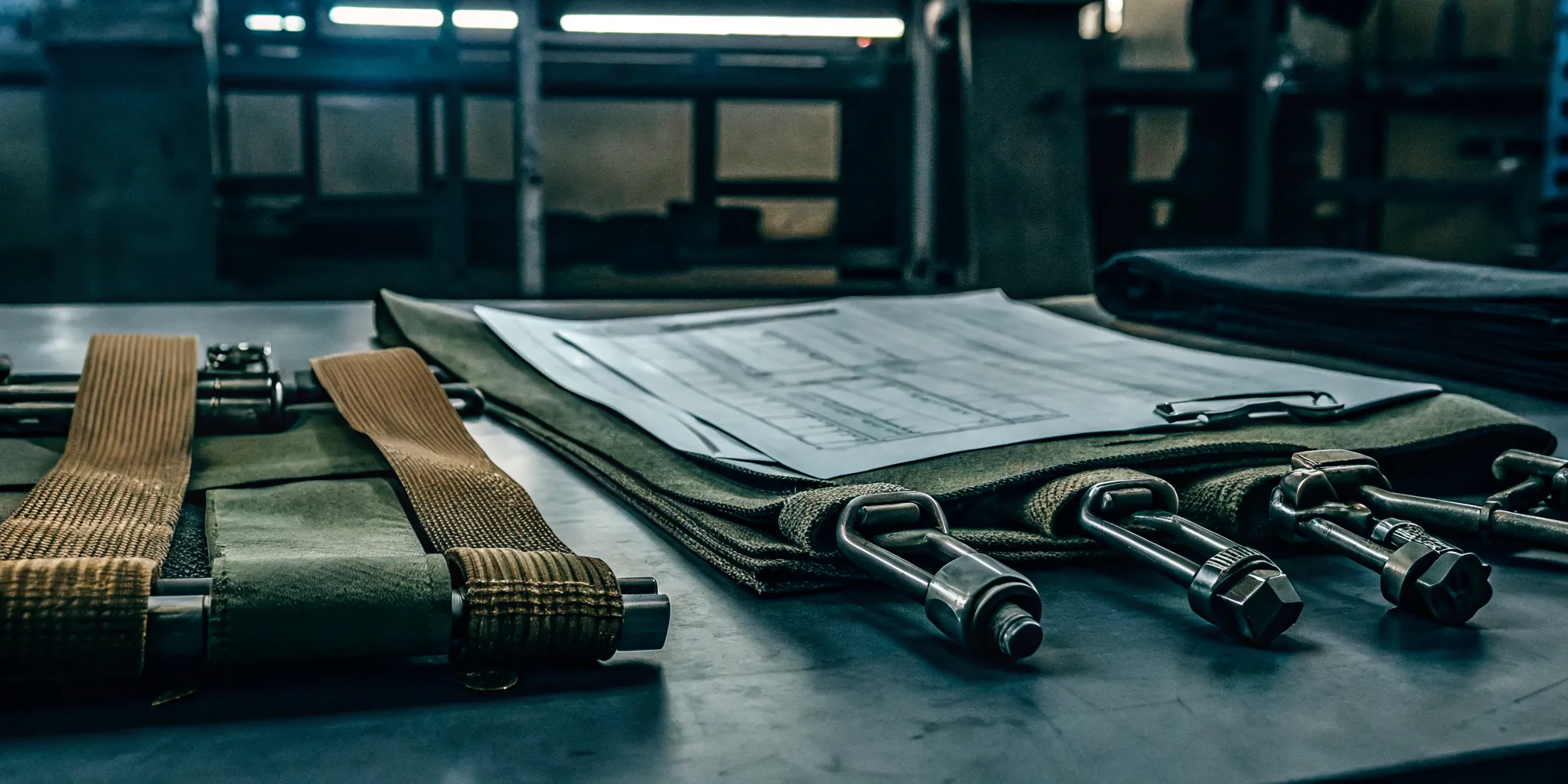
A published kN value is meaningful only when the test method, loading direction, component configuration, and acceptance criteria are clear. For life-safety hardware, procurement teams should evaluate more than the number printed in a catalog. They should confirm how the item was loaded, who performed the test, and whether the documentation distinguishes maximum breaking strength from an allowable working load.
Test conditions and major-axis loading
Strength ratings for connectors generally apply along the major axis, with the gate fully closed and locked. Loading a carabiner across its minor axis, against the gate, or with the gate open can produce a substantially different result. The rating therefore describes a defined test configuration, not a universal capacity in every orientation.
Testing must also account for the complete assembly. Webbing, stitching, hardware, gates, attachment points, and terminations can each influence the result. A reported value is useful when the tested configuration matches the configuration being procured and deployed. Buyers should ask whether the report identifies the tested model, materials, hardware, loading axis, and failure mode.
Maximum breaking strength versus working load
Maximum breaking strength (MBS) is the force at which a tested item fails under the specified conditions. It is not the same as the working load that should be applied during operations. Working-load limits incorporate design margins, use conditions, wear, dynamic loading, and the consequences of failure.
Some Fusion Tactical items are proof tested to 2.5 times their stated working load. Proof testing is an additional screening measure, not a replacement for a defined working-load limit or a substitute for inspection. Procurement specifications should state which value governs operational use and should avoid treating MBS as an authorized mission load.
Independent verification and procurement documentation
Independent testing provides an important check on manufacturer claims. Fusion Tactical identifies John Batchelor Testing, Midwest Testing, and Exvo OCM Test Laboratories among the third-party laboratories used to validate strength. A procurement file should retain the applicable test report or certificate, revision date, laboratory identity, sample description, standard or procedure used, and recorded results.
That documentation allows engineering and contracting personnel to compare the tested configuration with the requested item and to verify that the rating supports the intended application. It also creates an auditable record for qualification, acceptance, maintenance, and future replacement decisions.
What kN Strength Rating Does Your Mission Require?
The correct rating depends on how the equipment will be loaded, how many people or systems it may support, and whether the event is static, dynamic, or both. A crew retention lanyard, a fall-arrest connector, a SPIE extraction lanyard, and a general load-bearing component should not be selected from the same rating assumption.
Match the rating to the application
For rotorcraft crew retention, evaluate the restraint system against the movement and loading conditions of the aircraft, including abrupt changes in direction and operational vibration. The rating is only meaningful when the complete assembly, attachment geometry, connector orientation, and locking method are considered. Fusion Tactical's crew retention lanyard guidance can help separate operator restraint requirements from personal fall-arrest requirements.
Fall-arrest equipment is governed by a different design question: how the system arrests a falling person and limits forces through compatible anchors and connectors. ANSI/ASSE Z359.1 specifies a 16 kN minimum gate strength for applicable connectors, while fall-protection anchors are commonly rated at 5,000 pounds, or approximately 22.2 kN. Those thresholds are useful procurement reference points, but they do not automatically qualify a component for rotorcraft retention or extraction operations.
SPIE extraction introduces a higher-load, multi-person or hoisting context. The Fusion Tactical SPIE Extraction Lanyard uses 31 kN webbing, a 60 kN minimum breaking strength, and a 50 kN triple-locking carabiner. That configuration reflects the need for equipment built stronger than standard fall-safety tools in high-risk vertical and extraction operations. General load-bearing gear should be matched to its stated personnel, equipment, and attachment loads rather than compared by headline kN alone.
Build in working-load margin and safety factors
Minimum breaking strength is not the same as an approved working load. MBS describes the point at which a tested component fails under a defined setup. A procurement decision must then account for dynamic loading, wear, environmental exposure, connection angles, stitching, hardware orientation, and the applicable safety factor. A 60 kN result on one component does not make every configuration safe to 60 kN.
Ask the manufacturer to define the working-load limit, test configuration, compatible connectors, and inspection criteria for the intended mission. For complex or custom systems, use Fusion Tactical's engineering and testing services to review the load path and select a complete assembly rather than an isolated high-rated part.
How to Verify kN Strength Ratings Before You Buy
Verify a claimed rating through independent test evidence, the exact standard applied, and documentation that identifies how the component was loaded. A kN value without its test method, load axis, and certification record is not enough for a procurement decision.
Request the test report, not only the product specification
Ask the supplier for a current report from an independent laboratory and confirm that the report identifies the product. Material or webbing construction, test fixture, failure load, test date, and laboratory. Fusion Tactical references independent testing organizations including John Batchelor Testing, Midwest Testing, and Exvo OCM Test Laboratories. These records help distinguish a measured breaking strength from an unverified marketing claim.
Also ask whether the stated value is minimum breaking strength, working load, or a proof-test result. Those terms are not interchangeable. Select equipment may be proof tested to 2.5 times its working load. But that does not mean the proof-test value should be treated as the product's working load in the field.
Confirm the standard and loading condition
Record the standard cited in the procurement file and verify that it matches the intended application. Relevant references may include ANSI Z359 for fall-protection equipment, MIL-SPEC requirements for tactical webbing, and EN 362 or EN 12275 for applicable connector performance. A certificate should identify the standard edition or requirement, product configuration, and any limitations.
For connectors, confirm the rating axis. A major-axis rating generally applies only when the gate is closed and locked, not when the connector is cross-loaded, loaded over an edge, or loaded through the gate. A rated carabiner may show a 20 to 30 kN major-axis value, while the gate strength is a separate specification.
Finally, compare the documented threshold with the governing requirement. ANSI Z359.1 specifies a minimum gate strength of 16 kN, or 3,600 lbf, for applicable equipment. Fall-protection anchors are commonly specified at 5,000 lbf, approximately 22.2 kN. Keep copies of the certificate, test report, configuration details, and supplier declarations with the purchase record. Fusion Tactical's certifications and compliance resources and engineering and testing services can support that review.
Frequently Asked Questions
How many pounds of force does 1 kN represent?
One kiloNewton represents approximately 225 pounds-force. It is a force measurement, not a direct statement of how much mass a component can safely carry. The practical meaning of a rating depends on loading direction, attachment configuration, test method, and whether the force is static or dynamic. This conversion is a useful reference point, not a substitute for the manufacturer's complete specification.
How strong is 7 kN for tactical equipment?
Seven kN is approximately 1,575 pounds-force, but that figure alone does not establish suitability for a life-safety application. Buyers must confirm the component's intended use, safety factor, connector orientation, and applicable standard. A 7 kN rating may be appropriate for a specific non-fall-load component, while a fall-arrest, hoist, or extraction system may require a substantially different design basis.
Why does loading direction affect a carabiner's kN rating?
A carabiner's published major-axis rating applies when the load runs lengthwise through the body and the gate is fully closed and locked. Cross-loading, loading over an edge, or allowing gate contact can reduce performance and may invalidate the stated rating. A professional-grade carabiner commonly falls in the 20 to 30 kN range on its major axis, according to industry reference guidance.
What kN threshold applies to fall-arrest connectors?
ANSI/ASSE Z359.1 requires a minimum gate strength of 16 kN, or approximately 3,600 pounds-force, for covered carabiners and snap hooks used in personal fall-arrest systems. That threshold is a baseline requirement, not a universal selection rule. The complete assembly, connection method, user environment, and governing procurement specification must also be evaluated. Review the cited ANSI guidance for application context.
What documents should a buyer request before approving rated gear?
Request the manufacturer's full rating and loading conditions, applicable standard citations, material and configuration details, inspection criteria, and current test documentation. For mission-critical procurement, independent laboratory reports and traceable manufacturing or compliance records provide stronger evidence than a product-page number alone. If the intended use involves fall arrest, hoisting, extraction, or multiple personnel, ask the supplier to confirm that the tested configuration matches the operational system.
Ready to specify the right kN rating?
When tactical hardware supports a life-safety mission, the rating should align with the application, loading conditions, and verification requirements. Fusion Tactical can help procurement and engineering teams evaluate those details before selecting equipment. Call (909) 393-9450 or request a quote for verified kN strength ratings on tactical hardware to talk through your requirements.


