

Rescue Pulley System Procurement: Mechanical Advantage and Load Evidence: Construction Harness
A construction harness is one element in a work-at-height or rescue arrangement, not proof that the entire arrangement is suitable. Procurement teams need to define the task, interfaces, load path, and documentation that make up the system. This guide explains how to ask suppliers for mechanical advantage details and traceable load evidence, then compare the responses without treating one component rating as approval of a complete setup.
Discuss your equipment requirements
What should a construction harness requirement define?
Begin with the work profile rather than a product name. The same broad equipment category can be considered for fall arrest, restraint, work positioning, access, or a planned rescue. These functions have different interfaces and operating assumptions. State which functions are in scope, which are not, and what program rules govern the work. A harness selection should follow from that defined use, not from an unqualified label.
Write a short task narrative before requesting a quotation. Describe where the worker operates, the movement the task requires, how the worker connects to the system, and what happens if routine work stops unexpectedly. Identify the users and expected clothing layers, carried equipment, exposure to abrasion or contaminants, and storage conditions. If a rescue or lowering scenario is part of the requirement, describe it as a separate operating case. A task narrative helps a supplier identify missing details rather than guess what the buyer intended.
- Function: State whether the requirement addresses fall arrest, restraint, positioning, access, rescue, or a defined combination.
- Users and fit: Define the user population, adjustment needs, clothing layers, and equipment carried during the task.
- Work environment: Record edge exposure, abrasion points, moisture, heat, contaminants, access limits, and storage conditions that matter to the work.
- Interfaces: Identify the harness connection points and the ropes, connectors, anchors, and other equipment expected to attach.
- Rescue scope: Describe whether a response may involve lowering, raising, redirecting, or hauling, and identify the intended crew and control method.
- Acceptance evidence: List the documents, markings, inspection information, and configuration checks required before use.
A clear scope also makes proposals easier to compare. One response may cover a single component, while another may include supporting hardware or design review. Ask bidders to state inclusions, exclusions, and assumptions in the same format. For product context, the fall protection harness collection can help orient the discussion, but a collection page does not replace an application-specific requirement or technical review.
How should buyers define the system boundary?
Draw the load path from the user to the supporting structure. Show every connection and transition: harness attachment, connector, rope or lanyard, pulley, anchor interface, and the structure that supports the anchor. Mark which items are included in the proposed supply, which are already present, and which are outside the supplier's scope. If any item is provided by another agency or contractor, identify who will confirm its compatibility and suitability.
The boundary is important because a rating or test result for one component says something about that component under stated conditions. It does not by itself establish the performance of all connected parts. Connector orientation, side loading, rope routing, edge contact, attachment geometry, and supporting structure can all affect the review. The solicitation should request evidence for each offered item and a clear statement of the configuration and assumptions covered by that evidence.
Use a simple drawing that a reviewer can follow without interpreting marketing language. Label attachment points and direction of travel. Mark redirection points and any point at which the rope may contact a surface. Identify planned transitions, such as moving from work mode to a rescue arrangement, and note any equipment that must be repositioned or exchanged. If the drawing omits an interface, resolve that gap before treating the proposal as complete.
For a rescue configuration, describe whether the system is intended to raise, lower, redirect, or haul a load. Identify the load case and route that the team expects to address, likely sources of friction, and how movement will be controlled. A diagram can expose a practical issue that a component list hides: a proposed device may be present, but the route or connection sequence may not be explained. That is a request for clarification, not a reason to assume a configuration.
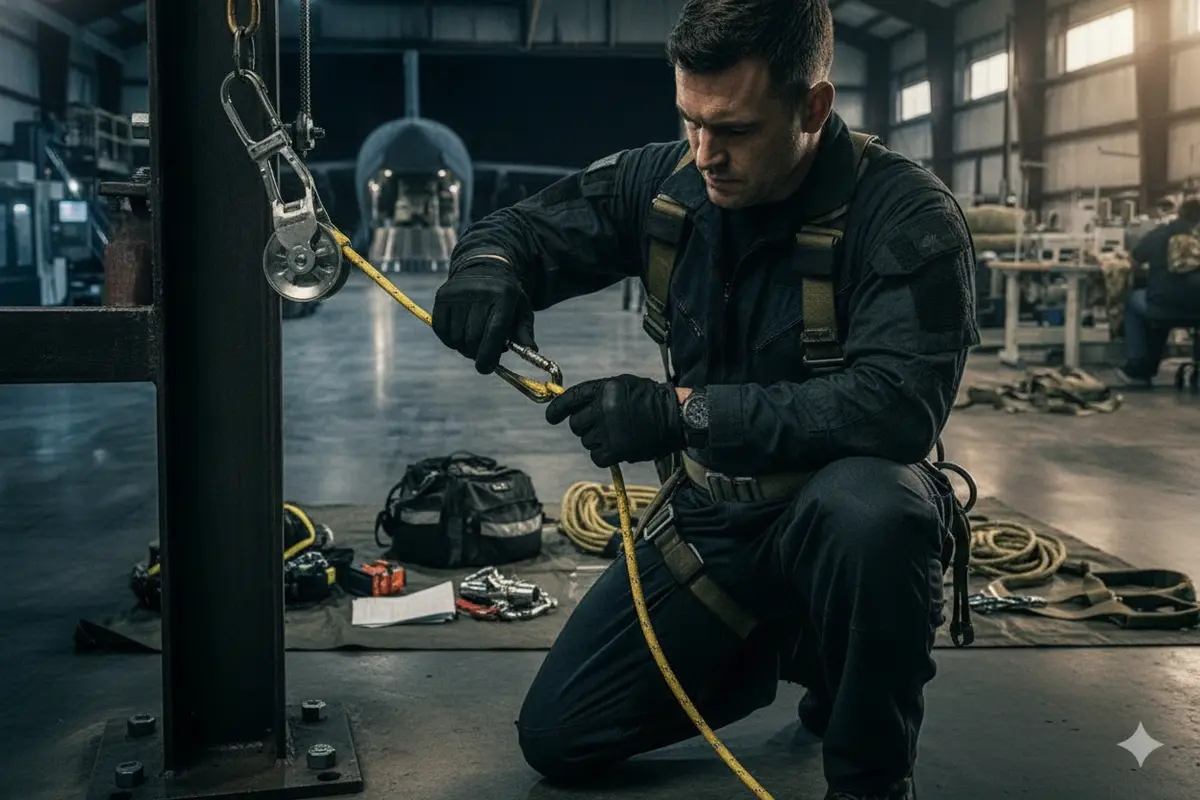
Record the system boundary in the procurement file. A useful record includes the drawing revision, item list, assumptions, and the name or role of the party responsible for each interface. If a bidder revises its offer, preserve the earlier version and document what changed. This gives technical reviewers a way to check whether an update affects a previously assessed connection or load path.
Which load evidence should a supplier provide?
Ask for evidence that is specific enough to identify what was evaluated and how the result applies to the offered equipment. A broad statement that an item is strong, tested, or compliant is difficult to score unless it identifies the applicable requirement and configuration. The aim is not to ask for documents for their own sake. It is to give reviewers a defensible basis for determining whether the evidence matches the procurement requirement.
- Item identity: Request the product name or model, revision, relevant material or construction variant, and configuration covered by the document.
- Applicable criteria: Ask for the standard, specification, or customer requirement used, including the precise edition or revision where applicable.
- Meaning of each value: Require units and definitions. Clarify whether a number is a working load limit, breaking strength, test result, or another quantity, and ask what conditions apply.
- Test or qualification basis: Request the report, certificate, or other substantiation appropriate to the contract. Ask what was tested and whether the record identifies the method and specimen configuration.
- Traceability: Ask how delivered items are tied to the evaluated configuration, including how changes in materials, hardware, or construction are controlled.
- Use and care information: Obtain instructions, stated limitations, inspection criteria, storage guidance, and removal-from-service triggers.
- Configuration exclusions: Ask the supplier to list any component, interface, or use condition that the submitted evidence does not cover.
Read load values in context. Two figures should not be compared as though they are equivalent if they use different units, definitions, test methods, or configurations. Do not multiply component ratings or combine them informally to infer a system capacity. The proposal should identify design assumptions and the limits of the evidence, while the responsible technical authority determines whether the complete configuration meets the program's needs.
When a program specifies kilonewtons, state that unit in the solicitation and require consistent reporting. If a bidder submits values in another unit, request a clear conversion and retain the original basis as well. Keep clarification questions and answers with the procurement record so every evaluator uses the same interpretation. This also helps prevent a strong-sounding value from receiving credit when its meaning or relevance remains unclear.
Separate evidence for an individual product from evidence for a configured system. A test record may apply to a particular component and a defined test arrangement; a system proposal may include additional interfaces and operating conditions. Ask the bidder to map each document to the relevant line item or part of the system diagram. If the mapping cannot be made, mark the gap and resolve it before award or acceptance according to the program process.
How do mechanical advantage and load paths affect a rescue proposal?
Mechanical advantage describes how a pulley arrangement can reduce the input force needed to move a load, subject to the arrangement and losses. The ratio alone does not tell a buyer how a team will perform in the field. Routing, friction, equipment condition, redirections, and setup affect actual effort. The Frostburg State University guide describes pulley systems as a way to pull weighted loads and notes hauling applications in swiftwater rescue: Mechanical Advantage Systems 1.
Ask the supplier for a sketch and a written explanation that match the stated task. The explanation should identify the haul line, pulley positions, redirections, progress-capture method if proposed, anchor interfaces, and any rope or connector compatibility assumptions. Ask the supplier to distinguish a theoretical ratio from an expected operating result and to identify factors that may reduce performance. Do not accept an unsupported promise of a specific field force, speed, or outcome as a substitute for a reviewable design basis.
A useful review proceeds in sequence. First, identify the load and the direction it must move. Second, follow the rope through each pulley and redirection on the drawing. Third, note where the rope changes direction or may rub against an edge. Fourth, confirm that the stated ratio describes that exact route. Fifth, check that the operating description explains how movement is controlled and how the team knows whether the arrangement remains configured as reviewed. These are questions for the responsible technical reviewer, not instructions to improvise a rig.
Consider a proposal that lists a pulley ratio but shows no route from the load to the anchor. The buyer cannot tell whether the stated ratio describes the offered arrangement, whether all connectors are identified, or whether the route includes an unreviewed redirection. A practical clarification request would ask for a labeled drawing, component list, and a short statement of assumptions. If the supplier then changes the layout, record the revision and review any affected interfaces again.
Also consider how the rescue arrangement relates to the construction harness. Confirm that the intended attachment points align with the written plan, that the proposed configuration does not introduce an unreviewed orientation or interference, and that the team has defined transitions between work and rescue modes. Equipment selection does not resolve training, site controls, rescue planning, or the competent review of the full arrangement. Assign those responsibilities in the project plan rather than assuming they are included in an equipment quotation.
When reviewing equipment options, buyers can consult the site's descender equipment collection and rope-grab collection as category references. Those pages are not a system design or a compatibility statement. Specify the needed function and interfaces, then request written confirmation for the exact items and configuration under review.
How can procurement compare proposals fairly?
Use one requirement matrix for every bidder. Separate mandatory criteria from preferred features, and agree on how the review team will interpret each criterion before scoring. Score evidence and fit to scope, not the confidence of the product description. A proposal that names exclusions and assumptions may be more reviewable than one with broad claims but no configuration details.
| Review area | Question for each proposal | Evidence to request |
|---|---|---|
| Intended use | Does the offered harness and system address the stated work and rescue functions? | Configuration description, use limitations, and assumptions |
| Load evidence | Are the figures and test records tied to the offered configuration? | Criteria, units, definitions, reports, and traceability |
| Interfaces | Are all connection points and orientations shown and reviewed? | System sketch, component list, and compatibility statements |
| Mechanical advantage | Does the rescue arrangement explain the ratio, route, and limitations? | Labeled rigging diagram and operating description |
| Lifecycle controls | Can users inspect, maintain, and identify equipment for removal? | Instructions, inspection criteria, records, and disposition process |
| Delivery acceptance | Can delivered items be checked against the approved offer? | Markings, documentation package, and acceptance checklist |
| Scope and responsibility | Are engineering, training, installation, and planning responsibilities clear? | Inclusions, exclusions, and named review responsibilities |
Apply the same evidence threshold to every response. If a supplier proposes an alternate, record it as an alternate rather than silently treating it as equivalent. Assess it against the same safety and performance objectives, including interfaces and lifecycle needs. If a required document is missing, distinguish a correctable clarification from a substantive gap. The procurement team should follow its established process for determining whether the bidder may supply additional information.
For example, one bidder may offer a harness and connectors with component documentation, while another may add a diagram of a proposed rescue route. These are not automatically comparable scopes. Ask each bidder to identify what is included, then compare the supplied evidence against the same requirements. If a system diagram or rescue plan is the agency's responsibility, record that boundary so absence of that work is not mistaken for a supplier failure or an included service.
A score sheet should preserve both the rating and the reason for it. A reviewer might note that a value is provided but its definition is not stated, or that a drawing identifies the rope route but omits an anchor interface. Such notes make the decision auditable and show exactly what clarification is needed. Avoid converting an unresolved technical gap into a favorable score based on assumption.
What does a useful requirement package contain?
A useful solicitation gives vendors enough detail to respond consistently without prescribing a design that the buyer has not validated. Include the task profile, intended functions, user and fit assumptions, environment, interfaces, performance criteria, required documents, quality controls, delivery needs, and acceptance method. Attach the system boundary drawing when one exists, identify its revision, and state whether it is illustrative or a mandatory interface definition.
State what the bidder must return. A response template can request an itemized configuration, evidence-to-requirement mapping, list of assumptions and deviations, applicable documents, delivery identification method, and information needed for inspection. Ask the supplier to identify each proposed substitution explicitly. This makes it easier to separate a compliant response from one that appears similar but relies on a different construction, interface, or test basis.
For purchases subject to government origin or procurement requirements, identify the applicable contract clauses in the solicitation and ask suppliers to state what their supporting documents cover. Fusion Tactical describes U.S.-based manufacturing and compliance capabilities, but buyers should confirm eligibility and documentation for the specific item and contract. A general company statement does not establish program-specific eligibility for every offered configuration. As another catalog reference, the Fusion Tactical harness product page should be treated as product information, not as a substitute for application-specific evidence or review.
Include a clear method for questions and changes. Set a deadline for technical questions if the procurement process requires one, distribute answers consistently, and preserve changes to the solicitation. When a question affects a load path, rated interface, or stated requirement, route it to the responsible engineering or safety authority. Keep the answer in the procurement record so all bidders work from the same interpretation.
How should buyers plan inspection and acceptance?
Acceptance should verify delivered items against the approved offer, not merely confirm that packages arrived. Match the model, revision, quantity, configuration, and markings to the contract. Check that required documents are present and consistent with the offered equipment. Record discrepancies and resolve them through the contract process before the items enter service.
A practical receiving sequence begins with the paperwork. Confirm the purchase order and approved configuration, then compare the packing list to quantities and identifiers. Inspect packaging and visible condition according to the applicable receiving procedure. Check labels and markings against the submitted records. Finally, confirm that instructions, stated limitations, inspection guidance, and required qualification evidence accompany the delivery. The sequence can be adapted to the agency's formal acceptance procedure.
Do not assume that paperwork is accurate simply because it is complete. Compare the configuration described in the test or qualification record with the item delivered. If the documentation names a different revision or omits a relevant component, flag the mismatch. If the supplier has approved a change, obtain the records that explain how the change is controlled and whether the offered evidence still applies. Acceptance staff should not resolve a technical mismatch by guessing.

Build lifecycle controls into the purchasing decision. Define who receives the inspection instructions, where records are maintained, and how users identify equipment that must be removed under the manufacturer's criteria or program rules. Inspection intervals and retirement decisions should follow applicable requirements and competent review. Do not invent one universal service life for every harness or connector.
For organizations buying for several teams, standardize the record fields without assuming each team uses the same configuration. A record may include equipment identifiers, assigned user group, approved configuration, issue date, inspection history, and disposition. This provides a traceable chain from requirement to delivery to field control. Define who may update that record and how an item awaiting review is separated from equipment available for use.
How can buyers manage a staged review?
A staged review helps a team find gaps early, before they become delivery disputes. At the first stage, confirm the task narrative, use cases, interfaces, and contract requirements. At the second, review the supplier's proposed configuration and map documents to the required evidence. At the third, resolve technical questions and record deviations. At the fourth, verify the delivered configuration and put lifecycle controls in place. Each stage should have an owner and a record of its outcome.
For a small purchase, these stages may be handled in one review meeting, but the checks still matter. For a multi-team procurement, assign responsibility across technical, safety, contracting, and receiving roles. The technical reviewer assesses configuration and evidence. The contracting officer manages solicitation terms and formal clarifications. The safety authority reviews operational assumptions. Receiving staff verify delivery against the approved record. The specific role names vary by organization, so document the actual owners.
Use a gap log that describes the issue, not just its status. For instance, “connector orientation not shown on drawing revision B” is more useful than “needs clarification.” Include the responsible party, the response, the resulting decision, and any document revision. Close a gap only when the answer resolves the question or the team formally accepts the remaining limitation through its established process.
What information makes a supplier conversation more useful?
Before requesting a proposal, assemble the minimum facts that shape the system: task description, operating conditions, user population, intended harness function, attachment interfaces, rescue scenario, applicable standards or contract clauses, required load evidence, quantities, and delivery expectations. Include drawings or details of existing equipment when they can be shared accurately. Clearly label any preliminary sketch so it is not mistaken for an approved design.
Ask direct questions about evidence and scope. Which exact configuration does the submitted test record cover? Are the stated figures working limits or test results? What assumptions does the rescue diagram make about routing and anchors? Which components or services are excluded? What records will accompany delivery? These questions lead to answers that evaluators can compare, and they reduce reliance on vague product language.
When discussing hardware, the carabiner collection and the aluminum snap hook product information can serve as references for the type of connector category being considered. They do not establish compatibility with every rope, anchor, or harness arrangement. State the interface and documentation needed for the particular application, and ask for written confirmation tied to the offered configuration.
For a supplier discussion, call Fusion Tactical at (909) 393-9450. Share the intended application and the documentation your team needs so the conversation can focus on the requirement rather than an unspecified product category.
Frequently asked questions
Is a construction harness by itself a complete fall protection system?
No. A harness is one component. The full arrangement may also include connectors, ropes or lanyards, anchors, compatible interfaces, procedures, and trained users. Define and review the complete arrangement for the actual task.
Does a higher load value automatically make an item the better choice?
No. A value has meaning only with its definition, test basis, configuration, units, and intended use. Compare the supporting evidence with the requirement and review the full system rather than choosing by one number.
What should a proposal say about pulley ratio?
It should show the arrangement and rope route, explain the stated ratio, and identify assumptions and factors that may affect performance. Request a labeled diagram and operating description tied to the task. The ratio should not be treated as a guarantee of field effort.
What should be checked at delivery?
Compare quantities, identifiers, markings, and configuration with the approved offer. Confirm that required test or qualification records, instructions, inspection criteria, and contract-specific documentation are included and match the delivered items.
Call to discuss your system requirements
A well-defined requirement gives procurement a consistent basis for comparing proposals and gives technical reviewers a clear record of the assumptions, interfaces, load evidence, and lifecycle controls to resolve before equipment enters service.


