

Aircraft Crew Retention Equipment Procurement Guide
Aircraft crew retention equipment procurement is not simply a matter of selecting a lanyard or matching a connector to an available anchor. Buyers need a documented fit between the mission, aircraft configuration, user procedure, load path, product evidence, and maintenance plan. A clear specification makes those relationships reviewable before award and helps prevent a technically plausible item from being applied outside its approved use.
What should an aircraft crew retention equipment procurement package define?
A useful procurement package begins with an operational requirement, not a preferred product shape. State which users, aircraft configurations, and phases of operation the equipment must support, then translate those conditions into reviewable interface, performance, documentation, and support requirements. The buyer should be able to trace each requirement to a source, an offered configuration, and an acceptance check.
Start with the system boundary. Is the procurement for a single personal retention component, a set of compatible components, or a larger installed or removable system? Identify what the supplier provides and what remains the responsibility of the aircraft integrator, operator, or government technical authority. Avoid treating an individual component rating as proof of suitability for the complete system.
Document the intended use in operational terms. Include the aircraft and mission context, the user role, attachment points, expected movement, and the procedures in which the equipment will be used. If multiple aircraft types or mission profiles are in scope, list them separately. A requirement that says only "aircraft use" leaves too much room for different assumptions about geometry, access, movement, and interfaces.
- Users and configuration: Identify crew roles, approved aircraft variants, and equipment combinations in scope.
- Use conditions: Describe the applicable operating phases and the procedures governing connection, disconnection, transfer, and stowage.
- System boundary: Define supplied components, aircraft-side interfaces, and integration responsibilities.
- Constraints: Record dimensional, environmental, compatibility, storage, or workflow constraints that the program has verified.
- Evidence: Specify the records the supplier must provide and how the buyer will evaluate them.
The buyer should also state who has authority to approve aircraft-side interfaces and operational procedures. Equipment procurement is not a substitute for aircraft engineering review, airworthiness approval, or unit-level procedure approval. Where those decisions are outside the contract, identify the approving organization and make the needed inputs explicit.
Translate broad needs into requirements that can be evaluated consistently. For example, "usable by crew in flight" is not precise enough to score. The specification can instead identify which approved crew position and procedure are in scope. What connection interface must be accommodated, what configuration drawings are required, and who verifies fit against the aircraft. The purpose is not to prescribe a design before the technical review; it is to define what the offeror must demonstrate and what the buyer will accept.
Separate mandatory conditions from preferences. An approved aircraft interface or required evidence may be a pass/fail condition. Packaging, delivery sequencing, or additional support documentation may be scored or treated as a contract deliverable, depending on the program. If every preference is written as an absolute requirement, the solicitation may unnecessarily narrow offers. If a safety-critical condition is left as a preference, evaluators may have no defensible basis for rejecting an unsupported configuration.
How should aircraft crew retention equipment procurement account for insertion methods?
Aircraft crew retention equipment procurement should treat each insertion method as a distinct operating configuration, not as an interchangeable use case. The package should be reviewed against the aircraft-side interface, the user's movement and transfer path, line and attachment management. Stowage, approved procedures, and the configuration records needed to keep the fielded system consistent with the evaluated design.
| Method | Interface and movement questions | Stowage, attachment, and approval controls |
|---|---|---|
| Fast-rope | How does the retention configuration interact with the aircraft exit, the rope path, hand placement. And the user's ability to move from the cabin to the rope without snagging or restricting required motion? | Define where unused lines and connectors are secured before movement. Document the approved configuration, transition sequence, and any aircraft or unit procedure that governs the interface. |
| Hoist | Identify the hoist connection interface, transfer points, attendant access, and the movement needed from the cabin or doorway to the suspended position. Review how the system behaves during transfer rather than evaluating only a static connection. | Control connector orientation, line routing, and loose equipment around the hoist path. Record the hoist-specific configuration and require procedure-level approval from the responsible technical authority. |
| SPIE | Evaluate how personnel connect to, move with, and disconnect from the SPIE system. The review should account for spacing, individual attachment interfaces, access for loading and unloading, and coordinated movement as a group. | Specify how attachment points, lines, and excess material are managed during carriage and transfer. Preserve the approved configuration and identify the SPIE procedure, aircraft interface, and equipment variant in the procurement record. |
| Rappelling | Review the relationship between the retention equipment, rappel line, user harness or other approved interface, and the movement required at the anchor, edge, and landing transition. Confirm that the selected arrangement supports the documented procedure. | Define attachment and line-management steps before movement begins, including where equipment is stowed when it is not actively used. Do not assume that approval for another insertion method transfers to rappelling. |
Why procedure-specific configuration matters
A procurement package should state the intended insertion methods and the boundaries of the evaluated configuration. A retention component may fit an aircraft-side interface yet remain unsuitable for a particular transfer sequence, line path, or user movement requirement. Conversely, a configuration approved for one method should not be represented as universally approved for every method without the required technical review.
For each method, buyers should request clear configuration documentation: equipment identifiers, interface assumptions, attachment and line-management instructions, stowage positions. Compatible aircraft or cabin arrangements, inspection or maintenance references where applicable, and the approval authority responsible for the operating procedure. This documentation helps a program office compare like-for-like proposals and prevents substitutions that change the system without a corresponding review.
The strongest specification separates requirements from vendor claims. Define the mission profile, transfer points, user access needs, stowage limits, and documentation deliverables first. Then require the supplier to identify the proposed interfaces and any assumptions that must be validated through the customer's engineering, safety, or operational approval process.
How should buyers assess the attachment and load path?
Assess the complete load path from the user interface through each connector and retention component to the approved aircraft attachment. The procurement file should identify each element, its orientation and connection method, and the authority responsible for verifying the aircraft-side attachment. A component-level document cannot establish that an unverified anchor, combination, or installation is appropriate.
Ask the supplier to identify the exact offered configuration rather than relying on a general catalog description. Require drawings, configuration identifiers, component lists, and clear descriptions of permitted interfaces as appropriate to the program. The information should make it possible to distinguish an evaluated configuration from a visually similar alternative.
Review connection geometry as well as nominal fit. Confirm how each interface is intended to engage, whether the design can be connected incorrectly, and whether adjacent equipment or aircraft structure could interfere with operation. The applicable technical authority should review these questions against the actual aircraft and procedure. Do not infer compatibility from a connector that can physically be clipped to an attachment.
Make load-path assumptions visible in the specification and evaluation record. Identify which components are rated, the basis for each rating, and whether the evidence covers the intended configuration. Clarify any boundaries on use, orientation, connection, or combination stated by the manufacturer. If the evidence concerns one component in isolation, do not describe it as a rating for the whole assembled system.
| Procurement item. | What to specify or request. | What the review should establish. |
|---|---|---|
| Mission and users. | Aircraft variants, crew roles, intended procedures, and use boundaries. | The offered configuration addresses the approved operational requirement. |
| Attachment interfaces. | Interface descriptions, drawings, connection method, and responsible approver. | Every aircraft-side and user-side connection has an identified approval path. |
| Load-path components. | Component list, configuration identifier, ratings and supporting evidence. | Evidence applies to the identified component and does not overstate system capability. |
| Inspection and service. | Inspection criteria, records, care limits, and removal-from-service process. | Operators can identify, document, and act on equipment condition. |
| Delivery and acceptance. | Required documents, markings, quantities, configuration, and discrepancy process. | Delivered items can be checked against the approved baseline. |
For a component-level hardware review, procurement staff can use the supplier's applicable product documentation and the technical authority's acceptance criteria. Fusion Tactical's helo lanyard product collection is one place to review the product family; the collection page should not replace configuration-specific specifications or aircraft approval. A separate carabiner collection can help buyers identify hardware offerings, but a listing alone is not evidence that a particular connector is suitable for a particular system.
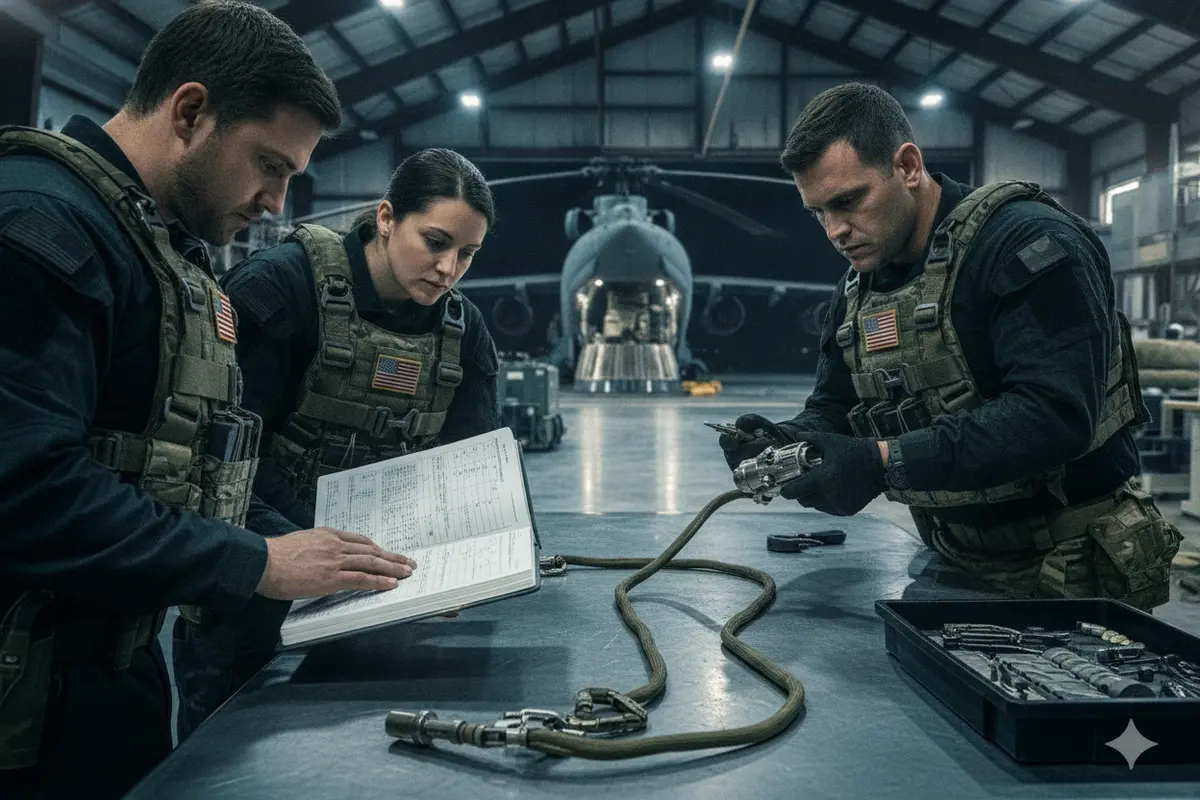
For review purposes, break an assembly diagram into distinct connection points and assign an owner to each verification. One row might cover the user-side connection, another the retention line and its end terminations, and another the aircraft-side attachment. The evaluator should be able to see which documents support the product claim and which separate aircraft records establish the approved attachment. This makes a gap obvious: if a drawing shows a connector but no evidence or authority covers the anchor. The procurement file should retain that item as open rather than presume it is resolved.
Where the mission involves more than one movement pattern or crew position, record the configuration and procedural differences explicitly. A component that fits one position or attachment arrangement should not automatically be presumed appropriate for another. Ask the program's technical reviewers to identify any combinations requiring separate evaluation and specify how the vendor must label or document them. This is a procurement traceability step, not a substitute for operational qualification.
Which ratings and test records belong in the vendor review?
Require the supplier to identify the standards, specifications, or test methods that apply to the offered equipment and explain the scope of the evidence. Procurement should not prescribe an impressive-sounding standard without confirming it fits the item and intended use. The technical authority should determine which requirements govern, how conformity will be shown, and whether the evidence covers the delivered configuration.
For each claimed rating, request the exact component or assembly it applies to, its configuration, the conditions and method underlying the claim, and the source document. Ask whether the evidence is a manufacturer declaration, a test report, a certification, or another type of record. These are not interchangeable labels. The record should identify the tested or evaluated item clearly enough to compare it with the item being offered.
Include a requirement for traceable product identification. Depending on the procurement, that may include model or part number, revision, serial or lot identification, date information, and applicable material or manufacturing records. Set the required level based on contract needs and risk; do not assume every product has the same traceability scheme. Require the supplier to explain how substitutions or design changes will be disclosed and approved.
Ask reviewers to check for scope gaps rather than simply checking whether a document is present. Does a test document apply to the offered model and revision? Does it address the requested configuration? Are limitations or conditions stated? Does the proposed use exceed what the evidence supports? Any unanswered point should be recorded as an open technical question, not silently treated as accepted.
Keep claims precise in the solicitation and award record. If the supplier provides evidence for a connector, describe it as evidence for that connector. If a program needs evidence for a combined system, ask for evidence appropriate to the combined configuration and have the designated authority review it. Avoid extrapolating a rating from one product, material, or configuration to another.
Build an evidence index before evaluation begins. List each required claim, the acceptable form of evidence, the submitted file or section, and the responsible reviewer. This prevents an evaluator from treating a marketing sheet as equivalent to a test record simply because both mention the same rating. For instance, if a solicitation asks for a drawing and a documented test basis. The response should identify both sources and show the tested configuration matches the offered one. If the vendor cites a standard but supplies no record showing applicability, the matrix should say "clarification required," not "verified."
Evidence review should also separate technical content from document control. Confirm revision and date, check whether the document identifies the product, and record any qualification or limitation that could affect the proposed use. If the supplier says a new revision is equivalent to an earlier evaluated version, request the change description and route it to the technical authority. Keep the prior version and the decision record together so later reviewers can reconstruct why the procurement accepted the configuration.
How can a procurement team compare vendors consistently?
Use a common evaluation matrix so each offer is judged against the same requirement and evidence threshold. Separate mandatory technical conditions from scored advantages. This prevents a polished narrative, low price, or broad claim of experience from obscuring a missing interface detail or unsupported performance statement.
- Confirm responsiveness. Verify that the offer identifies a complete configuration and responds to every mandatory requirement.
- Map evidence. Link each technical claim to the specific drawing, specification, test record, certificate, or declaration provided.
- Review exceptions. Record deviations, assumptions, exclusions, and proposed substitutions in one place.
- Assess production and support. Ask how configuration control, delivery, replacement components, and technical questions will be handled for this contract.
- Resolve open items. Route questions to the responsible technical and procurement reviewers before award, or state the contract mechanism for resolving them.
Do not treat "compliant," "military grade," or "aircraft ready" as self-proving terms. Ask what requirement the statement refers to and what records support it. A vendor review should distinguish verified facts from vendor assertions and unresolved assumptions. When an offer proposes an equivalent, compare the underlying requirement and evidence rather than relying on the word "equivalent".
Build a compliance matrix with one row for every solicitation requirement and columns for the offeror's response, evidence reference, evaluator finding, exception, and follow-up action. Use a consistent status vocabulary such as "compliant," "noncompliant," and "clarification required," with definitions in the evaluation plan. This gives the team a record of how it reached its decision and makes it easier to identify requirements that received no meaningful response.
Clarification should resolve a question without quietly changing the requirement or allowing an unsupported claim to pass. Document the question, the answer, and whether the answer changes the technical finding. If evidence is missing, decide whether the solicitation permits it to be supplied later and apply that decision consistently. Keep commercial evaluation separate from technical acceptability where the procurement process requires that separation.
A practical review can use a staged decision rather than one broad score. First determine whether the offer is responsive to mandatory requirements. Next confirm that the offered configuration and supporting evidence are specific enough for technical review. Then assess exceptions, delivery and support, and any scored value factors. Finally, compare price only under the method stated in the solicitation. This sequence helps the team avoid using a favorable commercial term to offset a missing safety-critical proof point.
For example, if two offers both identify the requested component but only one provides revision-controlled interface drawings, the matrix should show that evidence difference directly. Evaluators should not assume that a vague statement in the second offer means the same thing as a documented drawing. If the solicitation permits clarification, request the missing information and assess the response under the same rules applied to all offerors. Retain the initial and final findings, including any reason a claim remained unresolved.
Procurement rules depend on the funding path and contracting authority. For example, the FAA states that procurements made under its Airport Improvement Program must comply with relevant procurement requirements of 2 CFR part 200. Review the FAA's AIP equipment procurement guidance and verify the requirements that apply to the specific award rather than assuming this program-specific rule governs every aircraft equipment purchase.
Vendor support is another lifecycle consideration. Establish the expected channel for technical inquiries, the process for obtaining replacement components, and how the supplier will communicate product notices or changes that affect the approved configuration. Ask what records accompany replacement items and whether the original inspection and traceability approach remains applicable. Put contract-specific response expectations in the solicitation rather than relying on informal statements.
Vendor qualification should also examine whether the supplier can deliver the specified configuration consistently. Review quality controls, change notification, corrective-action processes, and relevant manufacturing capabilities in a proportionate manner. A procurement team may consider U.S. manufacturing, domestic-content obligations, or other contract clauses when they apply, but those are separate questions from technical suitability. State the applicable contract requirement rather than assuming that a general country-of-origin statement proves compliance with a specific clause.
For relevant tactical and safety equipment supply context, buyers can review the company's military equipment catalog and equipment accessories collection. Use catalog pages to locate product information, then request the contract-specific configuration and supporting records needed for the procurement file. For related product and safety topics, consult Fusion Tactical's equipment insights archive, while keeping the solicitation and approved technical data as the controlling sources for this purchase.
Assess supplier support with deliverables the contract can verify. Depending on the need, these may include a defined technical point of contact, product identification guidance, a process for documenting substitutions, and instructions for requesting replacement items. During evaluation, distinguish a stated capability from a commitment in the offer. If support timing or a document set matters to mission readiness. Write it as a requirement and specify when it is due, who reviews it, and how a shortfall will be handled.
What should acceptance, inspection, and configuration control cover?
Write acceptance criteria before solicitation so offerors know what will be checked at delivery. Acceptance should verify the delivered product against the approved baseline, not attempt to recreate a complete design qualification after shipment. Establish who inspects, which records must accompany the delivery, how discrepancies are documented, and what happens when items or documents do not match.
- Verify part numbers, revisions, quantities, and configuration identifiers against the award and approved submittals.
- Check required markings and traceability records, where specified.
- Confirm that required manuals, inspection instructions, and care limitations are present and match the delivered item.
- Record damage, missing components, documentation gaps, and deviations through the defined discrepancy process.
- Document acceptance, conditional acceptance, or rejection through the authorized contracting and technical channels.
Inspection planning should distinguish receiving inspection from recurring in-service inspection. The supplier should provide its applicable inspection and maintenance instructions, including criteria for damage, wear, contamination, unauthorized modification, or other conditions that require evaluation. The operator or responsible authority must establish the applicable inspection intervals and procedures. Do not invent a universal interval when it depends on product instructions, governing requirements, and program policy.
Define how equipment is removed from service, assessed, repaired if permitted, or disposed of. Assign responsibility for recording inspection results and linking each record to the item's identifier. Specify the process for reporting a suspected defect and communicating a safety-related notice across the program. If repair or component replacement is allowed, identify who may perform it and what documentation is required to return equipment to service.
Configuration control protects the relationship between reviewed evidence and delivered equipment. Require prior notice and approval for changes that affect form, fit, function, materials, manufacturing location, suppliers, or supporting evidence, as applicable to the contract. Establish how replacement parts and revised documents will be identified. A visually similar replacement should not be presumed interchangeable without the required review.
These controls are useful for both new awards and replenishment orders. If a program has used a system successfully, retain its approved baseline and verify that later deliveries match it. If the mission, aircraft, attachment, or procedure changes, reopen the relevant technical review rather than assuming the previous approval still applies.
A receiving checklist can make this process practical. Before delivery, identify the person authorized to inspect, the document set required for each shipment, and the location where records will be retained. At receipt, compare the delivered identifiers to the purchase order and approved submittals, note any discrepancy, and prevent an unresolved item from being silently mixed into accepted inventory. If the shipment contains multiple lots or revisions, record each one separately. This creates a usable chain between contract requirements and in-service records.
Plan for a change scenario as well as a routine delivery. If a supplier proposes a substitute because an original part is unavailable. Pause acceptance of that substitute until the designated reviewer checks the proposed configuration, evidence, and compatibility with existing equipment. If a field report identifies damage or a suspected defect, follow the program's removal and reporting process and determine whether related items need review. The procurement documents should make the decision path clear without trying to replace the operator's approved safety procedures.
Contact Fusion Tactical to discuss a program requirement
Frequently Asked Questions
In brief, buyers should judge crew retention offers against the approved mission, interfaces, configuration, and evidence rather than product labels alone. The following answers address common specification and lifecycle questions that arise during review.
Does a component rating prove that an entire retention system is suitable?
No. A component rating applies within the scope and conditions identified by its supporting evidence. The complete load path, interfaces, configuration, aircraft attachment, and intended procedure require review by the responsible technical authority.
What should a solicitation say about aircraft compatibility?
Identify the aircraft variants and approved interfaces in scope, specify what documentation the offeror must provide, and state who is responsible for aircraft-side approval. Do not treat a generic compatibility statement or physical fit as proof of approval.
Which records should a supplier provide with an offer?
Set the list to match the requirement. It may include configuration drawings, component identification, applicable specifications, rating or test evidence, inspection and care instructions, traceability information, and a list of exceptions. Ask for records that show the offered item matches the requested configuration.
How should procurement evaluate a proposed equivalent?
Compare the offered item's configuration and evidence against each underlying requirement. Record differences and obtain technical review of any change to interfaces, performance, materials, or use limitations. A supplier's use of the word "equivalent" is not a substitute for that comparison.
Can a catalog listing serve as the technical data package?
Usually it should be treated as a product-discovery aid, not automatically as the complete contract record. The solicitation should identify required configuration-specific specifications, drawings, evidence, and maintenance information, then determine whether the submitted records meet those needs.
Who sets inspection intervals for crew retention equipment?
The responsible program and technical authorities should establish inspection requirements using the applicable product instructions, contract requirements, and operational policy. Procurement should ensure the supplier provides clear instructions and should avoid inventing a one-size-fits-all interval.
When should a procurement team reopen its technical review?
Reassess when an aircraft or mission changes, an interface or procedure changes, the supplier proposes a substitution, or product configuration and supporting evidence are revised. The review should establish whether prior approvals still apply to the changed configuration.
A defensible procurement file connects the mission requirement to an identified configuration, appropriate evidence, a responsible approval path, and an actionable sustainment plan. That record gives technical and contracting teams a consistent basis for evaluating offers and managing changes throughout the equipment lifecycle.


