

Aerospace Safety Equipment Repair: What Procurement Teams Should Specify
Aerospace safety equipment repair is not simply a question of whether an item looks serviceable. Procurement teams need a documented process that connects the equipment identity, applicable instructions, condition assessment, authorized work, verification, and return-to-service decision. Before a purchase order is issued, define who may make each decision and what records must accompany the equipment.
Schedule an engineering consultation
What should an aerospace safety equipment repair requirement define?
Define the scope before a unit is shipped or a supplier begins work. The requirement should identify the equipment and configuration, state the reported condition, specify the governing technical documents, and name the authority that may approve repair or return to service. If any of those elements is unknown, require the supplier to report the gap rather than assume a repair method.
Repair is a controlled disposition, not a synonym for inspection, cleaning, adjustment, or refurbishment. The manufacturer’s current instructions, contract provisions, and applicable program requirements determine which activities are allowed. The FAA’s Aerospace Medical Research and Safety Assurance Division describes research aimed at improving occupant protection and survival in civil aerospace accidents; that context underscores the importance of treating safety decisions as evidence-based, while it does not itself establish repair instructions for a particular item. See the FAA Aerospace Medical Research and Safety Assurance Division for that specific research scope.
- Equipment identity: Capture item description, manufacturer, model or part number, serial or lot number where present, and configuration details needed to distinguish versions.
- Reported issue: Record the event, symptom, damage, wear, contamination, or maintenance finding. Separate observed facts from an operator’s interpretation of the cause.
- Technical authority: Identify the current manufacturer instructions, approved drawings, contract requirements, and the person or organization empowered to authorize disposition.
- Acceptance evidence: Set the required inspection results, test records if applicable, parts traceability, configuration updates, and release documentation before the work starts.
Do not assume that a familiar-looking item can be repaired using a generic procedure. Materials, seams, stitching, webbing, connectors, hardware, and interfaces can vary by model or revision. A supplier should identify the controlled document and revision used for each task, and explain how it verified that the document applies to the specific configuration.
Make the requirement operational by listing the questions that must be answered at intake. For example: Is the item’s identity legible and consistent with its asset record? Is its configuration complete, including attachments or installed components? What event or observation prompted the evaluation? Were there unusual loads, environmental exposure, contamination, or handling conditions? Record “unknown” where the user cannot provide an answer. That distinction is more useful than filling gaps with assumptions, and it gives the technical reviewer a defined issue to resolve.
Also identify decision gates in the process. A supplier may be authorized to receive, document, and inspect an item yet still need written permission before making a repair. Specify who can authorize work, what evidence that person needs, and whether cost or schedule changes require a separate approval. If several parties hold different responsibilities, such as the buyer, engineering authority, and end user, state which party makes the final disposition and which roles provide input.
How should buyers distinguish repair, inspection, refurbishment, and replacement?
Use separate terms in the scope because they describe different work and decisions. Inspection evaluates condition against defined criteria; repair restores an item through an authorized corrective action; refurbishment may include a broader set of approved restoration tasks; replacement removes the item from service and substitutes an eligible unit. Recertification or return-to-service approval should be used only when the applicable authority and program define what that status means.
This distinction protects both technical integrity and contract clarity. For example, a supplier might be asked to inspect an item and recommend disposition, but that does not automatically authorize the supplier to repair it. Likewise, a report that says “tested” is incomplete unless the buyer knows what test was performed, against which criterion, with what result, and under whose authority.
| Work or disposition | What the buyer should define | Evidence to request | Key approval question |
|---|---|---|---|
| Inspection | Inspection scope, criteria, access limits, and whether the work is visual, dimensional, functional, or another specified method | Item identification, findings, inspection method, criteria and revision, inspector identity, and disposition recommendation | Who may accept the inspection and decide the next step? |
| Repair | Authorized corrective actions, allowed parts and processes, technical references, and any limits on repair | Work order, before-and-after findings, parts and material records, process records, verification results, and release documentation | Who authorized the repair, and who may approve return to service? |
| Refurbishment | Precisely listed tasks and whether refurbishment changes configuration or affects any approval status | Task-by-task records, replaced-part traceability, inspection results, and configuration history | Does the governing program define refurbishment and its acceptance conditions? |
| Replacement | Eligibility of the substitute, required configuration, compatibility evidence, and disposition of the removed item | Identity and provenance of the replacement, required conformity records, and removal or disposal record | Is the replacement accepted by the responsible technical authority? |
Write the contract so a supplier cannot silently convert one scope into another. If assessment finds that repair is not authorized, technically supported, or economically justified, define whether the supplier should stop, submit a recommendation, preserve the item, or return it without further work. Changes to scope should require written approval from the designated buyer representative.
Consider a simple intake example. If an item arrives with a reported abrasion and the governing instructions allow inspection but do not clearly address that condition, the supplier’s first deliverable may be a finding report and a request for disposition. The supplier should not infer that a local patch, component exchange, or cleaning step is permitted. The buyer should send the finding to the named authority, document the response, and issue a revised work instruction only after the decision is recorded.
Replacement also needs a controlled definition. A substitute may appear similar but differ in revision, interface, material, or approved configuration. Require the supplier to identify the proposed replacement and provide the required compatibility and provenance evidence. If the removed item is retained for analysis, returned to the customer, or disposed of, state how custody and final status will be documented. This avoids a gap in the asset history and reduces the chance that an item already rejected for use is inadvertently recirculated.
Which records should accompany the equipment through repair?
Build traceability around a unique item identity and a continuous history. The record should allow a reviewer to connect the incoming equipment to the inspection, work performed, parts used, verification, and final disposition. Where an item has no unique serial number, specify an acceptable alternate identification method, such as a controlled lot or asset identifier, and ensure it stays with the item throughout the process.
At minimum, ask suppliers to retain and return the records applicable to the scope. The precise documents vary by equipment and contract; do not treat this checklist as a universal regulatory list.
- Receiving record with date, condition on arrival, package condition, and identity check.
- Customer-reported issue and any known use, exposure, or event history relevant to the assessment.
- Inspection findings, methods, criteria, instrument identity where applicable, and the current technical document revision.
- Repair authorization and work order, including the name or role of the approving authority.
- Parts, materials, and components installed, with traceability to the extent required by the governing specification or contract.
- Process records and verification results required for the approved task, including failed or repeated checks.
- Final disposition, limitations, configuration status, and return-to-service approval by the designated authority.
- Record retention period, delivery format, correction process, and access for customer or government review as applicable.
Traceability should also cover the people and organizations involved. Ask who performed the work, who checked it, and who released the item. If a subcontractor performs a special process or supplies a critical part, identify the flow-down controls and the records that will be available to the buyer. A general quality-system certificate can be relevant to supplier qualification, but it does not replace item-specific evidence or prove that a particular repair is authorized.
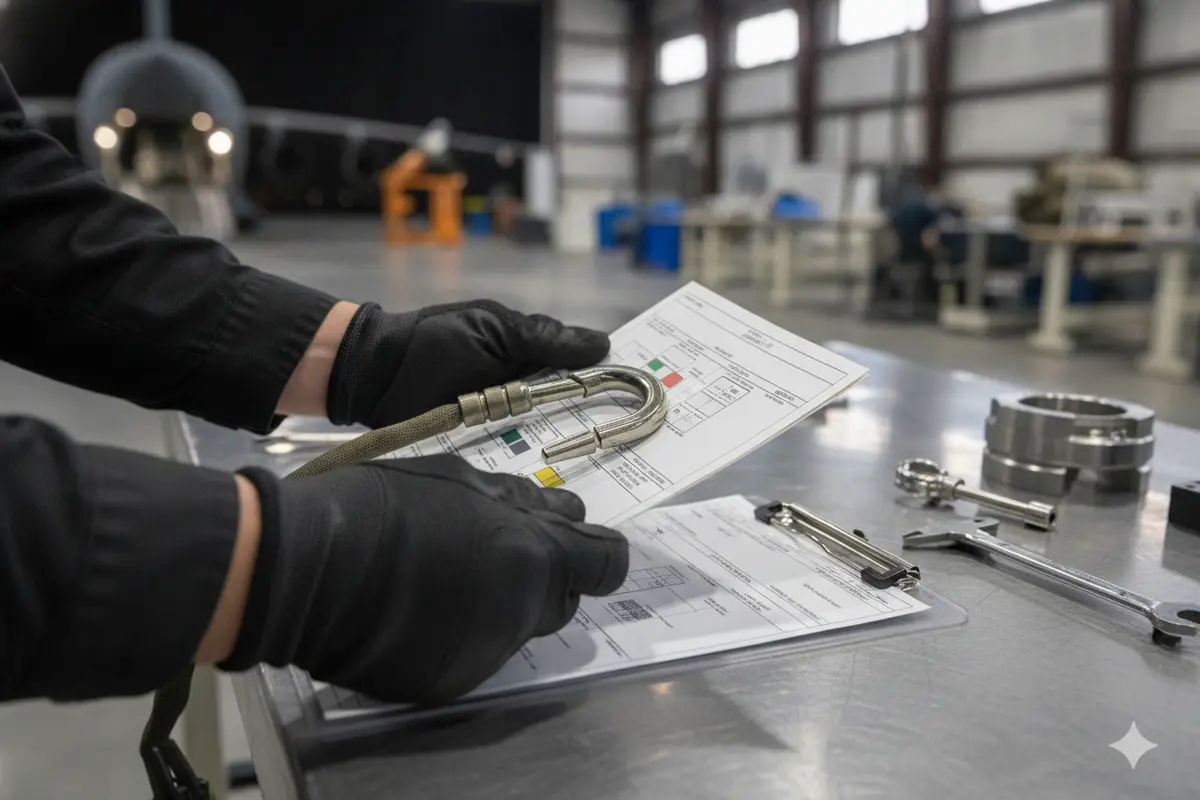
Organize records so a reviewer can reconstruct the sequence without relying on informal explanations. A useful package links the receiving inspection to the work authorization, then connects every completed task to its inspection or verification result. If a check fails and is repeated after corrective work, retain both results with an explanation of the approved action taken. Do not replace an earlier record without preserving the history of the correction.
Specify how records are labeled and delivered. A file naming convention can include an asset identifier, work-order number, and document type; a transmittal index can list each expected record and identify any item that does not apply. Define whether the supplier must provide records in a searchable electronic format, who can access them, and how long they must be retained. These details matter when procurement, engineering, quality, and operations review the same work package at different times.
Finally, define record correction controls. If an identifier, revision, or result is entered incorrectly, require a traceable correction that identifies what changed, who made the change, and when. A corrected report should not obscure the original decision trail. This practice supports later audits and technical reviews, especially when assets move between units or when a future issue requires comparison with earlier service history.
How can a procurement team assess repair authorization and technical capability?
Ask the supplier to show how it establishes authority for the exact item and task, not merely to describe broad experience. A supplier may be qualified to manufacture or engineer safety equipment without being an authorized repair station for every aerospace product. Conversely, a qualified service provider still needs the correct technical data, configuration knowledge, and customer approvals for the proposed work.
Use a structured review before award or before releasing assets for work:
- Confirm scope and authority. Request the procedure, authorization, or other evidence that permits the proposed task. Confirm whether the customer, original manufacturer, program engineering authority, or another designated party retains approval rights.
- Match the capability to the configuration. Verify that the supplier can identify the model, revision, materials, interfaces, and applicable limitations. Ask how mismatches or obsolete instructions are escalated.
- Review competence and controls. Ask how personnel qualifications, tool control, calibrated inspection equipment where required, process control, nonconformance handling, and record review are managed for the work in scope.
- Check parts and process sourcing. Establish whether replacement parts are original, approved, or otherwise permitted by contract. Require disclosure and approval of subcontracted work or substitutions.
- Agree on verification and release. Define inspection or test evidence, acceptance criteria, independent review if required, and the authority that signs the final disposition.
- Plan exceptions. Specify notification timing and approval steps for unexpected damage, unavailable parts, out-of-limit findings, or work that cannot be completed as proposed.
For program teams evaluating equipment design or integration rather than repair alone, compare the supplier’s documented engineering and manufacturing scope with the requirement. Fusion Tactical describes U.S.-based manufacturing and custom engineering capabilities; buyers can use the lanyard collection and helo lanyard systems as starting points for product-scope discussions, not as proof of repair authorization. The helo lanyard collection is another product-scope reference for helicopter retention equipment. For harness-related interfaces, see the harness collection and Fusion Tactical harness product information. Confirm product-specific requirements directly with the responsible technical authority.

During evaluation, ask for a sample of the type of item-level documentation the supplier would deliver, with sensitive details removed if necessary. Review whether the sample identifies the equipment, states the scope performed, cites criteria or technical references, records findings clearly, and shows who accepted or released the work. A polished capability presentation may describe the organization, but a representative work record reveals whether the proposed process can produce useful evidence at the individual asset level.
Use scenario questions to test how the supplier handles uncertainty. What happens if the serial or lot marking is unreadable? Who is notified if the condition differs from the report? What if instructions conflict, parts are unavailable, or an inspection instrument is outside its required status? A credible answer identifies a stop point, notification path, decision owner, and record of the approved resolution. The procurement team can capture these responses in the evaluation file and compare vendors against the same criteria.
Do not treat a broad certification, a past project, or a product catalog as a substitute for task-specific review. Ask what the credential covers, whether it applies to the proposed location and scope, and what exclusions or customer approvals remain. If the work involves an external provider, require advance disclosure and define how the prime supplier remains accountable for flow-down requirements, records, and corrective actions.
What should a repair purchase order and statement of work include?
A strong work package turns the buyer’s technical and record expectations into clear supplier deliverables. It should define the boundary between assessment and repair, along with a stop-work point before any action that needs additional approval. Include the applicable drawing, maintenance data, specification, or customer instruction by identifier and revision when known; direct the supplier to flag conflicts instead of choosing among documents without approval.
Consider including these clauses or fields in the request for quote and resulting order:
- Item description, identification fields, quantity, configuration, and reported condition.
- Requested scope with a clear distinction between evaluation, repair, refurbishment, and replacement.
- Applicable technical data and the process for resolving outdated, missing, or conflicting instructions.
- Approval authority, change-control contact, and an explicit stop-work requirement for unapproved tasks.
- Required parts provenance, subcontractor disclosure, process controls, and any contract-specific flow-downs.
- Acceptance criteria, required inspections or tests, and the format of item-level reports.
- Required certificate, release statement, or final disposition language, as defined by the governing authority.
- Record retention, delivery, access, and correction requirements, plus handling of nonconforming items.
- Packaging, preservation, shipping, and custody controls appropriate to the equipment and mission.
Keep the closeout language precise. “Repaired,” “inspected,” and “approved for return to service” should not be interchangeable status labels. State exactly which authority is responsible for each conclusion. If a supplier can only provide inspection findings and a recommendation, make that boundary visible so receiving staff do not interpret a report as an operational release.
Make pricing and schedule assumptions visible without allowing them to override technical controls. The order can state whether the supplier should quote assessment separately, whether a repair estimate requires a new authorization, and what notice is required if lead time changes due to a hold, unavailable part, or technical question. If a not-to-exceed amount or delivery milestone is used, clarify that it does not authorize work outside the approved scope.
Set a clear change-control route. The supplier should submit the condition found, proposed action, affected requirements, expected record changes, and any cost or schedule effect. The designated buyer or technical authority then approves, rejects, or requests more information in writing. Verbal direction in a routine discussion should not silently amend the purchase order; if an urgent communication is necessary, specify how it will be confirmed and added to the official record.
Include shipment and custody details that fit the equipment. Identify packaging and preservation instructions, required labels, shipping documentation, and the party responsible for arranging each leg of transport. For sensitive or controlled items, follow the applicable program and contract rules rather than relying on a generic shipping clause. On receipt, the buyer should be able to reconcile the package contents, equipment identifiers, and supplier records before changing the item’s status.
How should teams manage inspection, sustainment, and removal from service?
Repair procurement works best as part of a lifecycle process, not as a one-time transaction. Define how equipment enters inspection, who records its service history, what findings require escalation, and how a repaired item’s revised configuration is reflected in the asset record. The program’s governing instructions determine intervals and criteria; buyers should not invent a universal calendar or acceptance threshold.
Specify the practical handoffs. The user or maintainer records the issue and protects the item from unintended use. Receiving staff verify identity and custody on arrival. The supplier documents findings and pauses when approval is needed. The buyer or engineering authority reviews proposed dispositions. After work, a designated acceptance role checks records and ensures the item’s status is updated before it returns to the responsible organization.
For items that are damaged, altered, contaminated, involved in an event, or of uncertain history, require a documented assessment by the appropriate technical authority before reuse. A clean appearance is not evidence that hidden damage is absent. Nor should a maintenance record be treated as proof of conformity unless it identifies the inspection or work performed and the basis for its conclusion.
Finally, make repair decisions auditable over time. Retain the item’s prior condition, work history, parts changes, and release records in the asset file. Use controlled identifiers when configuration changes. If the organization decides that an item should be replaced, document the disposition and prevent an obsolete or rejected item from returning to service inadvertently. The same discipline supports sustainment planning, audits, and future technical investigations.
Teams can make the handoff practical with a simple status scheme in the asset record, provided it matches the organization’s governing process. A unit may be marked as awaiting assessment, under approved work, awaiting technical disposition, accepted for its defined use, or removed from service. State who may change each status and what evidence must be attached. A status label is only an administrative aid; it does not create technical approval or override the applicable instructions.
Review open actions at defined points, such as receiving, completion of inspection, authorization of corrective work, and closeout. Assign an owner and due date for missing records, unresolved technical questions, and supplier corrective actions. If an item remains on hold, control its physical location and identification so it is not mistaken for an accepted asset. When work is complete, reconcile the returned item, report, parts record, and asset history before closing the order.
Use accumulated records to improve future procurement without turning one repair history into a universal rule. Repeated findings may indicate that a specification, storage practice, inspection instruction, or sourcing assumption needs review. Route patterns to the appropriate engineering and program owners, and preserve the source records behind any proposed change. The authority responsible for the equipment should decide whether a pattern warrants revised criteria or maintenance planning.
Contact Fusion Tactical to discuss equipment requirements
Frequently Asked Questions
Does an aerospace safety equipment repair supplier automatically approve return to service?
No. Repair authority and return-to-service approval depend on the applicable program, contract, manufacturer instructions, and designated technical authority. Confirm those roles in writing before work begins.
Can a visual inspection establish that equipment is safe to use?
Not by itself in every situation. The required inspection methods and acceptance criteria depend on the equipment and governing instructions. A visual check should not replace additional evaluation when the applicable technical data calls for it.
What should buyers do if a repair procedure or revision is unclear?
Require the supplier to stop before performing the affected work and submit the conflict or information gap to the designated authority. The buyer should obtain an approved clarification or disposition before authorizing the next step.
Should every repaired item receive a new certificate?
There is no single certificate format that applies to every item and program. Specify the records, statements, or release documentation required by the governing authority and contract, and ensure they identify the equipment and work performed.
What if the supplier recommends replacement instead of repair?
Ask for the findings and technical basis for the recommendation, along with any applicable limitations. The responsible authority should make the disposition decision under the program’s requirements, and the buyer should document the outcome and asset-record update.
Does a supplier quality certification prove it can repair a specific component?
No. A quality certification can support a broader supplier review, but buyers must separately verify task-specific authorization, technical data, personnel competence, process controls, and required acceptance evidence.
Clear repair requirements help procurement teams protect configuration integrity, verify supplier work, and make return-to-service decisions through the authority responsible for the equipment.


