

Rescue Pulleys: Specifying Rated Hardware
Rescue pulleys are not interchangeable pieces of recreational climbing hardware. For technical operations, the pulley must match the rope, load path, attachment method, inspection program, and operating environment as one engineered system. Procurement teams should specify more than a product name or a headline strength number. They should define how the component will be loaded, what documentation is required, and how the selected pulley will integrate with the rest of the rescue system.
Request a quote for rated rescue pulley hardware and system requirements.
What are rescue pulleys?
Rescue pulleys are rated mechanical components that redirect rope and can improve hauling efficiency when incorporated into a properly designed rope system. Their performance depends on the complete load path, including the rope, anchor, connectors, sheave, side plates, bearings or bushings, and the load being moved. A pulley rating alone does not approve an entire rescue system.
In a technical operation, the pulley may serve several roles:
- Direction change: Redirects a rope while preserving a controlled line of pull.
- Mechanical advantage: Helps distribute a load across rope segments in a hauling arrangement.
- Progression or capture: Works with other rated components to support controlled movement and system management.
- System integration: Provides a defined interface between rope, anchor, connector, and load-management equipment.
The selection question is therefore not simply, "How strong is this pulley?" The better question is, "Does this exact pulley, with this rope and attachment configuration, perform within the documented limits of the planned system?" That distinction helps prevent a high-strength component from being placed in an incompatible or poorly documented assembly.
How should teams specify mechanical advantage?
Mechanical advantage should be specified as part of the planned hauling arrangement, not assumed from the number of sheaves. A single pulley can change direction or provide a basic advantage, while a multi-part system can distribute effort across multiple rope segments. Actual performance is reduced by friction, rope bend, sheave geometry, connector alignment, and edge contact.
Before selecting a rescue pulley, document the following:
- Define the moving load: State the expected load, equipment weight, casualty or cargo configuration, and any dynamic effects that the operating procedure must address.
- Map the load path: Draw the anchor, rope direction, pulley, connectors, and moving load. Mark every contact point and identify where the largest force is expected.
- Separate ideal from actual advantage: Use the planned system geometry as the starting point, then account for friction and operating losses. Do not promise a calculated advantage that field conditions cannot deliver.
- Confirm the anchor and connector limits: The weakest rated component, attachment point, or interface can control the system even when the pulley has a higher MBS.
- Write the operating method: Include rope routing, communication, capture or braking method, edge protection, and the conditions that require the system to be removed from service.
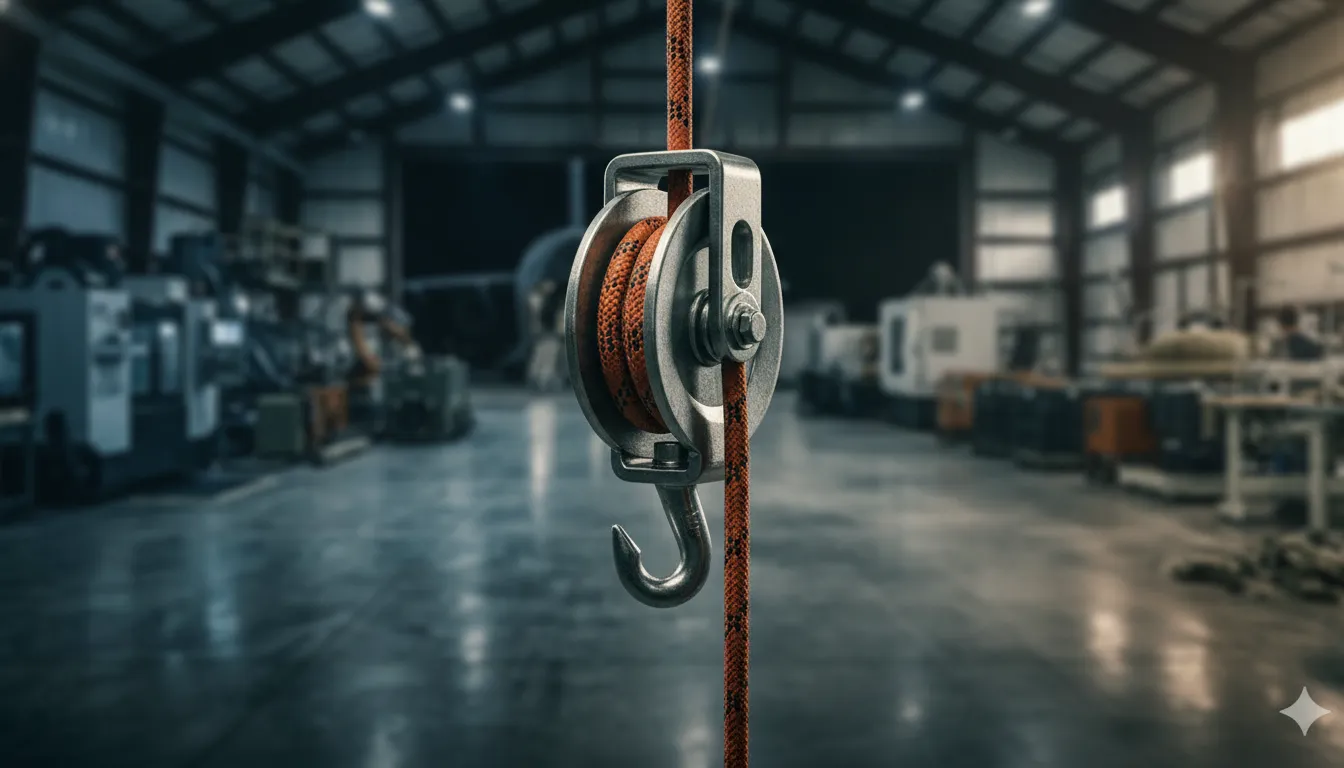
For procurement, the load-path drawing is valuable because it turns an equipment request into an auditable requirement. It also gives engineering, training, and logistics teams a shared reference when the same hardware will be used across towers, aircraft, confined spaces, industrial sites, or emergency response operations.
Rope and sheave compatibility
Rope and sheave compatibility is a first-order specification. The rope diameter must fall within the manufacturer's stated range, and the sheave profile must support the intended rope without excessive pinching, riding, abrasion, or uncontrolled movement. A pulley that fits a connector may still be wrong for the rope or for the system's expected loading.
Review these features together:
- Rope diameter range: Record the minimum and maximum supported diameter from the current product documentation. Fusion Tactical's Micro Aluminum Pulley is listed for 8 to 11 mm rope, while the Rescue Pulley 34 kN model is listed for 9 to 14 mm rope.
- Sheave and trough geometry: Confirm that the rope sits correctly in the groove and does not climb the flange or contact sharp edges. The Rescue Pulley 34 kN product page lists a 0.64 inch trough size.
- Sheave count: A double pulley can support more complex hauling or routing arrangements, but it also changes rope routing, clearance, inspection, and system training requirements.
- Side-plate access: Side-swing plates can simplify installation and inspection. Fixed plates can provide a compact, snag-resistant configuration. Neither design is automatically correct for every operation.
- Bearings or bushings: Identify the component type and the maintenance instructions. Smooth movement is important, but low friction does not remove the need to respect the system load and inspection limits.
- Edge and snag control: Rounded edges and a clean profile help protect rope and reduce interference with adjacent equipment, but operators still need an edge-management procedure.
The product page for the Fusion Tactical Rescue Pulley lists a 34 kN MBS, 9 to 14 mm rope compatibility, fixed aluminum side-swing plates, enclosed bushings, and smooth rounded edges. The Micro Aluminum Pulley is a compact 20 kN option listed for 8 to 11 mm rope. Those differences are procurement data, not marketing decoration. They define where each component may fit in a documented system.
How do kN ratings and attachment design affect procurement?
A kN rating is a force rating, not a complete work-load authorization. Procurement teams must distinguish minimum breaking strength, working load limit, system design load, and any application-specific factor required by the governing procedure. Never calculate a working load limit from an MBS alone unless the manufacturer or qualified engineer provides the method and assumptions.
When reviewing rated rescue pulleys, ask for:
| Specification | What to confirm | Why it matters |
|---|---|---|
| Minimum breaking strength | Published value, test basis, and component configuration | Shows the documented failure threshold for the tested component, not the permitted operating load |
| Working load limit | Whether a WLL is published and how it is established | Prevents a buyer from converting MBS into an unsupported operating limit |
| Attachment geometry | Hole size, connector orientation, side-plate movement, and loading direction | Controls alignment, gate loading, rope routing, and unwanted rotation |
| Material and finish | Aluminum or steel construction, corrosion considerations, and finish | Links the component to weight, environment, durability, and maintenance needs |
| Traceability | SKU, batch or lot information, certificates, warning material, and inspection records | Supports deployment control, accountability, and replacement decisions |
Fusion Tactical lists 20 kN and 34 kN pulley models in its rated hardware collection. The Nuro Tactical Fixed Pulley is listed as a compact 20 kN aluminum pulley with fixed side plates. The Rescue Pulley is listed as a 34 kN aluminum side-swing model. A higher number does not automatically make one product the correct choice. The right selection depends on load path, rope, attachment, space, operating method, and documentation.
Attachment design deserves the same scrutiny as the headline rating. A large attachment hole may accept multiple connector configurations, but a procurement specification should still state the approved connector type and orientation. Side-swing access may speed setup, while a fixed plate may be preferable where compactness and snag control are more important. These are system decisions, not universal rankings.
Rescue pulley system integration
Rescue pulley integration begins with the anchor and ends with the moving load. The pulley, rope, connectors, rigging plate, harness or litter interface, edge protection, and control method must be reviewed as one system. For workplace applications, the plan should also be consistent with applicable OSHA requirements, including 29 CFR 1910.140 and 29 CFR 1910.27 where those rules apply, as well as the manufacturer's instructions and the authority having jurisdiction.
A procurement package should identify:
- Anchor strategy: Primary and backup anchor locations, rated attachment points, direction of pull, and the effect of edge loading.
- Connector interface: Approved carabiners, swivels, rigging plates, or other connectors, including gate orientation and compatibility with the pulley body.
- Rope path: Rope diameter, routing through the sheave, bend radius, edge protection, and the method for preventing unintended rope movement.
- Load interface: How a harness, rescue seat, litter, or equipment package is connected and how the load will remain controlled during movement.
- Control and capture: The braking, progress-capture, or descent method, including the roles and communication signals used by the team.
- Environmental conditions: Water, grit, salt, chemicals, heat, cold, abrasion, and storage conditions that could change inspection or replacement requirements.
This system approach is what separates rated rescue hardware from a general-purpose accessory. A component should be selected for its documented role, not because it is visually similar to another pulley or because its price is lower. Fusion Tactical's engineering and testing resources provide a starting point for organizations that need to define, prototype, or refine a mission-specific hardware package.
Schedule an engineering consultation to review a rescue pulley load path and procurement package.
Inspection and documentation for rated hardware
Inspection should be defined before the pulley enters service. At a minimum, qualified users should inspect the pulley, sheaves, axle area, side plates, attachment points, finish, and rope-contact surfaces before each use and after any event that could cause damage. The manufacturer's instructions and the organization's written procedure control the inspection interval and removal criteria.
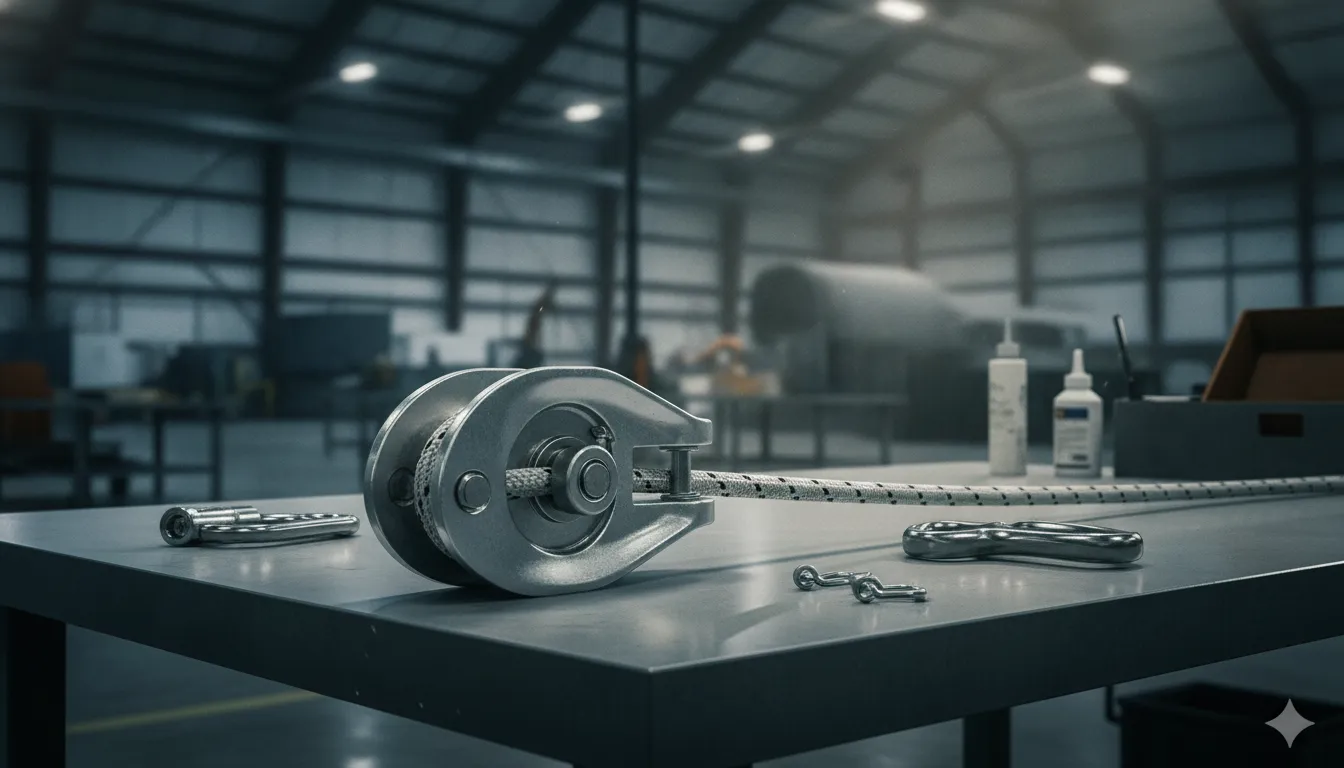
Use a controlled inspection record that captures:
- Identity: Product name, SKU, serial or lot information when available, and assigned equipment number.
- Sheave movement: Smooth rotation, unusual play, noise, binding, or contamination.
- Rope-contact surfaces: Grooves, flanges, trough, edges, burrs, corrosion, cuts, deformation, and embedded debris.
- Side plates and axle: Cracks, bending, missing fasteners, unexpected movement, and signs of side loading.
- Attachment points: Wear, distortion, sharp edges, contamination, and connector alignment.
- Markings and documentation: Legible ratings, warnings, certificates, and current instructions.
- Disposition: Accepted, cleaned and rechecked, quarantined, sent for qualified evaluation, or removed from service.
Remove equipment from service when inspection reveals damage, deformation, excessive wear, contamination that cannot be removed, abnormal movement, missing identification, or an unknown loading event. Do not return a suspect pulley to service because it still appears to turn. A qualified person or the manufacturer should determine whether an affected component can be evaluated, repaired, or replaced.
Fusion Tactical rescue pulley options
Fusion Tactical's pulley range supports different system roles. Use the following comparison as a starting point, then confirm the current product page, certificates, rope range, and application guidance before issuing a purchase order.
| Model | Published data | Potential procurement role |
|---|---|---|
| Rescue Pulley 34 kN | 34 kN MBS; 9 to 14 mm rope; aluminum; fixed side-swing plates; enclosed bushings; EN12278 listed | Rated rescue, climbing, and rigging systems that need the documented rope range and side-swing access |
| Nuro Tactical Fixed Pulley | 20 kN rating; compact aluminum body; fixed side plates | Compact single-rope and tactical rigging arrangements where a fixed configuration is appropriate |
| Micro Aluminum Pulley | 20 kN rating; 8 to 11 mm rope; compact aluminum design | Space- and weight-sensitive systems using compatible 8 to 11 mm rope |
| Secura Aluminum Double Pulley | Two independent sheaves; side-swing aluminum plates; climbing, rescue, and industrial rigging applications | Double-sheave routing, hauling, or directional-change arrangements; confirm rating and rope range before order |
| Advent Zipline Trolley Pulley | 50 kN MBS; 9 to 13 mm rope; 8 to 12 mm cable; two-point attachment; sealed bearings; EN12278 listed | Specialized zipline or trolley operations; do not substitute it for a general rescue pulley without system approval |
The table is not a substitute for a technical review. Product data can change, and an application may require a certificate, drawing, test report, or configuration that is not represented by a retail listing. Ask Fusion Tactical to confirm the exact SKU and documentation package for the intended mission.
Government and industrial procurement checklist
A procurement request should define the component, the mission, the evidence, and the delivery requirements. Buyers evaluating U.S.-manufactured or government-ready equipment should request a configuration-specific response rather than relying on a general category label.
- Exact model, SKU, material, finish, and intended system role.
- MBS, WLL if published, supported rope or cable range, and applicable test basis.
- Current warning book, user instructions, certificate, and available test or inspection records.
- Traceability fields, packaging requirements, replacement policy, and training or technical-support contacts.
- Required country-of-origin, Berry Amendment, TAA, or other contract clauses for the exact configuration.
- Prototype, sample, or engineering-review requirements before production quantities.
Berry Amendment and TAA questions should be answered against the actual bill of materials, contract clause, and order configuration. Fusion Tactical describes U.S.-based manufacturing and offers government-oriented sourcing support, but procurement teams should ask for the documentation that applies to the exact hardware and contract. The company also supports custom design and testing through its California operation, which can be useful when an off-the-shelf pulley does not match the required load path.
For a broader sourcing and engineering discussion, review Fusion Tactical's Berry-compliant manufacturing information, then contact the team with the rope diameter, target load, attachment geometry, operating environment, quantity, and required delivery evidence.
Frequently Asked Questions
What is the primary purpose of a rescue pulley?
A rescue pulley redirects rope and can improve hauling efficiency when it is installed in a properly designed and documented system. Its useful performance depends on the rope, sheave, attachment, anchor, connectors, friction, and load path. The pulley rating by itself does not approve the complete rescue arrangement.
How does a rescue pulley create mechanical advantage?
A rescue pulley contributes to mechanical advantage by distributing a load across rope segments in a planned hauling arrangement. The actual advantage is lower than the ideal calculation when friction, rope bend, sheave condition, alignment, and connector loading are included. A qualified team should document the system geometry and control method before use.
What kN rating should a rescue pulley have?
There is no universal kN rating that is correct for every rescue operation. The selected rating must be compatible with the planned system design load, manufacturer guidance, attachment configuration, rope, and applicable operating procedure. Buyers should distinguish MBS from WLL and should not convert one into the other without documented engineering or manufacturer direction.
What rope diameter do rescue pulleys support?
Rope compatibility varies by model and must be confirmed against the current product documentation. Fusion Tactical lists the Micro Aluminum Pulley for 8 to 11 mm rope and the Rescue Pulley 34 kN for 9 to 14 mm rope. Using a rope outside the published range can change tracking, friction, loading, and control.
What is the difference between a single and double rescue pulley?
A single pulley has one sheave and is often selected for a basic redirection or compact hauling role. A double pulley has two sheaves and can support more complex routing, but it also changes clearance, rope management, inspection, and training requirements. The number of sheaves should follow the system design, not serve as a standalone quality ranking.
Can a recreational climbing pulley be used in a rescue system?
Only use a pulley when the manufacturer documents it for the intended application, rope, load, and system configuration. A component designed for a different activity may lack the rating, attachment geometry, documentation, or inspection guidance required for a technical rescue program. Procurement teams should specify mission use and obtain configuration-specific evidence before approval.
How often should rescue pulleys be inspected?
Qualified users should inspect rescue pulleys before each use and after any event that could cause damage, while the organization follows the manufacturer's instructions and written inspection program for additional intervals. Check the sheave, rope-contact surfaces, side plates, axle area, attachment points, markings, and records. Quarantine equipment with damage, abnormal movement, missing identification, or an unknown loading event.


