

Rescue Anchor System Engineering and Procurement Guide
A rescue anchor system is more than an anchor plate or a high-strength connector. It is the complete load path from the operating structure through the substrate, attachment hardware, connectors, rope or webbing, and the supported load. For technical-rescue, defense, aerospace, law enforcement, and industrial programs, procurement should require evidence that the assembled system is appropriate for its intended loading, installation method, environment, and inspection program.
The most useful specification separates three questions: what each component is rated to withstand, how the installed configuration transfers force, and what documentation controls the delivered configuration. This guide gives engineering and purchasing teams a framework for evaluating those questions without treating a catalog rating as approval for an unverified installation.
What Does a Rescue Anchor System Include?
A rescue anchor system includes the structural or engineered attachment point, the substrate or host structure, the anchor plate or connector, any fasteners or slings, the rope or webbing interface, and the procedures that govern use and inspection. The system may be permanent, semi-permanent, portable, or assembled for a specific operation. Its suitability depends on the complete configuration, not on the strongest component listed in a catalog.
That system view matters because a 40 kN plate does not make a weak substrate a 40 kN anchor. A connector with a major-axis rating can be compromised by cross-loading. A fastener can be strong in tension but inappropriate for an edge distance or base material. Procurement records should therefore identify the exact part, orientation, interface, installation constraint, and use case covered by the evidence.
- Anchor interface: plate, eye, D-ring, bolt, davit interface, structural member, or other attachment point.
- Load-transfer components: connectors, slings, rope, webbing, shackles, fasteners, and any edge protection.
- Host structure: steel, aluminum, concrete, masonry, engineered frame, aircraft structure, or another verified substrate.
- Operational controls: rigging method, orientation limits, rescue procedure, authorized users, and inspection intervals.
- Evidence package: drawings, material information, ratings, test records, configuration control, and acceptance documentation.
How Should Engineers Analyze the Load Path?
Load-path analysis should follow force from the supported person, litter, rescuer, or equipment through every connection to the structure. The review should consider direct tension, shear, bending, side loading, offset loading, shock or dynamic effects, and the possibility that more than one connection does not share force equally. A system that looks symmetrical on paper can develop an uneven load when connector geometry, rope angle, stiffness, or anchor movement changes.
Begin with a configuration drawing that names each interface and shows the intended direction of force. Mark the primary anchor, secondary or backup anchor, directional points, connectors, and any component that could be loaded across a gate, edge, or unintended axis. Then define the maximum anticipated operational load and the credible abnormal loads. Do not substitute a component's minimum breaking strength for a program-specific allowable load without an engineering basis.
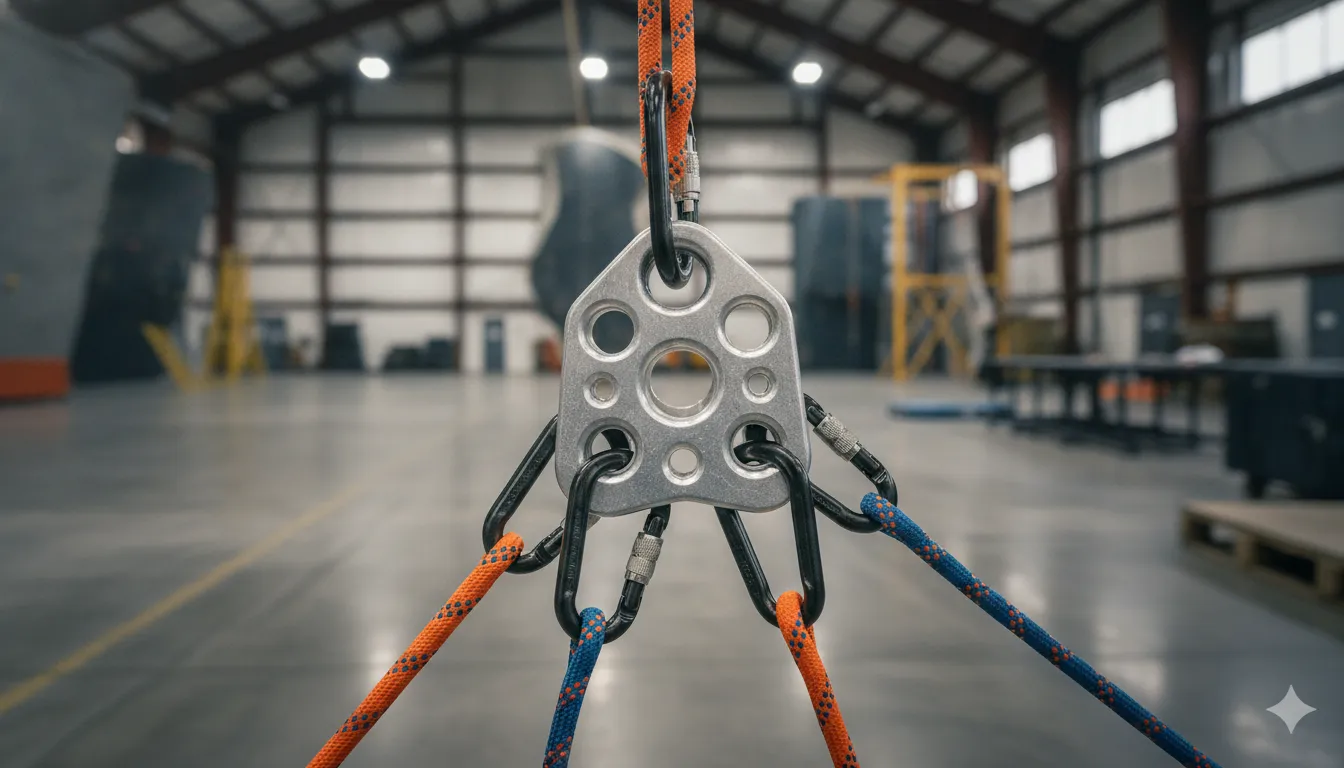
Check connection geometry and orientation
Connector orientation is a design input, not a field detail to be resolved after delivery. Confirm that the connector can close fully, remains loaded along its intended axis, and cannot be forced over an edge or into a gate-opening condition. Check clearances around plate holes, the radius of the attachment point, rope bend radius, and whether adjacent hardware can contact or interfere with the gate.
For multi-point plates, identify which holes are intended for the primary load, which are for secondary or directional connections, and how the plate is expected to align under force. Fusion Tactical's Bigfoot aluminum rigging plate is listed with a 40 kN rating and five attachment points. That published component information can support a bill of materials, but it does not replace an engineering review of the plate's installed use, connected hardware, or host structure.
Which Anchor Plate and Connector Features Matter?
Anchor plates organize multiple connections around a controlled interface. They can reduce clutter, improve access, and make a rigging plan easier to inspect. The selection should match the number of planned connections, expected rope and connector sizes, handling requirements, and the need to separate primary, secondary, and directional functions.
A compact plate may be appropriate when low bulk and rapid deployment are priorities. A larger plate may provide more usable geometry for multiple connectors and clearer system organization. Fusion Tactical's Littlefoot compact rigging plate is listed as a four-hole, 30 kN aluminum plate. Treat that figure as the product's stated component rating, then verify whether the complete rescue configuration, connector orientation, and substrate support the intended application.
| Specification area | What to document | Why it matters |
|---|---|---|
| Plate or anchor rating | Stated strength, test basis, axis, and exact part revision | Prevents a rating from being detached from its tested configuration |
| Connector interface | Gate type, major and minor axis limits, opening, orientation, and clearance | Controls cross-loading and unintended contact |
| Substrate interface | Material, thickness, fastener pattern, edge distance, and installation method | Establishes whether force can reach the structure safely |
| Environmental exposure | Corrosion, temperature, chemicals, abrasion, UV, and contamination | Identifies degradation and maintenance requirements |
| Operational use | Personnel, litter, equipment, angles, dynamic events, and rescue method | Connects the hardware selection to the mission profile |
How Do Substrate and Installation Constraints Change Capacity?
The substrate is part of the anchor. For a structural member, the review may include section properties, welds, fasteners, local bending, and load introduction. For concrete or masonry, it may include base material, embedment, edge distance, spacing, cracking, installation torque, and the approved anchor type. For aircraft or other lightweight structures, local skin, frames, fastener paths, and damage tolerance can control the design even when the attached hardware has a high rating.
Installation records should identify who performed the work, which drawing or procedure governed it, what tools or torque values were used, and what acceptance checks were completed. If the anchor is removable, document the inspection of the host interface at each setup. If the anchor is permanent, control the as-built condition and any later structural or configuration changes.
OSHA's 29 CFR 1910.140 establishes performance, care, and use criteria for personal fall protection systems and defines an anchorage as a secure point of attachment. OSHA's 29 CFR 1926.502 provides fall-protection criteria for construction. These references are useful compliance inputs, but they do not certify every rescue anchor arrangement. The responsible engineer must determine which requirements apply to the operation and whether additional rescue, aerospace, structural, or program requirements govern.
What kN Documentation Should Procurement Require?
Procurement should ask for a traceable evidence package rather than a single number copied into a purchase order. The package should state the exact product identifier, revision, material or construction, rated axis, test method or basis, and any restrictions on orientation or use. It should also identify whether the value is a minimum breaking strength, proof load, working load limit, or another defined quantity.
- Product drawing or controlled specification with revision and dimensions.
- Material, finish, and heat or lot information where applicable.
- Published rating with units, axis, test conditions, and limitations.
- Proof-test, tensile-test, or qualification records tied to the configuration.
- Connector compatibility and installation instructions.
- Inspection, retirement, storage, and cleaning criteria.
- Certificate of conformance and lot or serial traceability.
- Change-notification and configuration-control requirements for repeat orders.
Use consistent terminology. A kN value is a force rating, not automatically an allowable working load. It should not be divided by an assumed factor unless the program's engineering authority has defined that factor and its application. The evidence should also distinguish a component test from an assembled-system test. A plate, connector, sling, and substrate may each have separate records, while the system requires a separate load-path and installation basis.
How Should a Rescue Anchor System Be Made Redundant?
Redundancy is not simply adding a second piece of hardware. A useful backup reduces the chance that one credible failure mode disables the system. The primary and secondary paths should be separated where practical, use compatible interfaces, and be arranged so that the loss of one path does not create an uncontrolled shock or redirect force into a weaker component.
Define what the backup is intended to protect against. It may address component breakage, anchor movement, connector opening, damage to a rope or webbing segment, or loss of the primary host structure. Then assess whether the backup is independent enough to address that hazard. Two connectors clipped into the same compromised eye may not provide meaningful independence. Two anchor points may also share a common structural weakness.
Redundancy should be documented in the rigging drawing and operating procedure. Identify primary and secondary paths, expected load sharing, isolation distances, connection orientation, and the inspection that confirms both paths are available. Training should include the failure assumptions used by the design authority, not only a generic demonstration of how to connect hardware.
What Inspection and Maintenance Records Support Readiness?
An inspection program should be specific to the anchor system and its environment. Before use, the authorized inspector should verify part identity, deformation, cracks, sharp edges, corrosion, wear, contamination, connector function, gate closure, fastener condition, and correct orientation. For installed anchors, inspect the surrounding substrate and any signs of movement, cracking, elongation, fretting, or water intrusion.
Periodic inspection should compare the installed system with its controlled drawing and record the inspection date, inspector, condition, findings, corrective action, and release decision. After a shock load, overload, uncontrolled event, impact, fire, chemical exposure, or suspected damage, quarantine the affected components until a qualified authority completes the disposition. Do not return a system to service because it looks acceptable from a distance.

Keep records with the asset or program data package. Fusion Tactical's mission safety hardware production guidance emphasizes requirements analysis, controlled design, traceable materials, testing, inspection, and repeatable production. Those same controls are useful when a rescue anchor system moves from prototype to a repeat procurement.
What Should a Technical Buyer Put in the Purchase Package?
A procurement package should turn the operational need into verifiable requirements. Avoid a description such as "heavy-duty anchor plate" without a defined use, rating basis, interface, and evidence requirement. A better package gives suppliers enough information to quote the intended configuration while preserving engineering review for application-specific decisions.
- Define the mission: identify personnel or equipment loads, environment, access method, rescue method, and expected duration.
- Define the interfaces: specify the host structure, connector types, rope or webbing, fasteners, plate geometry, and orientation.
- Define the evidence: require drawings, ratings, test records, certificates, lot traceability, and inspection procedures.
- Define acceptance: state dimensional checks, installation verification, proof testing if required, documentation review, and nonconformance handling.
- Define sustainment: require spare-part continuity, change notification, training support, inspection intervals, and disposition criteria.
- Define sourcing: where required, include U.S. manufacturing, Berry Amendment or TAA requirements, quality-system expectations, and any program-specific flow-downs.
For integrated casualty movement and rescue operations, also define how the anchor connects to the rest of the system. Fusion Tactical's guide to litter carry systems for casualty transport illustrates why the litter, carrying interfaces, patient restraints, operators, and procedures should be evaluated together. The same systems thinking applies to an anchor that supports a rescue movement or extraction task.
How Can Buyers Compare Suppliers Beyond a Catalog Rating?
Supplier review should test whether the manufacturer can control the entire configuration. Ask for examples of requirements capture, engineering review, prototype validation, production inspection, and document control. Confirm that the proposed supplier can identify the exact materials, hardware, and process used in the quoted configuration, then preserve that configuration through repeat orders.
For defense, aerospace, government, and industrial buyers, also evaluate domestic manufacturing capability, compliance documentation, lead-time communication, engineering responsiveness, and the ability to support a nonstandard interface. A supplier that can provide only a generic product sheet may be appropriate for a low-consequence accessory, but it may not satisfy a mission-critical program's configuration and traceability needs.
Fusion Tactical positions its U.S.-based manufacturing, rated hardware, custom engineering, and Berry and TAA compliant capabilities for buyers that need more than an off-the-shelf component. The right next step is an application review that confirms the intended anchor geometry, load path, substrate, documentation, and procurement constraints before final selection.
Request a quote and discuss your rescue anchor system requirements with Fusion Tactical.
Frequently Asked Questions
What is a rescue anchor system?
A rescue anchor system is the complete engineered path that transfers a rescue load from the supported person or equipment through connectors and anchor hardware into a verified host structure. It includes the hardware, substrate, installation, rigging method, inspection, and documentation.
Is a higher kN rating always a better anchor?
No. A higher component rating does not overcome a weak substrate, poor connector orientation, incompatible interface, or unverified installation. The rating must be evaluated in the complete load path and tied to the intended use.
What should a procurement team request with a rescue anchor?
Request the controlled drawing, exact part and revision, material information, rated axis, test or proof records, certificate of conformance, traceability, installation limits, inspection criteria, and change-control requirements. Also define the intended system and host structure.
How do anchor plates help technical rescue operations?
Anchor plates organize several connections around a controlled interface, which can improve rigging clarity and reduce hardware congestion. They still require correct connector orientation, a suitable substrate, documented load paths, and an inspection plan.
What is the difference between a component rating and a system rating?
A component rating describes a defined part under stated conditions. A system rating considers the assembled plate, connectors, ropes or webbing, fasteners, substrate, geometry, and loading. The weakest or most limiting condition can control the system.
When should a rescue anchor be removed from service?
Remove it from service after a shock load, overload, impact, fire, chemical exposure, suspected deformation, crack, corrosion, gate malfunction, substrate movement, or any condition that cannot be resolved by the authorized inspection process. Quarantine it until a qualified authority determines disposition.
Can Fusion Tactical help with a custom rescue anchor configuration?
Fusion Tactical can review requirements for rated hardware, anchor plates, connectors, and integrated safety systems. Use the contact page to request a quote and provide the operating environment, load path, interface, documentation, and sourcing requirements.


