

kN Ratings for Mission-Critical Life-Safety Gear
kN ratings express the force a life-safety component resisted under a defined test. The marked number alone does not establish that a complete system is suitable for a mission.
Procurement and engineering teams must evaluate the rated axis, gate condition, test method, and material interfaces. They must also assess stitching, environmental limits, and governing requirements before approving a connector, lanyard, harness, or integrated retention assembly.
Procurement answer: A kilonewton is a unit of force equal to 1,000 newtons. To compare hardware intelligently, treat each kN marking as one input in a controlled system-level assessment, not as a working-load recommendation or a universal safety guarantee.
What do kN ratings measure?
A kilonewton measures force. One kilonewton equals 1,000 newtons, and one newton is the force required to accelerate one kilogram at one meter per second squared. For a quick reference, 1 kN is approximately 224.8 pounds-force. Therefore, an 18 kN rating is approximately 4,047 pounds-force, 23 kN is approximately 5,171 pounds-force, and 30 kN is approximately 6,744 pounds-force.
That conversion is useful for orientation, but procurement decisions should remain in the units and conditions stated by the applicable specification. Pounds-force is not the same as suspended mass, and a static conversion does not predict the peak force produced by a fall, extraction event, or abrupt restraint. Dynamic events can multiply force according to mass, velocity, stopping distance, system elasticity, geometry, and energy absorption.
Minimum breaking strength versus working limits
A marked strength commonly represents minimum breaking strength under a specified laboratory method. It is not automatically a working load limit, allowable load, arrest force, or recommended operating load. Those terms answer different engineering questions. A minimum breaking strength describes a test threshold. A working limit applies a defined design factor and operating assumptions. An arrest-force limit addresses the force transmitted during a fall-arrest event.
The procurement record should preserve the exact terminology used by the manufacturer and the governing specification. Translating every strength statement into a generic capacity can obscure whether the value applies to a single component. A specific axis, a new sample, or the complete delivered system.
Design factors also require technical authority. A purchasing team should not invent a safety factor by dividing the marked breaking strength by an arbitrary number. The responsible engineer or applicable standard must define the allowable relationship between expected loads, uncertainty, degradation, and verified strength.
Request documentation that identifies which value is being stated. If a supplier cannot distinguish a component's minimum breaking strength from its system-level allowable use, the rating is not sufficiently defined for a life-safety procurement file.
How should buyers interpret 18 kN, 23 kN, and 30 kN ratings?
The correct interpretation depends on the component, loading direction, gate condition, and applicable requirement. An 18 kN connector may be suitable for one defined subsystem, while a 30 kN connector may still be inappropriate when cross-loaded. Connected to an incompatible interface, or installed in an assembly whose webbing or stitching governs failure.
| Marked strength | Approximate pounds-force | Procurement interpretation |
|---|---|---|
| 18 kN | 4,047 lbf | Confirm the marked axis, gate state, component function, and required design factor. |
| 23 kN | 5,171 lbf | Commonly encountered as a major-axis value; verify the actual model certificate and intended system. |
| 30 kN | 6,744 lbf | Higher marked strength does not override orientation, interface, or complete-system limitations. |
Numbers should be compared only when test conditions are equivalent. A major-axis, gate-closed result cannot be compared directly with an open-gate result or a webbing assembly result. Likewise, a catalog value without a test method, lot traceability, or drawing revision may be inadequate for a controlled defense, aerospace, law-enforcement, or government procurement.
Apply the governing requirement first
Start with the solicitation, statement of work, system safety assessment, or agency requirement. Standards such as ANSI Z359 address defined fall-protection equipment and applications. EN 362 addresses connectors used as personal protective equipment against falls. OSHA regulations establish workplace obligations but do not turn every marked connector into an approved system. MIL-SPEC or program-specific requirements can add material, construction, inspection, and documentation controls.
Standards are not interchangeable labels. The purchasing team should identify the exact edition, product scope, and required evidence before treating compliance language as a pass criterion.
Why do connector orientation and gate strength matter?
Connector strength is directional. For a carabiner or snap hook, the highest kN rating generally applies along the major axis with the gate closed and locked. Minor-axis loading, open-gate loading, edge loading, and three-way loading can reduce available strength substantially. The procurement drawing and user procedure should keep the connector in its intended orientation throughout foreseeable movement.
Review every marked condition
- Major axis, gate closed: the primary longitudinal loading condition and commonly the highest marked value.
- Minor axis: a cross-loaded condition that may place force across the body and gate.
- Gate open: a reduced-strength condition requiring separate evaluation.
- Interface loading: force concentrated by a narrow attachment, edge, incompatible ring, or hardware stack.
A high major-axis number cannot compensate for a configuration that routinely cross-loads the connector. Buyers should assess gate clearance, locking method, captive-eye requirements, snag exposure, attachment geometry, glove use, and movement envelope. Fusion Tactical USA's engineering and testing capabilities support requirement analysis, prototyping, and verification for mission-specific assemblies.
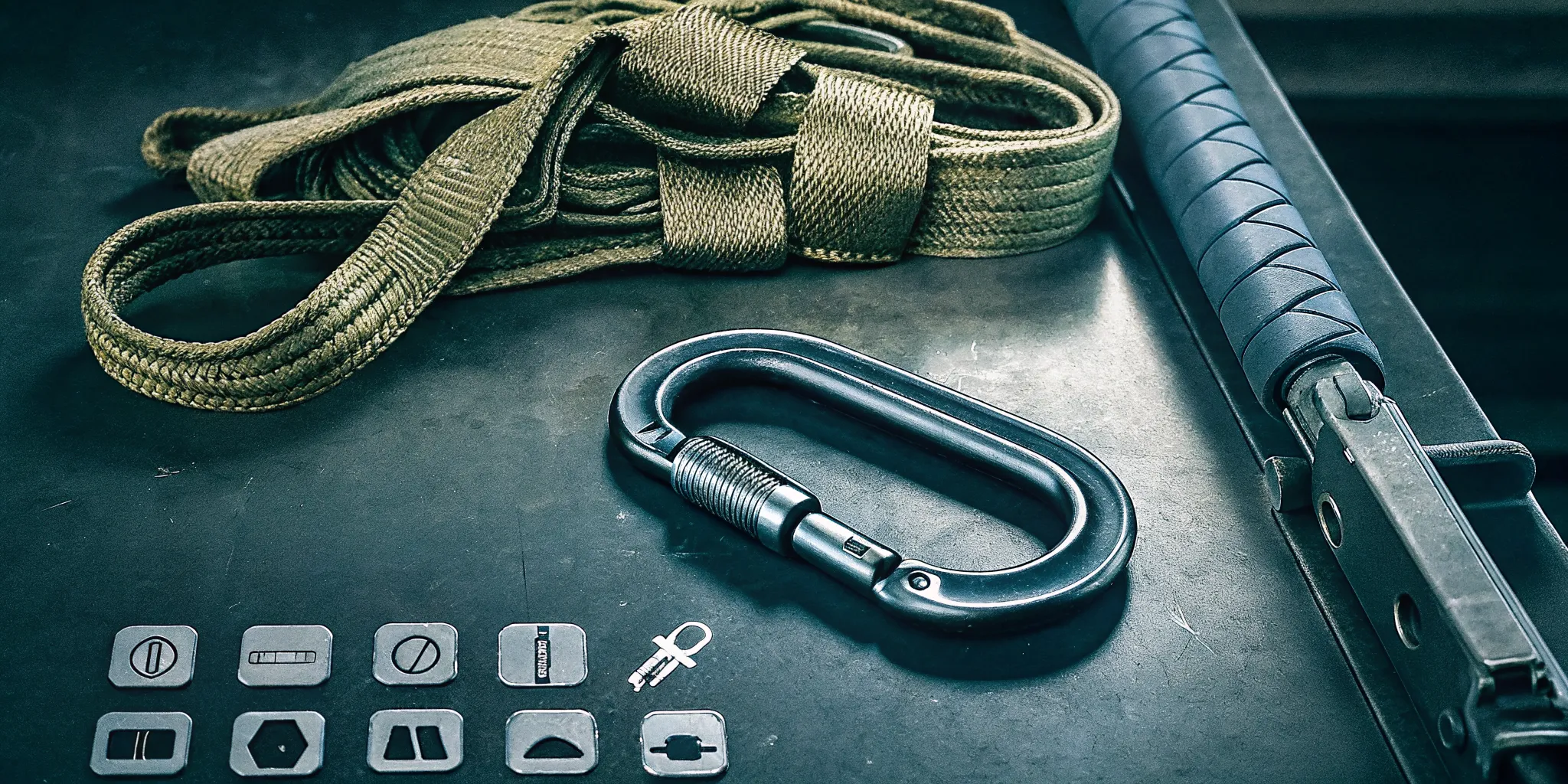
Do component ratings define complete-system strength?
No. A complete life-safety system is governed by its configuration, interfaces, and lowest-capacity credible failure mode. Connector body strength is only one part of the load path. Webbing specification, stitch pattern, thread, buckle geometry, D-rings, terminations, energy absorbers, attachment points, and user fit can influence performance.
For textile assemblies, purchasing teams should request evidence for the sewn assembly, not just the raw webbing. Fusion Tactical USA processes materials including MIL-SPEC Type 13 webbing and integrates textile and hardware components through its U.S. manufacturing operations in Chino, California. A raw-material rating remains useful, but cutting, folding, abrasion, sewing, and hardware interfaces change how load travels through the finished assembly.
Evaluate the load path as an assembly
A defensible review traces force from the operator or payload through every component to the approved anchor or attachment structure. It identifies the intended direction of loading, possible misuse states, tolerance stack-ups, and environmental conditions. It then connects each requirement to a drawing, test record, certificate, inspection criterion, or approved procedure.
This systems approach is especially important for operator retention, rescue, and extraction equipment, where movement can introduce off-axis loading and transient force. Procurement should also verify compatibility with adjacent government-furnished equipment rather than assuming that individually rated items will function correctly when combined.
Acceptance testing should represent the production configuration closely enough to support the stated requirement. Technical reviewers should confirm sample selection, fixture geometry, loading rate, conditioning, and pass-fail criteria. If a design changes after qualification, the program should document whether analysis or repeat testing is required.
Lot and revision traceability help connect the test evidence to delivered equipment. They also support investigation, corrective action, and controlled replacement if a material, process, or supplier issue is identified during service.
Request a custom engineering consultation before approving a modified or mission-specific assembly.
What documentation should support a life-safety rating?
A procurement-ready rating should be traceable to a defined product, configuration, test method, and acceptance criterion. The documentation package should let a technical reviewer determine what was tested. How it was loaded, what result was achieved, and whether the delivered item matches the tested configuration.
- Define the mission and load path. Record users, interfaces, movement, foreseeable misuse, environmental exposure, and required service life.
- Identify the governing requirements. Cite applicable specification editions, contract clauses, standards, and agency procedures.
- Verify each marked condition. Capture major-axis, minor-axis, gate-open, textile, stitching, and complete-assembly values where relevant.
- Review test evidence. Confirm the test method, fixture, sample count, acceptance threshold, laboratory, and report revision.
- Confirm configuration control. Link delivered materials, hardware, drawings, and manufacturing revisions to the tested article.
- Establish inspection and retirement criteria. Define pre-use inspection, periodic review, contamination limits, damage indicators, and removal-from-service rules.
Compliance and supplier qualification
Government buyers may also need domestic sourcing and supplier qualification evidence. Fusion Tactical USA offers Berry Amendment compliant capabilities and TAA compliant capabilities for applicable requirements. The company maintains CAGE Code 0KQN1, operates an ISO 9001:2015 certified quality management system, and supports government contracting through a broad manufacturing and engineering scope. Review Fusion Tactical USA's government and defense contracting profile for additional procurement identifiers and capabilities.
Fusion Tactical USA's documented work includes participation in aerospace programs, including a NASA partnership. These credentials do not replace product-specific verification. They demonstrate the quality-system and program context that procurement teams should evaluate alongside drawings, certificates, test data, and delivered-article controls.
How should programs manage ratings through service life?
A compliant procurement decision is only the start. In-service equipment can be affected by abrasion, contamination, chemical exposure, ultraviolet exposure, heat, deformation, corrosion, impact, unauthorized modification, and incomplete inspection records. The approved maintenance plan should preserve traceability from receipt through retirement.
Programs should define inspection authority, intervals, rejection criteria, cleaning limits, storage requirements, and recordkeeping. Equipment exposed to an event outside its approved use should be quarantined and evaluated according to the manufacturer's instructions and governing procedure. A visual appearance that seems acceptable does not establish remaining strength.
Training should address more than operation. Users and inspectors need to recognize off-axis loading, incomplete gate closure, incompatible connections, damaged stitching, glazing, cuts, corrosion, and unauthorized repairs. Records should identify the individual item when program rules require serialized control.
Retirement criteria should be established before deployment, not improvised after damage occurs. When required history is missing or a condition exceeds the approved limit, removal from service protects both personnel and the integrity of the program's safety case.
Questions to resolve before award
- Evidence: Is the kN rating supported by a relevant test report or certificate?
- Configuration: Does the delivered item match the tested drawing and material set?
- Integration: Have connector orientation and adjacent interfaces been evaluated?
- Compliance: Are sourcing, quality, and program-specific clauses documented?
- Lifecycle: Are inspection, training, maintenance, and retirement controls defined?
For made-to-order requirements, Fusion Tactical USA can support development from requirements analysis through prototype testing and production. Its U.S.-based design and manufacturing background gives procurement teams a direct path for resolving technical questions before fielding.
Frequently asked questions about kN ratings
Is a kN rating the same as minimum breaking strength?
A kN rating may express minimum breaking strength, but the supporting documentation must confirm what the number represents. It should not be treated as a working load limit or allowable operating load unless the manufacturer explicitly defines it that way for the applicable configuration.
Does a higher kN number always mean a safer component?
No. A higher number can indicate greater strength under one test condition, but safety depends on the entire system, intended use, orientation, compatibility, environmental limits, and governing requirement. An incorrectly loaded high-strength connector can be less suitable than a correctly integrated lower-rated component.
Can ratings for webbing and hardware be combined?
Component ratings cannot simply be added. The finished assembly must be evaluated as a connected load path. Stitching, bends, terminations, and interfaces can govern performance even when the raw webbing and hardware have higher individual values.
What should a buyer request from a supplier?
Request a product-specific technical data package that identifies the rated conditions, applicable standards, test method, configuration, inspection criteria, and traceability controls. For a custom assembly, require evidence that represents the delivered configuration rather than relying only on raw-material certificates.
Build a documented mission-specific load path
kN ratings are valuable when they are connected to a defined configuration, qualified test evidence, and controlled service-life plan. Fusion Tactical USA supports procurement officers, program managers, and technical teams that need U.S.-manufactured mission-critical safety systems, custom engineering, and documented production controls.


