

Load Rated Harness Design Manufacturer Guide
When a harness is part of a rescue, aviation, defense, or industrial safety system, the right supplier must do more than quote a webbing strength. A sound design connects the mission, the complete load path, the testing plan, and the evidence procurement teams need before approval.
Contact Fusion Tactical USA for custom harness engineering or procurement support.
How Does a Load Rated Harness Design Manufacturer Engineer for Mission Safety?
A load rated harness design manufacturer develops the complete system that transfers force through webbing, stitching, hardware, attachment points, and the user interface. The manufacturer should define the intended load case, select compatible materials, test the assembled configuration, and preserve traceable documentation. A component rating by itself does not prove that the finished harness is suitable for a specific mission.
What Does Load Rated Harness Design Actually Mean?
Load rated harness design means engineering a harness around a defined use, load direction, user configuration, and verification method. The rating must describe the tested assembly and its limiting condition, not simply the strongest part in the system. For procurement, the central question is whether the supplier can connect the stated capacity to a controlled design and evidence package.
Start with the application envelope. A fall arrest harness, a tactical retention harness, and a rescue or extraction harness can experience different force directions, impact conditions, attachment arrangements, and user movements. A static hoist load is not the same as a fall arrest event. A design review should therefore identify the mission, expected load, dynamic effects, environmental exposure, user interface, and any compatible connectors before a rating is assigned.
Define the complete load path
The load path begins at the point where force enters the harness and ends where it is transferred to the rated connector, structure, or anchor. Reviewers should be able to follow that path through each layer of webbing, every stitch pattern, hardware interfaces, adjustment points, and any sewn termination. Weakness at an interface can govern the capacity of the assembly even when the raw webbing has a higher published tensile strength.
Control the exact configuration
Dimensions, hardware, stitch geometry, webbing type, thread, bartack pattern, and adjustment range should be treated as controlled design inputs. Substituting a buckle or changing a termination can change the tested load path. A reliable manufacturer records the approved configuration and makes clear which variants are covered by the verification evidence.
Fusion Tactical USA presents custom solutions as an engineering process rather than a generic catalog substitution. Its custom solutions program and engineering and testing capabilities support requirements analysis, design development, and prototype evaluation for specialized equipment.
How Are Webbing, Hardware, and Attachment Points Engineered?
Webbing, hardware, and attachment points must be engineered as one load-bearing system. The finished capacity depends on the lowest-performing element and on how force moves between elements. Material selection, stitching, bend radii, connector orientation, and termination details all deserve review before production release.
Webbing and stitching establish the primary path
Webbing selection should account for fiber construction, width, tensile strength, abrasion, moisture, ultraviolet exposure, chemicals, and expected flexing. The nominal webbing strength is only one input. Stitching transfers force between overlapping layers, so stitch length, thread selection, edge distance, bar-tack placement, and the number of load-bearing rows matter. The design should also account for manufacturing tolerances that can reduce the effective section or create uneven loading.
A test specimen should represent the production design. A laboratory result from a straight webbing sample does not establish the strength of a sewn termination. Procurement teams should ask whether specimens were built using production materials, approved patterns, production equipment, and representative operators or process controls.
Hardware must match the direction of force
Connectors, buckles, D-rings, adjusters, and carabiners can have different capacities in direct pull, cross-loading, gate-open, or off-axis conditions. Hardware selection should specify the intended orientation and any prohibited loading modes. The interface between metal and textile also needs attention. Tight bends, sharp edges, concentrated pressure, and movement under load can abrade or cut fibers over time.
Attachment points require assembly-level review
Every attachment point should be reviewed for force concentration, stitching access, reinforcement, user positioning, and compatibility with the intended connector. Multiple attachment points can improve utility, but they also create more configurations to control and verify. The drawing and acceptance criteria should identify which attachment points are load-rated, which are positioning-only, and which are not intended for fall arrest, hoisting, or rescue loads.
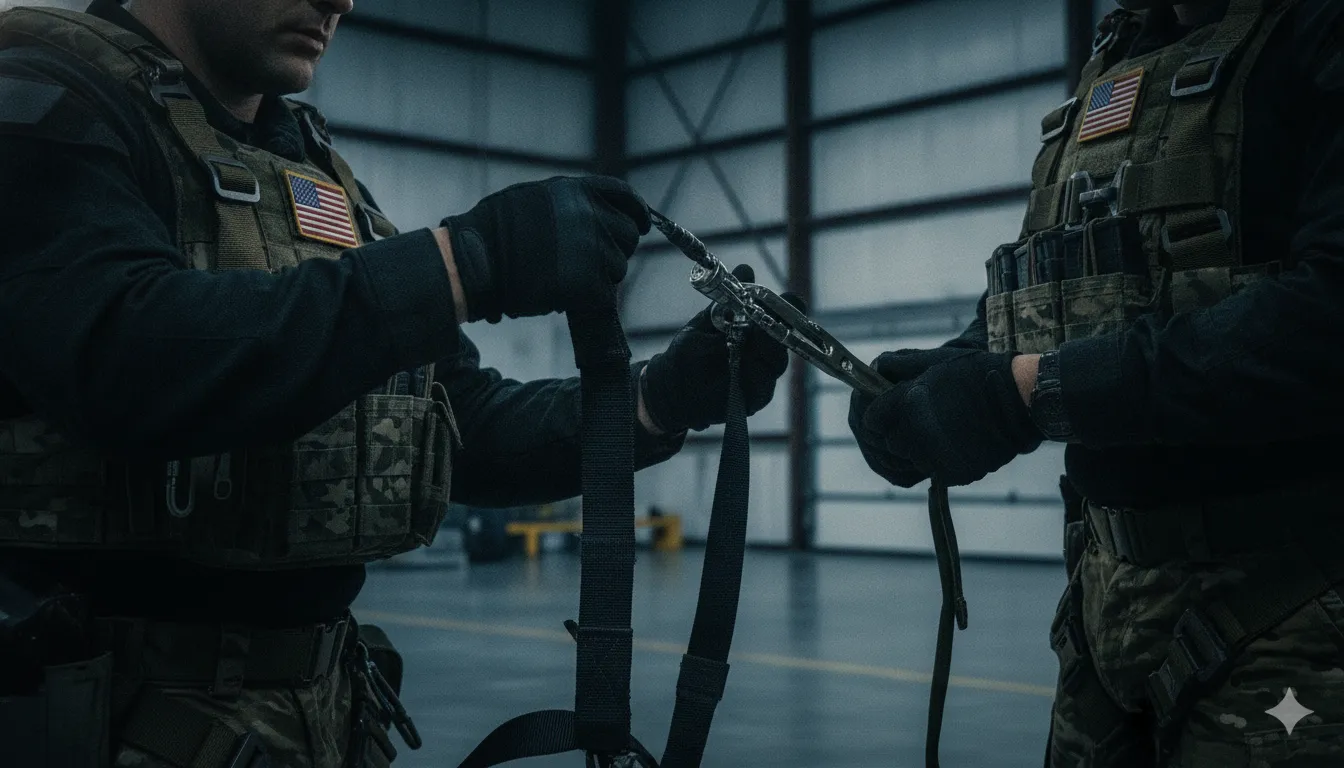
For U.S. government and defense programs, material origin and manufacturing controls may be part of the engineering requirement. Fusion Tactical USA describes Berry Amendment compliant manufacturing capabilities and TAA compliant options. Those designations should still be matched to the specific contract language, product configuration, and documentation requested by the contracting activity.
What Testing Evidence Should a Manufacturer Provide?
A credible load-rated harness program provides test evidence that matches the final design and intended use. At minimum, the evidence package should identify the specimen configuration, test method, load direction, result, failure mode, acceptance criteria, and relationship to the production design. A single headline number without those details is difficult to evaluate or compare.
Build a verification plan before the test
The verification plan should translate requirements into measurable checks. It can include material certificates, dimensional inspection, stitch and hardware inspection, static tensile testing, proof loading, dynamic testing where applicable, environmental conditioning, and post-test examination. The plan should state whether the test is qualification, production lot acceptance, design development, or a non-destructive proof check. These purposes should not be conflated.
Test assemblies, not isolated components only
Component testing can identify material or hardware properties, but assembly testing reveals how the parts interact. A sewn termination may fail by thread rupture, webbing pullout, edge damage, or stitch migration. A connector interface may fail through deformation, gate behavior, rotation, or cross-loading. Record the observed failure mode and the location of damage. That information helps engineers establish a rational design margin and improve future iterations.
Testing should also reflect the environment. Abrasion, ultraviolet exposure, moisture, contamination, temperature, and repeated handling can alter textile performance. The right test sequence depends on the mission and applicable standard. It is not defensible to claim that one universal test covers every harness application.
Preserve traceability from prototype to production
Reports should identify drawing or revision numbers, materials, lot information, hardware models, stitch patterns, specimen identifiers, equipment calibration, and personnel or laboratory records as appropriate. If the production design changes, the manufacturer should determine whether a partial or full requalification is required. This traceability is valuable to both engineering and procurement because it shows whether the evidence still applies to the item being purchased.
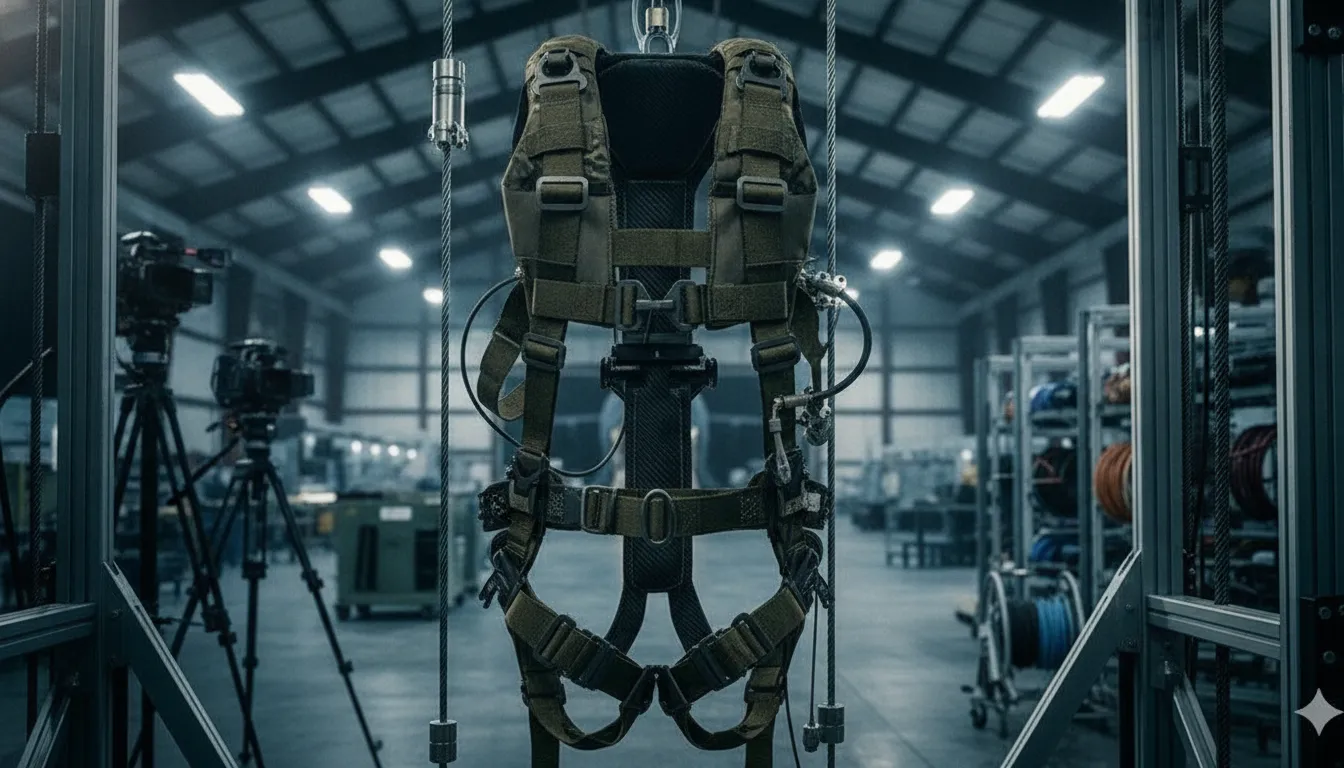
Fusion Tactical USA describes internal strength and material testing alongside third-party verification resources. Its professional manufacturing information is a useful starting point for procurement teams assessing how design, production, and quality activities connect.
Which Standards Apply to Load-Rated Harness Design?
No single standard automatically covers every harness mission. The applicable requirements depend on whether the harness is used for fall protection, rescue, tactical retention, hoisting, aviation, industrial access, or another defined purpose. A manufacturer should map the requested standard to the intended use and identify any requirements that remain outside its scope.
| Requirement area | What it can address | What procurement should verify |
|---|---|---|
| ANSI/ASSP Z359.11. | Full body harnesses in a personal fall protection system context. | Scope, edition, tested configuration, and intended use. |
| OSHA 29 CFR 1910.140. | Workplace fall protection requirements for covered operations. | Applicable regulation, employer duties, and system compatibility. |
| MIL-SPEC. | Specified materials, textiles, hardware, or contract attributes. | Exact specification, revision, type, class, and acceptance criteria. |
| ISO 9001:2015. | Quality management processes and document control. | Current certification scope plus product-specific test evidence. |
ANSI and OSHA address defined fall protection contexts
ANSI/ASSP Z359.11 addresses full body harnesses within the personal fall protection system context. The ANSI overview of Z359.11 can help reviewers understand the standard's scope, but it should not be treated as a universal approval for rescue or tactical configurations. OSHA rules, including the requirements in 29 CFR 1910.140, establish workplace fall protection requirements that may apply to particular operations and employers.
Ask the supplier to state exactly which product configuration was evaluated, which standard edition was used, and which portions of the mission are not addressed by that standard. This prevents a familiar label from being used as a substitute for application-specific engineering.
MIL-SPEC requirements should be tied to the contract
Military specifications can govern webbing, textiles, hardware, testing, sourcing, or other product attributes. The relevant specification, revision, type, class, and acceptance requirement should appear in the procurement package. "MIL-SPEC" without a cited requirement is not enough to establish compliance. A buyer should also distinguish a material specification from a complete harness performance requirement.
ISO 9001:2015 supports process control
ISO 9001:2015 certification concerns a quality management system, not a blanket rating for every product. It can provide useful evidence that documented processes, corrective action, document control, and continual improvement are part of the supplier's management system. Product qualification and test results remain necessary. Fusion Tactical USA identifies ISO 9001:2015 quality management practices and U.S.-based manufacturing among its capabilities, which procurement teams can validate against the specific program requirements.
How Should You Vet a Load Rated Harness Design Manufacturer?
Vet a load rated harness design manufacturer by reviewing its engineering method, production controls, test evidence, configuration management, and procurement support together. A supplier is a stronger candidate when it can move from requirements to controlled design, representative prototype, documented verification, and repeatable production without losing traceability.
Can the supplier translate mission requirements?
Ask for a requirements discussion before requesting a final price. The supplier should ask about users, load cases, attachment points, mobility, environment, compatible equipment, quantity, inspection, service life, and applicable standards. It should identify assumptions and unresolved risks rather than silently selecting a catalog configuration. This conversation is especially important when a harness will integrate into an aircraft, rescue system, vehicle, or government program.
Can the supplier show controlled engineering and testing?
Look for drawings, revision control, material identification, prototype records, test plans, reports, inspection criteria, and change-management practices. An in-house engineering team with CAD or 3D modeling capability can shorten the feedback loop, but the important issue is whether the process produces controlled outputs. Ask how a change to webbing, hardware, dimensions, or stitching is evaluated before release.
Can the supplier support the procurement file?
Procurement teams may need country-of-origin information, quality certifications, test reports, part or drawing numbers, packaging requirements, lot traceability, and contract-specific representations. Fusion Tactical USA lists a Chino, California manufacturing facility, CAGE Code 0KQN1, custom engineering, and Berry and TAA compliant capabilities in its government contracting materials. Buyers should request current documentation for the exact item and contract instead of relying on a general marketing statement.
For additional supplier review, compare the manufacturer's government and defense contracting profile with the solicitation's requirements. The certifications and compliance information can help organize follow-up questions about standards, quality systems, and product-specific evidence.
Why Do Custom Engineering and Rapid Prototyping Matter?
Custom engineering and rapid prototyping matter when the mission cannot be served safely by an off-the-shelf configuration. A prototype gives engineering and operational teams a physical way to review fit, routing, adjustment, connector access, and interference before committing to a production run. It also creates an opportunity to test the complete load path while changes are still manageable.
Use prototypes to expose interface risks
Early samples can reveal issues that are difficult to see in a drawing. A connector may rotate into an undesirable orientation. An adjustment may be hard to operate with gloves. A strap may contact an edge or interfere with another piece of equipment. These observations should be captured as design inputs and resolved through controlled iterations, not handled as undocumented field modifications.
Connect the prototype to the production plan
The prototype phase should define what is being learned and what must be frozen before production. Confirm materials, hardware, pattern files, stitch instructions, inspection points, labeling, packaging, and acceptance tests. A quick prototype is useful only when the lessons are transferred into the approved configuration and the verification record.
Fusion Tactical USA describes an in-house design team, 3D modeling, CAD, rapid prototyping, and made-to-order manufacturing. Its company overview and engineering resources provide context for evaluating that development model. Buyers should still establish a project-specific statement of work, acceptance criteria, and delivery documentation before authorizing production.
What Should Be in the Harness Procurement Package?
A complete procurement package should let a qualified reviewer identify the approved harness, understand its intended use, and verify that the evidence applies to the item being purchased. It should be specific enough to prevent accidental substitutions while remaining practical for production and inspection.
Requirements and configuration
- Intended mission, users, load cases, and prohibited uses.
- Approved drawing or configuration revision.
- Webbing, thread, hardware, reinforcement, dimensions, and stitch specifications.
- Rated attachment points and required connector orientations.
Verification and quality evidence
- Applicable ANSI, OSHA, MIL-SPEC, ISO 9001:2015, or contract requirements.
- Test plan, representative specimen description, results, failure observations, and acceptance criteria.
- Material certificates, inspection records, calibration information, and lot traceability as required.
- Change-control process and conditions that trigger additional testing.
Operational and delivery controls
- Define the mission, load cases, interfaces, and governing requirements.
- Approve the controlled configuration and verification plan.
- Review test results, quality records, and procurement documentation before release.
- Maintain inspection, change-control, and delivery records through the program.
- Inspection, maintenance, storage, retirement, and user-training information appropriate to the application.
- Country-of-origin, Berry Amendment, TAA, CAGE, or other procurement documentation when required.
- Packaging, labeling, quantity, lead-time, and replacement-part requirements.
- Named technical and procurement contacts for questions after delivery.
This structure helps separate three decisions that are often confused: whether the design is technically suitable. Whether the supplier can reproduce it, and whether the documentation satisfies the purchasing authority. All three matter for mission-critical equipment.
Frequently Asked Questions
What should a load rating identify?
A load rating should identify the tested assembly, load direction, test method, configuration, and limiting condition. It should not be presented as a property of isolated webbing when the finished harness depends on stitching, hardware, and attachment interfaces.
Does one harness standard apply to every mission?
No. Standards address defined equipment and use contexts. Fall protection requirements do not automatically establish suitability for hoisting, extraction, tactical retention, or another mission. The manufacturer should map each cited standard to the intended application.
What evidence should a manufacturer provide?
Ask for controlled drawings, material and hardware identification, a test plan, representative test reports, acceptance criteria, inspection requirements, and change-control information. The exact package depends on the program, but the evidence should show that the tested configuration matches the product being purchased.
How can procurement teams compare manufacturers fairly?
Use the same requirements matrix for each supplier. Compare load-path engineering, representative testing, traceability, quality controls, compliance documentation, prototype support, production capacity, and after-delivery support. Avoid comparing headline ratings that were produced under different methods or configurations.
When is custom harness engineering justified?
Custom engineering is justified when the mission, attachment geometry, user interface, environment, compliance requirement, or integration constraints differ from available standard configurations. A prototype and documented design review can reduce risk before production approval.
Contact Fusion Tactical USA to discuss custom harness engineering, testing requirements, or government procurement support.
Contact Fusion Tactical USA
Choosing a harness supplier is an engineering and procurement decision, not only a product comparison. Fusion Tactical USA supports mission-critical safety equipment through U.S.-based manufacturing, custom design, prototyping, testing, and government procurement capabilities. Share the intended application, load case, configuration, quantity, and documentation requirements so the technical discussion starts with a defined scope.
Request engineering or procurement support from Fusion Tactical USA.


