

Drone Deployment Readiness: A Program Guide
Drone deployment readiness is the state of a small unmanned aircraft program before anyone powers the aircraft. The airframe, batteries, control link, payload interface, transport case, and field records have to match the mission that was approved. A folded drone that leaves the shop in the wrong tube, with an unlogged battery or a loose mount, is not ready. It is only packed.
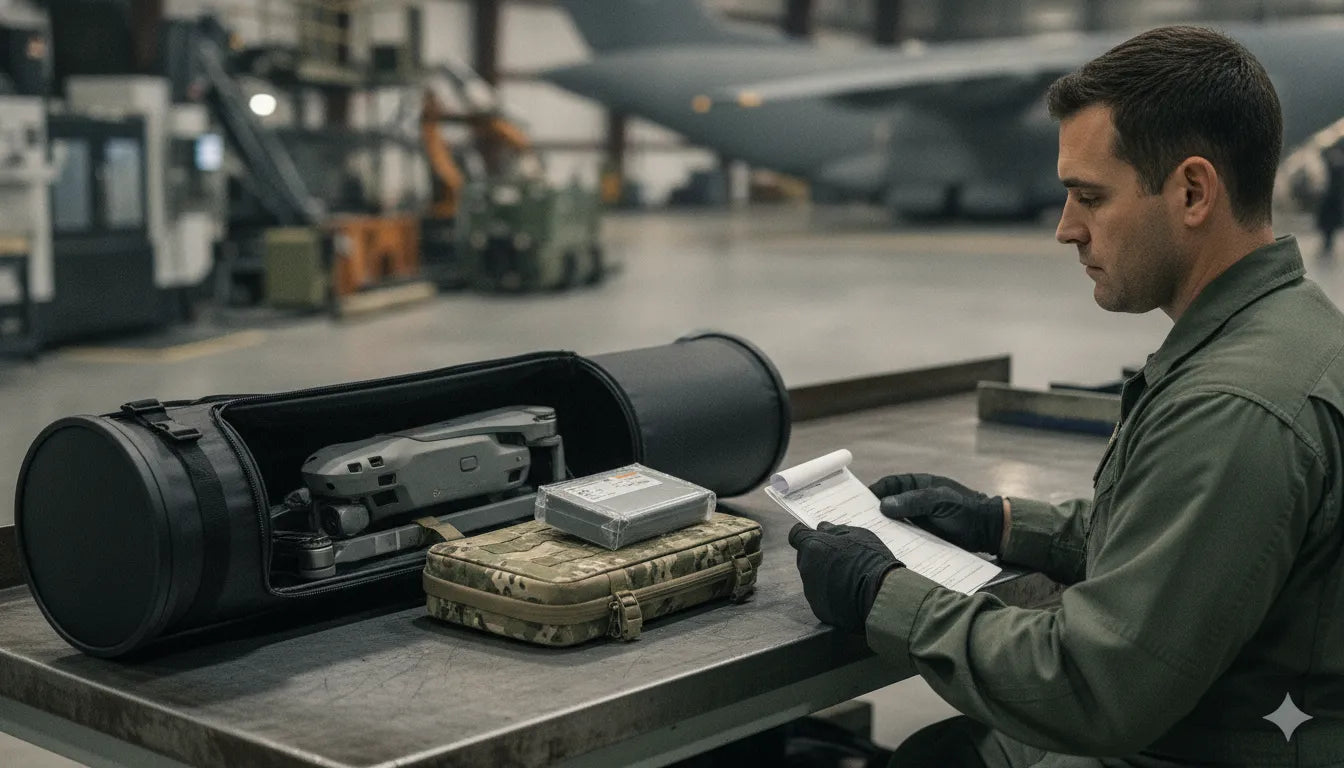
Call (909) 393-9450 to discuss deployment-readiness equipment
This guide is for program managers, procurement officers, and tactical leads in defense, aerospace, law enforcement, rescue, and industrial safety. It covers the workflow from storage to launch, the records that prove the aircraft was fit to fly, and the buy criteria for support equipment. It does not rate flight performance, and it does not replace the remote pilot's preflight duty under 14 CFR 107.49.
What drone deployment readiness means
Readiness is a gate, not a slogan. The gate opens only when four things are true at the same time. The aircraft configuration matches the approved mission. The power source is serviceable and legal to move. The people on the crew know their roles. The support gear that carries the system will not damage it on the way to the site.
Treat the gate as a short list the crew can finish without opening a manual. If a step needs a guess, the aircraft stays packed.
- Confirm the mission card: location class, time on station, payload, and who is remote pilot in command.
- Match the airframe and any carried object to that card. A camera, light, or drop device that was not on the card is a new aircraft configuration.
- Check power for the planned time, including the return and a reserve the program has already defined.
- Prove the control link, then brief every person who will stand inside the operation.
- Close the transport container only after the serial, battery, and defect log are current.
That sequence is the deployment workflow. Product pages can describe a tube or a case. They cannot tell a crew whether this sortie is authorized. Keep those jobs separate so buyers do not shop for a container when they still lack a gate.
Two failure modes show up again and again. The first is a crew that treats the case as the checklist. Closing a zipper is not a preflight. The second is a buyer that writes a specification around one airframe and then changes payloads without updating the container, the battery count, or the record. Both failures look like equipment problems. They are readiness problems.
Build the deployment workflow before the aircraft moves
Start at the cage or the vehicle, not at the launch point. The person who pulls the system should be able to see, without a phone call, which configuration is cleared, which batteries are in date, and which defects are still open. If that view does not exist, do not improve the launch speech. Fix the handoff.
Assign the handoff
Name one person who releases the kit and one person who accepts it in the field. The release signature covers container condition, battery count, and open defects. The accept signature covers the same items after transport. If either signature is missing, the kit goes back. Do not let a verbal "it looked fine" replace the line.
Keep the release card on the outside of the container or in a sleeve that survives rain. A card inside a closed tube is a card nobody reads until the aircraft is already out.
Separate storage from the launch brief
Storage answers a different question: will this airframe survive the trip and the shelf. Launch answers whether this flight is allowed. Mix them and crews skip the harder one. A useful storage state is simple. The aircraft is dry, restrained, and identified. Batteries are removed or isolated the way the manufacturer requires. The container closes without forcing a propeller, arm, or antenna.
The launch brief is the 107.49 work. The remote pilot assesses weather, airspace, people and property on the surface, and other ground hazards. The pilot then confirms that everyone in the operation knows emergency steps, roles, and hazards.
Control links must work. Available power must cover the intended time. Any object on the aircraft must be secure and must not hurt controllability. Flights over people add the extra aircraft rules in that same section. Put those checks on the mission card. Do not bury them in a purchasing spreadsheet.
Stop the launch when the record and the aircraft disagree
If the serial on the airframe does not match the card, stop. If a battery was swapped and not logged, stop. If a payload rail was added after the last acceptance, stop. These stops feel slow on a ramp. They are cheaper than an untracked configuration in a mishap file.
Write the stop so a junior technician can use it. "See the lead" is not a control. "Serial mismatch, return to cage, no power-up" is a control.
Protect the aircraft in transport without writing a case catalog
Transport is part of readiness because most small-UAS damage that delays a mission happens before the motor starts. Impacts, crushed arms, and loose batteries show up when the container was chosen for capacity marketing instead of the folded aircraft.
Fusion Tactical USA documents two support products for this job. Both are support gear, not aircraft. The DolaMite drone case is a camo soft case listed at 10.4 liters. The page describes a fit for drones up to 13 inches, in 500D ballistic nylon, at $105.
The Armada rapid deployment drone tube is a black tube listed at 4.2 liters. It is also 500D ballistic nylon, for foldable drones up to 15 inches, at $145. Both were sold out when this guide was checked. Neither listing states a drop rating, a waterproof rating, or a flight claim. Do not invent those numbers in a solicitation.
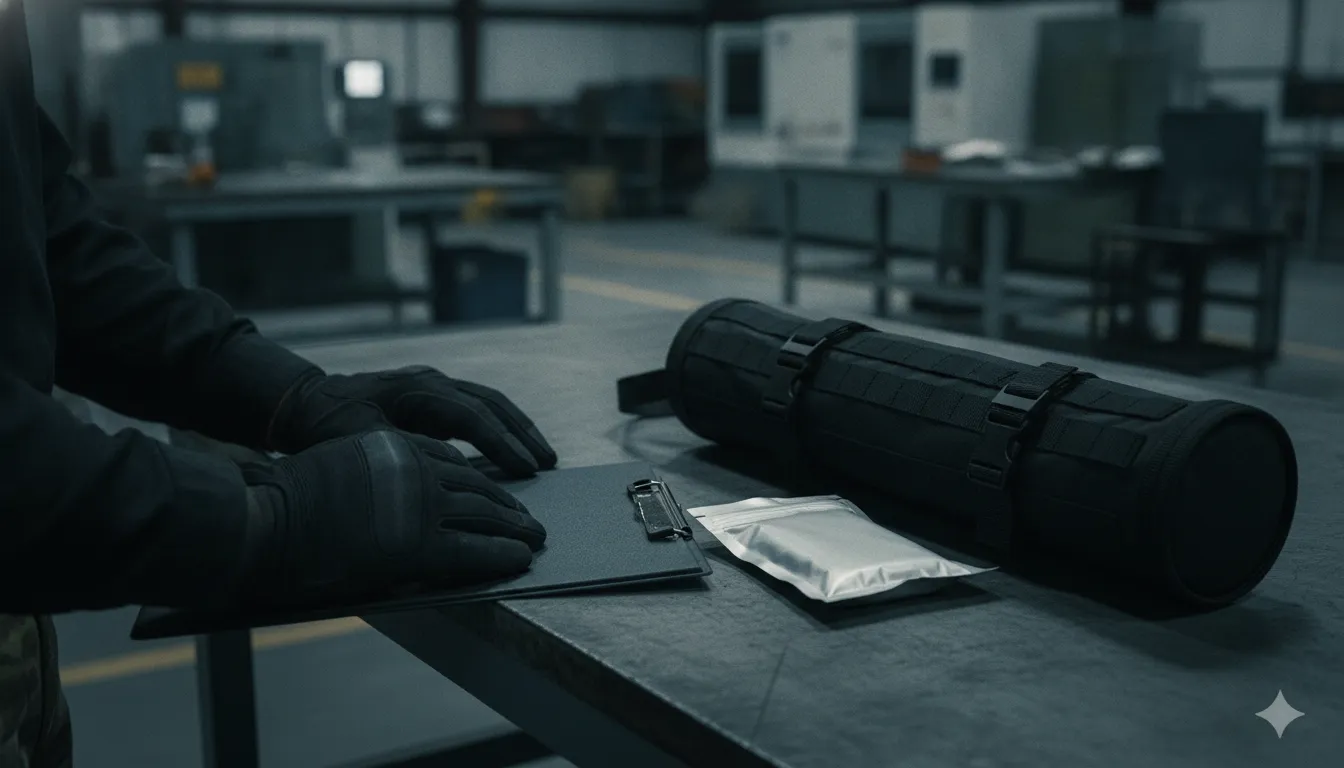
Use the products as examples of the decision, not as the decision. A tube favors a fast pull of one folded aircraft when the crew already knows the fit. A larger soft case favors more volume and a camo shell for teams that stage with other tactical bags.
The program still has to test the actual aircraft in the actual container. A 13-inch or 15-inch envelope on a product page is a starting limit. It is not proof that your model will close cleanly with blades, guards, and a payload attached.
Procurement language should ask for evidence the offeror can show:
- Internal restraint that holds the folded aircraft without load on propellers or gimbals.
- A closure the crew can open with gloves, without tools, when the concept of use is rapid deployment.
- A stated material and capacity, with a fit check against the program's aircraft list.
- A separate pocket or sleeve for the battery if the aircraft maker requires isolation.
- No claim of impact, water, or flight performance unless a test report is attached.
Case geometry, stitch patterns, and side-by-side SKU comparisons belong in a transport-and-storage article. This guide stops at the readiness gate: if the container cannot accept the approved configuration without damage, the aircraft is not deployable, whatever the price is.
Control power, payloads, and the records that travel with the kit
Three interfaces decide whether a packed kit can become a sortie. Power, the object attached to the aircraft, and the paper or digital record. Miss one and the other two do not save the mission.
Power
107.49 requires enough available power for the intended operational time before flight. Readiness adds the question the pilot cannot answer at the pad if nobody tracked it earlier. Which packs were charged, which are damaged, and which are spares.
Lithium batteries are also a transport problem. The FAA PackSafe page on drones states that primary and spare batteries can make a drone a dangerous good on a passenger aircraft. It tells operators to use the manual and the airline before the trip. Read that page before anyone writes "carry on" into a unit SOP.
For highway and cargo movement, 49 CFR 173.185 covers lithium cells and batteries, including damaged and defective cells. A readiness program does not need to reprint those rules. It needs a local rule for who may ship a swollen pack, and where that pack sits, so it never rides in the flight kit by mistake.
Practical controls are short. Mark packs with a unique ID. Log cycles, or log the date of the last capacity check your plan requires. Quarantine any pack that is swollen, hot after rest, or dropped. Do not put a quarantined pack back into the flight container for one call.
Payload and equipment interfaces
Anything the aircraft carries must be secure, and it must not adversely affect flight characteristics or controllability. That sentence in 107.49 is the procurement test for mounts, lights, speakers, and small sensors. A program that adds a rail because a vendor demo looked useful has changed the aircraft. The readiness file should name the allowed interfaces, the fastener check, and the person who can approve a new one.
Keep payload work separate from airframe shopping. Fusion's public materials discuss UAS integration as a direction, including storage and deployment accessories, not as a claim that the company manufactures a complete drone or a flight-control stack. Buyers should scope support equipment to the aircraft they already operate. If a later program needs a new mount, that is a configuration change with its own test, not a sentence in a case description.
Field documentation
The record that travels can be one page. It should show aircraft serial, container serial or mark, battery IDs, open defects, the mission type, and the remote pilot. It should also show the last time someone confirmed the control link on the ground. Store the page with the kit. A record that lives only on a share drive is missing the moment the truck leaves.
After the flight, the same page captures landing condition, battery state, and any new defect. That closeout is what makes the next release signature honest. Programs that skip closeout slowly fill the shelf with aircraft nobody can clear.
Set procurement criteria a contracting officer can score
Score support equipment against the readiness gate. Do not score it against a flight-time brochure. The table below is a starting rubric for a small-UAS deployment kit. Adjust the evidence column to the contract type you actually use.
| Criterion | What to ask for | Evidence that counts | What does not count |
|---|---|---|---|
| Fit to approved aircraft. | Folded aircraft and allowed payload close without force. | Fit-check photos or a witnessed trial on the program's list. | A capacity in liters with no aircraft named. |
| Rapid, safe access. | Gloved open and close without tools when that is the concept of use. | Timed crew trial and a written snag list. | The words "rapid deployment" with no trial. |
| Power control. | Isolation method and a quarantine path for bad packs. | SOP extract plus a labeled sleeve or box. | A spare pocket with loose cells. |
| Configuration control. | Serials, battery IDs, and open defects travel with the kit. | Sample record used on a real handoff. | A blank template that never leaves the office. |
| Material and origin claims. | Only claims the maker will put on a drawing or a cert. | Material callout, country of manufacture, quality cert if required. | Unstated MIL-STD or drop ratings. |
| Sustainment. | Who repairs the container and how defects are reported. | Repair point of contact and a defect code list. | A one-time purchase with no owner. |
Quality-system language belongs in the supplier file, not in this checklist's flight steps. Buyers who need AS9100 evidence should use the AS9100 buyer guide. Buyers comparing a full safety-system purchase should use the aerospace safety systems procurement guide. ISO 9001:2015 context for tactical hardware sits in the manufacturing quality note. Those pages cover supplier qualification. They do not clear a drone to launch.
Domestic-preference and trade-agreement rules are also separate gates. If the buy is a DoD textile or a federal supply action, confirm Berry Amendment or TAA status on that action before you copy a product adjective into the statement of work. The Berry Amendment contractor guide is the place for that test. NAICS positioning for defense work is summarized on the government contracting page. Citing a code is not the same thing as claiming a complete UAS production line.
Autonomous ground platforms and unmanned mobility structures are a different article. The autonomous mobility platforms guide covers that hardware class. Do not stretch a drone-case requirement until it becomes a vehicle program.
A clean award describes the container, the record, and the fit check. It leaves weather, airspace, and the go/no-go call with the remote pilot and the unit's aviation authority. That split keeps contracting officers from buying a "ready drone" they cannot accept, and it keeps pilots from inheriting a case that does not fit the aircraft they fly.
Talk with Fusion Tactical about kit support
Frequently asked questions
What is drone deployment readiness?
It is the gate that says a specific small unmanned aircraft, with a known power state, payload, crew, and transport container, may move from storage toward a launch brief. Packing the aircraft is only one step in that gate.
Does a deployment checklist replace the FAA preflight?
No. Under 14 CFR 107.49 the remote pilot in command still has to assess the environment, brief participants, check the control link and power, and secure anything the aircraft carries. A unit checklist can organize that work. It cannot delete it.
How should a program choose between a drone tube and a soft case?
Choose by fit and concept of use. A tube such as the 4.2 liter Armada is aimed at one folded aircraft and fast access. A 10.4 liter soft case such as the DolaMite holds a larger listed envelope in a camo shell. Test your aircraft in the container. Do not buy from liters alone, and do not expect either listing to state a drop or waterproof rating.
Can spare drone batteries ride in the same kit without a rule?
They need a rule. Passenger-aircraft trips can make lithium batteries a dangerous good, which the FAA PackSafe drone page flags before travel. Damaged cells fall under 49 CFR 173.185 and should be quarantined, not tucked into the flight container for convenience.
What should a solicitation avoid claiming?
Avoid flight endurance, sensor performance, impact ratings, and MIL-STD compliance unless a test or a drawing is in the file. Also avoid implying that a case maker manufactures the unmanned aircraft. Scope the buy to transport, storage access, and the readiness record.


