

Confined Space Rescue Team Training: Equipment Readiness and Supplier Evidence
Confined space rescue team training should be evaluated as a documented capability: the team, equipment, procedures, practical exercises, and records must match the hazards and response role in the program. Before choosing a course or supplier, procurement should verify the training scope, instructor evidence, hands-on assessment, equipment configuration, and the process for maintaining readiness.
Discuss equipment and supplier requirements
What should procurement verify before selecting confined space rescue team training?
Start by defining the decision the training must support. A course description alone does not establish that a team can perform the assigned response, nor does a product catalog show that equipment matches the site plan. Procurement should connect the training requirement to the hazard assessment, response model, team roles, equipment list, and acceptance evidence.
That means separating three questions that are often blended together:
- Capability: What rescue tasks and responsibilities are within the team’s assigned scope?
- Training: What instruction and practical evaluation demonstrate that members can perform those tasks?
- Equipment: What system configuration is needed, and what documents confirm the supplied items are suitable for that defined use?
Each question has a different owner and evidence trail. The safety authority or program owner defines the operational need. Training leadership specifies instruction and evaluation. Procurement gathers supplier documentation and ensures the purchase matches the approved requirement. A strong review keeps those responsibilities connected without treating a supplier’s marketing language as proof of team readiness.
The International Association of Fire Fighters describes its confined-space rescue course as covering basic response information and hands-on practice with a department’s rescue equipment. That is a useful reminder for buyers to verify both instructional content and practical work with the team’s own configuration, rather than relying on classroom hours alone. See the IAFF confined-space rescue training description as one public example of course scope.
How should the buyer define the training and equipment boundary?
Write down the environments, hazards, response assumptions, and assigned actions that the training covers. Identify whether the team is expected to provide entry rescue, non-entry retrieval, patient packaging and movement, technical support, or another defined function. Do not assume that one general course or piece of equipment covers every scenario. The site risk assessment and the responsible safety authority should set the operational boundary.
Document the boundary in terms that can be evaluated, not just labels. For example, state the types of spaces and access constraints in scope, the roles expected to act, the interface with site personnel, the equipment configurations to be practiced, and any conditions that require escalation to another response resource. This helps prevent an offer from being judged against a vague phrase such as “complete rescue training.”
Then map each task to the capabilities and resources it requires. A planning matrix can include the task, responsible role, prerequisite instruction, equipment configuration, practical evaluation, and record retained. If patient movement is part of the assignment, specify how packaging, attachment, transitions, and movement will be evaluated by qualified instructors under the program’s procedures. The article does not substitute for a hazard assessment, a rescue plan, or competent technical direction.
| Review area | What to define | Evidence to request |
|---|---|---|
| Operational scope | Hazards, space types, rescue function, team roles, and limits | Approved scope statement, hazard assessment references, and course outline |
| Instructor capability | Relevant technical background, instructional role, and authority | Current qualifications or experience records, references, and named instructor responsibilities |
| Practical evaluation | Tasks, observable performance criteria, and remediation process | Exercise plan, evaluation rubric, attendance and completion records |
| Equipment configuration | Approved equipment list, interfaces, and inspection controls | Item identification, manufacturer instructions, applicable technical documentation, and configuration record |
| Lifecycle readiness | Inspection, maintenance, storage, replacement, and refresher triggers | Written procedures, responsible owners, record templates, and review schedule |
Use the matrix as a requirements tool, not a universal checklist. Applicable regulations, standards, employer procedures, and the site’s risk assessment determine what must be included. The team’s technical authority should approve the performance criteria before a solicitation is released.
A useful next step is to label each requirement as mandatory, desirable, or unresolved. Mandatory requirements should have a clear pass/fail evidence test. A desirable item can be scored only if the evaluation plan explains how it affects selection. For an unresolved issue, name the person who will decide it and the record that will document the decision. This small classification prevents reviewers from quietly changing the requirement midway through bid evaluation.
Which supplier and instructor evidence should be part of the review?
Ask the provider to show how its proposed content matches the defined scope. Evidence should make clear who will teach, what learners will do, how performance will be observed, what constitutes completion, and how deficiencies are handled. Request the course outline and evaluation approach before award so reviewers can identify omissions while changes are still manageable.
Instructor credentials should be relevant to the tasks, environment, and instruction being offered. Confirm that the proposed instructors have suitable technical experience, have the authority and qualifications required by the applicable program, and can explain how they keep their knowledge current. Do not use a certificate title as a substitute for checking its issuer, scope, currency, and relevance.
A 2018 journal study assessed confined-space entry and rescue training, including questions about the state of training. It can help frame why a buyer should evaluate the content and evidence behind a program rather than treating course completion as a complete measure of readiness. The study abstract on confined-space entry and rescue training is a research reference, not a procurement specification; buyers should confirm requirements with their responsible safety professionals.
For equipment suppliers, request documentation that corresponds to the exact products and configuration offered. Depending on the requirement, that may include manufacturer instructions, identification and traceability details, applicable standards or test documentation, declared ratings and their scope, inspection guidance, and information about interfaces. Verify that each statement applies to the offered model and intended use. Do not infer a system rating by adding component ratings or assume a product’s presence in a rescue catalog makes it suitable for a particular task.
Fusion Tactical USA manufactures tactical and safety equipment and supports custom manufacturing and engineering work. Buyers considering any manufacturer should distinguish verified product documentation from proposed design work, and should confirm compliance claims for the specific contract and product configuration. Ask the supplier to identify what is in the current catalog, what would be custom, and what records would accompany delivery.
Check evidence in a repeatable order. First match the document to the requirement: a general company capability statement does not establish the properties of a specific item. Next verify the document issuer and date, then check the model, configuration, intended application, and limitations described. Finally, record who reviewed it and whether the evidence was accepted, rejected, or sent back for clarification. If a supplier makes a claim that cannot be tied to a document, keep it out of the approved baseline until it is substantiated.
How can procurement compare offers consistently?
Use a common evaluation structure for each bidder. Score the response against pre-established requirements, and keep mandatory pass/fail criteria separate from weighted preferences. This makes a low price or polished course description less likely to obscure missing evidence.
- Check scope alignment. Confirm that the proposed course and equipment address the defined rescue functions, team roles, site conditions, and limits.
- Review the training design. Compare learning objectives, prerequisites, hands-on exercises, instructor-to-participant arrangements, evaluation criteria, and remediation.
- Validate evidence. Check the issuer, dates, applicability, and model or configuration coverage of credentials and technical documents.
- Assess equipment integration. Identify interfaces, user instructions, inspection controls, and dependencies on equipment supplied by the agency or another contractor.
- Compare deliverables and lifecycle support. Confirm what records, equipment lists, training materials, and closeout documents will be delivered, and who owns ongoing readiness tasks.
- Record exceptions. List deviations, assumptions, exclusions, substitutions, and open technical questions. Resolve them before award or make them explicit contract conditions.
Price comparisons are meaningful only when bidders are pricing the same scope. A lower offer may omit practical assessments, equipment familiarization, documentation, or follow-up instruction. Ask each bidder to identify inclusions and exclusions in the same format. If technical reviewers cannot determine whether a requirement is met, mark it unresolved rather than assuming compliance.
Consider having technical, safety, training, and contracting representatives review the same response. The technical authority can judge task and equipment fit; training leadership can review lesson and evaluation design; procurement can check contractual clarity and supplier evidence. Keep the decision record with the approved baseline and the rationale for any accepted deviation.
For example, imagine two proposals with similar course titles. One includes a written outline, exercises using the team’s assigned equipment, task-level evaluation records, and a documented remediation path. The other lists a duration and completion certificate but leaves the exercise configuration and assessment method unclear. The buyer should not treat those offers as equivalent. Request a clarification in the same format from each bidder, then evaluate the revised response against the same criteria. If one bidder cannot provide the required detail, document the gap instead of filling it with assumptions.
What should practical exercises and acceptance criteria cover?
Practical exercises should reflect the approved training objectives and be conducted under controlled conditions by qualified personnel. Procurement does not need to dictate unsafe or improvised techniques. Instead, it should require a documented exercise plan that identifies the tasks to be evaluated, the safety controls, the equipment configuration, participant roles, and the method for recording performance.
Evaluation criteria should describe observable performance, not simply attendance. The rubric may address whether members follow the approved procedure, communicate and coordinate assigned roles, inspect and use the specified equipment as instructed, recognize a condition outside the exercise boundary, and complete required handoffs or documentation. Technical leadership must set the precise criteria for its operating context.
Include a clear process for a participant who does not meet a criterion. The plan should explain whether coaching, additional practice, reassessment, or referral for further instruction is required, who approves successful completion, and how the result is recorded. A completion certificate can confirm participation or completion under a provider’s rules; it does not by itself establish ongoing operational readiness.
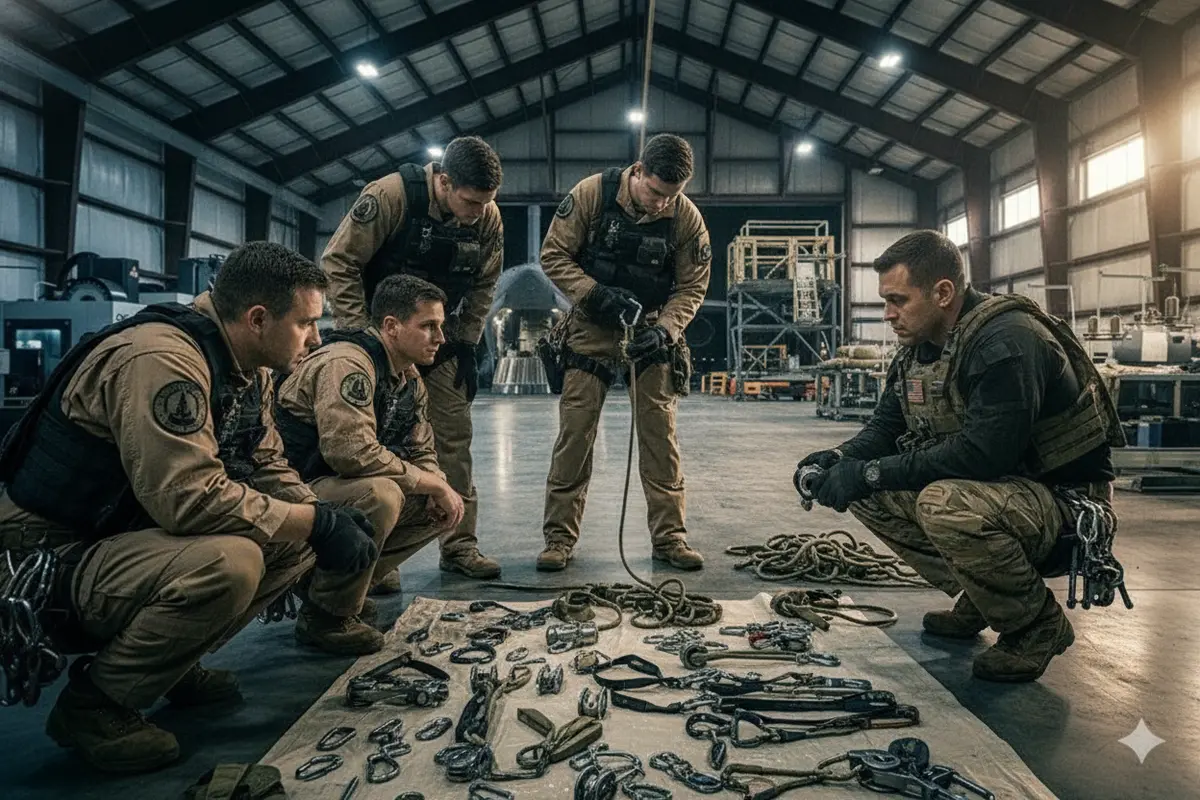
Where the team is using its own equipment, define how the provider will accommodate the actual configuration and record any mismatch. If the exercise uses training-only or substitute items, identify those substitutions and state what additional familiarization or verification the team needs before operational use. The buyer should not allow an exercise to create an undocumented alternate configuration.
Ask for an exercise plan that makes the sequence and safeguards reviewable before training begins. It can identify the learning objective for each exercise, the participant role being assessed, the equipment and procedures used, the controls set by the instructor, and the record produced afterward. A tabletop scenario may help evaluate decision-making and communications, while a practical station can assess specific actions under controlled conditions. The plan should state which outcomes each method can and cannot establish, so a discussion exercise is not mistaken for hands-on evaluation.
Acceptance criteria should also separate provider deliverables from the employer’s operational authorization. The provider can report that an individual met defined course criteria, while the employer decides whether that person is assigned to a response role under its program. Define both decisions in advance. The closeout package can then show course completion, assessment results, exceptions, and any further actions without overstating what the training demonstrated.
How should buyers review equipment readiness and records?
Build a configuration record that ties the training plan to the equipment actually assigned. Capture manufacturer, model or item identifier, quantity, relevant instructions, approved use, compatibility assumptions, storage location, and the person or function responsible for inspection and maintenance. Record serial or lot details where applicable to the program and manufacturer’s documentation.
Training and equipment records should be useful after the course ends. At a minimum, define how the organization will retain participant and evaluation records, the current equipment list, inspection or maintenance records, known limitations, and actions required to close any gaps. Set ownership for updating records after a product change, repair, replacement, procedure revision, or change in team role.
Do not treat a purchase order, a training certificate, or a supplier declaration as an inspection regime. The employer’s competent and responsible personnel must determine inspection frequency, removal criteria, maintenance, and retirement in line with applicable rules, the manufacturer’s instructions, and the approved program. Procurement should ensure those responsibilities and deliverables are visible in the contract.
Equipment selection may include storage and transport as well as the primary rescue system. Fusion Tactical’s catalog includes rope-storage options such as a tactical rope bag and a haul bag. Those links identify product categories, not a representation that a particular bag is approved for every confined-space program. Confirm the required capacity, environment, contents, labeling, and procedures with the responsible team before specifying a storage item.
Likewise, components must be evaluated for their stated role and configuration, not selected by name alone. Review applicable manufacturer documentation for any lanyard equipment or descender equipment proposed in a system, and verify its compatibility and intended application with the system designer or technical authority. Do not treat this article or a category page as technical approval.
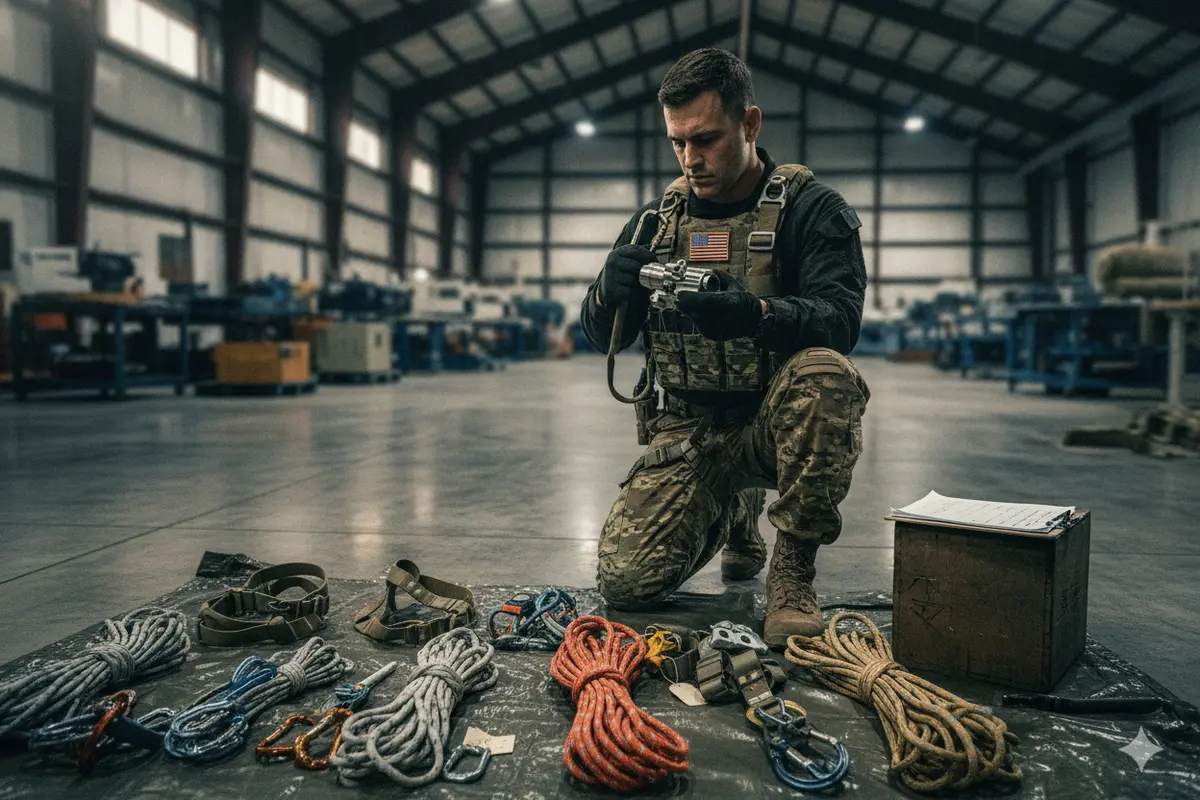
A practical record set should answer four questions without requiring someone to reconstruct the decision from email. What configuration was approved? Which people were trained and evaluated against which objectives? What limitations, substitutions, or deficiencies were recorded? Who owns each follow-up action and by when? A controlled inventory and a course closeout file can be linked by a configuration identifier or revision date, making it easier to see whether later practice used the approved setup.
Plan for ordinary changes as well as major ones. If a component is replaced, a procedure changes, or a new member joins the team, the program owner should determine whether review, familiarization, or additional evaluation is appropriate. Procurement can support this by asking for records in a usable format and by ensuring contract closeout does not leave a missing manual, unresolved deviation, or undocumented substitution.
How can a purchase order preserve the approved training baseline?
Translate the evaluation into contract deliverables. State the approved training scope, participant assumptions, practical components, instructor roles, equipment configuration to be used, assessment and remediation process, records due at closeout, and acceptance authority. Attach the approved course outline, equipment list, evaluation criteria, and any agreed technical documents when appropriate.
Control substitutions and changes. Require written review before a provider changes a principal instructor, course content, exercise configuration, proposed product, or documented performance claim. Define which changes require technical approval and which require a formal contract modification. This avoids a gap between the offer that was evaluated and the program that is delivered.
Acceptance should be based on deliverables the buyer can verify: training delivered to the approved scope, required practical evaluations recorded, identified deficiencies documented, technical documentation received, and agreed equipment items or configurations reconciled. Acceptance of a course deliverable should not be written as a guarantee of future rescue outcomes. Operational readiness depends on the organization’s procedures, personnel, equipment, practice, and continued oversight.
Before award, hold a short clarification review for unresolved assumptions. Confirm who supplies the training equipment, whether the exercises use the program’s actual configuration, what participant prerequisites apply, how the provider will handle a failed assessment, and what records will be delivered. Put answers in the offer or contract rather than relying on informal assurances.
Use a closeout checklist to make acceptance practical. For example, the buyer can confirm receipt of the final outline and attendance record, task-level evaluation results, instructor and course records, equipment documents specified in the award, an exception list, and actions assigned to the employer. If a deliverable is incomplete, identify the missing item and responsible party rather than signing a blanket acceptance that obscures an open issue. The procurement file should preserve the approved version of the training plan and any authorized changes.
What questions should buyers resolve before award?
- Does the proposed scope align with the site hazard assessment and the team’s assigned rescue functions?
- Who approves the training objectives and performance criteria?
- What qualifications and experience will the named instructors bring to the work?
- Which exercises are practical, what equipment configuration will be used, and how will performance be evaluated?
- What documents show the applicability of each offered product, rating, standard, or compliance claim?
- What equipment is included, what is excluded, and what interfaces remain the buyer’s responsibility?
- How will the provider document attendance, assessment, remediation, and any deviations from the approved baseline?
- Who owns post-course inspection, maintenance, refresher training, and record updates?
Use these questions to close gaps while the requirement is still being shaped. When evidence is missing, ask for a specific document or clarification and assign an owner. If the response cannot establish suitability for the defined application, keep the issue open for the technical authority rather than treating silence as approval.
Frequently Asked Questions
Does a course certificate establish rescue team readiness?
No. A certificate documents participation or completion according to the provider’s criteria. The employer must separately assess whether the course matches the assigned role and whether personnel meet the program’s requirements for assignment and continued readiness.
Should practical training use the team’s assigned equipment?
Where practicable and approved by the responsible technical authority, exercises should reflect the actual configuration. If substitute or training-only items are used, document what differs and determine what familiarization or verification is needed before that configuration is used operationally.
What should a buyer request from a training provider?
Request the course outline, objectives, prerequisites, instructor responsibilities and relevant evidence, practical exercise plan, evaluation criteria, remediation process, equipment assumptions, and closeout records. Confirm that the provider’s proposed scope matches the program baseline.
Can procurement decide which rescue techniques the team should use?
Procurement can require clear scope, qualified review, documented instruction, and verifiable deliverables. The responsible safety and technical authorities should establish the procedures and performance criteria for the organization’s hazards and response model.
How should unresolved supplier claims be handled?
Ask for specific supporting documentation tied to the offered product or service. Record the claim, the evidence requested, and the reviewer’s decision. Do not treat a general catalog statement or an unverified assertion as proof that a requirement has been met.
When should training or equipment records be reviewed again?
Set the review triggers in the program. Common triggers for review include changes to team roles, procedures, equipment configuration, or the hazards and access conditions covered by the plan. The responsible program owner should determine what follow-up is required under applicable rules and procedures.
Call to discuss a program requirement
A disciplined buyer review connects training objectives, practical evaluation, equipment evidence, and lifecycle records to the approved rescue scope. That gives the program a clearer basis for award, acceptance, and continued readiness without asking a course or supplier to replace the organization’s own safety authority.


