

Tactical Rigging Hardware Manufacturer: What Government Buyers Should Verify
Choosing a tactical rigging hardware manufacturer is not just a matter of comparing connector shapes or catalog descriptions. Government and industrial buyers need evidence that the proposed hardware fits the intended load path, that the manufacturer controls its design and production, and that each delivered configuration can be verified. This guide lays out a practical review sequence for procurement teams sourcing mission-critical rigging components.
Discuss your hardware requirements
What should a buyer define before evaluating a manufacturer?
Start with the application and its boundaries. A supplier cannot demonstrate fit when the buyer has not defined what the component must do, how it will be connected, and what conditions it will face. Document the intended use before reviewing a quotation or a product page.
For each item, record the function, the connected components, the direction and type of loading, expected operating environment, inspection approach, service life assumptions, and any limitations on use. Distinguish normal operating conditions from foreseeable misuse, shock loading, side loading, abrasion, corrosion exposure, contamination, and temperature extremes. These conditions may affect the design or the evidence required.
Then define the procurement boundary. Is the purchase for a standalone connector, a replacement component, or a complete assembly? Will the supplier provide engineering input, production, testing, documentation, or some combination? Assign responsibility for system-level review. A manufacturer may provide component information, but the buyer or designated system integrator must confirm that the complete assembly suits the operational requirement.
- Operational need: Describe the task, users, environment, and operating constraints.
- Interface definition: Identify mating parts, attachment geometry, clearances, and orientation.
- Performance basis: State the required loads, safety factors, test methods, and applicable specifications, where established by the authority having jurisdiction.
- Acceptance evidence: Specify the records and inspections needed at delivery.
- Change controls: Define who can approve material, process, supplier, or design changes.
Requirements should be measurable where possible. Terms such as “heavy duty” or “mission ready” do not give the supplier an objective design target or the buyer a defensible acceptance standard. When a requirement is not yet known, mark it as an open item and assign an owner instead of treating an assumption as an approved requirement.
How should the load path be reviewed?
Review the complete load path rather than looking at the hardware item in isolation. A connector can only perform within the conditions supported by its design and test evidence. Its attachment point, orientation, connected webbing or rope, surrounding structure, and neighboring components can all influence how forces are applied.
Ask the manufacturer to identify the component’s intended loading directions and any conditions that reduce its performance or invalidate the stated rating. Confirm whether the stated value is a working limit, minimum breaking strength, proof value, or another defined measure. Do not treat these terms as interchangeable. The procurement specification should define which value is required and how it will be verified.
Look closely at interfaces and geometry. Gate clearance, nose shape, pin retention, swivel movement, edge contact, cross-loading, and contact with adjacent parts can affect function. In an assembly, confirm that connectors cannot rotate into an unintended orientation or bear against a sharp edge. Where a system includes several components in series, check that the documented capacity and operating limits of every link support the defined system requirement.
A useful review artifact is a load-path drawing or interface map. It should identify the load origin, each component, connection method, direction of expected force, and the point where the load is transferred to the supporting structure. Request that discrepancies between the drawing and the proposed hardware be resolved in writing before award or release to production.
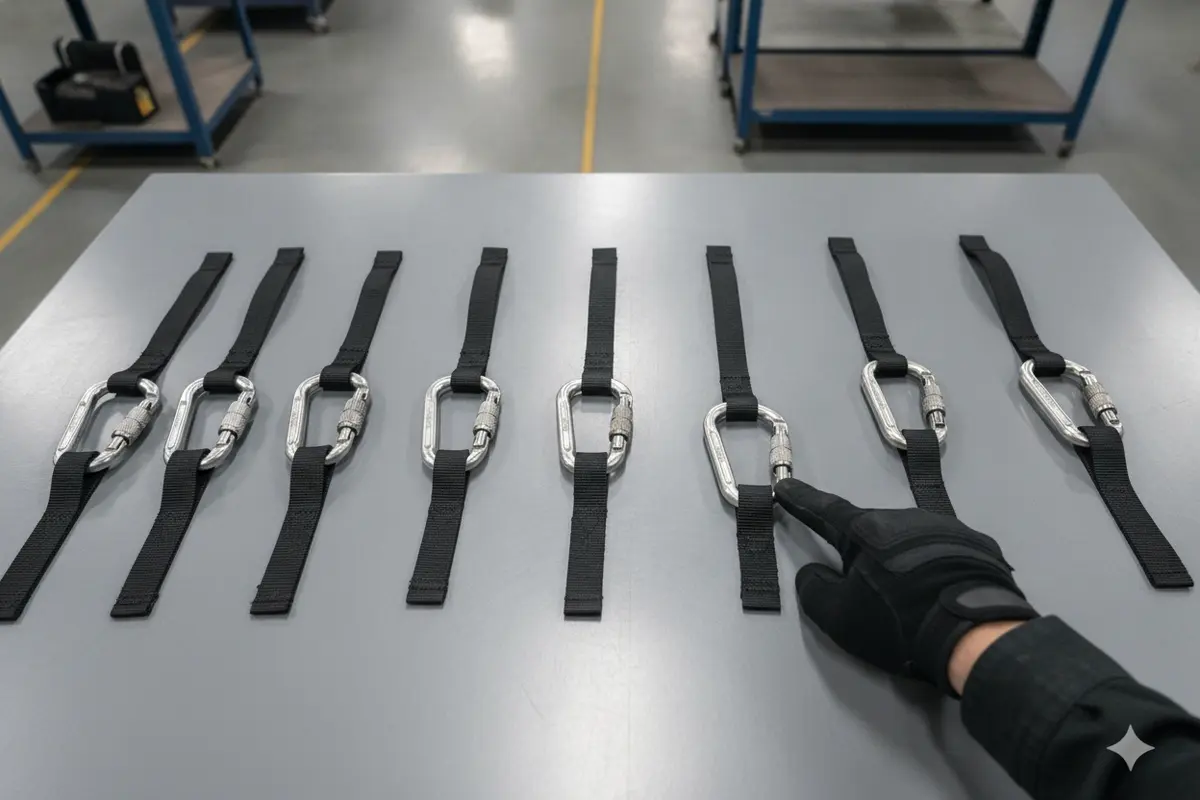
Product examples can help a team understand different component forms, but a catalog listing does not establish suitability for a specific assembly. For instance, buyers reviewing a snap hook product or a swivel connector should compare the current product documentation with their own interface and loading requirements.
What evidence supports material and traceability claims?
Traceability lets the buyer connect a delivered item to the materials, production records, and inspection evidence applicable to it. The depth of records should match the program’s risk, contract terms, and regulatory obligations. Make those expectations explicit before ordering, since records are harder to reconstruct after products have moved through production and distribution.
Ask how the manufacturer identifies materials and lots, and how those identifiers follow the component through manufacturing, inspection, and shipment. For metal components, relevant records may include material specifications, certificates, heat or lot references, and incoming inspection results. For textile or composite elements in an assembly, request records appropriate to those materials and their role in the system. Verify that the evidence corresponds to the exact part number and configuration being procured.
Traceability is not the same as a general statement that a company uses quality procedures. Confirm what records will be supplied with the order, what records will be retained, how long they will be retained, and what process applies if a record is incomplete or a lot is found nonconforming. The buyer should know whether individual units, batches, or production lots are identified and how a field issue could be narrowed to affected items.
For government procurement, separate manufacturing-origin requirements from technical performance requirements. If a contract invokes a domestic sourcing rule or another procurement clause, request evidence that is specific to the item and the contract. Do not infer compliance from a broad marketing statement or from the location of a sales office. Have the contracting authority or compliance lead determine which clauses and documentation apply.
How can buyers assess engineering and production controls?
Ask the supplier to explain the controlled path from requirement to released product. A credible answer should identify who approves the design, how drawings and specifications are revision-controlled, how production instructions are established, and how inspection results are documented. Buyers do not need every proprietary work instruction, but they should be able to verify that a repeatable process exists and that changes are controlled.
During a capability review, explore these areas:
- Design authority: Who reviews and approves new designs, deviations, and revisions?
- Manufacturing planning: How are specifications translated into production steps and inspection points?
- Equipment and calibration: How is measuring and test equipment maintained and calibrated?
- Nonconformance: How are out-of-tolerance results identified, contained, investigated, and dispositioned?
- Corrective action: How are recurring issues addressed and effectiveness checked?
- Subcontracted work: How are external processes and suppliers qualified and monitored?
Review records that demonstrate the control system in practice, such as a sample inspection report, a revision history, or an anonymized nonconformance workflow. Evaluate whether the records are complete and traceable, not just whether a procedure exists. If the supplier holds a relevant quality certification, confirm its scope and current status through appropriate documentation. Certification can support an evaluation, but it does not replace product-specific verification or contract acceptance.
Where a requirement is customized, ask how design intent is carried through prototypes, qualification, and production. Clarify whether a prototype is representative of the production method and materials. A prototype that demonstrates fit may not establish repeatable manufacturing capability or prove that a production lot meets the contract’s acceptance criteria.
What testing and inspection should be required?
Testing must answer a defined question. Before accepting a test report, identify the test article, configuration, sample size, method, equipment, acceptance criteria, and responsible organization. Confirm whether the test was performed on a development sample, a qualification configuration, or production items. A result without this context may not support the intended procurement decision.
Separate design validation, production verification, and field inspection. Design validation evaluates whether the design addresses the stated use. Production verification checks that manufactured items meet defined acceptance criteria. Field inspection assesses condition and continued suitability after delivery. These activities address different points in the equipment lifecycle and should not be substituted for one another.
For each required test, the contract or technical data package should state what constitutes a pass, what happens after a failure, and whether retesting is allowed. If the manufacturer proposes sampling, document the sampling plan and rationale. If destructive testing is required, clarify how test specimens relate to delivered production and how replacement units are identified.
Inspection also needs an operational home. Define who performs inspection, when it occurs, what defects require removal from service, and how findings are recorded. The U.S. Army Corps of Engineers’ rigging guidance states that hardware should be inspected for defects before use on each shift and as needed during use; refer to the applicable requirement for the specific work and equipment: USACE Section 15 rigging guidance. The procurement team should coordinate inspection criteria with the organization responsible for the equipment’s use and maintenance.
When evaluating a manufacturer, ask for a sample inspection record that shows the part identity, inspection criteria, result, date, and disposition of exceptions. If inspection relies on visual characteristics, define the relevant defect categories and acceptance limits. If dimensions or function are checked, specify the measurement method and acceptance range.
How should configuration management work?
Configuration management protects the link between an approved design and what is actually delivered. Every purchase should identify the part number, revision, options, attachments, and any approved deviations. Drawings, quotations, test reports, and packing documentation should refer to a consistent configuration.
Ask how the supplier evaluates proposed changes to materials, manufacturing locations, tooling, subcontractors, dimensions, or processes. A change that appears minor may affect fit, interface behavior, or test evidence. Require prior written approval for changes that could affect form, fit, function, performance, compliance, or traceability. Define who at the buyer organization has authority to approve them.
For repeat orders, compare the new release against the accepted baseline. Identify whether the supplier has made changes since the previous delivery and request a statement of configuration status when appropriate. Preserve the approved drawings, specifications, test basis, and acceptance records in the program file so that future procurement and maintenance teams can work from the same controlled baseline.

What should a supplier comparison table include?
A comparison matrix makes the review consistent across candidate suppliers. Score only against defined evidence, and separate mandatory pass or fail requirements from weighted preferences. “Not provided” should remain visible as an evidence gap rather than being treated as proof of noncompliance or assumed capability.
| Review area | Evidence to request | Decision check |
|---|---|---|
| Requirement fit | Requirement-response matrix and identified exceptions | Does the response address the full intended use and stated limits? |
| Load path and interfaces | Drawings, interface dimensions, loading directions, and defined ratings | Are connections and operating conditions consistent with the system design? |
| Materials and traceability | Material records, lot identification method, and retention policy | Can the delivered configuration be linked to applicable production records? |
| Testing and inspection | Test plan, sample reports, acceptance criteria, and inspection instructions | Do the methods and results support the stated procurement requirement? |
| Production controls | Process overview, revision control, calibration approach, and nonconformance workflow | Are changes and exceptions controlled and recorded? |
| Contract and origin obligations | Item-specific compliance documentation and contract response | Does the evidence address the clauses that apply to this purchase? |
| Delivery and acceptance | Inspection plan, required records, packaging, and shipment identification | Can receiving staff verify the item and documentation against the order? |
Use the matrix to direct follow-up rather than to create a false impression of precision. A supplier with a strong response in one category may still have an unresolved mandatory issue in another. Record the evidence source, reviewer, date, open question, and resolution for each requirement so that the selection can be audited later.
How can procurement teams organize the evaluation?
A staged process reduces late changes and makes technical reviews easier to coordinate. The exact sequence depends on the contract, but the following approach works for many hardware sourcing efforts:
- Establish the need. Document the mission, interface, environment, required performance, and contract obligations.
- Issue a common request. Send each supplier the same requirements, drawing revision, questions, and required evidence list.
- Screen mandatory items. Identify exceptions, missing evidence, and requirements that cannot be met before comparing preferences.
- Review technical fit. Have qualified engineering and safety reviewers assess load path, interfaces, ratings, and system boundaries.
- Review manufacturing and quality evidence. Assess traceability, process controls, test methods, and change control.
- Resolve open items. Assign each question an owner and deadline; record the response and disposition.
- Set acceptance terms. Include configuration, records, inspections, deviations, and nonconformance handling in the order documents.
- Retain the baseline. Keep the approved package and delivery records available for future inspection and repeat purchases.
Make engineering, quality, procurement, and end-user roles clear. The team should also distinguish supplier evidence from buyer verification. A supplier may provide drawings, test results, origin statements, and quality records, while the buyer checks that each item is complete, applicable to the ordered configuration, and consistent with the solicitation. Assigning a reviewer to each evidence type prevents technical documents from being treated as self-validating.
What should buyers verify about U.S. manufacturing?
When domestic production is relevant to a contract, define what “manufactured in the United States” means for that procurement. The phrase can refer to different requirements depending on the contract and the governing clause. Identify the applicable rule with the contracting officer or compliance lead, then request evidence that addresses that rule for the specific item, rather than relying on a general company statement.
Ask the supplier to identify the production location and the stages performed there. Depending on the contract, useful records may include a manufacturing flow, supplier declarations, records for critical materials, or documentation showing where relevant operations occurred. Clarify how imported inputs, outside processing, or subcontractors are handled. The purpose is to map evidence to the requirement, not to make assumptions from a mailing address or brand name.
For a contract requiring a particular sourcing standard, keep the rule and its supporting evidence together in the procurement file. Record who reviewed the evidence, what conclusion was reached, and whether any exceptions were approved by the proper authority. If a supplier proposes a change in manufacturing location or a subcontracted process, require disclosure and determine whether the change affects the contract’s compliance basis before accepting it.
Fusion Tactical’s company information describes U.S.-based production and manufacturing capabilities, but procurement teams should still assess the specific item, contract clauses, and documentation required for their own award. This distinction keeps a supplier’s general capabilities separate from a contract-specific determination.
Procurement can manage competition and contract terms, but technical suitability should be reviewed by personnel responsible for the system. Quality staff can define evidence and acceptance controls. Operational users can identify handling, inspection, and maintenance needs that might not appear in a drawing.
For buyers comparing parts across broader rescue or operational systems, review the relevant product families as context, not as a substitute for technical verification. Fusion Tactical’s lanyard collection, descender equipment, and fire and rescue equipment illustrate adjacent categories where component interfaces and system-level requirements may matter. Confirm current specifications directly for the configuration under review.
Talk through a procurement requirement
Frequently Asked Questions
What documents should accompany a rigging hardware purchase?
Specify documents based on the contract and risk. Common items include approved drawings or specifications, product identification, material or lot records where applicable, inspection results, test reports, deviation approvals, and care or inspection instructions. State which records must ship with the order and which must be retained and made available on request.
Does a supplier’s quality certification prove that a component is suitable?
No. A quality certification can provide evidence about a management system within its defined scope. It does not by itself establish that a particular component meets a buyer’s requirements, that an assembly is correctly designed, or that a production lot passed its required acceptance checks. Review both system-level and product-specific evidence.
How should a buyer compare stated load values?
First identify what each value means, the test method, configuration, loading direction, and acceptance basis. Do not compare values that describe different measures or conditions as if they were equivalent. Have the responsible technical authority confirm that the value and its supporting evidence meet the system requirement.
When should a supplier be notified of a design or process change?
Define notification and approval requirements in the purchase documents before production. Require prior approval for changes that may affect design, materials, interfaces, performance, compliance, manufacturing location, or traceability. The supplier should identify the change, affected configurations, supporting evidence, and proposed implementation date.
What is the most important first step in supplier evaluation?
Write a clear, measurable requirement and identify the system boundary. This gives every supplier a common basis for response and gives engineering and procurement reviewers a way to compare evidence without relying on broad claims or assumptions.
A documented evaluation helps procurement teams connect requirements, hardware configuration, manufacturing evidence, and acceptance controls before award, then preserve that evidence for the equipment’s service life.


