

Emergency Response Safety Harness Load Rated: Buyer Guide
For rescue teams, government program managers, and procurement officers, an emergency response safety harness load rated for life-safety use is a systems decision, not a catalog item. When responders work at height, move through confined spaces, carry out helicopter operations, or perform high-angle rope rescue, the harness is the load path between the operator and the anchor. If that path fails under dynamic loading, the consequences cannot be contained by a warranty or a product description.
The challenge for buyers is that "harness" is not a precise specification. Industrial fall protection, technical rope rescue, tactical extraction, and aircraft retention each place different demands on webbing, stitching, hardware, and attachment points. A harness selected for one mission can be unsuitable for another. The equipment that protects a construction worker during a controlled fall arrest is not automatically the right system for an emergency responder who must be recovered, repositioned, or extracted under load.
Here is the answer: an emergency response safety harness load rated for professional use should be evaluated through documented kN ratings, proof-testing requirements, the intended rescue or egress application, and alignment with ANSI Z359.11, the standard addressing full-body harness safety requirements. Procurement teams should also verify inspection procedures, traceability, and applicable Berry Amendment or TAA requirements before issuing a specification.
This guide covers what load-rated design means, how to read kN ratings, and a step-by-step process for building a defensible specification for load-rated emergency response equipment.
Ready to evaluate load-rated emergency response safety harnesses for your team? Request a quote or schedule an engineering consultation to align your specification with your rescue and procurement requirements.
What Is a Load-Rated Emergency Response Safety Harness?
A load-rated emergency response safety harness is a full-body system designed to support, retain, or recover a person during high-risk operations. It distributes arrest and rescue forces through the upper and lower body rather than concentrating them at the waist. For procurement teams, the meaningful specification is not appearance. It is documented performance under the loads, movements, and operating conditions the mission demands.
Unlike a basic restraint belt, a full-body harness uses connected shoulder, torso, pelvic, and leg components to manage force across stronger areas of the body. That geometry helps maintain a more controlled body position during a fall, extraction, or helicopter retention event. The equipment may also integrate with larger retention systems used in tactical extraction and helicopter rescue operations.
How does a full-body harness distribute force?
During a fall or dynamic rescue movement, force travels through the harness webbing, stitching, attachment points, and connecting hardware. A correctly fitted full-body design spreads that force across the wearer's upper and lower body. This distribution is central to life-safety performance because it reduces dependence on one narrow contact area and helps the system retain the operator in a predictable position.
Load-rated designs are engineered for more than a single static connection. Emergency response teams may need rapid egress, high-load rescue, or retention while operating in high-altitude and otherwise unforgiving environments. The harness therefore has to work as part of a complete system, including compatible lanyards, anchor points, connectors, and procedures. Its rating must match the intended application and be supported by testing and traceable documentation.
Some emergency response harness systems are also designed to remain practical during extended field deployment. The objective is a balance of low carry burden, durable materials, secure adjustment, and reliable connection points. Those considerations matter when responders must move quickly while carrying mission equipment, or when a harness is integrated with a helicopter retention or extraction configuration. Helicopter retention systems illustrate why harness selection cannot be separated from the operational platform.
Why are body belts no longer used for fall arrest?
A body belt concentrates arrest force around the waist and does not provide the same full-body force distribution or retention geometry. OSHA no longer permits body belts for fall-arrest applications, a distinction reflected in professional harness guidance from OSHA and industry sources such as FallTech's full-body harness guide. A body belt may have a limited role in specific positioning or restraint applications when the governing procedure allows it, but it should not be specified as a substitute for a fall-arrest harness.
The underlying technology has a long connection to military parachuting equipment. That heritage helped advance harness systems intended to retain a person under severe movement and loading conditions, while modern standards and application-specific testing define how today's equipment must perform. ANSI identifies Z359.11 as the safety requirements standard for full-body harnesses. Buyers should evaluate the complete system, documented load ratings, fit, compatibility, inspection requirements, and mission profile before approving equipment for operational use.
What Load Ratings Do Emergency Response Safety Harnesses Need?
Emergency response safety harnesses need clearly documented kN ratings matched to the intended life-safety application, not merely a general user-weight capacity. Procurement teams should verify the rated strength of the complete system, including webbing, stitching, buckles, attachment points, and connecting hardware. Each component should also have a defined working load and a documented test basis.
In life-safety equipment, kN, or kilonewtons, is the standard measure used to describe breaking strength. One kilonewton represents approximately 224.8 pounds-force, but the conversion alone does not determine whether a harness is suitable. The relevant question is whether the manufacturer has specified the rating for the actual rescue, extraction, retention, or fall-related load path and supported it with testing documentation.
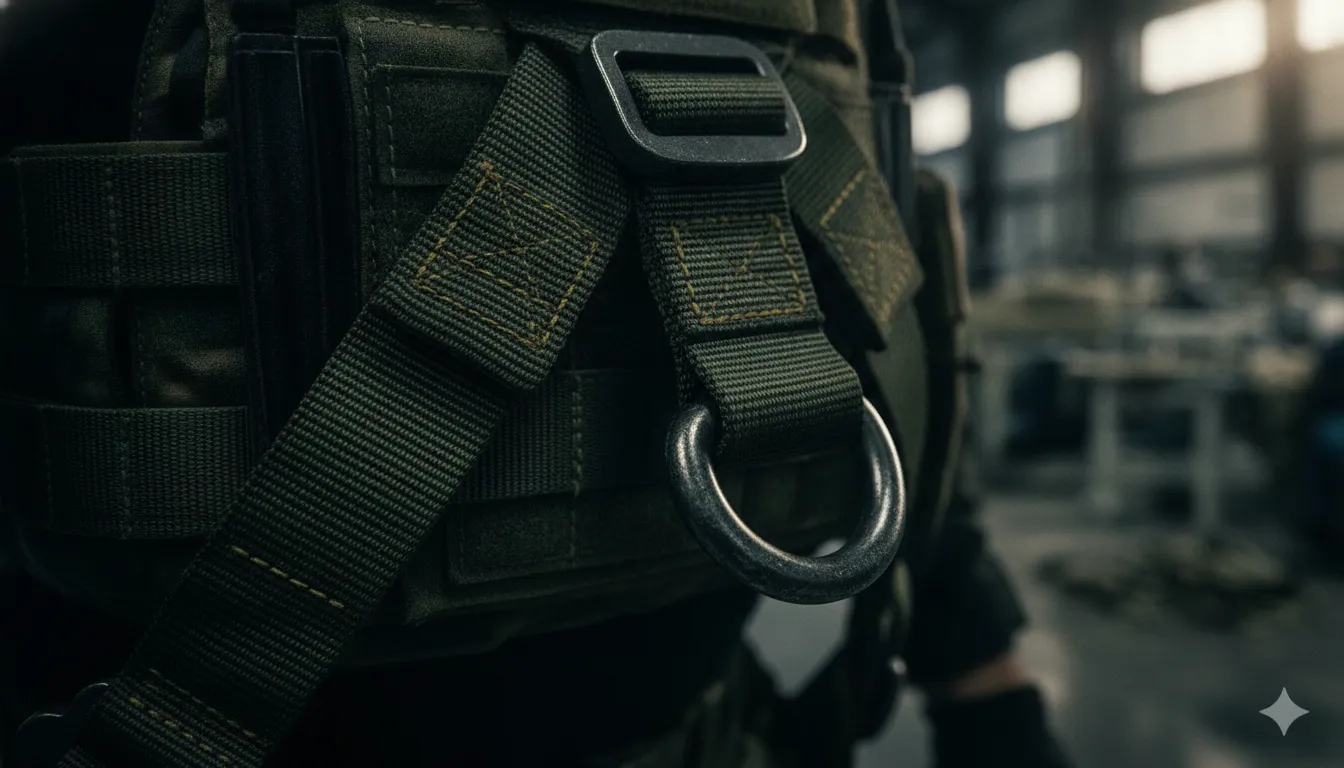
Read kN ratings as part of a complete load path
A harness does not perform as an isolated piece of fabric. Forces travel through the attachment point, webbing, stitched terminations, buckles, and any connector or lanyard used with the system. The lowest-rated component can become the limiting point, so a procurement specification should identify the rating of each critical interface rather than relying on a single headline number.
For critical load-bearing hardware used in rescue and tactical operations, Fusion Tactical documents proof testing to 2.5 times the working load limit. This distinction matters. The working load is the controlled load for the intended operation, while proof testing provides evidence that the hardware can withstand a substantially higher test load without compromising structural integrity. Proof testing is not permission to exceed the operating limit, and it does not replace application-specific engineering.
Webbing selection is another important part of the specification. MIL-SPEC Type 13 webbing is identified with a tensile strength of approximately 5,000 pounds. That figure describes webbing tensile performance, not the rating of a finished harness. Stitch pattern, seam construction, hardware geometry, abrasion, heat, chemicals, and field condition can all affect the capacity of the completed assembly. Ask for finished-product test records, not only raw-material specifications.
Separate user capacity from rescue strength
Commercial fall-protection harness and lanyard systems commonly use a user-capacity range of about 310 pounds, including tools. MSA notes that ANSI full-body harness capacity is generally stated within a 130-to-310-pound range under applicable OSHA or CSA requirements: MSA's capacity guidance. This is a useful sizing reference, but it is not a substitute for a rescue-system kN specification.
Emergency response teams should define the anticipated dynamic loads, operating configuration, personnel and equipment mass, and whether the harness will support retention, extraction, positioning, or another mission function. Then require a documented kN rating for that use. For teams evaluating load-rated rope rescue harnesses, the manufacturer should be able to explain how the rating, proof testing, materials, and finished construction align with the operational requirement.
Emergency Response Safety Harnesses vs. Industrial Fall Protection
Emergency response harnesses and industrial fall-protection harnesses serve different operational problems. A rescue team needs equipment that supports rapid egress, extraction, rope access, and dynamic loading, while an industrial worker generally needs a system optimized for controlled fall arrest during upright work. The right choice depends on the forces, movement, attachment points, and response time your mission requires.
In short, an industrial harness is not automatically suitable for high-load rescue or tactical extraction. An emergency response safety harness load rated for dynamic rescue work should be specified around kN-rated life-safety performance, rapid deployment, and the intended rescue configuration, while industrial equipment should be selected against the applicable OSHA and fall-arrest requirements.
| Evaluation factor | Emergency response safety harness | Industrial fall-protection harness |
|---|---|---|
| Primary use | Rapid egress, high-load rescue, helicopter or tactical extraction, and hi-angle rope rescue where the operator may be repositioned or recovered under demanding conditions. | Static or controlled fall arrest on construction and industrial sites, typically while the worker remains upright and connected to an established anchorage system. |
| Load-rating focus | Specific kN ratings for life-safety applications, including dynamic rescue loading and the forces created during raising, lowering, or extraction. Hardware and attachment points must be evaluated as a complete system. | Rated performance for the intended personal fall-arrest system, worker weight, tools, anchorage, and energy-absorbing components. The design priority is arresting a fall within the governing system limits. |
| Deployment speed | Quick-connect buckles and mission-specific configuration support rapid donning and doffing when seconds affect egress or rescue access. The harness must still be fitted and secured correctly before loading. | Designed for routine inspection, adjustment, and connection during a work shift. Donning speed matters, but the system is generally not built around emergency extraction under dynamic conditions. |
| Standards | Specify applicable life-safety and rescue requirements, then verify the design, testing evidence, and kN performance for the actual operation. ANSI harness requirements may be relevant, but a general industrial rating does not establish rescue suitability. | Commonly selected against OSHA personal fall-protection requirements and applicable ANSI/ASSP Z359 equipment standards for the work environment and system configuration. |
| Hardware | Mission-specific attachment points, rescue-rated connectors, quick-connect buckles, and components selected for rope access, extraction, or retention. Critical hardware should have documented proof testing. | Standardized dorsal or front fall-arrest attachment points, adjustment hardware, and compatible lanyard or lifeline connections intended for industrial work positioning and fall arrest. |
Procurement teams should map the harness to the event, not just the nominal weight rating. If personnel may transition from aircraft or elevated platforms into rope rescue, extraction, or recovery operations, review the complete configuration, including attachment geometry, connector compatibility, webbing, stitching, and foreseeable dynamic forces. Fusion Tactical's tactical load-bearing systems are positioned for specialized government, defense, and emergency-response applications rather than routine site fall arrest.
Ask for test documentation that explains what was tested, at which load, and under what configuration. Proof testing critical hardware to 2.5 times the working load is one documented engineering practice, but it does not replace application-specific design review, user training, inspection, or compliance verification.
Which Standards Govern Load-Rated Safety Harnesses?
Answer: Load-rated safety harnesses are governed by a combination of equipment standards, workplace regulations, and procurement requirements. ANSI/ASSP Z359.11-2021 addresses full-body harness design and performance, while OSHA 29 CFR 1910.140 establishes requirements for personal fall protection systems. For federal and defense buyers, Berry Amendment and Trade Agreements Act requirements may also determine where the equipment and its components can be manufactured.
These standards should be treated as part of a complete qualification process, not as interchangeable labels. A harness can satisfy a fall-protection requirement while still being unsuitable for rapid extraction, aircraft operations, or other emergency-response missions. Procurement teams should define the operational load case, connection points, inspection program, and contracting requirements before approving a product.
ANSI/ASSP Z359.11-2021 and full-body harness requirements
ANSI/ASSP Z359.11-2021 sets safety requirements for full-body harnesses. It provides a framework for evaluating harness construction and performance, including the way a full-body system manages forces through the upper and lower body. For buyers specifying an emergency response safety harness load rated for life-safety use, the standard is an important baseline for reviewing test documentation and intended use.
The history behind the standard also explains why body belts are not an acceptable substitute for a modern fall-arrest harness. OSHA prohibited body belts for fall arrest in 1998 after the industry moved toward full-body systems that distribute arrest forces more effectively. ANSI notes that full-body harness technology drew early inspiration from military parachuting equipment, but emergency-response buyers must still verify that a current design matches the mission rather than relying on appearance or heritage alone.
OSHA rules for personal fall protection systems
OSHA 29 CFR 1910.140 governs personal fall protection systems in general industry. The rule is relevant when a harness is used as part of a personal fall protection system, but it does not by itself define every requirement for tactical extraction, aircraft retention, or specialized rescue operations. The complete system must be evaluated, including anchors, connectors, lanyards, compatibility, inspection, and the conditions in which personnel will use it.
That distinction matters when a harness must support dynamic or high-load rescue work. Ask the manufacturer for the applicable load ratings, test methods, component specifications, and limitations. Fusion Tactical identifies critical load-bearing hardware as proof-tested to 2.5 times the working load, but buyers should match that documentation to the specific configuration and contract requirement.
Berry Amendment and TAA requirements for government procurement
For Department of Defense contracts, the Berry Amendment can require covered items to be manufactured in the United States with American-made components. The TAA addresses federal trade eligibility, generally requiring covered products to be made or substantially transformed in the United States or designated countries. These are procurement rules, not substitutes for equipment testing or a harness safety standard.
Request chain-of-custody records, country-of-origin information, and the exact compliance statement for the contract. Reviewing those records alongside ANSI and OSHA documentation gives program managers a defensible basis for selecting equipment. For additional guidance, review Fusion Tactical's fall arrest safety harness standards before finalizing a specification.
How to Spec and Source a Load-Rated Emergency Response Harness
Procurement teams should treat harness selection as a life-safety systems decision, not a catalog comparison. A complete specification connects the operational mission, rated load, test evidence, materials, compliance requirements, and engineering support before a purchase order is issued.
The most defensible process is to define the use case first, then require traceable proof of performance and origin. This approach helps teams source equipment that is appropriate for rescue, extraction, and emergency response conditions rather than relying on generic harness terminology.
- Define the rescue mission and use case. Document whether the harness will support helicopter egress, confined-space rescue, vertical access, casualty extraction, hoisting, or a combination of missions. Identify the users, expected body and equipment loads, attachment points, and whether the system must integrate with ropes, aircraft interiors, or other retention equipment. These details determine the harness geometry, hardware configuration, and inspection requirements. For a broader equipment package, review Fusion Tactical's heavy-duty emergency rescue gear.
- Establish the kN load rating and governing standard. State the required minimum breaking strength, working load, and intended load path in the procurement specification. Confirm that the proposed configuration is life-safety rated in kN and identify the applicable standard or agency requirement, including ANSI/ASSP Z359.11-2021 where relevant and OSHA 29 CFR 1910.140 for applicable personal fall-protection systems. Do not accept a general weight-capacity statement in place of a rated configuration. The rating must apply to the actual harness, hardware, attachment points, and use case being purchased.
- Require proof-test documentation. Make test records a deliverable, not an informal assurance. Require evidence that hardware was proof-tested to 2.5 times its working load, and provide the applicable proof-test documentation or equivalent traceable test records. The documentation should identify the tested component or configuration, test method, acceptance result, lot or serial information, and date. If the supplier cannot connect the test evidence to the equipment being delivered, the evidence is insufficient for a mission-critical procurement review.
- Verify material specifications and traceability. Confirm the webbing, stitching, connectors, and protective components meet the required specification. For tactical rescue applications, require the applicable MIL-SPEC webbing documentation where specified, rather than accepting an undefined commercial webbing description. Review material certificates, batch traceability, color or finish requirements, and environmental limitations. This step protects the team from substitutions that may look equivalent but have not been evaluated in the intended load path.
- Confirm Berry Amendment and TAA compliance. Put country-of-origin and supply-chain requirements directly into the request for quote. Require documentation supporting Berry Amendment eligibility for applicable Department of Defense end items and Trade Agreements Act compliance for federal procurement. Confirm whether compliance applies to the complete end item, critical components, or both. A verbal claim of U.S. manufacture is not a substitute for documented origin and chain-of-custody information.
- Request mission-specific engineering support. When the standard configuration does not fully match the mission, request a custom engineering consultation before finalizing the specification. Fusion Tactical's engineering capabilities support custom configuration, rapid prototyping, and made-to-order manufacturing. Ask for review of attachment geometry, user interface, hardware selection, testing scope, and integration constraints. Teams evaluating specialized configurations can also compare load-rated rope rescue harnesses against the operational requirements identified in Step 1.
Why U.S. Manufacturing and Compliance Matter for Procurement
For procurement teams, the value of an emergency response safety harness load rated for demanding operations extends beyond the hardware itself. The manufacturer must be able to demonstrate controlled production, traceable materials, contract eligibility, and dependable support when equipment is deployed in a high-risk environment.
U.S. manufacturing and documented compliance reduce procurement uncertainty by connecting the finished harness to a verifiable quality process. They also make it easier to validate sourcing requirements, approve custom configurations, and maintain confidence that the equipment will perform when failure is not an option.
Quality systems create repeatable manufacturing
ISO 9001:2015 quality management principles provide a framework for consistent manufacturing, while AS 9100 principles add discipline relevant to aerospace and other tightly controlled programs. In practice, this approach supports documented processes, controlled changes, inspection points, and accountability across design and production. Those controls matter when a harness includes load-bearing webbing, stitched seams, hardware, and attachment points that must work as an integrated system.
Procurement teams should ask how a supplier verifies materials, manages revisions, records inspections, and responds to nonconforming product. Proof testing is another important part of the evidence package. Fusion Tactical identifies critical hardware and leashes as proof-tested to 2.5 times the working load, giving buyers a clearer basis for evaluating structural margins. Review the company's engineering and testing services to understand how custom requirements can be evaluated before production.
Chain of custody supports Berry and TAA requirements
For federal and defense contracts, domestic manufacturing claims must be supported by documentation rather than treated as a marketing label. Berry-compliant manufacturing requires full chain-of-custody documentation, allowing procurement teams to trace relevant materials and production steps. That record can support vendor verification, contract files, and downstream audits.
Dual Berry Amendment and Trade Agreements Act capability is a meaningful differentiator because requirements vary by contract and agency. The Berry Amendment addresses qualifying Department of Defense purchases and U.S. manufacturing requirements, while TAA rules address where products are made or substantially transformed for covered government procurement. Buyers should confirm which rule applies to the solicitation and request the supporting documentation before award.
Contract readiness includes capability and responsiveness
Compliance is only one part of supplier qualification. Broad NAICS coverage can help a manufacturer participate in federal and defense contracting opportunities, while established engineering support helps procurement teams translate an operational requirement into a defensible specification. Made-to-order manufacturing is especially useful when standard commercial configurations do not address a team's load path, attachment layout, deployment method, or environmental conditions.
Rapid prototyping can shorten that feedback loop. Fusion Tactical's documented capabilities include custom engineering, made-to-order production, and prototype turnaround of approximately three to five days, allowing a team to evaluate a mission-specific design before committing to a larger purchase.
How Often Should Load-Rated Harnesses Be Inspected?
Inspect a load-rated emergency response harness before every use, then schedule a formal inspection at least annually with a trained competent person. Record each inspection in a logbook or digital safety system, and remove any harness from service when wear, damage, contamination, or structural failure indicators are found. This cadence supports a documented safety program and helps teams identify defects before equipment is exposed to operational loads.
Before each deployment, the user should examine the complete harness rather than checking only the most visible webbing. Look across webbing, stitching, connection points, buckles, adjustment hardware, labels, and load-bearing interfaces. Fraying, cuts, pulled or broken stitches, abrasion, distortion, corrosion, unusual stiffness, chemical residue, or heat damage can signal a loss of structural integrity. Any component that has been exposed to an event capable of damaging it should be quarantined for evaluation, even if the defect is not immediately obvious.
What should the formal inspection cover?
The annual review should be performed by a competent person who has been trained to identify wear, damage, and structural failure indicators in the specific equipment used by the response team. Training should cover the harness design, its rated use, inspection criteria, cleaning limits, storage requirements, and the conditions that require retirement or manufacturer review. The inspector should compare findings with the manufacturer's instructions and the unit's equipment-control procedures, not rely on a generic visual check.
Document the inspection date, equipment identifier, inspector, findings, corrective action, and service decision. A logbook or digital system creates traceability across deployments and makes recurring defects easier to identify. It also gives procurement and safety managers evidence that inspection controls are being applied consistently.
How does stowage affect service life?
Inspection frequency cannot compensate for poor maintenance. Store harnesses clean, dry, and protected from direct ultraviolet exposure, excessive heat, sharp edges, and chemicals that can degrade webbing or hardware. Keep them away from fuels, solvents, acids, and other contaminants during transport and storage. Follow the manufacturer's approved cleaning and drying procedures, and never return equipment to service until it is fully dry and has been checked for damage. Consistent stowage protects load-bearing materials between missions and supports reliable readiness when rapid deployment is required.
For emergency response teams, the practical standard is simple: inspect before use, complete a competent-person review every year, document both, and quarantine anything questionable.
Need help building a load-rating and inspection specification that meets ANSI, OSHA, and procurement requirements? Contact Fusion Tactical USA for a consultation and documented engineering support.
Frequently Asked Questions
What load rating should an emergency response harness meet?
Specify a life-safety rating in kN that matches the intended rescue, extraction, fall-arrest, and operator-retention loads. Review the complete system, including webbing, stitching, connectors, attachment points, and hardware, rather than selecting a harness by body weight alone. Ask the manufacturer for documented working-load limits and proof-test records. Fusion Tactical reports proof-testing critical load-bearing hardware to 2.5 times the working load limit: engineering and testing services.
How often should load-rated emergency response harnesses be inspected?
Inspect the harness before every use, and have a competent person complete a formal inspection at least annually. Check webbing, stitching, buckles, connectors, attachment points, labels, contamination, abrasion, cuts, heat damage, and any evidence of shock loading. Record inspections in a logbook or digital safety system, and remove equipment from service when its history or condition cannot be verified. OSHA guidance should be reviewed alongside the manufacturer's instructions.
How does an emergency response harness differ from industrial fall protection?
An emergency response harness is selected for operational needs such as rapid egress, extraction, high-angle rescue, and dynamic loading. Industrial fall-protection equipment is commonly optimized for controlled, static work-at-height applications. The correct procurement decision depends on the mission profile, attachment configuration, mobility requirements, rescue plan, and applicable standards. Do not substitute one system for the other without documented engineering and operational review.
What standards should procurement teams verify?
Confirm which requirements apply to the complete system and intended use. ANSI/ASSP Z359.11 addresses full-body harness safety requirements, while OSHA regulations govern applicable personal fall-protection systems. Federal buyers should also verify Berry Amendment and TAA status, country of origin, component traceability, test documentation, and supplier quality controls. ANSI standards information and applicable OSHA requirements provide starting points for procurement review.
Can a harness be customized for a government or rescue program?
Yes. A qualified manufacturer can review the mission profile, load cases, attachment locations, materials, sizing, deployment sequence, and documentation requirements before producing a made-to-order configuration. Require a written specification, verification plan, inspection criteria, and compliance documentation so the delivered harness can be evaluated consistently across the program.
Ready to Specify the Right Harness?
Procurement decisions for emergency response equipment require clear load-rating, compliance, and configuration requirements. A focused engineering consultation can help your team align the harness specification with its intended operational use and purchasing criteria. Request a quote or schedule an engineering consultation for load-rated emergency response safety harnesses by contacting Fusion Tactical USA.


